Rainier City Library opened a new Business Resource Center this month, three bookshelves in the corner of its one-room space on the second floor of Rainier City Hall stocked with marketing, accounting, and economic development titles donated by the Rainier Chamber of Commerce, after a May 14 ribbon cutting.
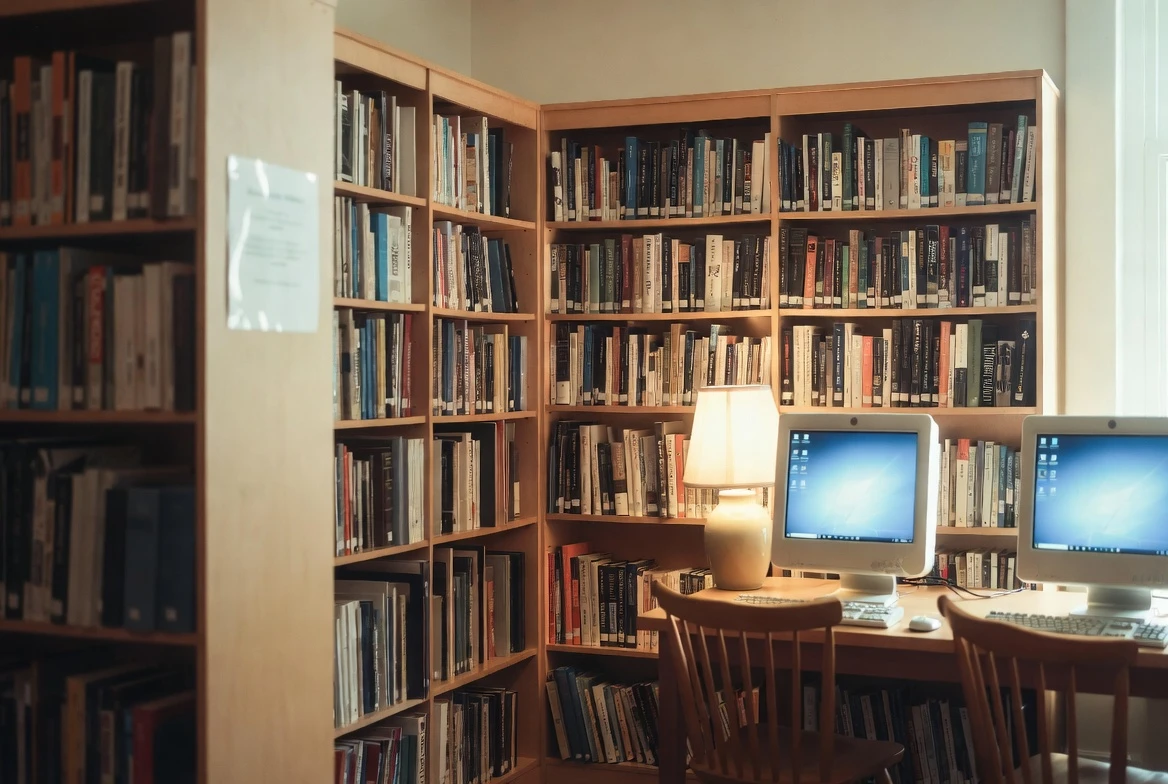
Allen Snider, the library’s head librarian, set the new shelves a few feet from the public computers so that someone applying for a job, sketching a resume, or pricing accounting software can roll a chair five feet and pull down a book without filling out a form.
A Three-Shelf Branch of the Local Economy
The collection occupies the corner of the Rainier City Library‘s footprint nearest the public personal computers. Three bookshelves hold titles on marketing, accounting, economic and commercial development, job hunting, and what Snider calls “how to keep jobs going inside the city.” A plaque listing donors is in the works.
“It’s just been kind of a work in progress getting it organized and set up,” the librarian said, describing the slow build of the collection alongside his day job categorizing, tagging, and barcoding each title.
The library shares its building with city offices. The one-room footprint forces every new collection to compete for floor area. Snider’s framing puts the business shelves inside the foot-traffic loop, not at the back of a separate room. Someone working on resume formatting at a public computer is, by design, three steps from a book on resume design.
That integration is the point of a small library business collection. The economics rule out a dedicated business room with its own staff and its own door. The geography rules in proximity. The shelves work because they sit in the eyeline of anyone already in the library for a different reason.
Credit for assembling the initial reading list goes to Nicole Jordan, president of the Rainier Chamber of Commerce. Some titles came from her personal collection. Sierra Trass of the Columbia Business Alliance helped move the project to a ribbon cutting the librarian called “a blast.” Several donated titles were purchased during what he described as “a good Prime Day sale last year.”
How Libraries Quietly Became Small Business Front Doors
Rainier’s three-shelf collection lands at the small end of a national pattern. Between 2020 and 2022, the American Library Association (ALA) ran a national Libraries Build Business initiative funded by a grant from Google.org. A cohort of 13 public libraries across 12 states received individual awards to design programs for local entrepreneurs.
By the end of the pilot, ALA’s summary report on cohort outcomes tallied nearly 15,000 aspiring and existing business owners served. The cohort mixed rural, tribal, suburban, and urban systems in the same group, which the trade press treated as one of the program’s headline findings: the model travels.
- $2 million grant from Google.org funded the ALA’s Libraries Build Business pilot from 2020 to 2022.
- 13 libraries across 12 states made up the cohort, including rural and tribal systems.
- ~15,000 aspiring and existing entrepreneurs attended programs at cohort libraries during the pilot.
- $50,000 to $150,000 was the range of individual awards distributed to cohort members.
What gets built varies by community. Carson City, Nevada opened an 8,000 square foot business resource information center with classes, advisors, and reservable rooms. The New York Public Library runs ten to fifteen workshops a week through its small business hub. Gwinnett County, Georgia ran an entrepreneurship incubator for formerly incarcerated participants and graduated 22 in its first year.
The Rainier version is smaller by orders of magnitude. There is no dedicated staffer, no incubator, no weekly programming calendar. The asset is the collection itself, plus a head librarian a few steps away from anyone who picks up a book. That sits closer to the older library model of reference plus referral than to the grant-funded incubator model, and closer to what most American small cities can actually afford.
Columbia County’s Economic Team Dissolved in January
Rainier’s project also arrived at a moment when the surrounding county is rebuilding its small business support infrastructure from a thin base. Columbia Economic Team, the county’s previous economic development organization, dissolved in January.
In May, the Columbia Business Alliance launched out of Scappoose’s Community Development Center to carry on programs that include Keep It Local, a county-level Small Business Resource Center, and a monthly Munch and Learn class series.
Sierra Trass, who worked with the former organization as its small business specialist, moved over to the Alliance as economic development specialist. Its mandate covers the county at large from a Scappoose base. That puts roughly 30 miles between the county’s most active small business advisory office and Rainier’s downtown.
For a sole proprietor weighing whether to register an LLC (limited liability company), the calculus of a one-hour round trip to talk to an advisor is different from the calculus of walking into the local library on the way to pick up a child. The head librarian framed the floor plan in those proximity terms after the May 14 opening.
It’s essentially located in the kind of corner of the library, right next to where our public computers are. So the ultimate kind of vision is it’s the sort of fluid workspace where people can browse different shelves, come up to the front desk, ask me a quick question, kind of float back over to the computers and then over to the business center.
What Rainier Stocked, and Who Donated It
The collection covers basics rather than specialty knowledge. The shelves include:
- General principles of economic and commercial development
- Marketing fundamentals, including small business branding
- Accounting forms, bookkeeping, and tax basics for sole proprietors
- Resume design and job-search strategy
- Tips on retaining jobs already present inside the city
- Pamphlets, in the works, on unemployment access and the path to small business ownership
Donors are local. Members of the Rainier Chamber of Commerce, several of whom paid for titles during a Prime Day sale last year, contributed the bulk of the collection. Jordan’s personal shelves filled some of the remaining gaps. Trass and the new county group helped close out the project list.
The donor plaque is in production. So is the broader plan to fold pamphlets, community service brochures, and what the librarian called a “broad kind of swath of community resources” into the same corner as the collection grows.
Catalog access is the bridge between the physical collection and reader discovery. Titles are searchable through the library’s online catalog at bit.lyrainierlibrarycatalog, the URL the city is using on signage and on its library web page.
Rainier’s project sits within a county where small business ecosystem work is being rebuilt almost from scratch. The donor list reads less like a one-off civic gesture and more like a stake claimed on the side of the small library doing what the larger institutions cannot do at street level.
Rainier by the Numbers
The city’s economic profile sets the ceiling on what a business shelf can realistically reach. Per the most recent U.S. Census QuickFacts page for Columbia County, Rainier sits at roughly 1,944 residents with a median household income near $66,989. About 10.2% of the workforce is self-employed. The 2023 Business Census counted 104 business establishments in the area, with combined annual payroll of $59.9 million across 1,083 employees.
Statewide, the Oregon Small Business Development Center Network reports for the 2023 to 2025 biennium that its 17 community college based centers helped small businesses create 1,448 jobs, retain 1,356 jobs, increase sales by more than $71 million, and access $155 million in capital across some 750 companies.
The nearest SBDC center to Rainier is hosted at a community college elsewhere in the region. The gap between that state level network and a city with about a hundred operating businesses is where the new library shelves sit.
| Resource | Location | Cost to User |
|---|---|---|
| Rainier Business Resource Center | Second floor of Rainier City Hall | Free, walk-in, no appointment |
| Columbia Business Alliance | Scappoose, roughly 30 miles south | Free advising, by appointment |
| Oregon SBDC Network | Hosted at 17 community colleges statewide | Free advising, fee-based training |
Only the library option is new. The other two predate May, just not within walking distance of downtown Rainier.
The Limits of a Three-Shelf Strategy
The honest measure of a small library business collection is not how many titles it carries but how many readers it converts into actions that would not have happened otherwise. That number is hard to track in real time, and almost nobody publishing about library business programs does. ALA’s national report counted roughly 15,000 attendees across its 13 cohort libraries during the pilot, but did not separate out new business filings, loans closed, or jobs created. The Libraries Build Business model is a referral and resource model first, and Rainier’s version sits further upstream from outcomes than that.
What a three-shelf collection can do is lower the cost of asking the first question. A first time visitor browsing accounting basics does not have to commit to a 30 minute advisory call or a 12 week class. The shelf is the on-ramp; the county’s small business advisor is the second step; the state SBDC pipeline is the third. The library does not need to be the whole pipeline.
Rainier’s collection will be tested on a slow basis. A donor plaque, additional pamphlets, and brochures on unemployment access and small business ownership are on the planned list. For most of the city’s residents, the test is whether the chair next to the public computer turns toward the shelf often enough to justify the three bookshelves keeping their corner.