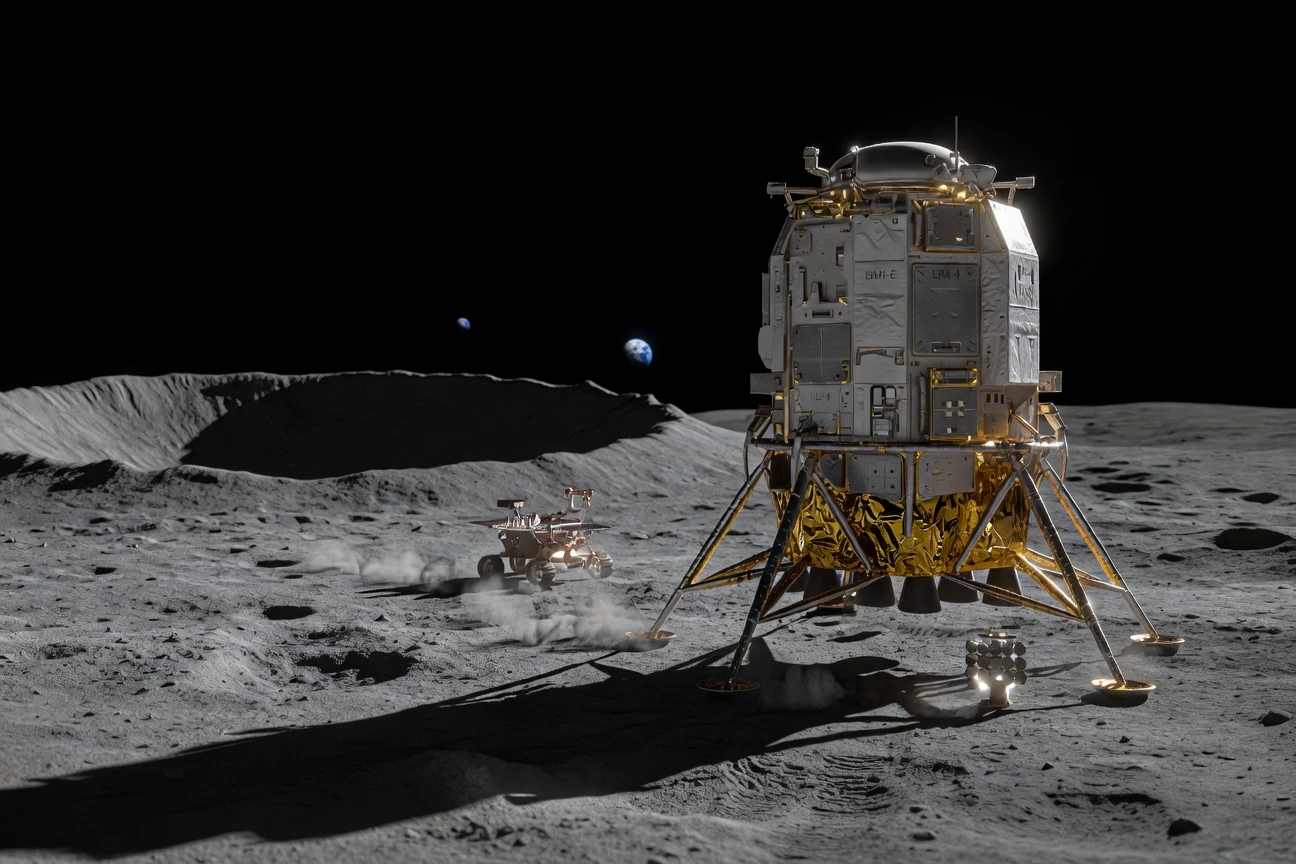
NASA committed roughly $20 billion over seven years to put a permanent outpost at the lunar south pole, with three uncrewed missions scheduled to fly before the end of this year and the first crew landing pencilled in for 2028. Administrator Jared Isaacman laid out the architecture at agency headquarters in Washington on Tuesday, naming Blue Origin’s Blue Moon Mark 1 Endurance, Astrobotic’s Griffin, and Intuitive Machines’ Nova-C Trinity as the three commercial landers carrying the first wave of cargo to the Shackleton Connecting Ridge.
Six private firms now sit on the critical path to every milestone in the announcement. The agency is buying rides, rovers, drones, and eventually living quarters from contractors who must each clear flight qualification before any astronaut leaves the launchpad, which makes this the deepest commercial outsourcing of human spaceflight in NASA’s history.
The Three Missions on the Manifest This Year
Moon Base I, targeted no earlier than fall 2026, will set down on the Shackleton Connecting Ridge with two anchor payloads: Stereo Cameras for Lunar Plume-Surface Studies (SCALPSS, an instrument that records how lander thrusters churn the regolith), and a Laser Retroreflective Array that lets orbiting spacecraft fix their position by bouncing laser pulses off the surface. Both are scouting instruments. They exist to tell future crews where, exactly, they can safely touch down.
Moon Base II will follow on Astrobotic’s Griffin lander, carrying more than 1,100 pounds of cargo and Astrolab’s FLIP rover, a mobility testbed that will inform the design of the crewed Lunar Terrain Vehicle (LTV, the pressurised surface rover) scheduled to support the Artemis-III landing. Moon Base III rounds out the year with the Lunar Vertex science package on Intuitive Machines’ Nova-C Trinity lander, which will study lunar swirls, bright surface markings that scientists suspect are shaped by buried magnetic anomalies. That third mission also carries instruments from the European Space Agency (ESA) and the Korea Astronomy and Space Science Institute (KASI), the first international payloads NASA has booked under the Moon Base banner.
| Mission | Lander | Provider | Anchor payload | Target launch |
|---|---|---|---|---|
| Moon Base I | Blue Moon Mk 1 Endurance | Blue Origin | Plume-surface stereo cameras, laser reflectors | Fall 2026 |
| Moon Base II | Griffin | Astrobotic | Astrolab FLIP rover; 1,100+ lb cargo | Late 2026 |
| Moon Base III | Nova-C Trinity | Intuitive Machines | Lunar Vertex; ESA and KASI payloads | Late 2026 |
Six Contractors Now Hold the Critical Path
The earlier Artemis architecture concentrated risk on NASA-built hardware: the Space Launch System rocket, the Orion crew capsule, government-managed mission operations. Surface infrastructure remained an open question. The contract picture released this week assigns that surface to commercial primes, with the agency’s own role narrowed to integration, mission control, and crew training.
- Blue Origin: $188 million base contract with a $280.4 million option period for two further task orders, providing the Blue Moon Mark 1 Endurance cargo lander on Moon Base I, per NASA’s update on Moon Base rovers, landers, and missions.
- Astrobotic: Griffin lander selected for Moon Base II, building on its earlier participation in NASA’s Commercial Lunar Payload Services initiative.
- Intuitive Machines: Nova-C Trinity awarded the Moon Base III delivery slot, the company’s first NASA contract beyond standard CLPS taskings.
- Astrolab: $219 million LTV contract covering the FLIP technology demonstrator and the Crewed Lunar Vehicle CLV-1, a roughly 2,000-pound vehicle rated for six miles per hour on level terrain.
- Lunar Outpost: $220 million LTV contract for the Pegasus rover, designed for up to a year of autonomous, manual, or tele-operated driving at speeds above nine miles per hour.
- Firefly Aerospace: selected for the 2028 MoonFall mission, which will deliver four JPL-built lunar drones for surface site surveys.
Two contractors will draw the largest share of attention before the year is out. Blue Origin must prove its Blue Moon lander can land precisely on the Shackleton Connecting Ridge, and Astrobotic must execute Griffin after the company’s first lunar attempt, Peregrine, failed to reach the surface in January 2024 because of a propellant leak. Neither track record gives NASA much room to absorb a second miss.
The 2028 Astronaut Landing Faces a Hardware Calendar
Isaacman set the crewed Artemis-III landing target at 2028. That date sits roughly 30 months from this week’s press conference, and the schedule between now and then is a sequential dependency chain rather than a set of parallel programmes.
Moon Base I has to fly first, ideally this autumn, to validate landing precision near Shackleton and to retire the plume-surface unknown that has nagged engineers since the Apollo lunar module kicked debris in unexpected patterns in 1969. Moon Base II then needs Astrolab’s FLIP rover to survive the lunar night and qualify mobility hardware. Moon Base III delivers science, but it also gives Intuitive Machines a flight to recover from its Athena lander’s 2025 tip-over near the south pole.
Astrolab and Lunar Outpost will then have roughly 18 months to finalise rover designs, qualify flight units, and conduct crewed evaluations. The Artemis-III Human Landing System contracts, held by SpaceX and Blue Origin, must converge on a flight-ready vehicle in the same window. Any 90-day slip from any one contractor compounds. The crewed landing date holds only if every contractor on the manifest hits its first launch attempt close to schedule, which is not what the recent CLPS record shows.
How the $20 Billion Stacks Against Apollo
The cost figure looks large until it is benchmarked. Apollo’s total budget through 1973 was roughly $25.4 billion in then-year dollars, equivalent to about $260 billion today when adjusted by the Planetary Society’s inflation-adjusted Apollo accounting. The Moon Base programme will consume less than a tenth of that to deliver, on paper, a permanent outpost rather than six brief sorties.
- $20 billion: Moon Base programme commitment, fiscal years 2026 through 2032
- $10 billion: appropriation already booked through the Working Families Tax Cut Act
- $439 million: combined Astrolab and Lunar Outpost LTV contracts
- $468.4 million: Blue Origin cargo lander total, including option period
- 1,100+ pounds: cargo capacity on the Griffin lander alone
The structural difference from Apollo is who owns the hardware. NASA contracted Apollo to Grumman, North American Aviation, and Boeing on cost-plus terms with no expectation of re-use; every lunar module was built to fly once. The Moon Base contracts are firm-fixed-price, performance-based milestones, with each contractor expected to fly the same vehicle architecture multiple times and to sell capacity to other customers between agency missions. The bet is that commercial gravity, not federal will, will keep the programme alive across administrations.
The Chang’e 8 Clock Behind the Timeline
Beijing released payload selections for its Chang’e 8 mission in April 2025. The lander, rover, and tethered flying detector are targeted to launch around 2028 to a plateau near Mons Mouton in the same south pole region NASA is heading for. Chang’e 8 will test in-situ resource utilisation including 3D printing of structural bricks from lunar soil, technologies the China National Space Administration says will form the basic structure of its International Lunar Research Station programme.
The ILRS construction phase begins from 2031, with a basic station targeted for completion by 2035. NASA’s permanent phase under Isaacman’s plan begins from 2032. The two programmes therefore arrive at the south pole within months of each other, and the regions of permanently shadowed water ice both teams want to access overlap.
Then we will be able to say, hey, we are permanently here and we are not giving it up.
That line came from Carlos Garcia-Galan, NASA’s Moon Base programme executive, describing the agency’s third-phase ambition at Tuesday’s news conference. Read against China’s parallel timeline, the language reads less like aspiration and more like territorial claim staking.
Where the First Cracks Will Show
Three vehicles, three contractors, three new flight programmes in roughly six months. The CLPS record over the past 24 months shows the most likely failure modes are propulsion anomalies during descent and lander stability on touchdown.
Astrobotic’s January 2024 Peregrine attempt lost propellant within hours of separation and never reached the moon. Intuitive Machines’ first Nova-C, in February 2024, reached the surface but broke a landing leg and tipped onto its side. The same operator’s Athena lander, in March 2025, repeated the tip-over closer to the south pole. Blue Origin’s Blue Moon Mark 1 has never flown. If pattern holds, the base case for the three Moon Base missions is one full success, one partial, one loss.
The agency has built that expectation into the contract structure. Firm-fixed-price means the loss falls on the contractor’s balance sheet, not NASA’s, and the agency has bought enough redundancy across vendors that a single Moon Base failure does not collapse the crewed timeline. What it cannot buy redundancy against is a sequential failure across two of the three landers, which would push science payloads and rover qualification into 2027 and put the Artemis-III crewed window at real risk.
The next 12 months will deliver the first read. If Blue Origin’s Blue Moon and Astrobotic’s Griffin both reach the surface intact, the commercial-prime model gets the proof point the $20 billion plan was built around, and the late-decade crew landing stays in reach. If either lander fails on its first attempt, NASA will be carrying a multi-decade outpost programme into 2027 with the same hardware questions Apollo answered using government engineers in 1969, and the calendar starts working against the agency rather than for it.