Women’s flag football sits one January vote and one funding check from a national title game. The NCAA Committee on Access, Opportunity and Impact has already recommended that all three divisions sponsor legislation for a National Collegiate Flag Football Championship, with the first championship projected for spring 2028.
More than 100 schools plan to field varsity teams in the coming academic year. Early movers are locking coaches and blue-chip recruits while the high-school pipeline keeps expanding and the Olympic clock ticks toward Los Angeles.
The Path the NCAA Already Drew
Flag football entered the Emerging Sports for Women program at the January 2026 Convention after all three divisions approved it. That step let every varsity roster count toward the 40-school minimum required for a championship recommendation.
By May the committee declared the threshold cleared. Over 100 schools are preparing to compete next year. The remaining steps are mechanical but firm.
- Summer-Fall 2026: Each division reviews the recommendation and may sponsor legislation by its deadline.
- January 2027: Divisions I, II and III vote. All three must pass the proposal; an NCAA Women’s Flag Football Committee would begin work the same month.
- Funding approval: Oversight committees must green-light championship costs before the event is staged.
- Spring 2028: First National Collegiate Championship if the timeline holds.
NAIA already approved the sport as its 30th championship and will crown a title winner in spring 2027, giving the NCAA a live comparison model one year earlier.
The sequence leaves little room for drift. Legislation must clear every division in the same January cycle, and the funding green light has to follow close enough for organizers to book venues and officials for a spring 2028 bracket. Programs already hiring staff are betting that both gates open on schedule.
High School Numbers That Forced the Door
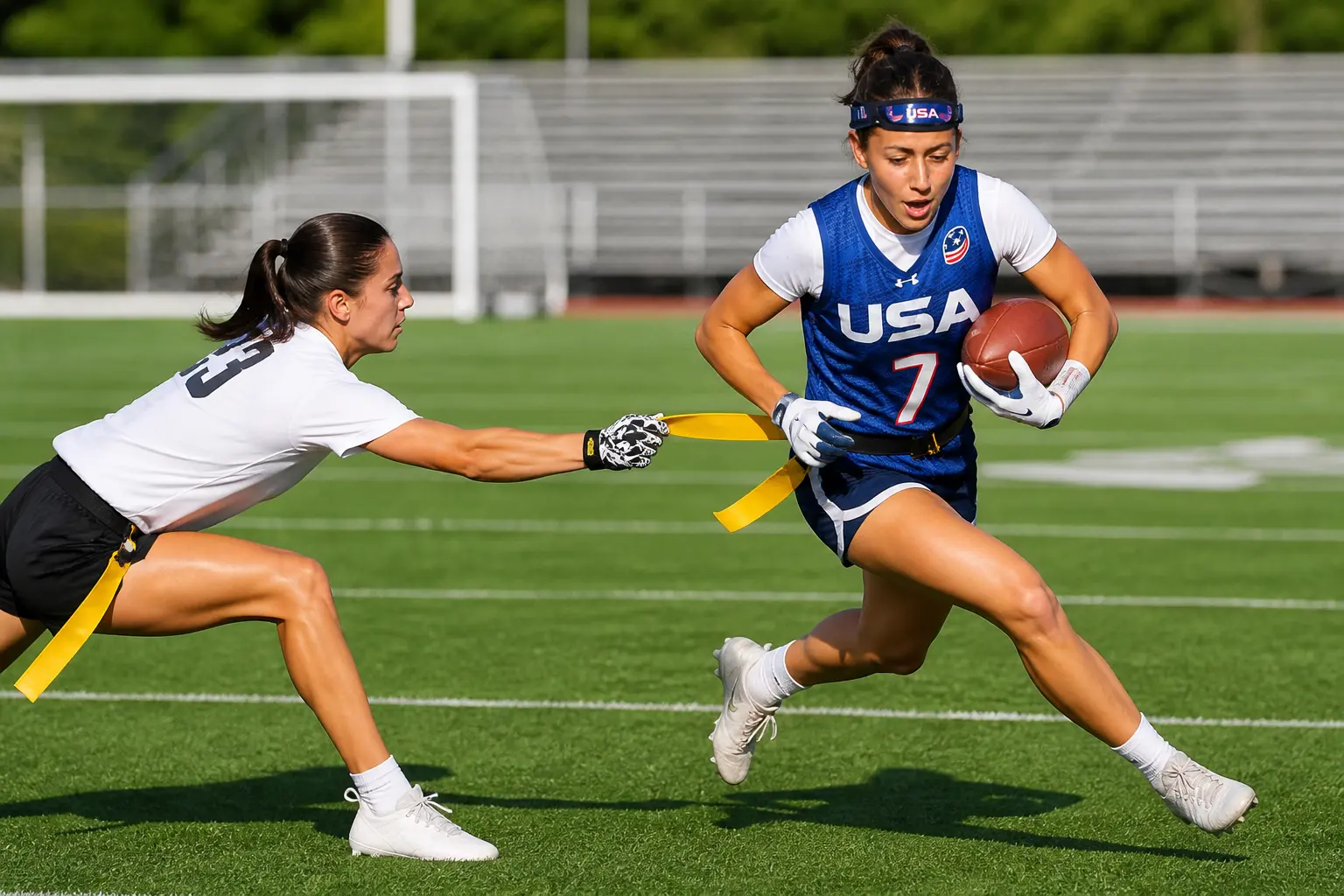
The participation surge is no longer a projection. The National Federation of State High School Associations reported that 68,847 girls played high school flag football in 2024-25, a 60 percent jump in a single year. Nearly 1,000 additional schools added the sport.
More than 20 states now sanction it as a varsity girls sport. Florida still leads with roughly 10,000 participants; Georgia, Nevada and Arizona have built multi-class championships that pack stadiums. North Carolina became the 21st state in 2026 and expects more than 150 high schools with help from the Carolina Panthers.
- 68,847 girls competed in high school flag football in 2024-25
- 60% year-over-year participation increase
- 1.12 million average viewers for the 2026 NFL FLAG Girls High School Championship on ESPN platforms, the most-watched game in event history
- 350+ teams from 13 countries at the NFL FLAG Championships in Westfield, Indiana
College coaches already treat those events as open tryouts. The same weekend that delivered the 1.12 million audience also put hundreds of prospects in front of recruiting staffs.
The depth of the talent pool is what changed the math for campus athletic directors. A single-year 60 percent jump, paired with nearly 1,000 new high-school programs, means the next several recruiting classes arrive already trained in schemes and terminology that once had to be taught from scratch. States with multi-class championships give coaches film and rankings they can trust.
Early Movers Building Rosters Now
The first NCAA champion will almost certainly come from a program that started hiring and signing before the January 2027 vote. Cal Poly is the clearest example. Rod Sherman and his wife Kristen took over in March. Sherman once coached Christian McCaffrey in high school and helped build a successful California girls flag program.
They have already landed Team USA receiver/safety Ashlea Klam (from NAIA power Keiser) and quarterback/receiver Maci Joncich. Both will play for the United States at the IFAF World Championships in Germany this month, then return for classes and a planned 24-game varsity schedule that includes trips to Texas, New York, North Carolina and Arizona. Practices and lifts begin this month.
“For so long, flag football was seen as just the female version of football or the easier version of football,” Joncich said. “Now, it’s getting the respect it deserves.” Looking ahead to a possible national title game she added simply, “It’s so cool.”
Nebraska went the other direction and hired proven success. Liz Sowers won five NAIA national titles at Ottawa University (Kansas) before becoming the Cornhuskers’ head flag coach. Traditional football factories and non-traditional schools are both in the market.
Approximately 80 NCAA schools fielded varsity teams in the 2026 season. At least 50 more are expected to launch in 2026-27. Ten conferences will sponsor the sport that year, including new entries from the American Southwest, Central Atlantic Collegiate, Southern Collegiate Athletic and Southern Intercollegiate Athletic conferences. The Big South plans a championship in spring 2028; the Big 12 is exploring a similar timeline.
- Atlantic East, CIAA, Conference Carolinas, ECAC, Empire 8 and United East already active
- American Southwest, CACC, SCAC and SIAC joining for 2026-27
- Big South targeting 2027-28 sponsorship
- Big 12 and several D-III leagues in active discussion
That conference map matters for automatic bids and travel budgets once a championship bracket exists. Leagues that sponsor early give their members a clearer path into the first NCAA field, while schools still waiting on conference action must build non-conference schedules strong enough to earn at-large consideration.
Club Teams Feeding the Varsity Wave
Not every campus starts from zero. UCLA’s club program, assembled from scratch by linebacker/receiver Tenley Hill, already fields 19 players. Many had never played flag before. Hill calls the work “surreal” and sees the club as a ready foundation if the athletic department elevates the sport.
Penn State’s men’s and women’s hockey teams followed the same club-to-varsity path years earlier. NIRSA, the organization that supports college recreation, reports the fastest club growth it has ever tracked, with programs at Georgia, Florida State, Indiana and dozens of other campuses. Pam Watts, NIRSA’s executive director, said simply, “The pace is like something we’ve never seen.”
Those club rosters become the first varsity recruiting classes. Intramural standouts and high-school graduates who never imagined a college football path suddenly have one. The new five-year eligibility window for Division I athletes adds another layer of flexibility for players transferring in or delaying enrollment.
Club growth also lowers the startup cost for athletic departments. A campus that already has 19 organized players, volunteer coaches and a practice routine can move to varsity status without building culture from nothing. That is why the NIRSA pace Watts described has become a quiet pressure point for schools still undecided.
What Prior Emerging Sports Show
Flag football is following a known map. The Emerging Sports for Women program, created in 1994, has already graduated eight sports to full championship status.
| Sport | Championship Status Year |
|---|---|
| Rowing | 1996 |
| Ice hockey | 2000 |
| Water polo | 2000 |
| Bowling | 2003 |
| Beach volleyball | 2015 |
| Wrestling | 2025 |
| Acrobatics and tumbling | 2026 |
| Stunt | 2026 |
Flag football was added to the Emerging Sports for Women program in January 2026 and received its championship recommendation only four months later. That is among the fastest timelines on record. Nearly 7,000 student-athletes competed in emerging sports in 2024-25, a 24 percent increase. Total NCAA participation hit more than 554,000.
Gretchen Miron, the NCAA’s director of education and external engagement, noted the cultural fit: “We’re a very football-heavy country. So for women and girls to move directly into this as participants rather than just as observers or contributors in other ways has been very exciting to see.” The same pathway has already produced full championships in sports that once looked like long shots. Parallel growth appears in other NCAA women’s championship pathways that started small and scaled.
The four-month sprint from Emerging Sports entry to championship recommendation compresses a process that took years for several earlier sports on the list. Wrestling, acrobatics and tumbling, and stunt only reached championship status in 2025 and 2026. Flag football is trying to clear the final votes and funding step on a shorter clock than those peers faced after their own recommendations.
NAIA Hands the NCAA a Working Model
The NAIA decision does more than fill a calendar gap. By crowning a champion in spring 2027, the NAIA creates a full season of bracket logistics, broadcast patterns and roster construction that NCAA staff and coaches can watch in real time.
| Governing body | Championship status | First title game |
|---|---|---|
| NAIA | Approved as 30th championship | Spring 2027 |
| NCAA | Recommendation issued; January 2027 votes pending | Spring 2028 if timeline holds |
Keiser already sits inside that NAIA ecosystem, which is why a transfer such as Ashlea Klam arrives at Cal Poly with championship-level experience. Liz Sowers brings five NAIA titles from Ottawa into the Nebraska job. Those direct hires show how the earlier NAIA cycle is already stocking NCAA sidelines.
For athletic directors still weighing a 2026-27 launch, the NAIA season offers a cost and attendance reference point before their own oversight committees vote on championship funding. The comparison is live, not theoretical, and it arrives a full year before the first NCAA trophy would be awarded.
Why Rosters Locked Now Carry Extra Weight
The recruiting calendar for the Classes of 2027 through 2030 is open because new programs still have roster spots to fill. That window will not stay wide. Once ten conferences sponsor the sport and more than 100 varsity teams are active, the same blue-chip prospects will face fuller offer sheets and fewer guaranteed starting roles.
Early movers are converting that temporary imbalance into depth. Cal Poly’s 24-game schedule, stretching from Texas to New York to Arizona, is built to stress-test a roster that already includes national-team talent. Nebraska’s hire of a five-time NAIA champion signals the same urgency from a Power conference brand.
- Team USA players signing before the January 2027 vote
- 24-game varsity slates on the books for 2026-27
- Coaches with multiple NAIA titles moving into NCAA jobs
- NIL conversations already underway on campuses
NIL talks and open roster spots reinforce each other. A prospect who can start immediately on a new varsity team, earn name-image-likeness income, and still chase an Olympic roster spot in 2028 has reasons to commit now that will look different once every conference has a full league and a conference tournament.
The 2028 Collision With the Olympics
Everything converges in the same calendar window. Flag football makes its Olympic debut in Los Angeles in 2028 with six-team tournaments for both men and women. USA Football will select the national teams. College programs that launch now become the primary development pipeline.
The NFL has already voted to support a professional women’s flag league and continues to underwrite youth and high-school growth through NFL FLAG. Last month’s championships in Westfield drew more than 45,000 fans and 14.3 million total viewers across Disney and ESPN platforms.
Hall of Fame quarterback Steve Young, whose daughters Summer and Laila play the game, put the appeal in plain terms at a recent Oakland camp: “This game is made for girls. At its roots, the tactics and the choreography, not the hitting, but the choreography, the roots of football, it’s made for girls. Now that it’s getting into college and you’ll see it in the Olympics, there will be an explosive effect to it. The girls are going to thrive.”
The boys had the game forever, and now the girls have the opportunity.
Jerry Rice said that at the same circuit of events. The line travels because the opportunity is no longer theoretical. NIL conversations have already started on campuses. Schedules are being written. Recruiting calendars for the Classes of 2027 through 2030 are wide open because new programs still have roster spots to fill.
Rod Sherman sees the larger cultural shift. “Having different visions of what female players can do because of what they’ll see as possible by this current group of trailblazers that have done so much for this younger generation is symbolic of so much in our society. They don’t have to compromise on their quest to be great.”
By the time the first NCAA trophy is lifted in spring 2028, the sport will already have an Olympic stage, a professional path under construction, and a high-school base that has more than doubled in two years. The schools that hired first and signed first will hold the early hardware. Everyone else will be playing catch-up in a game that suddenly has a national champion and a global audience on the same calendar.