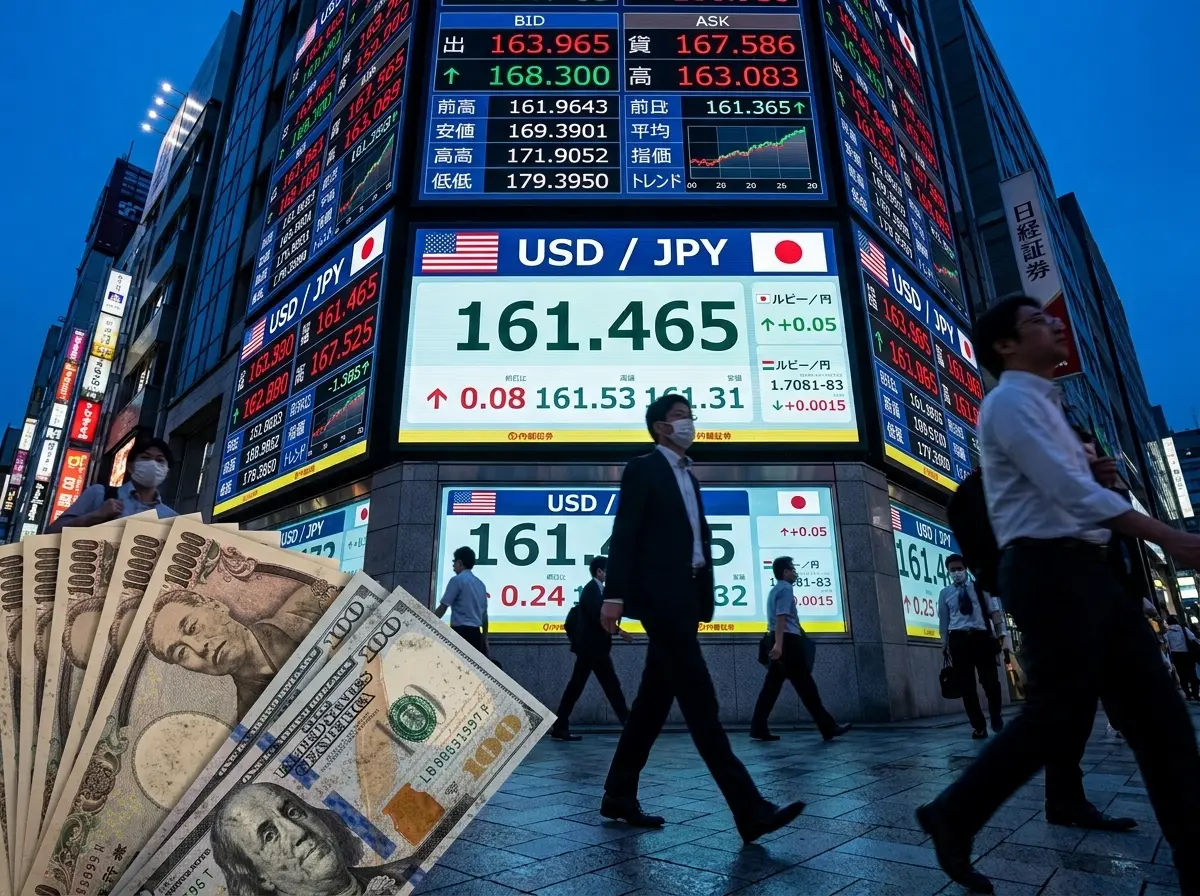
The United States bought Japanese yen on July 31, 2026, in its first coordinated support action for the currency since the 1998 Asian financial crisis, joining Tokyo after the yen touched a forty-year low near 164 per dollar. The move briefly lifted the yen into the mid-150s and sent a clear signal to markets. For the hundreds of thousands of American small firms that import Japanese parts, machinery and goods, it also quietly ended years of an accidental cost subsidy.
Treasury Secretary Scott Bessent confirmed the purchase days later. A Reuters photo of his notepad at a Camp David cabinet meeting listed “Buy Japanese Yen $5-10 bil.” Japan had already spent tens of billions the day before. The second-order effects reach far beyond exchange-rate charts.
What the July 31 Buys Did
Japanese authorities intervened heavily on July 30 in New York hours, with estimates of $36 billion to nearly $59 billion in yen purchases according to Bank of Japan data and broker tallies. The next day the US Treasury, acting through the Federal Reserve Bank of New York, sold euros from reserves to buy yen. Bessent told CNBC the goal was to curb volatility and reduce risks to Asian markets.
The dollar had traded above 163 yen, touching levels not seen in four decades. After the coordinated action and the public confirmation on August 3, it dropped as low as the mid-150s. By mid-August the pair had drifted back toward 157-159 as markets tested the resolve of both governments.
- July 30, 2026: Japan conducts large-scale yen buying in New York session, largest one-day effort in recent history by some measures.
- July 31, 2026: US Treasury notifies banks via New York Fed and executes yen purchases; Bessent notepad shows $5-10 billion range.
- August 3, 2026: Japan Finance Ministry and Bessent publicly confirm the joint operation; yen spikes further on the announcement.
- Mid-August 2026: Yen surrenders roughly half its gains, trading near 159 as further action remains possible.
| Moment | Yen per dollar |
|---|---|
| Pre-intervention low | Near 164, above 163 |
| After July 31 coordination | Mid-150s |
| Mid-August drift | 157-159 |
The sequence mattered as much as the size. Japan moved first and in force. The United States followed inside a day, then both governments confirmed in public. That order turned a unilateral defense into a joint signal. President Donald Trump called the step a gesture of friendship. Markets heard something else.
Washington’s Real Stake in a Stronger Yen
Friendship was the public line. The quieter calculation involved US Treasury bonds and regional currency stability. Japan holds more than $1 trillion in US government debt. A disorderly yen slide raises the chance that Japanese investors sell those holdings to raise dollars or cover losses, pushing American long-term yields higher at a politically sensitive moment.
A stable yen is not only important for the U.S., but very important for the entire region.
Scott Bessent, US Treasury Secretary, CNBC
CFR fellow Brad W. Setser, who previously worked currency policy at Treasury, laid out the logic plainly. A weak yen pressures other Asian currencies and works against efforts to attract manufacturing investment back to the United States. Brad Setser’s breakdown of the Treasury stake notes that the inflation-adjusted yen had returned to 1960s lows, far beyond Japan’s fundamentals. The intervention buys time for the Bank of Japan to raise rates and for Japanese investors to resume hedging their overseas assets.
On X, market voices quickly connected the dots. One widely shared thread observed that Bessent’s subsequent push for Fed dollar facilities to Japan looked less like yen defense and more like protection for the US bond market itself. If Tokyo can borrow dollars against its Treasuries instead of selling them, yields stay calmer. That reading matches the second-order pattern: the headline is currency support; the balance-sheet effect is American.
In plain terms, the United States is defending a creditor relationship as much as a currency pair. Stable Japanese holdings help keep long-term US borrowing costs from spiking when political calendars leave little room for error. Regional calm is the public frame. Bond-market calm is the practical one.
The Cheap Yen Subsidy Just Got Costlier
For years the weak yen acted as an unspoken discount for any US business buying Japanese cars, machine tools, electronics, boilers or components. A stronger yen reverses that. Even a 4-5 percent move can erase thin margins. Forbes contributor analysis in the source piece noted a firm running 12 percent gross margins with 20 percent landed costs feels pain well before a 30 percent swing.
Small firms dominate the import side. According to Census data cited by the US Chamber of Commerce, 97 percent of US importers are small businesses, 236,045 out of 242,515 total importers. They account for roughly one-third of import value. Nearly half of those small importers employ fewer than 50 people.
| Origin | Small-Business Import Value ($ millions) | Number of Small Importers |
|---|---|---|
| All countries | 868,252 | 236,045 |
| China | 157,026 | 116,735 |
| Mexico | 97,283 | 18,438 |
| Canada | 85,562 | 21,761 |
| Japan | 25,603 | 12,445 |
| Germany | 36,749 | 23,621 |
Japan supplied $25.6 billion in small-business imports in the latest detailed figures, with more than 12,000 small US firms buying directly. Those relationships now face higher dollar prices on the next order cycle. Tariffs already squeeze the same group; currency moves stack on top.
- Prior winners: US importers of Japanese capital goods and consumer products, plus Japanese exporters who gained share on price.
- Prior losers: Japanese households paying more for energy and food under the weak yen.
- New pressure point: US firms that built pricing models around a 150-plus yen rate and did not hedge.
The intervention flips the ledger overnight for anyone who failed to hedge. A mid-single-digit swing looks modest on a chart and brutal on a bid sheet when gross margins sit near 12 percent.
Energy Bills Compound the Squeeze
Currency is only one variable. Japan imports almost all of its oil. Middle Eastern crude has long supplied the bulk of that need. The Iran conflict raised global energy prices through 2026 and disrupted flows. Combined with a weak yen, the import bill exploded.
- Energy dependence: Japan meets more than 85 percent of energy needs through imports; crude oil reliance on the Middle East ran near 94 percent in recent data.
- Trade hit: June 2026 import values rose 25.4 percent year-over-year as oil costs and the yen both worked against Tokyo.
- Stockpiles drawn: Japan released oil reserves earlier in the conflict to cushion the shock, yet prices still fed through to electricity, transport and industrial costs.
Japan relies on imports for more than 85 percent of energy, according to CSIS analysis of the Iran war’s regional effects. Higher Japanese wholesale prices eventually reach US buyers of Japanese-made equipment. A service firm or manufacturer that quotes fixed prices for 90 days can find its cost base moved before delivery. Consumers facing higher pump prices grow more sensitive to final sticker shock, compressing the room for pass-through.
The same energy shock that weakened the yen in the first place now collides with a stronger yen’s effect on other Japanese export prices. Importers get hit from both directions in sequence. First the weak yen and costly oil lifted Japanese input bills. Then the coordinated support lifted the yen and raised the dollar price of the finished goods those inputs became.
What Small Importers Can Still Control
Most small-business owners do not sit in front of Bloomberg terminals. They do watch bid margins and inventory replacement costs. Three practical habits surface repeatedly among firms that survived prior currency swings.
- Run quarterly pricing reviews on the top 10 SKUs or core services, stress-testing a 5 percent and 10 percent currency move against current landed costs.
- Call distributors for fresh quotes every 90 days rather than rolling last quarter’s numbers into new bids; gaps of 15-20 percent have appeared in past cycles.
- Identify at least one onshore or alternative-country supplier for critical inputs so a yen spike does not strand production.
Maintaining three to five qualified sources for the same material turns currency risk into a negotiation lever instead of a pure cost hit. Direct relationships with overseas mills or factories, easier than a decade ago, cut middleman markups that amplify FX moves. None of these steps require a full treasury desk. They require calendar discipline.
The 97 percent figure means the problem is not exotic. It is the default condition of American import commerce. Firms that treat the exchange rate as someone else’s problem discover the margin gap only after the purchase order is locked. Fresh quotes and dual sourcing will not restore the old discount. They can still keep a thin margin from vanishing between bid and delivery.
Past Interventions Set the Pattern
The last time the United States bought yen to support it was 1998, during the Asian financial crisis, when the currency approached 148 per dollar. In 2011 the G7 intervened in the opposite direction after the Fukushima earthquake and tsunami sent the yen sharply higher on repatriation flows. That distinction matters: 2026 is support, not suppression.
Japan itself has intervened more often, including large operations in 2022 and 2024 to slow yen declines. Success is usually temporary. Without higher Japanese policy rates and a narrowing of the interest differential with the United States, speculative pressure returns. Setser and others note that Japanese investors have under-hedged foreign assets for years; any rise in hedging demand would itself support the yen more durably than one-off purchases.
Bessent has already signaled willingness for further joint action. Japan’s finance ministry said the same. Markets will test both. The July 31 episode bought weeks or months, not a permanent floor.
Hedging Demand Outlasts One-Day Purchases
Official buying can shock a chart in hours. Lasting support depends on private balance sheets. Japanese investors still hold large pools of foreign assets that have been under-hedged for years. When those holders raise hedge ratios, they buy yen in size without a finance ministry order.
The July action creates space for that shift. It also creates space for the Bank of Japan to move policy rates higher without an uncontrolled slide underway. Narrow the interest gap with the United States, and speculative shorts lose their easiest tailwind.
Until those two forces show up in flows, markets will treat every quiet session as a chance to probe. Confirmation on August 3 extended the bounce. Mid-August price action already showed how fast half the gains can fade when follow-through is uncertain.
Regional Currencies Feel the Same Pressure
Bessent tied a stable yen to the wider region, not only to the dollar pair. Setser’s account makes the channel clear: a weak yen pressures other Asian currencies and complicates the case for bringing manufacturing investment back to the United States. Exchange-rate gaps shape where firms place capacity. A yen at multi-decade extremes warps those comparisons.
Joint intervention therefore does double duty. It slows a disorderly move in one currency and reduces the risk of a broader Asian slide that would feed back into US trade and investment plans. Friendship is the language used in public. Supply-chain math is the quieter audience.
For US buyers of Japanese goods, the regional story still lands as a cost story. Parts, tools, and equipment priced out of Japan now clear at a less friendly rate, while energy-driven wholesale costs in Japan have not fully unwound. The corridor is tighter than it was before July 30.
By late August the yen sat well off its weakest prints yet short of the levels that would restore earlier importer margins. Energy prices remain elevated. Small US firms that source from Japan now operate in a tighter corridor: the accidental subsidy is gone, the energy pass-through is live, and the next order cycle will show the difference in dollars and cents.