
NEWS
Trossen Robotics Arms Went Unnamed on 60 Minutes
Trossen Robotics arms ran DeepMind’s 60 Minutes lab demos without a name check, then showed up again when Gemini Robotics 2 had to learn new robot bodies.

Trossen Robotics arms ran the manipulation demos in DeepMind’s April 20, 2025 60 Minutes segment, and the broadcast never said the company’s name. Scott Pelley was in London with DeepMind chief executive Demis Hassabis to talk about machines that learn like people. The arms on the bench already had a vendor, a price list, and two DeepMind papers that cited them.
Trossen said so itself eight days later. The Illinois company wrote that sharp-eyed viewers could spot its robotic arms and platforms in the lab shots, picking up objects and working through scenes meant to show embodied intelligence. The 14-minute piece gave Hassabis the airtime. The hardware vendor got a silhouette.
60 Minutes Showed the Arms and Skipped the Name
Pelley’s report, first shown on April 20, 2025 and posted again on August 3, 2025, is a tour of DeepMind’s AGI bet. Hassabis put human-level versatility five to ten years out. He also put a clock on robots.
I also think another big area will be robotics. I think it will have a breakthrough moment in the next couple of years where we’ll have demonstrations of maybe humanoid robots or other types of robots that can start really doing useful things.
Demis Hassabis, CEO, Google DeepMind, on 60 Minutes
The same segment is full of software that does not need a gripper. Project Astra, an app that sees through a camera, named paintings Pelley held up and invented a diner story around Edward Hopper’s Automat. Later Pelley walked London in glasses while Astra identified Coal Drops Yard. Those shots are a model looking at the world. They are not Trossen’s product.
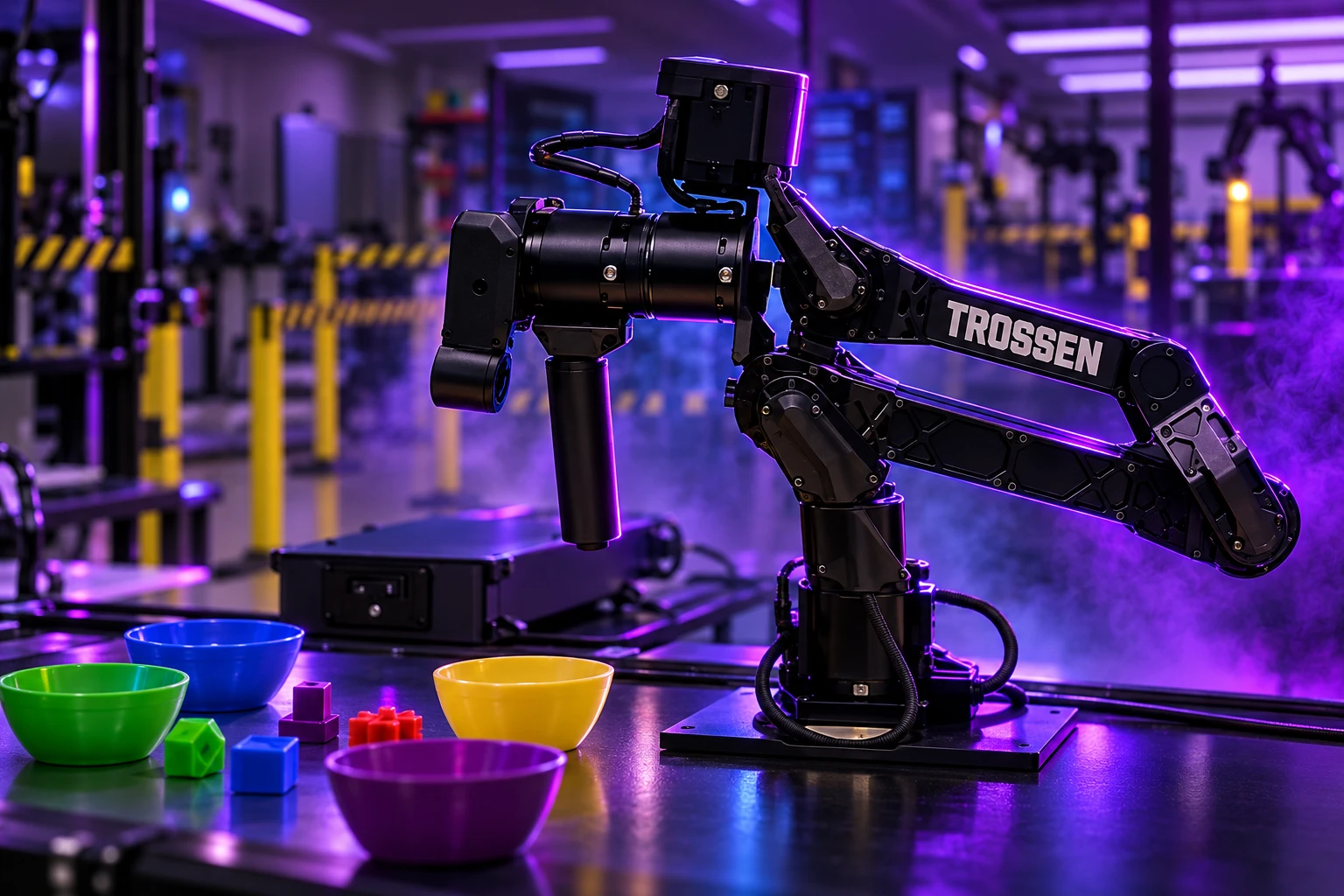
The physical work sits in a different scene. DeepMind researchers Alex Lee and Giulia Vezzani walked Pelley through a robot that had to parse a messy instruction: put the blocks whose color is the combination of yellow and blue into the matching color bowl. Green, in other words. The robot did it. Vezzani called that reasoning. Trossen, in an April 28, 2025 note, said its arms and platforms were the hardware visible in those manipulation demonstrations. 60 Minutes did not print the name.
The segment is still up as a 14-minute cut.
That gap between the voiceover and the bench is the whole business. DeepMind’s papers had already told other labs which arms to buy. A Sunday-night audience never heard the brand, and the people who order hardware for a university lab already knew it.
Stanford’s Cheap Kit Walked Into DeepMind
The kit has a name of its own. ALOHA, A Low-cost Open-source Hardware System for Bimanual Teleoperation, came out of Stanford in 2023 in a paper by Tony Z. Zhao, Vikash Kumar, Sergey Levine, and Chelsea Finn. They wanted fine work, threading a zip tie, slotting a battery, prying a condiment lid, on hardware a lab could actually buy. They built a teleoperation system within a $20,000 budget, using two larger follower arms and two smaller leader arms a person puppeteers by hand. The paper puts those arms at about $5,000 each and says a non-expert can assemble the rig in less than two hours from off-the-shelf robots and a handful of 3D-printed parts.
The learning trick was Action Chunking with Transformers, ACT, which predicts a short sequence of joint targets instead of one twitch at a time. With 10 minutes of demonstrations, about 50 trajectories, the system hit 80-90% success on six real tasks, including that translucent condiment cup and the battery slot. The point of the paper is blunt: you do not need a surgical robot to teach a policy that pinches and pries.
Google DeepMind then took the same recipe in-house. The ALOHA 2 paper, posted February 7, 2024, names the parts in plain language. The workcell uses two ViperX 6-DoF follower arms from Trossen Robotics and two smaller WidowX leader arms from the same company, mounted on a 48-inch by 30-inch table with an aluminum cage. Operators backdrive the leaders; the followers copy the joints. Four Intel RealSense D405 cameras record 848 x 480 images from overhead, worm’s-eye, and both wrists.
THE ALOHA HARDWARE STACK
| Setup | Published | What sits on the table | Cost stated |
|---|---|---|---|
| Original ALOHA | 2023 | Two ViperX followers, two WidowX leaders | Within $20,000, DIY |
| ALOHA 2 | 2024 | Same Trossen arm pair, new grippers and D405 cameras | Designs open-sourced |
| Stationary AI kit | 2025 listing | Four-arm Aloha workstation from Trossen | $23,995.95, assembled |
| WidowX Core follower | 2026 lineup | Single 6-DoF arm | $2,995 |
Those rows are not the same product. The 2023 figure is a lab budget for a build. The 2025 figure is Trossen’s assembled Stationary AI kit. The 2026 figure is one new-generation arm. Labs that copy DeepMind’s papers still start from that Trossen pair, which is why a Sunday broadcast that skipped the name did not skip the supply chain.
ALOHA Unleashed, a later DeepMind paper, pushed the same platform into shirt hanging, shoelace tying, gear insertion, and a robot-finger swap, and described more than 26,000 real-robot demonstrations across five tasks. The model work is DeepMind’s. The body on the table is the kit Stanford popularized and Trossen sells.
A Hobby Shop in Downers Grove
Trossen is not a humanoid startup with a launch video. Founder Matt Trossen has said he started the company in 2004 after a 3 a.m. idea about motors and sensors, then ran an American storefront for other people’s parts. The shop is in Downers Grove, Illinois. For years it sold hobby kits. The research turn is more recent than the DeepMind cameo makes it look.
THE TROSSEN TIMELINE
- 2004: Trossen says the company started as a parts store for people who wanted motors they could actually buy.
- 2009: The firm began putting ROBOTIS DYNAMIXEL smart servos since 2009 into its own arms, the partnership ROBOTIS still cites.
- 2016: Trossen narrowed the catalog to research platforms under the Interbotix line, preassembled and ROS-ready so labs could spend time on software.
- 2023: Stanford’s ALOHA paper uses four of those arms and the kit goes viral in robot-learning labs.
- February 7, 2024: DeepMind’s ALOHA 2 paper names Trossen’s ViperX and WidowX as the workcell.
- April 20, 2025: 60 Minutes films DeepMind’s lab and does not name the vendor.
- July 30, 2026: DeepMind’s Gemini Robotics 2 blog lists Trossen among new bodies an on-device model can learn.
Matt Trossen, on a March 2025 product walkthrough, put the spike in one line: Stanford took four of the legacy arms, the kit went crazy, and overnight the company had an unbelievable amount of interest. He called himself the chief nerd and chief mechanical engineer. The Interbotix years look, in hindsight, like a bet that research labs would rather unbox a matched pair than machine a custom arm for every thesis.
Trossen also lists Stanford, Carnegie Mellon, and UC Berkeley among the institutions on its hardware. That is the company’s own accounting. Separate public work already puts WidowX arms in the Bridge dataset and in Open X-Embodiment evaluations at Stanford’s IRIS lab and Berkeley’s RAIL lab, which is a narrower, sourced fact: the same small arm family shows up when labs compare robot-learning models across bodies.
What ALOHA 2 Changed on the Bench
DeepMind did not just reprint the Stanford shopping list. ALOHA 2 is a fatigue and downtime paper as much as a kinematics paper. The team wanted hundreds of demonstrations per robot per day, and a fleet that could collect thousands in a day, which meant the human holding the leader arms could not wreck their hands by lunch.
ALOHA 2 BENCH CHANGES
- Leader grippers: A low-friction rail replaced the original scissor, and opening force fell from 14.68N to 0.84N.
- Follower grip: Closing force at the fingertip rose from 12.8N to 27.9N, more than double, with carbon-fiber nylon that can flex under load.
- Gravity compensation: Off-the-shelf hanging retractors replaced rubber bands; in a six-person test, operators inserted 1.38 shapes per minute against 0.97 with an active software scheme.
- Cameras: Smaller RealSense D405 units with custom mounts cut bulk on the follower wrists and added depth and a global shutter.
- Simulation: A MuJoCo model of the exact workcell went into DeepMind’s Menagerie so policies could be tried in sim against identified dynamics.
Those newton figures are why a TV shot of a robot folding a shirt is also a procurement story. If the leader gripper takes 14.68N to open, a graduate student tapers off. If it takes 0.84N, the same person can keep labelling data. DeepMind open-sourced the hardware designs and a tutorial so other labs could copy the cell. Trossen’s commercial kits are the buy-it-built version of that cell. 60 Minutes showed the built version and left the invoice off screen.
Fewer Than 200 Examples on a New Body
Hassabis’s “next couple of years” line from April 2025 did not land on empty calendar. On June 24, 2025, DeepMind released Gemini Robotics On-Device, a vision-language-action model meant to run on the robot. The lab said it trained that first on-device model only for ALOHA robots, then adapted it to a bi-arm Franka FR3 and to Apptronik’s Apollo humanoid. The cheap Trossen-style workcell was the pretraining body. The industrial and humanoid bodies came after.
On July 30, 2026, DeepMind published Gemini Robotics 2. The on-device sequel, Gemini Robotics On-Device 2, is built to adapt to new bi-arm robot embodiments in a few hours, typically with less than 200 examples, even when the new machine has a different shape, sensor set, and joint count. The blog names the demo bodies: Dexmate, SO101, and Trossen platforms.
ON-DEVICE 2, AS DEEPMIND STATED IT
- Adaptation time: A few hours on a new bi-arm body.
- Data need: Typically less than 200 examples.
- Named new bodies: Dexmate, SO101, and Trossen, shown doing a spread of tasks.
- Published: July 30, 2026, with the wider Gemini Robotics 2 stack.
Trossen repeated the claim on September 30, 2026, calling its platforms one of the robots in that On-Device 2 launch and pointing labs at the same few-hour, sub-200-example pitch.
Our platforms were one of the robots in Google DeepMind's Gemini Robotics On-Device 2 launch this quarter. The model adapts to new bi-arm robots in a few hours, typically with fewer than 200 examples.
Built for teams training robot models: https://t.co/D19yokSdpz
— Trossen Robotics (@trossenrobotics) September 30, 2026
That is the name check 60 Minutes never ran, arriving in a model card instead of a voiceover. It also puts Trossen in a peer set, not on a throne. Dexmate and SO101 are in the same sentence. Apptronik, Franka, and five-finger hands carry the humanoid half of the demo. The hidden stake is smaller and more durable than a branding win: when DeepMind wants to prove a policy can jump to a new pair of arms, a Trossen bimanual cell is still one of the bodies it uses.
On October 1, 2026, Trossen’s own recap listed ongoing work with Google DeepMind, Intel, Stereolabs, and ASUS, plus a first Physical AI residency and five new products. The Sunday silhouette had become a line item in a quarterly letter.
Why Labs Still Hire Humans to Drive the Arms
The papers keep calling the hardware low-cost. The scarce resource is still the person holding the leader grips. ALOHA 2’s whole gripper redesign exists because lumbrical muscles fail before GPUs do. Direct joint-space puppeteering, the ALOHA method of a smaller arm in your hands driving a larger arm on the table, is also slow compared with a bare human hand doing the same pick. That is why labs argue about leader ergonomics as hard as they argue about model architecture.
Hardware remains the part of robot learning that does not compress. A new VLA can be copied in a git clone. A matched four-arm cell with cameras, a cage, and a gravity rig still has to be bought, bolted, and repaired. Teams that skip that bill and train only in simulation then have to face the same table the 60 Minutes cameras pointed at. Trossen’s pitch, and DeepMind’s ALOHA 2 tutorial, are both answers to that bill. One sells the cell. One posts the drawings.
People who collect that data also keep asking for more open designs, which ALOHA 2 already offered for the 2024 cell. The 2026 commercial lineup is the opposite move, a single architecture and SDK across arms, a bench, a mobile base, and a teleop station. Labs can still build. Many will purchase, because a Sunday-night shot of a robot folding laundry is easier to copy with a quote than with a mill.
WidowX Prices Now Start at $2,995
By September 2026 Trossen had folded the Aloha-era kit into a wider Physical AI lineup: WidowX arms, Glide leader hardware and a Cockpit station for teleop, Workbench for two-arm data collection, and Rivet for mobile manipulation. One SDK across the four. The company floated trade-in credit up to $7,500 on old hardware and a remote-teleop tie-up so a follower can take demonstrations from somewhere other than the next chair.
Current list prices sit far from a humanoid round. A WidowX Core follower priced at $2,995 is the value 6-DoF arm; the Core leader is $3,099.99. Workbench Lite, the two-arm station without onboard compute, starts at $1,495 before arms. The 2025 Stationary AI kit, the closer heir to the four-arm Aloha cell, was listed at $23,995.95, table not included. Academic and startup discounts of 20% on a first order still sit on the product pages.
Those numbers are why the missing 60 Minutes chiron was never going to decide the market. Procurement officers do not need a voiceover. They need the paper that says ViperX and WidowX, the tutorial that says four cameras, and a quote that fits a grant. Hassabis can keep talking about humanoids that do useful work. The unnamed stakeholder is the shop that already sold the arms in the shot, then sold the next generation of those arms to whoever wanted to reproduce the shot, then showed up again when DeepMind needed a new body for an on-device model to learn in a few hours.
Pelley’s cameras treated the grippers as scenery. The papers treated them as a bill of materials. The bill is still on the table.

The Court Revisits the Climate Nuisance Door It Left Open

ChatGPT Now Compiles Live Interfaces With GPT-6

A Tanker Attack Moves the War Into Qatar’s Waters

Personio Buys Circula to Own the DATEV Channel

Bluesky Files for .bsky and Enters the Registry Queue

Microsoft’s 96% Cyber Score Sits at 86.3% on the Board

Musk’s $914 Billion Lead Is a Public SpaceX Bet

Free Live Sports Streaming in 2026: What to Watch Without Cable

The Odyssey’s IMAX Film Run Hit a 41-Theater Limit

Andrew Garfield’s Spider-Man Films Are No Longer Free
-
 NEWS3 months ago
Microsoft’s 96% Cyber Score Sits at 86.3% on the Board
-
 BUSINESS5 months ago
Musk’s $914 Billion Lead Is a Public SpaceX Bet
-
 ENTERTAINMENT3 months ago
The Odyssey’s IMAX Film Run Hit a 41-Theater Limit
-
 SPORTS4 months ago
Free Live Sports Streaming in 2026: What to Watch Without Cable
-
 ENTERTAINMENT2 years ago
Andrew Garfield’s Spider-Man Films Are No Longer Free
-

 ENTERTAINMENT4 months ago
Endgame Encore’s $86 Million Trial for Infinity Vision
-

 NEWS5 months ago
Singapore’s 3×3 and Surfing Debuts Miss the Medal Stand
-

 ENTERTAINMENT1 month ago
Sterling Point Holds No. 2 on Prime Video After 32 Days