Qolab just raised $54.2 million from an investor that almost never leads a quantum computing round: a university’s own pension and endowment office. UC Investments, which manages roughly $190 billion for the University of California system, led the startup’s Series B. The round closed less than a year after Qolab’s chief technology officer collected a Nobel Prize for physics he helped discover four decades earlier.
The money is not chasing a cleverer algorithm. It is chasing factory floor precision, the unglamorous discipline that once turned semiconductors from lab curiosities into a trillion dollar industry. Qolab is wagering that manufacturing decides who builds a working quantum computer first, ahead of any single new breakthrough in physics or software.
The Wager Behind Qolab’s New Money
Qolab was founded in 2022 out of research labs in Madison, Wisconsin. Its first backers put in $22.5 million, a Series A led by Octave Ventures with Applied Materials joining as a strategic investor. That was treated as seed capital for a physics bet.
The Series B is a different kind of vote. It was announced on July 2 during the 75th Lindau Nobel Laureate Meeting, where Qolab co-founder and CTO Dr. John Martinis, a 2025 Nobel physics laureate, appeared alongside other laureates and young researchers. UC Investments oversees roughly $190 billion in pension, endowment and working capital assets for the university system, and it rarely leads a private hardware round this size.
“Quantum computing is entering a new era, where decades of scientific research are beginning to translate into technologies capable of addressing real world challenges,” Martinis, who is also a distinguished professor at UC Santa Barbara, said when the round was announced. Between the two rounds, Qolab has now disclosed roughly $76.7 million in combined funding since 2022.
What Makes a Josephson Junction So Hard to Mass Produce?
Superconducting quantum chips depend on a component called a Josephson junction, a razor thin insulating barrier sandwiched between two layers of superconducting aluminum. Get the junction’s size and uniformity wrong across a chip, and the qubits built from it lose coherence before they can finish a calculation.
For years, the industry standard way to build that junction has been electron beam lithography paired with an evaporation lift off technique that relies on organic photoresist stencils. It works fine for a handful of qubits in a university lab. Moor Insights & Strategy, the technology advisory firm that first detailed Qolab’s process, has noted that the lift off method leaves microscopic chemical residue behind.
That residue produces uneven junction sizes and drags down yield across a wafer. A processor with a few dozen qubits can tolerate that. A processor built to hold a million physical qubits, the scale most researchers say is needed for fault tolerant computing, cannot.
Subtractive Etching Swaps Out a Leaky Legacy Process
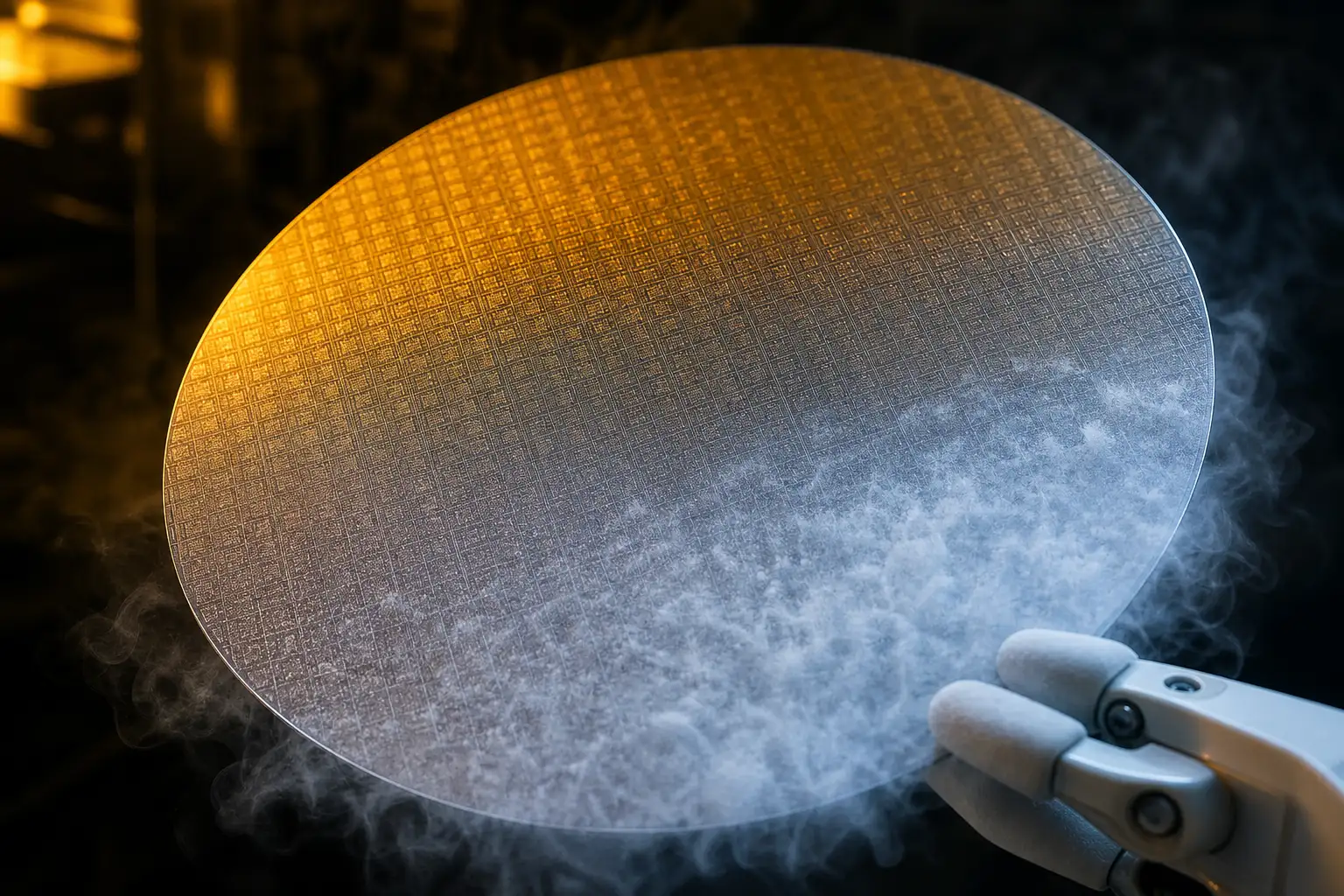
Qolab’s fix is to stop treating quantum chip fabrication as a laboratory craft and start treating it as a semiconductor manufacturing problem. The company adapts 300 millimeter silicon foundry tools, the same equipment that already stamps out chips for smartphones, servers and PCs, and applies it to qubit production.
In place of lift off, Qolab uses precision subtractive etching, which the company says produces an atomically clean material interface instead of a residue streaked one. Applied Materials has argued publicly that the quantum industry needs to borrow the semiconductor world’s playbook on error rates and uniformity to get anywhere near production scale.
Several pieces of that playbook now sit inside a single Qolab wafer:
- Foundry tools instead of lab tools, replacing electron beam lithography stations with 300 millimeter equipment built for commercial chip volume
- Subtractive etching instead of lift off, trading organic photoresist stencils for a cleaner etched junction interface
- Wafer scale tiles, bonding separate qubit and wiring wafers into modular units with integrated cryogenic amplifiers and filters, cutting the coaxial cable count inside the refrigerator
- Matched control electronics, pairing its processors with Quantum Machines’ OPX1000 platform to deliver cleaner microwave and flux pulses to the qubits
Each layer targets the same enemy: noise. Fewer cables, cleaner pulses and a cleaner junction interface all point at reducing the raw error rate a future error correction system has to clean up.
An Investor Roster That Looks Like a Fab, Not a Fund
Look past the venture firms in Qolab’s cap table and a pattern shows up. Applied Materials, the world’s largest supplier of semiconductor fabrication equipment, invested through its venture arm, Applied Ventures, as part of the Series A. Western Digital, a maker of storage hardware built on precision nanofabrication, followed with its own strategic investment in 2025.
Applied Materials did not stop at writing a check. It co-authored a technical roadmap with Qolab, a paper outlining how to scale from hundreds to millions of qubits, which Martinis presented at the American Physical Society’s March Meeting. Dr. Robert Visser, a vice president in Applied Materials’ Office of the CTO and one of the paper’s authors, said the collaboration aims to create superconducting qubits with lower error rates and better uniformity.
| Round | Amount | Lead or Key Backers | Notable Detail |
|---|---|---|---|
| Seed and Series A | $22.5 million | Octave Ventures (lead); Applied Materials | Closed in stages from 2022 into early 2025 |
| Applied Ventures collaboration | Included in Series A | Applied Ventures, Applied Materials’ venture arm | Paired with a joint scaling roadmap paper, announced March 2025 |
| Western Digital investment | Undisclosed | Western Digital | Focused on nanofabrication and materials science, 2025 |
| Series B financing and commitments | $54.2 million | UC Investments (lead); WARF, Octave Ventures, Phoenix Venture Partners | Announced July 2, 2026, at the 75th Lindau Nobel Laureate Meeting |
The Wisconsin Alumni Research Foundation’s presence ties back to co-founder Robert McDermott’s home institution, the University of Wisconsin-Madison, where he is a professor working on quantum measurement and cryogenic interconnects.
Solving the most difficult challenges in quantum computing requires deep collaboration with the semiconductor industry to effectively scale manufacturing.
Alan Ho, Qolab’s co-founder and chief executive and a former head of product at Google Quantum AI, said that when the Series B was announced.
Qolab Bets on Cleaner Chips While IBM Bets on Smarter Code
The clearest way to see Qolab’s wager is to set it against IBM’s. In June 2025, IBM laid out a roadmap to a fault tolerant machine called Starling by 2029, targeting around 200 logical qubits able to run 100 million quantum gates. IBM’s path leans on switching from surface codes to quantum low density parity check codes, which the company says can cut physical qubit overhead by up to 90 percent.
That is a software and architecture bet. IBM is trying to get useful computation out of noisy, imperfect physical qubits by wrapping them in smarter error correcting math, with modular processors named Loon, Kookaburra and Cockatoo feeding into Starling before a further system called Blue Jay targets 2,000 logical qubits.
Qolab is making the opposite bet. Rather than lean harder on error correction software that is still mostly theoretical at scale, the company is trying to make the raw physical qubits clean enough that the error correction burden shrinks on its own. Martinis, who was appointed to the President’s Council of Advisors on Science and Technology earlier this year, has pointed to cutting the raw noise burden on qubits as the real precondition for practical error correction, not a software patch on top of noisy hardware.
Neither bet is proven at true million qubit scale yet. IBM has a public date attached to its wager. Qolab, so far, does not.
Forty Years from a Berkeley Lab to a Nobel Stage in Stockholm
Martinis’s part of this story did not start in Madison. It started in a Berkeley lab in the 1980s, under a physicist named John Clarke, and it took forty years to reach a Nobel podium.
- 1984 and 1985: Martinis, working under his doctoral adviser John Clarke at UC Berkeley alongside Michel Devoret, ran the circuit experiments that later won the Nobel Prize.
- 1987: Martinis earned his physics PhD from Berkeley.
- 2004: He joined UC Santa Barbara as a physics professor, building some of the world’s most coherent superconducting qubits.
- 2014: Google recruited Martinis and his UCSB team to build the Google Quantum AI hardware program.
- 2019: Martinis led the team behind Google’s claimed quantum supremacy demonstration, with Alan Ho as strategic coordinator.
- 2022: Martinis, Ho and Robert McDermott founded Qolab in Madison, Wisconsin.
- March 2025: Applied Ventures invested and Qolab published its joint scaling roadmap with Applied Materials.
- October 2025: The Royal Swedish Academy of Sciences awarded the Nobel Prize in Physics to Clarke, Devoret and Martinis for the 1984 to 1985 tunnelling experiments.
- December 2025: Martinis received the prize in Stockholm.
- July 2026: Qolab closed its $54.2 million Series B, led by UC Investments.
There is a symmetry in that arc that a press release cannot manufacture. Martinis shared his Nobel with the adviser who trained him more than forty years earlier, then turned around and built a company betting that the industrial world, not the physics world, finishes what that Berkeley lab started.
What Could Still Break Qolab’s Wager
None of this makes the outcome certain. Adapting 300 millimeter foundry tools to qubit production is a manufacturing claim, and manufacturing claims have to survive contact with real yield data at real scale, not just a single wafer run.
IBM has years of public roadmap execution behind it and a firm 2029 target. Rigetti and other superconducting rivals are still in the race too, and trapped ion and neutral atom companies are chasing fault tolerance through entirely different physics. Qolab has not published a competing delivery date of its own.
What Qolab does have is a rare combination: a Nobel laureate CTO, a CEO who helped run the industry’s most famous supremacy demonstration, a hardware chief with deep academic roots in cryogenic electronics, and now, capital from the university system that trained its own founder. That is the bet UC Investments just backed.
Frequently Asked Questions
Is Qolab’s quantum computer available to buy or use yet?
No. Qolab has not announced a commercial ship date or a public delivery timeline for a fault tolerant system, unlike some rivals that have already set target years for their own roadmaps.
How is Qolab’s approach different from IonQ, Rigetti or other quantum computing companies?
IonQ builds its qubits from trapped ions, a different physical approach entirely. Rigetti, like Qolab, uses superconducting circuits, but Qolab is the one restructuring its fabrication around 300 millimeter silicon foundry tools rather than lab scale lithography. Every modality still has to solve yield and noise in its own way.
Where are Qolab’s labs and headquarters located?
Qolab’s primary research labs sit in Madison, Wisconsin, tied to co-founder Robert McDermott’s work at the University of Wisconsin-Madison. The company also has ties to Santa Barbara, California, through CTO John Martinis’s professorship at UC Santa Barbara, and it collaborates with Lawrence Berkeley National Laboratory.
What is the President’s Council of Advisors on Science and Technology?
The President’s Council of Advisors on Science and Technology, known as PCAST, is a panel of outside experts who advise the White House on science and technology policy. Martinis was appointed to it earlier in 2026.
How cold do superconducting quantum computers have to run?
Superconducting qubits operate at temperatures near absolute zero, inside dilution refrigerators colder than deep space. That extreme cold is what lets circuits like Qolab’s Josephson junctions hold a quantum state long enough to compute with.