The National Oceanic and Atmospheric Administration (NOAA) handed its most critical computing job to a technology company this week. NOAA named Google Cloud the primary provider for the Weather and Climate Operational Supercomputing System (WCOSS) on Monday, the infrastructure that turns raw atmospheric data into hurricane, tornado and winter storm forecasts. The migration is due to finish by December 2027.
The announcement is a modernization win for an agency that has spent years chasing faster computing. It also lands about eighteen months after the National Weather Service lost hundreds of the forecasters and technicians who would be the ones actually using that new horsepower.
Google’s New Forecast Engine
NOAA’s decision makes Google Cloud the backbone for the agency’s core numerical weather prediction work, the physics-heavy simulations that produce the Global Forecast System (GFS), the country’s primary global weather model, along with hurricane tracks and severe storm guidance used by broadcasters and emergency managers. NOAA described the move as one of the first times an operational forecasting system anywhere in the world has shifted onto public cloud infrastructure.
“Cloud-based high-performance computing will accelerate the transition of research into operations by eliminating traditional bottlenecks of on-premise systems,” NOAA Administrator Neil Jacobs said in a statement announcing the selection. “Not only will this new approach provide access to the latest chips, it will advance weather forecasting by aligning operational and research compute and provide capabilities for elastic on-demand model development.”
Ken Graham, director of NOAA’s National Weather Service, said the agency is now charting a course to global leadership in cloud-based numerical weather prediction. “This is a significant achievement for NOAA, one that will ensure our critical modeling operations can seamlessly adapt to emerging science and strengthen our mission to protect life and property,” Graham said.
Beyond the statements, NOAA and Google point to concrete changes the shift is meant to unlock:
- On-demand scaling for model development, letting researchers add computing power for a single high-resolution hurricane run without waiting on a hardware upgrade cycle that used to take years.
- Faster access to new processors, since NOAA won’t need a fresh multi-year federal procurement contract every time it wants updated chips.
- A shared research-and-operations environment, meant to move promising experimental models into live forecasts faster than the current process allows.
- Built-in redundancy, since cloud workloads can shift to different physical hardware automatically instead of depending on two fixed machines.
The compute itself runs on Google Cloud’s H4D virtual machines built for tightly coupled simulations, powered by fifth-generation AMD EPYC processors designed for the kind of massive, synchronized number-crunching that weather models demand.
Cactus and Dogwood Built the System It’s Replacing
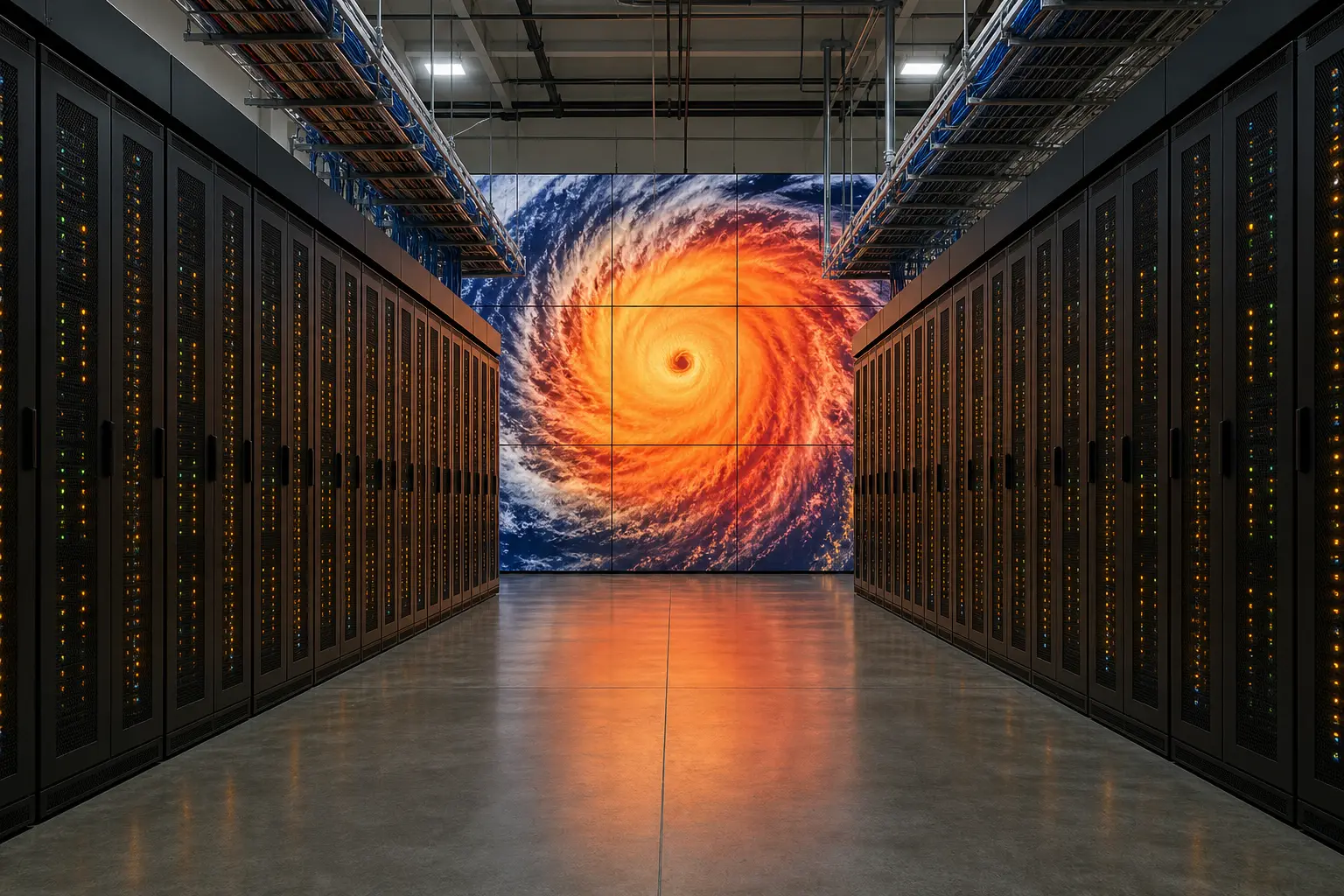
The system NOAA is moving away from has names: Cactus and Dogwood, twin Hewlett Packard Enterprise Cray supercomputers installed in Manassas, Virginia, and Phoenix, Arizona, each named for a plant native to its site. They came online in 2022 under a multi-year contract with General Dynamics Information Technology, tripling NOAA’s operational forecasting capacity at the time.
Each machine originally ran at 12.1 petaflops, about 12 quadrillion calculations per second and three times the roughly 4.2 petaflops of the system it replaced. A later upgrade pushed each machine to 14.5 petaflops. Those numbers made Cactus and Dogwood the physical foundation under the GFS, the hurricane models and the severe weather guidance the country has relied on for four years.
The contrast between the outgoing and incoming setups is stark on paper.
| Attribute | Cactus and Dogwood (Outgoing) | Google Cloud WCOSS (Incoming) |
|---|---|---|
| Primary operator | General Dynamics Information Technology, under a 10-year, $505.2 million ceiling contract | Google Cloud |
| Hardware | HPE Cray supercomputers | H4D virtual machines, fifth-generation AMD EPYC chips |
| Hardware refresh cycle | Locked in for the life of the contract | Continuous, tied to Google’s own chip release schedule |
| Locations | Manassas, Virginia and Phoenix, Arizona | Google’s global data center network |
| Status | Operational since 2022, active through the transition | Migration targeted for completion by December 2027 |
NOAA has not said what becomes of Cactus and Dogwood once the migration finishes, or whether General Dynamics keeps any role in the new arrangement.
A Decade of AI Weather Bets Just Became Policy
The Google Cloud contract is the infrastructure half of a much older relationship. NOAA and Google have worked together for more than a decade on data and artificial intelligence projects, and that history runs directly through the machine-learning models NOAA now uses to forecast the planet’s weather.
- 2023: Google DeepMind published GraphCast, an AI model it said could predict 10-day weather more accurately than Europe’s benchmark model, the European Centre for Medium-Range Weather Forecasts’ HRES system, while running far faster.
- 2024: DeepMind followed with GenCast, a diffusion-based probabilistic model built on GraphCast and the earlier MetNet-3 system, with results published in the journal Nature for extreme weather risk.
- December 17, 2025: NOAA’s National Centers for Environmental Prediction made two AI-driven forecast models fully operational, the AI Global Forecast System (AIGFS) and AI Global Ensemble Forecast System (AIGEFS), both fine-tuned on NOAA’s own atmospheric data and replacing an experimental system called EAGLE.
- July 27, 2026: NOAA named Google Cloud the primary provider for its entire operational supercomputing system.
- December 2027: Target date for finishing the full migration.
Google’s AI weather research now runs inside the country’s official forecast pipeline, not a side project sitting next to it. The cloud contract extends that same relationship to the machines underneath every model, AI-driven or otherwise.
Why Did NOAA’s Staffing Shrink First?
The National Weather Service lost more than 600 employees in early 2025 as the Trump administration pushed to shrink the federal workforce broadly. As of mid-2026, the Weather Service remains hundreds of positions short of where it stood before those departures.
The administration’s fiscal 2026 budget request went further, proposing roughly a 40% cut to NOAA’s overall funding and the elimination of the Office of Oceanic and Atmospheric Research, along with NOAA’s weather laboratories and its cooperative institutes at 80 partner universities. Congress rejected the deepest of those cuts. The final fiscal 2026 appropriation set NOAA funding at $6.171 billion, about $1.6 billion above what the administration had requested and close to the prior year’s level. Senator Brian Schatz of Hawaii was among the lawmakers who pressed the administration over the staffing shortfalls.
Money and staffing are separate fights, and the cloud contract resolves neither on its own. NOAA is buying computing power it hopes will accelerate its science. It has not yet rebuilt the workforce that turns that science into forecasts.
One Vendor, Two Critical Roles
The scale of NOAA’s reliance on a single company is becoming harder to overlook. Google now supplies the AI architecture behind NOAA’s newest operational forecast models, and after this week’s award, it will also run the physical infrastructure those models and their physics-based counterparts depend on. Neither NOAA nor Google has published contract terms addressing what happens if pricing changes or the arrangement sours mid-migration.
A similar concentration has shown up elsewhere as AI companies embed themselves in public systems. An AI governance standard shaped by one vendor’s involvement drew scrutiny for putting the company writing the technology in a position to help write the rules meant to govern it. NOAA’s arrangement is a procurement contract, not a standards body, but both cases put one company on both sides of a system the public depends on.
Hurricane Season Still Runs on the Old Machines
The calendar complicates the pitch. Peak Atlantic hurricane season runs through October, and NOAA’s forecasters are tracking this year’s storms on Cactus and Dogwood, not Google Cloud. The December 2027 target means at least one more full hurricane season, likely two, will run on the machines NOAA is already moving away from.
Forecast accuracy has real consequences on the ground. Atlanta’s flooding this year was a reminder of what happens when infrastructure cannot keep pace with a storm, after storm drains clogged before the flood hit following a long dry spell. Better model resolution does not fix clogged drains, but it can buy emergency managers more warning time, which is the outcome NOAA is actually selling here: faster, more frequent model updates.
The cloud contract runs through December 2027. The National Weather Service, as of mid-2026, is still hundreds of positions short of where it stood before last year’s cuts.
Frequently Asked Questions
What Is the Weather and Climate Operational Supercomputing System?
WCOSS is NOAA’s name for the computing infrastructure that runs its live numerical weather prediction models, including the Global Forecast System and hurricane models, converting incoming atmospheric data into the forecasts broadcasters and emergency managers use. Google Cloud is now its primary provider, a role previously filled by on-premise machines operated under contract by General Dynamics Information Technology.
Will This Change Forecasts During the Current Hurricane Season?
Not directly. NOAA’s migration to Google Cloud is scheduled to finish by December 2027, so forecasts for the 2026 hurricane season, and likely the 2027 season too, continue to run on the existing Cactus and Dogwood supercomputers rather than the new cloud infrastructure.
What Happens to the Cactus and Dogwood Supercomputers?
NOAA has not said. Its announcement focused on the new Google Cloud arrangement without addressing the fate of the HPE Cray machines in Manassas, Virginia, and Phoenix, Arizona, once the migration is complete.
How Long Have NOAA and Google Worked Together?
Over a decade, according to NOAA, spanning several AI applications before this contract. That history includes Google DeepMind’s GraphCast and GenCast research, which NOAA later adapted with its own data to build the AI Global Forecast System that went operational in December 2025.