Microsoft Corp. will run a new family of Azure artificial intelligence computing instances on Advanced Micro Devices Inc.’s upcoming Helios server racks, the companies confirmed this week. NVIDIA Corp. still controls more than 95% of the data center graphics processor market, according to the Futurum Group, a technology research firm. AMD holds roughly 4.5%. Helios is the clearest attempt yet to move that number.
The deal puts Microsoft alongside Meta Platforms Inc., OpenAI and Oracle Corp. on AMD’s customer list. It is not a break with NVIDIA, though. Microsoft sits on the board of the open standards group built so no single chipmaker can lock hyperscalers into one proprietary fabric, and Azure is deploying NVIDIA’s rival rack this year too.
Three New Azure Instances Built Around AMD Silicon
Microsoft unveiled the AMD partnership alongside three new Azure virtual machine families.
AMD and Microsoft have spent years building high-performance infrastructure together, and today we’re extending that partnership across the full stack of AMD AI solutions on Azure.
That was AMD Chief Executive Officer Lisa Su, describing the announcement. The headline series, called ND MI455X v7, runs on Helios racks and targets inference work such as AI agents and search tools, according to Microsoft. Each Helios system packs 72 of AMD’s upcoming Instinct MI455 GPUs. AMD has released only a handful of specs so far: 432 gigabytes of HBM4 memory per chip (the newest generation of memory stacked directly beside the processor), 19.6 terabytes per second of bandwidth, and a new compute architecture called CDNA 5.
| Azure Instance Family | Built For | Key Hardware Spec |
|---|---|---|
| ND MI455X v7 | AI inference, agents and search tools | Helios racks, 72 Instinct MI455 GPUs, 432GB HBM4 memory each |
| HDv2 | CPU side of AI work, like dataset prep | Up to 500 EPYC Vulcan cores, 4TB memory, 32TB flash storage |
| HXv2 | Chip design (EDA) and HPC simulation | 176 EPYC Vulcan cores above 5GHz, 800Gb InfiniBand |
The other two families handle different jobs. HDv2 targets the CPU heavy side of AI work, like cleaning and formatting datasets before an agent ever touches them. HXv2 upgrades an existing Azure line built for electronic design automation, the software engineers use to lay out computer chips; Microsoft says it now also covers scientific simulations, with 50% more cache per core than the prior generation.
“The significantly increased per VM and per core performance, and the inclusion of 800 Gb InfiniBand, enable large-scale MPI-based simulations and make HXv2 an ideal fit for a wide variety of HPC customers,” Scott Guthrie, Microsoft’s executive vice president of cloud and AI, wrote in a blog post. MPI, short for message passing interface, is the protocol supercomputing clusters use to split one giant simulation across thousands of machines at once.
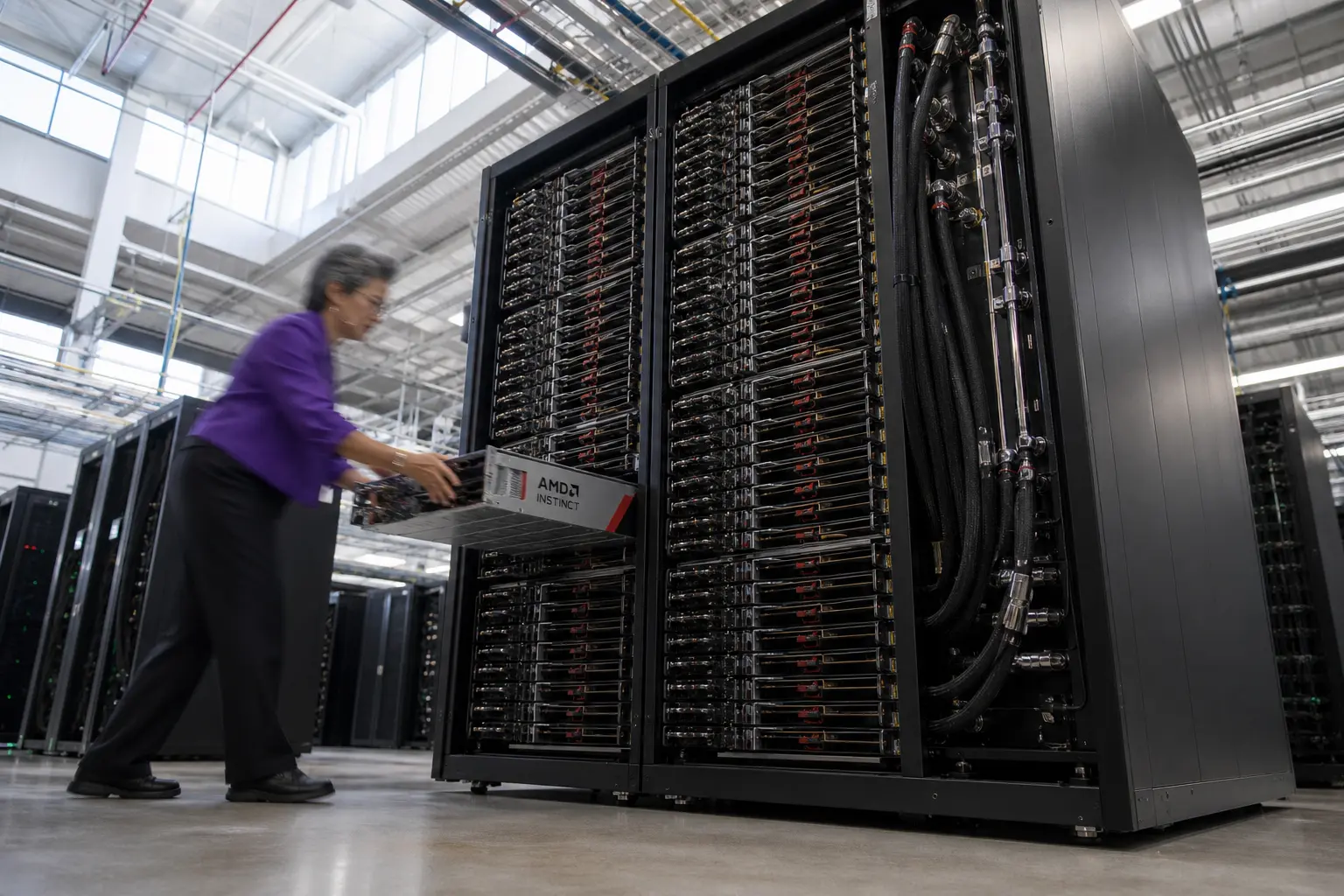
The 7,000-Pound Machine Built to Chase NVIDIA
Helios itself is not a finished product a customer buys off a shelf. It is a reference design, a blueprint AMD hands to manufacturing partners like Supermicro so they can build their own version of the rack.
AMD’s own annual report credits its acquisition of ZT Systems with speeding up the project, describing its most comprehensive AI infrastructure platform to date. The finished hardware is enormous. A full Helios rack can weigh up to 7,000 pounds, wider and heavier than NVIDIA’s competing Vera Rubin system, and it is expected to cost at least a million dollars more, north of $5 million per rack.
Inside, the chips sit across 18 wide trays, each holding four Instinct GPUs and a single EPYC central processing unit, adding up to the rack’s 72 GPUs. The trays run wider than a standard rack server to fit all that silicon, and they lean on liquid cooling to keep it from overheating.
AMD paired the GPUs with two other chip families. Pensando data processing units, or DPUs, take over infrastructure chores like coordinating storage gear and encrypting network traffic. AMD says a DPU handles that work more efficiently than a general purpose CPU would, which lowers costs and frees up CPU capacity for whatever the customer’s own application needs. The CPUs come from AMD’s upcoming Venice series, now ramping production on Taiwan Semiconductor Manufacturing Co.’s two nanometer process. Venice also uses a TSMC packaging technique called SoIC to stack chiplets directly on top of each other, and the trays trade data over an open source protocol called UALoE.
What Is UALink, and Why Does Microsoft Help Run It?
UALink is an open industry standard that lets AI accelerators from different manufacturers talk to each other at high speed, the same job NVIDIA’s proprietary NVLink does inside its own racks. Microsoft, AMD, Intel, Meta Platforms, Google and Amazon Web Services all sit on its board, and that is the point: no single chipmaker owns the wiring.
AMD proposed the idea, but Microsoft’s board seat matters more than a courtesy title. Forrest Norrod, executive vice president and general manager of AMD’s Data Center Solutions Group, said the work being done on the standard is “critical for the future of AI.” NVIDIA has not joined the group.
Microsoft’s motive reaches past AMD, too. Google’s TPU chip, Intel’s Gaudi and Microsoft’s own Maia and Cobalt processors are all listed as candidates to eventually run on the same open interconnect. Every one of those chips gives Microsoft leverage against paying whatever NVIDIA decides to charge, or waiting however long NVIDIA decides customers should wait.
The Customer List AMD Waited a Decade to Build
Microsoft is not walking into an empty room. AMD says seven of the ten largest AI compute buyers in the world are now using or evaluating its chips, the widest customer list its Instinct GPU line has assembled against NVIDIA to date.
- Oracle – committed to 50,000 MI450 series GPUs starting in the third quarter of 2026, which it calls the first public AI supercluster built on Helios racks
- OpenAI – signed a 6 gigawatt infrastructure agreement with AMD in October 2025, with the first gigawatt of MI450 capacity landing in the second half of 2026
- Meta Platforms – lining up as much as 6 gigawatts of Instinct capacity, starting with custom MI450 based silicon
- Microsoft – the newest name on the list, building three Azure instance families around Helios and AMD’s EPYC processors
AMD first put this plan in writing in June 2025, publicly detailing its open AI ecosystem vision alongside Meta, OpenAI, Oracle and Microsoft. It is the same playbook that rebuilt AMD’s server CPU business once already. The company briefly grabbed close to a quarter of the data center processor market back in 2003, lost nearly all of it to a string of delays and layoffs, then clawed back share after launching its first EPYC chip in 2017. “Under Lisa’s leadership for the last 12 years, it’s been a very different AMD,” Norrod said.
Where NVIDIA Still Wins
NVIDIA’s advantage in actual orders has not disappeared. Its Vera Rubin NVL72 rack matches Helios GPU for GPU, 72 to 72, but pairs those chips with 36 of NVIDIA’s own Arm based Vera CPUs, twice the CPU to GPU ratio AMD runs with 18 EPYC Venice chips per rack. NVIDIA’s custom Vera CPU packs 88 cores of its own design, and that extra CPU muscle handles more of the orchestration work inside each rack.
NVIDIA’s interconnect also still leads on paper. Its NVLink 6 fabric moves data at 260 terabytes per second, and NVIDIA says the design lets a rack get assembled and serviced 18 times faster than the current Blackwell generation.
| Spec | AMD Helios (MI455X) | NVIDIA Vera Rubin (NVL72) |
|---|---|---|
| GPUs per rack | 72 | 72 |
| Memory per GPU | 432GB HBM4 | 288GB |
| CPU to GPU ratio | 18 Venice CPUs to 72 GPUs | 36 Vera CPUs to 72 GPUs |
| Rack weight | Up to 7,000 pounds | Lighter, narrower design |
| Estimated price | At least $5 million | About $1 million less than Helios |
NVIDIA is not standing still while AMD ships, either. The company confirmed Vera Rubin entered full production on June 1, with the first hyperscaler deployments due in the second half of 2026. Microsoft Azure is on that list too, alongside Amazon Web Services, Google Cloud and Oracle Cloud Infrastructure. Nvidia is defending two fronts with the same hyperscalers standing on both sides of the fight.
From Open Standard to Shipping Rack
Monday’s announcement is the latest entry in a timeline that stretches back more than two years.
- May 2024: AMD, Microsoft, Meta, Google, Intel and other companies incorporate the UALink Consortium to build an open rival to NVIDIA’s NVLink.
- April 2025: UALink publishes its first full specification, covering links between accelerators inside a shared pod.
- June 2025: AMD details its Instinct MI400 line and Helios rack design at its Advancing AI event, with OpenAI’s Sam Altman appearing on stage to back the platform.
- October 2025: AMD and OpenAI announce a 6 gigawatt infrastructure agreement built around Helios hardware.
- May 2026: AMD starts ramping production of its Venice server processors on TSMC’s 2 nanometer process.
- This week: Microsoft confirms it will run three new Azure instance families on Helios racks and AMD EPYC chips, with shipments due later this year.
Markets reacted fast. AMD shares climbed more than 4% on the news, and Microsoft’s stock rose more than 1%. Neither company disclosed financial terms or how much Helios capacity Microsoft actually ordered. Meta, meanwhile, keeps collaborating closely with AMD on AI roadmaps for the next Instinct generation, a separate track from whatever Microsoft and AMD build together next.
The two companies also said they will extend the work to Azure Boost, a Microsoft system that offloads virtualization computing from CPUs onto dedicated chips. Microsoft will tune Azure Boost specifically for AMD’s hardware going forward, one more piece of the full stack Su described.
Frequently Asked Questions
How fast is UALink, and how many chips can it connect?
UALink’s first full specification supports up to 1,024 accelerators sharing memory inside one pod, moving data at up to 200 gigabits per second per lane. That is the direct alternative to NVIDIA’s NVLink, which currently supports up to 576 GPUs per pod but keeps the technology inside NVIDIA’s own hardware.
Why has NVIDIA not joined the UALink Consortium?
NVIDIA already owns NVLink and the InfiniBand networking gear that scales it across a data center, and both are proprietary to NVIDIA hardware. Joining a group built to make that technology optional for everyone else would work against the company’s own advantage.
Does AMD actually claim to be cheaper than NVIDIA?
Yes. AMD has said its MI355X chip, one generation behind the MI455X used in Helios, delivers 40% more AI tokens per dollar than NVIDIA’s competing hardware, according to comments from Andrew Dieckmann, AMD’s general manager for data center GPUs. AMD frames the pricing gap as a way to win customers who cannot get enough NVIDIA supply at any price.
Is Microsoft dropping NVIDIA hardware from Azure?
No. NVIDIA says Vera Rubin entered full production on June 1, with first hyperscaler deployments arriving in the second half of 2026, and Microsoft Azure is named alongside Amazon Web Services, Google Cloud and Oracle Cloud Infrastructure as an early partner for that hardware too. Microsoft is running both platforms rather than picking one.
How big could AMD’s AI chip business get?
AMD has told investors its addressable market for AI data center processors alone exceeds $200 billion, separate from its GPU business. Analysts covering the stock see that estimate as conservative given the customer list Helios has already attracted.