
ENTERTAINMENT
Leviticus: The Australian Horror Film Where the Monster Is Homophobia
Adrian Chiarella’s queer horror debut Leviticus premieres June 18 in Australia and June 19 in the US, the latest collaboration between Causeway Films and NEON.

Leviticus, the debut feature from Australian filmmaker Adrian Chiarella, opens in Australian cinemas on June 18 and in the United States the next day, and it arrives with the kind of momentum most first films never see. The queer horror film sparked a bidding war at the 2026 Sundance Film Festival, sold to NEON in a deal reported in the seven-figure range, and lands with a 94% fresh rating on Rotten Tomatoes and an 83 on Metacritic.
Its thesis is direct: the monster is homophobia itself. That framing, and the company behind it, is what separates Leviticus from most of the genre’s recent entries. The film is the latest from Causeway Films, an Australian production house that announced itself with The Babadook in 2014, broke out with Talk To Me in 2022, and has spent the years since methodically exporting Australian horror to global audiences. Where most debut features arrive unheralded, Leviticus arrived with a distributor, a premiere slot, and a slate behind it.
The Monster That Wears the Face of Desire
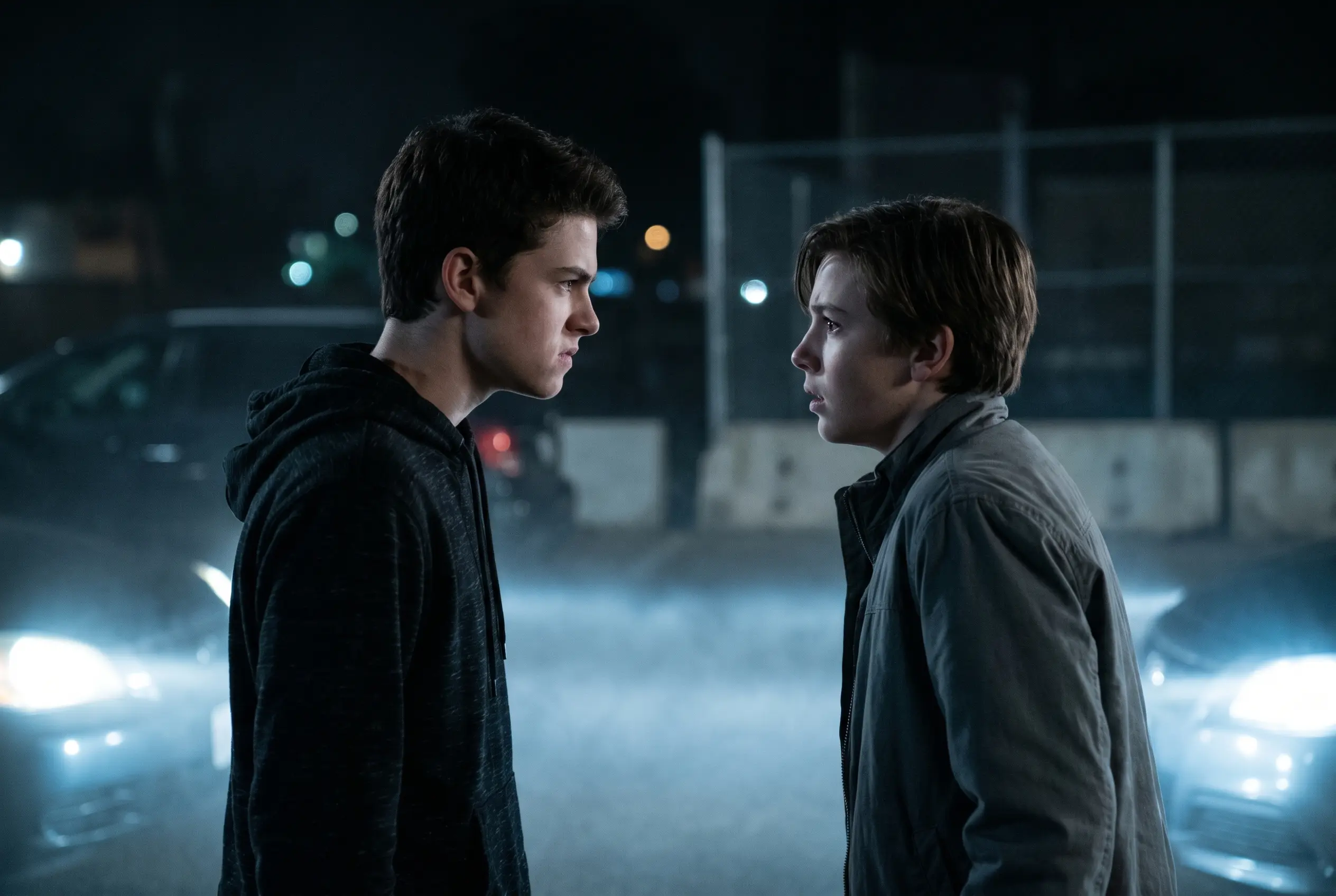
Leviticus follows Naim, a 17-year-old played by Joe Bird, whose life shifts when he kisses schoolmate Ryan, played by Stacy Clausen. After a run-in with a conversion therapy preacher, the two boys are stalked by an entity that takes the form of whoever they desire most, and for both of them, that means the other.
The setup reads like a coming-of-age horror. The inversion sits underneath it. The demon does not punish the boys for what they want. It is summoned by the community that refuses to let them have it.
Mia Wasikowska, who plays Naim’s mother Arlene and is also an executive producer on the film, anchors the family at the centre of the dread. Ewen Leslie and Jeremy Blewitt fill out the adult circle around the boys. Variety called the film “a tightly conceived, gripping queer horror that reaches for unassuming brilliance through a supernatural premise that’s as terrifying as it is thematically relevant.” It is, on paper and on screen, a horror film with a love story at its core.
A Seven-Figure Bidding War at Sundance
NEON acquired worldwide rights to Leviticus in what the first major Sundance deal report called the first major deal to emerge from the 2026 Sundance Film Festival. The deal is reportedly in the seven-figure range, for Chiarella’s debut feature, and excludes Australia and New Zealand. The film had debuted a few days earlier in Sundance’s Midnight section, a programming slot that has launched some of the most acclaimed horror and genre films of the past four decades.
Australian distribution sits with Maslow Entertainment, with the film set to premiere locally on June 18 and to open in the United States on June 19, the day after its Australian premiere at the 73rd Sydney Film Festival, where it also played in the Official Competition. NEON is the same distributor that released Bong Joon-ho’s Parasite in 2019 and Sean Baker’s Anora in 2024.
The critics, in numbers, have lined up behind the film. The Rotten Tomatoes consensus calls it “emotionally-involving” and “eerie.” The Metacritic score sits in the range the site labels universal acclaim.
- Sundance debut: 23 January 2026 (Midnight section)
- NEON acquisition: reported seven-figure range
- Rotten Tomatoes: 94% of 47 critics positive
- Metacritic: 83 out of 100
- Running time: 88 minutes
The Midnight section of Sundance, where Leviticus premiered on 23 January 2026, has historically been a launchpad for genre cinema. NEON’s track record with auteur and genre cinema, including Anora and Longlegs, made the studio a natural fit. Causeway Films, with The Babadook and Talk To Me on its slate, brought a known track record to the table. The next question is who made the film, and how a debut feature came to invert the genre’s worst trope.
How the Filmmaker Inverted the Exorcist
Chiarella, who grew up in Sydney with an Italian father and a Chinese mother, told an extended interview with the Leviticus director that he first started writing the film after reading about exorcisms performed on LGBTQI+ teenagers around the world. He considered a queer spin on The Exorcist, then dropped it. “That concept just feels like it’s perpetuating this myth that there’s a gay demon,” he said. “I started thinking: what’s the opposite of that?” The opposite became the film’s central conceit.
The director, who was sent to an all-boys religious school by his atheist parents, drew on his own encounters with the ideas the film interrogates, and he has said the hardest scenes to shoot were not the supernatural ones. In a late-night car park confrontation, with no monster in sight, the boys face the people who summoned it. “The more real-world the homophobia was, the harder it was to shoot,” Chiarella said, adding that the real-world homophobia, unfiltered by any supernatural metaphor, was the part that hit him hardest.
The Causeway Films Export Machine
Causeway Films has built a reputation for backing debut and early-career Australian filmmakers with distinctive voices, and the slate tells the story. The Babadook in 2014 announced the production house, Talk To Me in 2022 crossed over to a global horror audience, Bring Her Back in 2025 extended that run, and now Leviticus arrives with a Sundance sale and a US theatrical release behind it.
Producer and co-founder Samantha Jennings, in an interview with SBS News, argued that the pattern is rooted in Australia’s national character. Even though there is a mythology around Australians as laid-back, she said, there is also a lot unspoken and a lot repressed. That tension, she suggested, is part of what makes Australian horror resonate internationally.
Even though there’s this kind of mythology around Australians as laid-back and easygoing, there is a lot unspoken and there’s a lot repressed in terms of our society and a lot that isn’t faced.
Producer and co-founder Samantha Jennings, whose credits include The Babadook and Talk To Me, has backed that line of risk-taking and international distribution throughout Causeway’s recent slate. The production house, co-founded by Jennings and Kristina Ceyton, has backed Jennifer Kent’s The Babadook and The Nightingale, the Philippou brothers’ Talk To Me and Bring Her Back, and Jon Bell’s The Moogai. Leviticus, on the production company’s film page for Leviticus, was produced by Jennings, Ceyton, and Hannah Ngo, with Mia Wasikowska listed among the executive producers. The film sits inside a body of work that has made Causeway a known quantity for international buyers.
- The Babadook (2014), directed by Jennifer Kent
- The Nightingale (2018), directed by Jennifer Kent
- Talk To Me (2022), directed by Danny and Michael Philippou
- The Moogai (2024), directed by Jon Bell
- Bring Her Back (2025), directed by Danny and Michael Philippou
Leviticus is the latest entry in that line. The pattern, from The Babadook in 2014 to Leviticus in 2026, has been a string of distinctive voices finding international distribution.
The Ending That Beats the Trope
“I did not want to land in the ‘bury your gays’ trope with this film,” Chiarella said, naming the long-standing pattern in which queer characters are killed off, denied happy endings, or punished harder than their straight counterparts. He pushed back on the assumption that horror demands a grim finale. “As much as horror movies seem like a really dark genre,” he said, “they’re actually not super depressing. They’re not designed to leave you feeling depressed about the world.”
The film’s closing minutes are soundtracked by Frank Ocean, a late addition that came after Chiarella wrote the artist a personal letter. NEON also released a folder of footage to fans ahead of release, encouraging them to make their own edits on social media, a move that has helped build a small fan-edit culture around the film in the weeks before it opened. Chiarella has said he wished the film had existed when he was younger, and that the response from younger cast members and audiences has been the part of the release he did not expect.
Frequently Asked Questions
What is Leviticus about?
Leviticus is a 2026 Australian supernatural horror film that follows two gay teenagers, Naim and Ryan, who are stalked by an entity that takes the form of the person they desire most, each other. The film uses horror to explore homophobia as the true monster, inverting the usual pattern of queer characters being punished for their desire.
Who directed Leviticus?
Adrian Chiarella wrote and directed Leviticus as his debut feature. He grew up in Sydney with an Italian father and a Chinese mother, and was educated at an all-boys religious school, experiences that shaped the film’s depiction of religious homophobia.
When does Leviticus come out?
Leviticus opens in Australian and New Zealand cinemas on June 18, 2026, distributed locally by Maslow Entertainment, and in the United States on June 19, 2026, distributed by NEON.
How did the critics respond to Leviticus?
Leviticus holds a 94% fresh rating on Rotten Tomatoes from 47 critics and a Metacritic score of 83 out of 100, putting it in the universal acclaim range. The Guardian called it a haunting and innovative horror film, and the Hollywood Reporter wrote that it takes a solemn, eerie look at homophobia and repression.
What is the “bury your gays” trope?
The bury your gays trope refers to a long-standing pattern in film and television in which queer characters are killed off, denied happy endings, or given more tragic fates than their straight counterparts. Chiarella has been explicit about wanting to avoid it in Leviticus.
Who produced Leviticus?
Leviticus was produced by Samantha Jennings, Kristina Ceyton, and Hannah Ngo of Causeway Films, the same Australian production company behind The Babadook and Talk To Me. Mia Wasikowska, who plays Naim’s mother Arlene, is among the executive producers. The film was developed with Screen Australia funding.

The Court Revisits the Climate Nuisance Door It Left Open

ChatGPT Now Compiles Live Interfaces With GPT-6

A Tanker Attack Moves the War Into Qatar’s Waters

Personio Buys Circula to Own the DATEV Channel

Bluesky Files for .bsky and Enters the Registry Queue

Microsoft’s 96% Cyber Score Sits at 86.3% on the Board

Musk’s $914 Billion Lead Is a Public SpaceX Bet

Endgame Encore’s $86 Million Trial for Infinity Vision

Free Live Sports Streaming in 2026: What to Watch Without Cable

The Odyssey’s IMAX Film Run Hit a 41-Theater Limit
-
 NEWS3 months ago
Microsoft’s 96% Cyber Score Sits at 86.3% on the Board
-
 BUSINESS5 months ago
Musk’s $914 Billion Lead Is a Public SpaceX Bet
-
 ENTERTAINMENT3 months ago
The Odyssey’s IMAX Film Run Hit a 41-Theater Limit
-
 SPORTS4 months ago
Free Live Sports Streaming in 2026: What to Watch Without Cable
-
 ENTERTAINMENT4 months ago
Endgame Encore’s $86 Million Trial for Infinity Vision
-

 ENTERTAINMENT2 years ago
Andrew Garfield’s Spider-Man Films Are No Longer Free
-

 GAMING2 months ago
Xbox Puts 15-Hour Caps on Game Pass Cloud Play
-

 NEWS5 months ago
Singapore’s 3×3 and Surfing Debuts Miss the Medal Stand