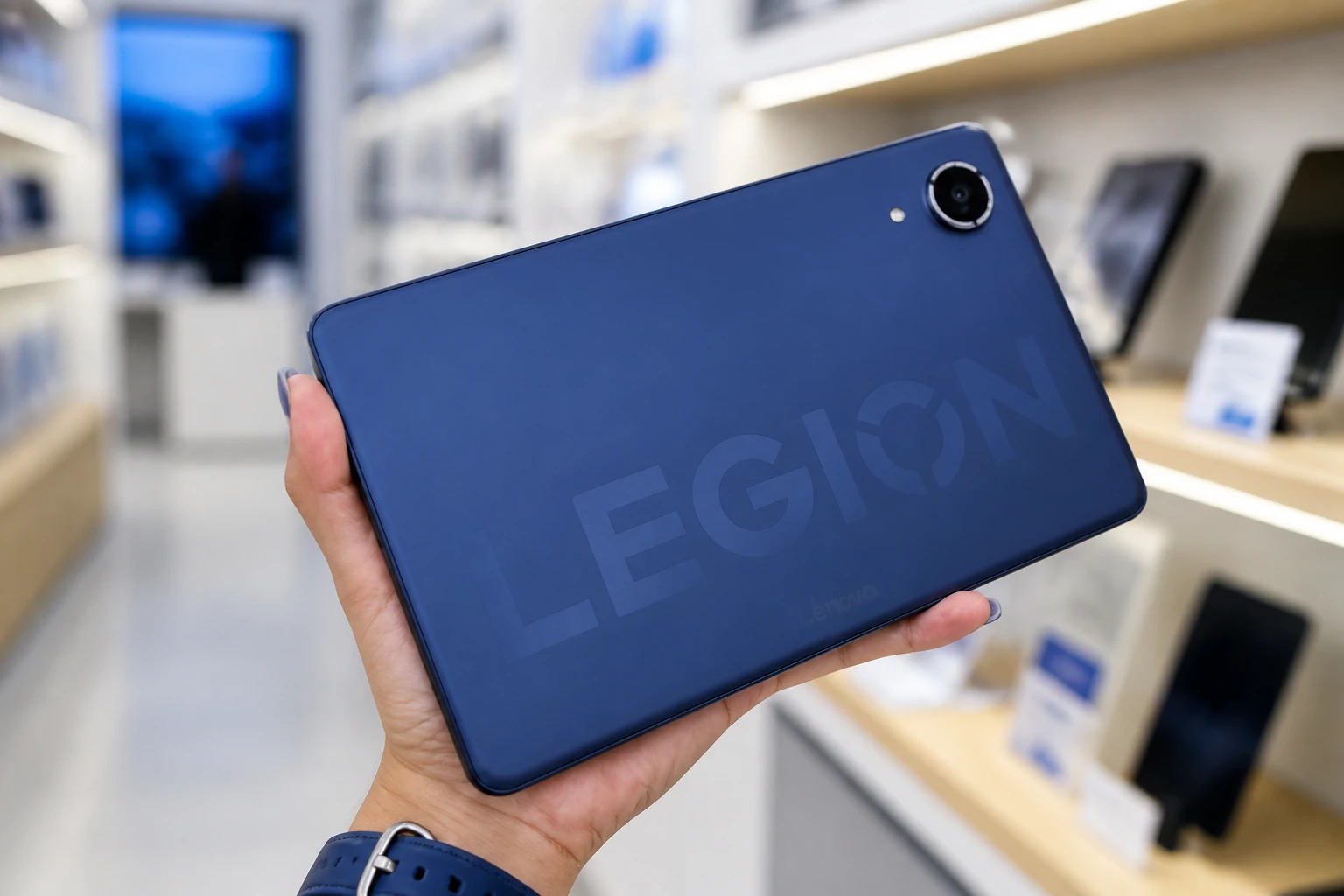
Real store photos of the Lenovo Legion Y700 Infinite gaming tablet appeared on Weibo on August 15, showing the dark blue chassis held in landscape just ten days before its confirmed China launch on August 25. The shots confirm the punch-hole OLED face, single rear camera with flash, and Legion branding that leaks had only sketched.
Lenovo has already locked the core formula: an 8.4-inch 2,560 x 1,600 OLED running at 165 Hz with 3,400 Hz touch sampling, 5G, and an overclocked Snapdragon 8 Elite Gen 5 that the company says posts 4,585,844 AnTuTu points. The second-order question the photos force is whether the shrink from the larger Gen 5 still delivers lasting frame rates once the vapor chamber and 7,470 mAh cell meet real sessions.
Those ten days between the Weibo drop and the launch event leave little room for design surprises. Shoppers who walk into a store after August 25 will meet the same dark blue finish, punch-hole face, and rear module the photos already locked in public view.
Store Shots Lock the Dark Blue Finish
The Weibo images, credited to Shan Fei and circulated via IT Home, place the tablet in a retail setting. One frame shows the front Android interface under soft store light. Another reveals the rear: a centered camera module, LED flash, and subtle Legion logo on the blue metal or glass finish.
Thickness is listed around 6.5 mm and weight near 298 grams in matching leaks. Dual USB-C ports sit on the short edges for simultaneous charging and controller use. A side fingerprint reader is expected. The design looks cleaner and more pocketable than the 8.8-inch Legion Tab Gen 5 that preceded it.
These are not renders. They are the first clear look at production hardware shoppers will see after August 25.
Retail lighting in the shots also shows how the Legion branding reads at arm length. The logo stays subtle enough that the chassis does not shout gaming hardware in a bag or on a desk, yet it remains visible enough to mark the line for buyers who already own Legion gear.
Short-edge ports and the expected side fingerprint reader complete a layout built for landscape grip. That orientation matches how most mobile games and cloud streams are played, so the physical controls land where thumbs already rest.
8.4 Inches of OLED and a 4.58 Million Score
Lenovo confirmed the panel size, resolution, 165 Hz refresh and 5G support. The overclocked Snapdragon 8 Elite Gen 5 Leading Edition pushes prime cores to 4.74 GHz and the GPU higher than the standard part. The resulting AnTuTu figure of 4,585,844 sits above the RedMagic Astra 2 monthly averages of roughly 4.16 million to 4.30 million.
Memory configurations from leakers start at 12 GB RAM with 256 GB storage and climb to 24 GB with 1 TB. LPDDR5T and UFS 4.1 Pro are the expected pairings. Cameras land at 8 MP front and 50 MP rear, matching recent Legion tablets.
| Model | Display | Battery | Key Chip Claim | Weight / Thickness |
|---|---|---|---|---|
| Y700 Infinite | 8.4″ OLED 2560×1600 165 Hz | 7,470 mAh 68 W | Overclocked SD 8 Elite Gen 5, 4.58 M AnTuTu | ~298 g / 6.5 mm |
| Legion Tab Gen 5 | 8.8″ IPS ~3K 165 Hz | 9,000 mAh 68 W | Standard SD 8 Elite Gen 5 | Heavier / thicker |
| RedMagic Astra 2 class | 9.06″ OLED up to 185 Hz | Larger cell, active cool | SD 8 Elite Gen 5, ~4.2 M AnTuTu avg | Heavier |
The table makes the deliberate trade visible. Peak silicon climbs while screen area and cell capacity drop.
The 3,400 Hz touch sampling rate pairs with the 165 Hz panel to cut input lag in fast titles. That sampling figure matters most when a controller is attached and small stick movements need to register without delay.
Benchmark headroom over the RedMagic Astra 2 class average gives Lenovo a headline number for launch day. Sustained frame rates after thermal soak will decide whether that gap holds once the thinner chassis and smaller cell are under load.
The Gen 5 Trade-Offs Lenovo Accepted
The earlier Legion Y700 record-breaking model and its Gen 5 successor prioritized battery bulk and a bigger IPS panel. The Infinite reverses that. Battery falls to 7,470 mAh from 9,000 mAh, yet 68 W charging and bypass charging stay. The chassis sheds mass and thickness for one-handed or bag carry that the 8.8-inch units never managed as cleanly.
5G with dual-SIM (physical plus eSIM) and multi-antenna design for landscape stability is new to the Y700 line. That cellular layer turns the tablet into a true always-connected machine rather than a Wi-Fi docked device. Previous global Legion Tabs proved demand exists outside China; the Infinite tests whether buyers will accept less runtime for that freedom and the OLED jump.
Leaks put the Infinite roughly 50 g lighter than the Gen 5 in some tallies. At under 300 g it sits closer to large phones than traditional tablets.
The IPS-to-OLED shift is the other half of the trade. Contrast and black levels rise on the smaller panel, which helps HDR game scenes and dim-room streaming. Buyers who valued raw screen area on the 8.8-inch Gen 5 will feel the crop first; buyers who valued pocketability will feel the gain.
- Battery drops from 9,000 mAh to 7,470 mAh
- Weight falls by roughly 50 g in leak tallies
- Thickness lands near 6.5 mm
- 68 W charging and bypass charging both remain
- Panel moves from larger IPS to 8.4-inch OLED
Central Vapor Chamber Keeps Grips Cooler
Overclocking demands cooling. Lenovo confirmed a 15,000 mm² vapor chamber. That is smaller than the Gen 5’s 17,353 mm² unit, but placement is the claimed advantage. The SoC sits in the center of the chassis so heat stays away from the natural hand zones.
- 15,000 mm² vapor chamber area
- Central mounting keeps grip zones cooler
- 4 °C cooler grip claim versus an active-cooled Snapdragon 8 Elite Gen 5 phone under load
- Passive system, no fan noise or moving parts
Lenovo’s Weibo materials stress that hands stay comfortable during long sessions. Reviewers will test whether the smaller chamber and thinner body can hold the 4.74 GHz clocks without throttling after 20 or 30 minutes of high-frame Genshin or similar titles. Passive cooling has worked well on prior Y700s; the Infinite raises the power density.
Power density is the core risk. The same overclocked Snapdragon 8 Elite Gen 5 Leading Edition that posts 4,585,844 AnTuTu points must dump heat through less chamber area and a thinner shell. Central placement buys grip comfort; it does not add surface area.
The 4 °C cooler grip claim versus an active-cooled phone sets a clear review target. If independent tests match that delta under load, the passive layout holds its case. If grip zones climb faster than the claim, the thinner body becomes the limiting factor before the cell does.
Dual Ports and the G9 Controller Pairing
Accessories are already confirmed. The G9 controller and CR7 Supreme Cooler Kit will ship alongside the tablet. Dual USB-C ports let a player keep the cooler or charger attached while the controller docks on the other side. That flexibility drew quick notice on X, where posts called dual ports the feature gamers actually needed more than another milliamp of battery.
Bypass charging further protects the cell during plugged play. The fingerprint reader and dual linear motors round out the tactile package. For users who already own Legion gear, the Infinite becomes a drop-in upgrade rather than a new ecosystem.
Simultaneous cooler and controller use is the practical win. One port feeds power or active cooling; the other locks the G9 in place. That split removes the usual choice between sustained clocks and comfortable controls.
Dual linear motors add haptic feedback that matches the higher touch sampling on the OLED. Together with the side fingerprint reader, the package aims at fast unlock and clear in-game cues without breaking landscape grip.
Where RedMagic and Handhelds Feel the Pressure
The compact 5G OLED formula targets two groups at once. Larger gaming tablets such as the REDMAGIC Astra gaming tablet specs class offer bigger panels and often active fans, yet stay Wi-Fi only and bulkier. Dedicated Windows handhelds deliver full PC games but at higher weight, lower battery life, and no cellular.
Crowd takes on X framed the Infinite as a possible “mini gaming PC” that still fits a jacket pocket. If the sustained thermals hold and China pricing lands aggressively, the device undercuts both the pure Android tablet giants and the Steam Deck-style machines for mobile players who want cloud streaming or native Android titles on the go. International release remains unconfirmed, so the first months will be China-only data.
A quick baseline from the full Legion Y700 2025 specifications shows how far the series has moved from earlier LCD and mid-tier chip generations. The Infinite accelerates that curve.
Weight near 298 grams and thickness near 6.5 mm put the Infinite in a different carry class from both bulkier Android gaming slabs and Windows handhelds. Pocket or light bag carry becomes realistic in a way the 8.8-inch Gen 5 never fully achieved.
5G Radios Expand the Session Map
Dual-SIM support with one physical tray and one eSIM is new territory for the Y700 line. Multi-antenna tuning for landscape play aims to hold signal when the chassis is held sideways and thumbs cover more of the frame.
That always-on cellular path changes where a session can start. A train commute, a cafe queue, or a hotel room without trusted Wi-Fi all become viable for cloud streams or native downloads. Earlier Legion Tabs leaned on Wi-Fi docking; the Infinite treats the network as portable.
The cost is radio draw on a 7,470 mAh cell that already shrank from the Gen 5’s 9,000 mAh pack. Bypass charging and 68 W top-ups offset some of that when a plug is nearby. Away from power, buyers will learn how hard 5G and the OLED push the smaller battery together.
Previous global Legion Tabs showed demand outside China for the gaming-tablet shape. The Infinite asks a sharper question: will those same buyers trade runtime for cellular freedom and a brighter, higher-contrast panel in a shell that finally feels phone-adjacent in the hand.
Launch Timing Frames the First Reviews
The public path from leak images to on-sale hardware is short and fixed. Store photos and the launch date now bookend the wait.
- August 15: Real store photos of the dark blue Y700 Infinite appear on Weibo via Shan Fei and IT Home
- August 25: Confirmed China launch event locks pricing, configs, and final claims
Ten days is enough for hands-on first looks but tight for long thermal soaks and battery rundowns. Early coverage will likely stress design, ports, and peak benchmarks. Multi-hour Genshin-style tests and 5G drain figures will trail the event by days or weeks.
China-only data will define the first narrative. International release remains unconfirmed, and global Legion Tab runs have historically followed successful domestic cycles, sometimes with trimmed RAM options under different branding. Until that step lands, review samples and street pricing stay local.
The 4,585,844 AnTuTu claim and the 4 °C grip claim give reviewers two hard numbers to chase on day one. Everything else, from throttle curves to mixed 5G-plus-OLED runtime, needs longer sessions than a launch-floor demo can provide.
August 25 Will Price the Global Question
Lenovo will reveal pricing and full configuration details at the China event. Base 12 GB / 256 GB units and the 24 GB / 1 TB flagship are the expected tiers. Global availability usually follows successful China runs for Legion Tabs, sometimes under the Legion Tab branding with trimmed RAM options.
The photos remove design doubt. The remaining variables are price, real-world throttling, and whether the 7,470 mAh cell plus 68 W charging can support multi-hour sessions once 5G radios and the OLED run together. Buyers who liked the Lenovo Yoga Tab Android experience for everyday use will weigh the Infinite’s gaming focus against battery life and size.
On August 25 the numbers become official. Until then the store images and the 4.58 million AnTuTu claim set a high bar for a tablet that deliberately got smaller.
LPDDR5T and UFS 4.1 Pro pairings at the top of the range match the overclocked silicon’s bandwidth needs. The jump from 12 GB / 256 GB to 24 GB / 1 TB gives clear steps for buyers who store large game clients locally versus those who lean on cloud streams and smaller installs.
Price will decide how sharp the trade-offs feel. An aggressive China tag makes the lost milliamp-hours and smaller chamber easier to accept. A premium tag puts more weight on whether the dual ports, G9 pairing, and 5G layer deliver daily value beyond the benchmark poster.