IQE plc now expects revenue to grow more than 30% this year, just three months after a rescue investment pulled the Cardiff chipmaker back from a possible break-up sale. Half year revenue reached at least £64 million (about $82 million), beating management’s own targets, and the company is now free of bank debt with £41.6 million in cash.
That reversal traces to MACOM Technology Solutions, the Massachusetts chipmaker that led an £81 million rescue package in April after IQE’s board had been weighing a full sale of the company. Three months after MACOM’s money landed, the wager already looks like it is paying off.
From Fire-Sale Talk to a Rescue in Ninety Days
Nine months ago, IQE was not a growth story. Shares fell 8.5% in a single October session to 5.94p, having touched a 52 week low near 4.685p, valuing the whole company at roughly £55.5 million. Quarterly losses ran deep, with a negative net margin near 18% and real bank debt still on the books.
By January, the picture had not improved. IQE told investors revenue had fallen to £45.3 million, blaming wireless market softness and delayed U.S. defense funding. Its strategic review, already underway, widened to consider an outright sale of the company or a disposal of its Taiwan operations just to repay debt.
- October 2025: IQE shares slide to a 52 week low near 4.685p, dropping 8.5% in a single session and pushing the company’s market value down to about £55.5 million.
- January 2026: A trading update flags revenue down to £45.3 million, and the strategic review widens to include a possible outright sale or a disposal of IQE’s Taiwan operations.
- April 27, 2026: MACOM Technology Solutions agrees to lead an £81 million rescue fundraising priced at 19.8p a share, securing board seats and ending takeover talks.
- May 2026: Shareholders approve the fundraising at a general meeting, and the deal completes once national security and foreign investment clearances come through.
- July 21, 2026: IQE’s half year trading statement flags revenue of at least £64 million and lifts full year growth guidance above 30%.
Less than three months separate the rescue deal from the growth guidance that followed it.
Inside MACOM’s Bet on a Distressed Supplier
MACOM Technology Solutions, a Nasdaq listed semiconductor supplier based in Lowell, Massachusetts, was already IQE’s customer before it became its rescuer. When the fundraising closed, MACOM emerged with a stake, a lending position, and a seat at the boardroom table all at once.
| Instrument | Amount | Key Terms |
|---|---|---|
| Equity subscription | £30 million | 151,515,151 new shares at 19.8p, about 11.5% of voting rights |
| Convertible loan notes | £15 million | Zero coupon, 60 month term, convertible at the 19.8p issue price |
| Warrants | Over 75.7 million shares | Exercisable only if the notes are redeemed early without conversion |
| Board seats | Two non-executive directors | Rights to appoint two MACOM executives to IQE’s board |
MACOM also secured long-term supply agreements covering multiple epitaxial technologies as part of the deal. In its own announcement of the agreements and investment, MACOM chief executive Stephen Daly said, “IQE is an important supplier to MACOM. We believe this transaction will strengthen our supply chain resilience, while positioning IQE to improve its balance sheet and financial performance across its business.”
IQE’s own announcement concluding its strategic review framed the deal in similar terms. Chairman Mark Cubitt said at the time, “This fundraise removes debt pressures and leaves the Group with a capital structure to enable future growth.”
The Half Year Numbers That Followed
IQE’s July 21 trading statement showed that plan working faster than expected. Management said the first half exceeded its own forecasts, with strong demand across every core segment.
- Half year revenue of at least £64 million, ahead of management’s own expectations
- Full year revenue growth guidance raised to more than 30% year on year
- EBITDA expected in the low teens of millions of pounds for the year
- Cash position of £41.6 million as of June 30, with no bank debt
Chief executive Jutta Meier described the update in stark terms.
I am very pleased that half trading exceeded our expectations. Our long-established leadership in InP and other key material systems means we are critically embedded in supply chains enabling industry trends that will continue to deliver further progress in H2. I remain extremely excited about the significant opportunities ahead for the transformed IQE, and look forward to sharing our continued progress.
Meier said this in IQE’s trading statement. Brokers reacted quickly. Panmure Liberum raised its price target from 50p to 54p after the update, having upgraded its rating from hold to buy only weeks earlier. Three analysts tracked by stockanalysis.com now rate the stock a buy overall, with an average target near 57p.
Why Is Indium Phosphide Suddenly Everywhere in AI?
Indium phosphide is a compound semiconductor used to build the lasers and photodetectors inside optical transceivers, the components that move data between servers in AI data centers. Demand is surging because hyperscale computing clusters need faster, lower power optical links, and indium phosphide remains the main way to build them at meaningful scale.
- $26 billion: LightCounting’s forecast for 2026 sales of Ethernet optical transceivers tied to AI clusters, up 60% from $16.5 billion in 2025
- 33.5 million: Goldman Sachs’s revised 2026 forecast for global 800G transceiver shipments, up from an earlier estimate of 25 million units
- $4 billion: NVIDIA’s investment in the optical supply chain, cited as evidence of vertical integration reshaping the sector through 2026
A market report distributed in June said component supply, particularly indium phosphide lasers, remains a binding limit on how fast manufacturers can produce high bandwidth transceivers. IQE’s own trading statement pointed to the same dynamic, citing InP demand for optical photonics tied to data centers and AI infrastructure alongside steady strength in aerospace, defense, 3D sensing and wireless products.
A $14 Million Order Points to the Next Leg
Days before the trading statement, IQE disclosed a separate win. A multi-year production order worth $14 million from an undisclosed strategic global technology customer will be manufactured at IQE’s Newport foundry, supporting applications in AI and data center markets.
IQE said increasing data generation and hyperscale infrastructure requirements are driving demand for high-performance storage technologies, and that it continues to engage with the same customer on future opportunities, including next-generation technology across multiple stages of the customer’s data lifecycle.
Meier called it recognition of IQE’s position in the supply chain, saying the order supports “the rapid growth of AI and datacentre markets from IQE’s volume manufacturing facility at Newport” and reflects a differentiated epitaxy portfolio spanning indium phosphide optical communications, silicon photonics and gallium arsenide laser datacom applications.
Two MACOM Executives Now Sit on IQE’s Board
Robert Dennehy and David O’Carroll joined IQE’s board as non-executive directors following the MACOM investment, formalizing the rights MACOM secured when the deal closed. MACOM now holds about 11.5% of IQE’s voting rights.
Dennehy has more than 30 years of experience at MACOM and has served as its senior vice president and chief operating officer since November. O’Carroll has more than 10 years at MACOM, with expertise in international operations, finance and government relations, and has been vice president since October 2023, overseeing facilities in France, Japan and Ireland alongside MACOM’s Asian operations.
“I am delighted to welcome Robert and David to the board of IQE,” said chairman Mark Cubitt. “I look forward to working with them and the rest of the Board as we capitalise on the opportunities ahead for the company.”
The arrangement leaves MACOM in an unusual position. It is IQE’s customer, its lender through the convertible notes, its largest disclosed shareholder, and now a voice in the boardroom deciding how IQE spends its cash.
IQE’s Free Float Still Runs Thin
The rescue came at a cost to existing shareholders. Repeated placings since the crisis have pushed IQE’s share count to around 1.33 billion shares in issue, and the stock’s 52 week range still spans roughly 4.7p to 72.8p, a reminder of how thin and volatile trading in the shares remains.
Concentration risk has not gone away either. The customer behind the new $14 million Newport order is undisclosed, and MACOM’s dual role as both IQE’s biggest customer and a lender with board representation ties much of IQE’s near-term fortune to a single relationship.
For now, three analysts rate the stock a buy, and Panmure Liberum’s 54p target sits well above the 19.8p price at which MACOM bought into the company just months ago.
Frequently Asked Questions
What does IQE plc actually make?
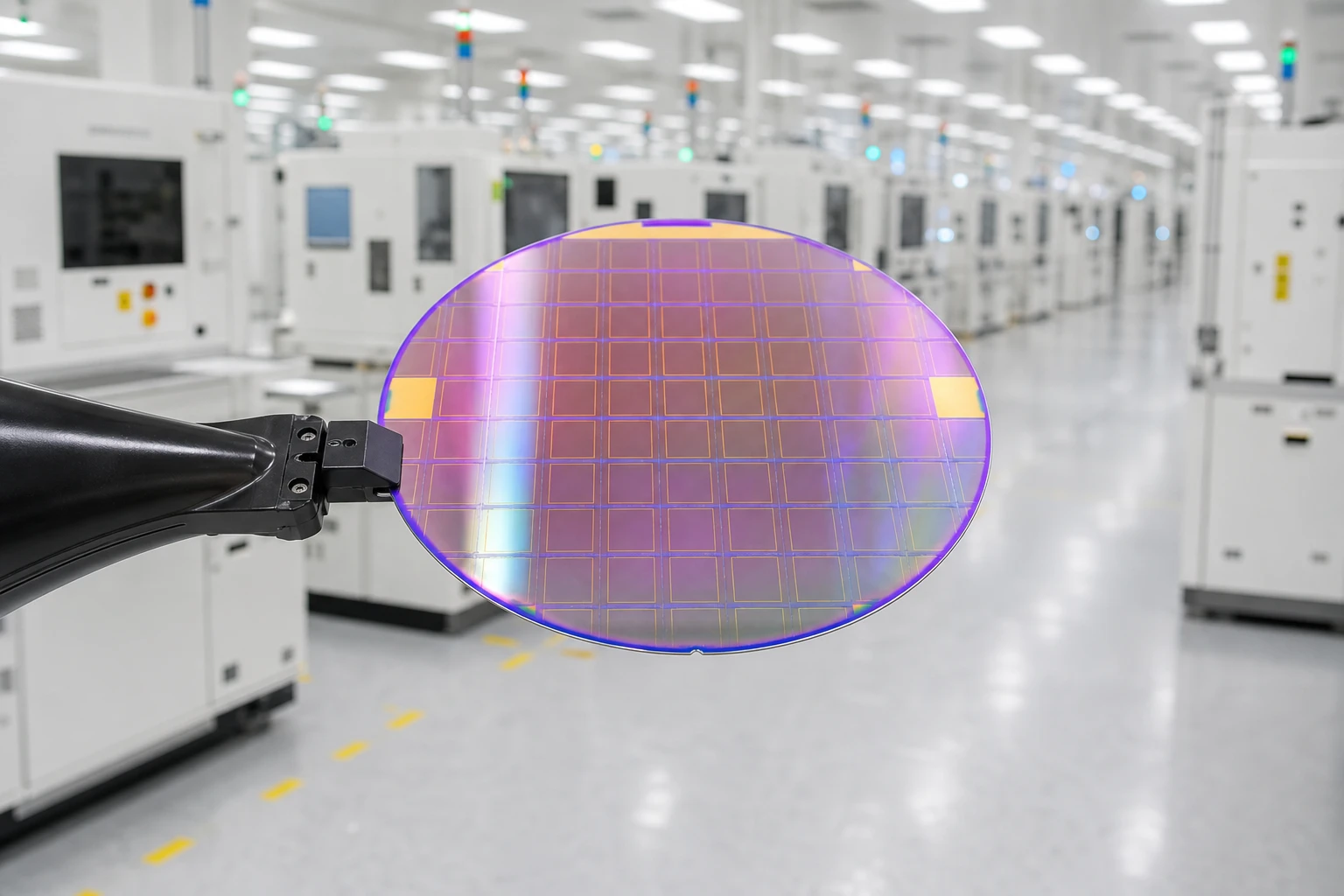
IQE designs and manufactures compound semiconductor wafers, thin layers of materials such as indium phosphide, gallium arsenide and gallium nitride grown onto substrates for use in optical, wireless and sensing chips. Its three reporting segments are Wireless, Photonics and CMOS++, and Photonics generates the majority of group revenue.
What is indium phosphide used for?
Indium phosphide efficiently emits and detects light, which makes it the material of choice for lasers and photodetectors inside optical transceivers. Those components carry data between servers inside AI data centers and sit at the center of IQE’s photonics business.
How much of IQE could MACOM end up owning?
MACOM holds about 11.5% of IQE’s voting rights through its £30 million share subscription at 19.8p. That stake could grow further if MACOM later converts its £15 million loan notes or exercises warrants over more than 75.7 million additional shares.
Where does IQE plc’s stock trade?
IQE trades on London’s Alternative Investment Market, known as AIM, under the ticker IQE, with about 1.33 billion shares in issue. Its shares have swung between roughly 4.7p and 72.8p over the past year.
What happened to the plan to sell IQE’s Taiwan operations?
That option fell away once the MACOM led fundraising closed. IQE’s board concluded its wider strategic review in April 2026 and said a sale of the company was no longer being considered, ending months of speculation about a break-up.
Disclaimer: This article is for informational purposes only and does not constitute investment advice. IQE plc is a small cap, high volatility AIM listed stock, and readers should consult a licensed financial adviser before making investment decisions. Figures are accurate as of publication on July 22, 2026.