The International Olympic Committee provisionally lifted the suspension of the Russian Olympic Committee on Tuesday, opening a path for Russian athletes to enter the qualification period for the 2028 Los Angeles Summer Olympics. The IOC Executive Board acted after its Legal Affairs Commission concluded that the ROC no longer counts four regional sports bodies in Russian-occupied Ukrainian territories among its members, the threshold the IOC had set when it suspended the federation on 12 October 2023.
The decision is provisional on its face. The Executive Board reserves the right to reverse course, every international federation still makes its own call, and Russian athletes face a separate anti-doping gate run through the International Testing Agency before they step on a track or start a heat.
What the IOC Decided, and What the Four Regions Had to Do With It
The full statement on the provisional lifting carries a single trigger and a long list of conditions. The trigger: the ROC “no longer includes as its members any regional sports organisations in territories falling under the jurisdiction of the National Olympic Committee (NOC) of Ukraine.” The ROC also confirmed to the IOC that it “does not, and will not, conduct any activities in these territories.” The four territories are the Russian-occupied oblasts of Luhansk, Donetsk, Kherson, and Zaporizhzhia, the same regions whose Olympic councils the ROC recognised in 2023 in a move the IOC called a violation of the Olympic Charter and the territorial integrity of Ukraine’s NOC.
“Provisional” is doing real work in the IOC’s language. The Executive Board said it “will continue to closely monitor the situation relating to any ROC activities in those territories, and reserves the right to take any further measures if deemed necessary.” A statement that is provisional can be reversed if the IOC sees the ROC re-extending into the four regions. The trigger for that reversal would be the same Legal Affairs Commission that cleared the way on Tuesday.
The decision follows a separate IOC action in May 2026 lifting recommended restrictions on Belarusian athletes, and it sits on top of a year of quiet erosion in the original February 2022 framework that barred Russian and Belarusian athletes from international competition in the first place. The change is not total: the IOC’s stance on the invasion itself is, in the body’s own words, “unchanged.”
The LA28 Clock and the Protective Measures That No Longer Apply
The IOC’s reasoning for speed is the qualifying calendar. The qualification period for both the LA28 Olympic Games and the Dolomiti Valtellina 2028 Winter Youth Olympic Games has already started, the body said, and the Executive Board moved to “offer equal access to these competitions to all athletes.” Without the change, Russian athletes would have continued to face the same restrictions during a qualification period that has already started.
The recommended conditions of participation for International Federations and international sports event organisers of 28 February 2022 and 28 March 2023, as they relate to Russian athletes and teams, including the protective measures, are no longer applicable. The word “protective” refers to the package of vetting and neutrality requirements that governed how Russian athletes returned to competition in 2023. That package included a screening for public support of the war in Ukraine, a process Individual Neutral Athletes had to clear before competing at the 2024 Paris Summer Games and the 2026 Milano Cortina Winter Games. The package is now gone for Russia, with Belarus already off the same set of restrictions since May.
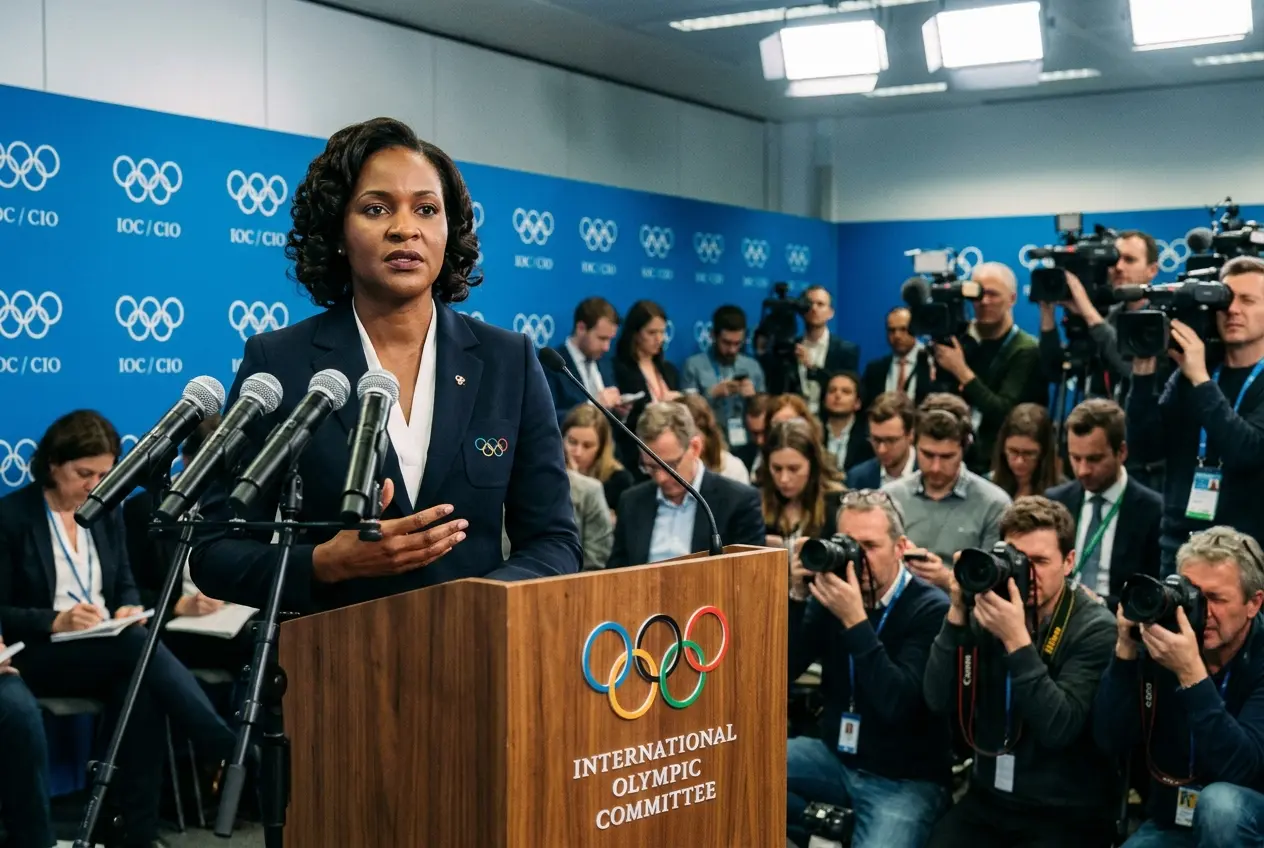
IOC President Kirsty Coventry framed the move as a question of principle, telling reporters the body was acting to give every athlete a fair shot at qualifying. The change, she said, gives Russian athletes the same access to international competition as their peers. Her language mirrored the IOC’s own written rationale, which framed the shift as a matter of equal access to a qualification period that has already started.
The IOC also raised, in the same announcement, the question it has now answered in principle but not in detail: whether Russians will compete under their own flag, anthem, and colours. That decision, the IOC said, will come “at the appropriate time.” Coventry separately told reporters the IOC has “not changed” its view on the invasion, which it “strongly condemns.” The body’s stance on the war, in other words, is still on the books while the door to competition is being reopened. The body has not yet named a date for the separate flag decision.
The Federations Now Hold the Keys
The consequential shift in Tuesday’s decision is the line the IOC drew around it. The body’s recommended conditions of participation are gone, but the IOC did not impose membership on anyone. The choice of how to treat Russian athletes, flags, anthems, and officials “is at the discretion of each IF and international sports event organiser,” the IOC said, “and should reflect whether their national federations are in good standing.” That hands the harder decisions to 30-plus summer and winter federations, each with its own political pressure and its own commercial calendar.
The federations have already split. World Aquatics’ April ruling on Russian and Belarusian athletes allowed both countries’ swimmers to compete under national flags, while World Boxing approved boxers from the same two countries to compete as neutral athletes the same month. World Athletics went the other way in June 2026, upholding its ban on Russian and Belarusian athletes from any international competition. FIFA and UEFA, by contrast, have said there are no immediate plans to readmit Russia’s national and club teams.
| Federation | Position | Effective |
|---|---|---|
| World Aquatics | National flag, anthem, and uniform allowed | April 2026 |
| World Boxing | Compete as neutral athletes, “with immediate effect” | April 2026 |
| World Athletics | Excluded from international competition (upheld) | June 2026 |
| FIFA and UEFA | No immediate plans to readmit Russia | July 2026 |
The Guardian’s report on the decision, citing Coventry, notes that several hundred Russians could yet compete in the LA Games, a sharp jump from the 27 athletes from Russia who competed across the 2024 Paris Summer Games and the 2026 Milano Cortina Winter Games under Individual Neutral Athlete status. The IOC’s provisional lifting has opened the doorway. The federations will decide which rooms Russian athletes can walk into.
“Athletes Should Not Pay for the Actions of Their Government”
We don’t want to hold athletes accountable for the actions of their government. We made it clear that all athletes had the possibility to compete at the Olympic Games. This is what this decision speaks to.
The framing from Coventry is the political logic the IOC has been moving toward for over a year. In December 2025 an Olympic Summit endorsed opening international youth competition to Russian and Belarusian athletes, the same forum that backed the doctrine that athletes should not be held to account for what their governments do.
In June 2026 the IOC Session voted to reinforce the Fundamental Principles of Olympism in the Olympic Charter, a step the body describes as part of the “Fit for the Future” process. The principle Coventry articulated on Tuesday was endorsed at the same Summit, alongside the decision to open international youth competition to Russian and Belarusian athletes. The doctrine now applies to the senior Russian team as well. The IOC’s stance on the invasion of Ukraine remains unchanged, the body’s announcement said.
A Doping Gate Built on Suspicion of RUSADA
The path for Russian athletes now runs through a separate, technical door. The IOC’s announcement sets out four conditions for any Russian athlete seeking to return to international competition, all of them routed through the International Testing Agency. RUSADA, the Russian Anti-Doping Agency, stays in the picture for the home side, but the authority over the testing programme, the results management, and the final go-or-no-go belongs to the ITA, with the IOC holding the trigger if RUSADA’s compliance status does not change before 2028.
The IOC cited “recent allegations regarding the Russian Anti-Doping Agency’s (RUSADA) governance” as the reason for the extra layer, along with “pending confirmation that reinstatement conditions concerning the World Anti-Doping Code have been met.” The announcement did not name the allegations, but the timeline they sit on is long. A 2015 WADA-commissioned report found evidence of systematic doping in Russian athletics, and a separate set of findings documented a state-sponsored cover-up around the 2014 Sochi Winter Olympics. WADA imposed a four-year ban in 2019 after Moscow was found to have manipulated laboratory data, a sanction later reduced to two years by the Court of Arbitration for Sport.
The Guardian reports that Coventry, asked about LA28, said: “We ask to ensure that adequate testing is done on Russian athletes coming into the LA28 Games.” The ITA, which the IOC will lean on for the actual testing programme, is the same body that runs anti-doping operations for more than 70 international federations, a structure that gives the IOC a single point of control to enforce the new regime.
- Delegated anti-doping programme: membership in a national RUSADA/ROC programme run by the International Testing Agency, including risk assessment, test distribution plan, and results management.
- Pre-return testing: multiple tests based on a sport-specific risk assessment, with the exact window set by each International Federation.
- ITA-coordinated testing programme: an overall test count and timing agreed between the IF and the ITA.
- Backstop: if RUSADA is still non-compliant with WADA in 2028, the IOC will instruct the ITA to apply the same independent testing to all qualified Russian athletes.
Each International Federation sets the exact pre-return testing window for its own sport, and the ITA agrees the overall test count and timing for each sport’s programme. What the four conditions amount to, in practice, is a parallel anti-doping track for Russian athletes that runs through Lausanne, not Moscow. The IOC is gating Russian participation on a regime it can audit and override. The override mechanism, if RUSADA is not back in WADA compliance by 2028, is the IOC’s instruction to the ITA to apply the same independent testing to all qualified Russian athletes.
Moscow Welcomes, London Appalls, Kyiv Is Silent
Russian Sports Minister Mikhail Degtyarev framed the IOC’s move as the start of a wider opening. “Our country’s return to the Olympic family is a green light for international federations to reinstate all our athletes,” he said. He added that Russia had done “extensive diplomatic work” to bring its athletes back and would “definitely take advantage” of the IOC’s decision to let international federations host world championships at their discretion. Russia’s parallel bid to host major international events again, however, remains foreclosed for IOC-run events under the body’s own policy.
The reaction from the United Kingdom was a near-opposite. UK Culture Secretary Lisa Nandy called the decision “utterly appalling” and said her government’s position is unchanged: “The Russian state should not be represented in international sport while the illegal full-scale invasion of Ukraine continues.” She added that Russia’s “flagrant disregard for anti-doping regulations makes a mockery of their participation in future events,” a line that points at the same RUSADA governance question the IOC’s new testing regime tries to answer. Global Athlete, a body that represents athletes in governance disputes, also pushed back, with its director general Rob Koehler saying the IOC “has chosen to rewrite, to lower, its own standards for stakeholder accountability” by bringing Russia back “despite its history of state-sponsored doping and its ongoing war against Ukraine.”
Al Jazeera’s report on the announcement noted “there was no immediate reaction from Ukraine.” The IOC’s own statement reaffirmed that it “continues to stand in solidarity with the Olympic community of Ukraine,” a line it has carried in every communication on the war since 2022.
What the IOC Has Not Decided
The flag, the anthem, the colours, and any other form of Russian identification at the Olympic Games themselves remain open. The IOC’s announcement deferred that choice “to the appropriate time,” and Coventry confirmed on Tuesday that no decision has been made on whether Russia will be allowed to display national symbols at the LA Games. The body also restated two permanent positions: it will not organise IOC events in Russia, and it will not invite Russian government or state officials to its events.
Those carve-outs leave the most visible symbols of the return to be settled by a separate IOC decision that has not yet been dated. The flag, anthem, and colours Russian athletes will be identified by at the LA28 medal ceremony will be set by a different IOC meeting, on a date the body has not yet named.
Frequently Asked Questions
Will Russian athletes compete at the 2028 Los Angeles Olympics?
The IOC’s provisional lifting of the ROC suspension on July 7, 2026, lets Russian athletes enter the qualification period for LA28. Whether individual Russian athletes reach the Games depends on qualifying results and on each International Federation’s eligibility rules.
Will Russia compete under its own flag and anthem at LA28?
Not yet. The IOC said on Tuesday that a decision on the Russian flag, anthem, colours, or any identification at the Olympic Games will be taken “at the appropriate time.” That decision was not made alongside the suspension lift.
Which sports have already let Russian athletes compete?
World Aquatics ruled in April 2026 that Russian and Belarusian athletes can compete under their national flags, anthems, and uniforms. World Boxing allowed boxers from both countries to compete as neutral athletes the same month. World Athletics upheld its ban on Russian and Belarusian athletes from international competition in June 2026.
When was the Russian Olympic Committee originally suspended?
The IOC suspended the ROC on 12 October 2023 after the federation recognised the Olympic councils of four Russian-occupied Ukrainian regions: Luhansk, Donetsk, Kherson, and Zaporizhzhia.
Does this decision mean the IOC has softened its stance on the war?
No. The IOC’s announcement states that the body’s stance on Russia’s invasion of Ukraine, which it “strongly condemns,” is “unchanged.” The provisional lifting applies to the ROC’s membership status and to athletes’ competition access, not to the IOC’s position on the invasion.