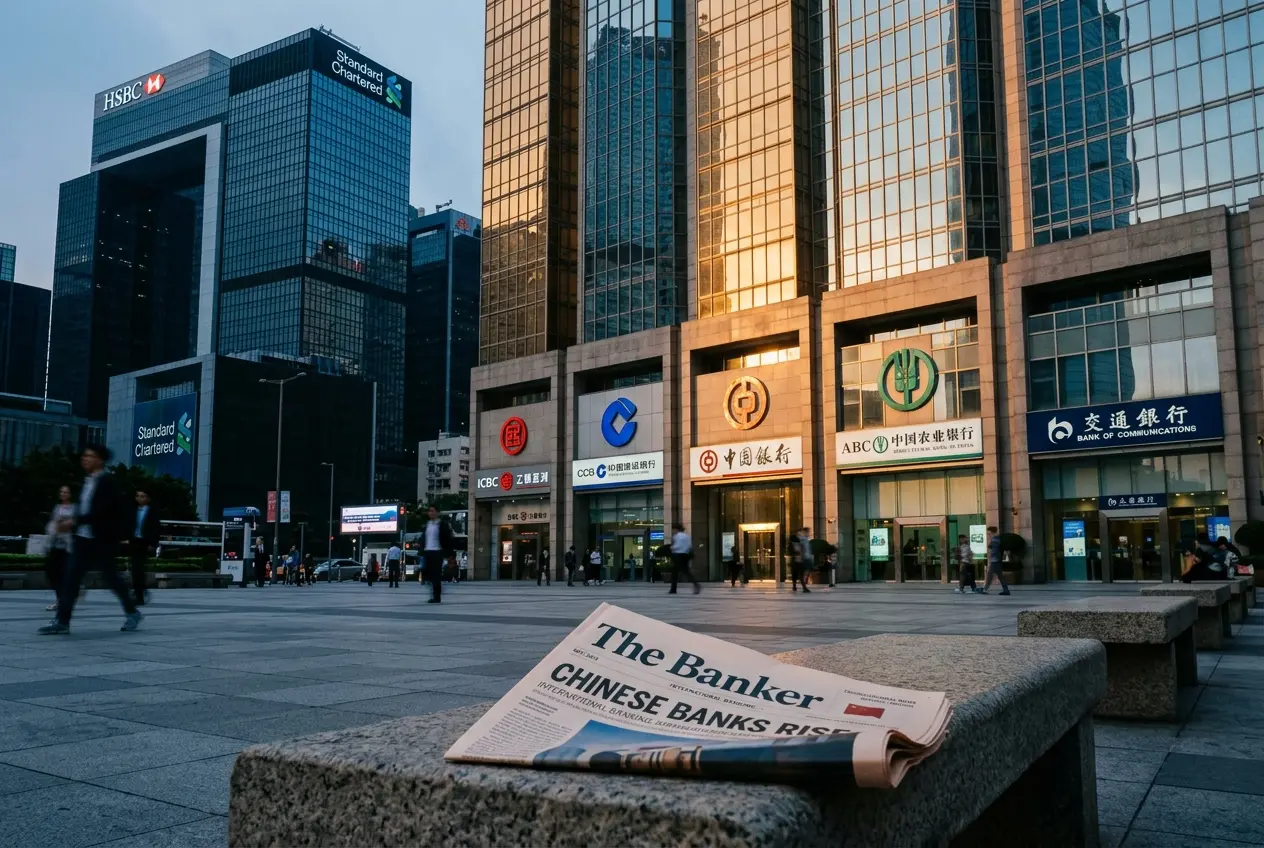
The Banker’s 2026 Top 1000 World Banks ranking lands with a familiar headline and a more uncomfortable one underneath. Chinese lenders again tightened their grip on the summit of the global industry, but the editor who oversaw this year’s list warned that a quiet recapitalisation by Beijing is doing a lot of the heavy lifting, and that profitability among Chinese state-owned giants is still significantly lower than at their US counterparts.
Seven of the top ten positions by Tier 1 capital are now held by Chinese banks, according to The Banker’s 2026 deep dive by senior editor John Everington, and the Industrial and Commercial Bank of China has now sat at number one for thirteen consecutive years, the only lender since the ranking’s launch ever to break into double digits on that streak. The ranking is compiled from data on more than 5,000 of the world’s biggest banks.
Where China Actually Sits in the Top Ten
The shape of the leaderboard has stayed Chinese-dominated for years, but the 2026 list sharpens the picture. ICBC leads, with China Construction Bank second and Agricultural Bank of China third, per The Banker Database’s 2026 top-1000 cut. Bank of China keeps its long-held fourth slot, with JPMorgan the largest US bank at number four in earlier editions, while HSBC and the Standard Chartered-style franchises of Britain, alongside the US trio of Bank of America and Citi, fill out the places US and European banks still manage to defend.
The Banker’s accompanying editorial warns that the absolute size numbers mask what is happening underneath them. The share of growth in Tier 1 capital that China’s state-owned banks have recorded “stems from increased state support,” the publication’s senior editor John Everington writes, describing the trend as “increasingly hard-won” for lenders inside the world’s second-largest economy.
The Quiet Stakeholder: Beijing’s Recapitalisation Engine
The phrase “state support” hides a specific mechanism. As Chinese lenders struggle to grow retained earnings fast enough under economic pressure, their biggest shareholders have been the central government and state-linked investment vehicles, who have poured fresh equity into the balance sheets of the banks they own. ICBC’s own 2025 annual report, filed earlier this year, frames the milestone in those terms, confirming that the lender “was ranked the 1st place among the Top 1000 World Banks by The Banker for the thirteenth consecutive year.”
The Banker is unusually direct about what that means for the leaderboard. Its own database note explains that much of the recent Tier 1 capital growth at Chinese lenders is coming from increased state support, while profitability among those state lenders “remains significantly lower than their global counterparts, particularly in the US.” On a like-for-like basis, a US megabank sitting in the same Top 10 slot is, today, more profitable per dollar of capital than the Chinese state champion sharing the row above it.
Why the Gap Behind the Ranking Is Getting Wider
The Banker’s table tells you who has the most capital. It does not tell you who is earning the most on it. That distinction has been widening through the current cycle of US tariffs, a slower Chinese property market, and weaker loan demand inside China, with state-owned lenders being told to support the real economy by accepting lower margins.
So the seven-of-ten headline reads one way to investors looking for global balance-sheet exposure. The 2025 ICBC report instead shows the asset side: ten million plus corporate banking customers, a heavier policy-bank role than its US peers play, and a Tier 1 capital base that has compounded without producing the same bottom line. Bank of America, a US institution with comparable political risk and a smaller balance sheet, has run more aggressive return-on-equity programmes in the same window.
That gap is the hidden-stakeholder story The Banker is sitting on. China’s grip on the leaderboard is real, but the bigger under-the-fold story is the Western megabanks quietly outperforming on profitability while ceding the size race to a state-backed machine.
The Geopolitics Pushing Banks Past Their Borders
The Banker’s lead note drops a second thread you do not see in the rankings themselves: Chinese lenders are now chasing growth overseas because the home market cannot keep feeding their Tier 1. As “geopolitical tensions between the two superpowers hit new highs in 2025 with the launch of President Trump’s fresh tariff regimes and as the domestic economy languishes, Chinese banks are increasingly seeking growth opportunities beyond their home market, in line with Beijing’s cherished goal of boosting international use of the renminbi in the place of the US dollar,” per The Banker’s database write-up.
That overseas pivot is still small in revenue terms but already visible in licence moves, branch openings in the Gulf and Southeast Asia, and a steady drumbeat of renminbi-clearing deals. The deeper stake is that every Chinese bank pushing itself into a dollar-clearing lane is also a soft-power vehicle for Beijing’s currency ambitions. HSBC, Standard Chartered and the European megabanks run the inverse risk: the corridors they built over decades are the corridors Chinese state banks now want to live in.
What the 2026 Numbers Say About Profitability
Three headline metrics for the global Top 1000 ticked up this year: Tier 1 capital, total assets and aggregate pre-tax profit, a turn from the subdued readings of recent cycles. The growth, though, is uneven. Japanese megabanks MUFG, SMTB and Nomura posted strong pre-tax gains after the Bank of Japan’s move off its negative interest rate regime. Russian lenders climbed the movers’ table on rouble strength, and the South African, Nigerian, Moroccan and Egyptian lenders all pushed up the African rankings.
Inside the Chinese block, however, profitability metrics have lagged the Tier 1 expansion. The Banker’s own caveat is the one to remember: absolute size absolutely matters, but profitability among China’s state lenders “remains significantly lower than their global counterparts, particularly in the US.” That is the line every investor screen using Tier 1 capital as the proxy for banking strength needs to keep in view.
What the 2026 List Is Really Telling the Industry
There are two reasonable reads of the 2026 table, and both are true at once. On Tier 1 capital, the centre of gravity of the global banking industry has shifted decisively to China, and the seven-of-ten result is the cleanest data point the industry has ever produced for that shift. The Banker has been calling this move for three decades, and the 2026 list is the most decisive installment yet.
On return on capital, US and European lenders are the quietly better-positioned camp underneath the headline. China’s grip at the top is real, but it is also reinforced by the quiet cheque of the Chinese state at exactly the moment the domestic cycle makes organic capital generation harder. That is why Beijing’s recapitalisation engine is the real stakeholder here: it is what the Chinese leaderboard looks like without it; it is what US and European megabanks are out-earning against; and it is the variable that decides whether the seven-of-ten result still reads the same in 2027.
Related reading on Mind Cron: more from the Top 1000 World Banks archive and China coverage across finance and policy.