Indian judokas claimed four medals including two history-making golds at the Commonwealth Games 2026 in Glasgow, the first golds the country has ever won in the sport at the event. Asmita Dey and Harsh Singh stood atop the podium on the same July 31 evening, ending a run of eleven prior medals that never included gold.
The haul immediately turned their eyes to the Asian Games in Aichi-Nagoya weeks later and the longer road to the Los Angeles Olympics. Four medals from twelve entries also set a new high-water mark for the discipline at these Games.
The Night Two Firsts Arrived Together
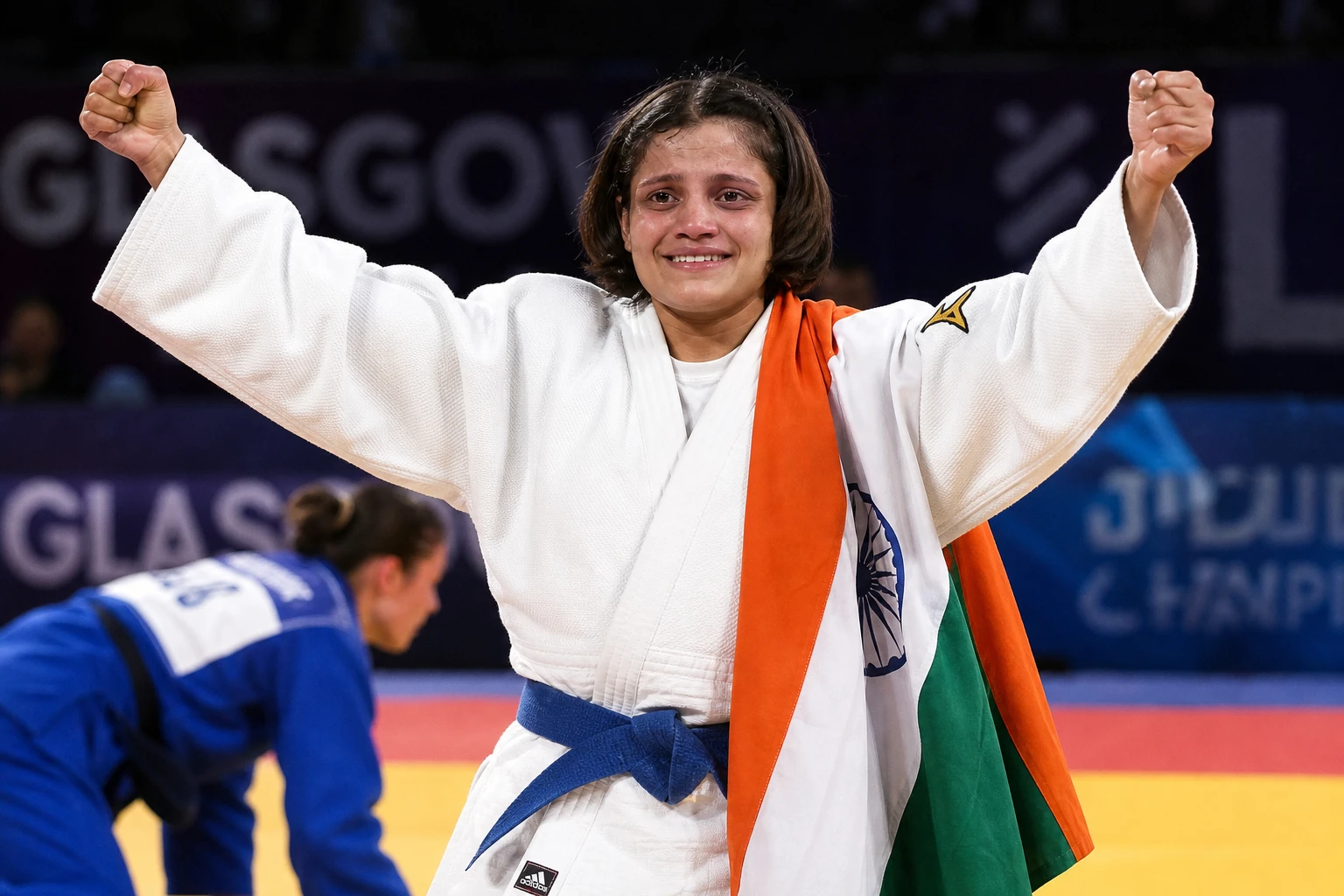
Asmita Dey opened the evening in the women’s -48kg. The 23-year-old from Tripura beat Scotland’s Eva Ewing by ippon in the quarters and edged home favourite Summer Shaw by yuko in the semis. In the final she trailed Canada’s Heidi Quach 0-1, forced golden score, then landed the decisive yuko for a 2-1 win.
Minutes later Harsh Singh, also 23, dominated the men’s -60kg. He scored ippons early, beat Australia’s Pedro Carlos Antun Neto by waza-ari in the semi, then defeated Olympian and 2022 bronze medallist Joshua Katz of Australia by waza-ari for a commanding final victory listed as 10-0.
Yamini Mourya added silver in the women’s -57kg after a long final loss by ippon (three shidos) to England’s Acelya Toprak. Unnati Sharma took bronze in the women’s -63kg with an ippon win over South Africa’s Skye Knoester in the bronze bout. India entered 12 judo events and left with two gold, one silver and one bronze.
- Asmita Dey, gold, women’s -48kg, first Indian judo CWG gold ever
- Harsh Singh, gold, men’s -60kg, first Indian male judo CWG gold
- Yamini Mourya, silver, women’s -57kg
- Unnati Sharma, bronze, women’s -63kg
The double gold arrived inside a single session. One athlete forced golden score after trailing; the other never let the final slip into doubt. Together they closed a gap that eleven earlier medals had left open.
From Eleven Medals Without Gold to a Double Breakthrough
Before Glasgow, Indian judokas had collected five silvers and six bronzes across previous Commonwealth Games. The 2022 Birmingham edition produced three medals and zero gold. The twin golds on one night therefore rewrote the entire record book for the discipline in Indian colours.
| Edition | Gold | Silver | Bronze | Total |
|---|---|---|---|---|
| Pre-2026 cumulative | 0 | 5 | 6 | 11 |
| Birmingham 2022 | 0 | – | – | 3 |
| Glasgow 2026 | 2 | 1 | 1 | 4 |
The first-ever CWG gold medals in judo arrived after years of steady junior and open-circuit progress that never quite converted on the multi-sport stage until now.
Glasgow’s four-medal return is the largest judo haul India has recorded at these Games. Two golds in one evening did more than add to the total; they changed the shape of the historical table from a long silver-and-bronze list into a podium that finally includes the top step.
Tripura’s Mechanic’s Daughter and the Army Havildar
Asmita Dey began as an 800m runner good enough for district trials. A coach steered her onto the mat. She is the bicycle mechanic’s daughter from Tripura, raised in Belonia with three siblings. Her father Arjun Kumar Dey ran a repair shop and supported her until his death; her mother sent her back to training ten days later so he would not think the dreams had stopped. She moved through Belonia Vidyapeeth, Tripura Sports School, SAI Bhopal under Yashpal Solanki, and the TOPS development group. Asian Junior bronze in 2022 made her the first Tripura judoka with an international medal. She added Junior Asia Cup gold, Asian Open silver, Casablanca African Open gold in 2025, and fifth at the 2026 Asian Senior Championships.
Harsh Singh, a Havildar in the Indian Army’s specialised judo node, spent a full year rebuilding after a knee injury. International coaches, physiotherapy and sports science at the Inspire Institute of Sport complemented the military programme. He had never won a major international senior medal before Glasgow. Both athletes are 23. Yamini Mourya, 28, from Sagar in Madhya Pradesh and a multi-time national champion, brought the veteran experience.
- March 22, 2003, Asmita Dey born in Belonia, Tripura
- 2018, joins SAI Regional Centre Bhopal
- 2022, Asian Junior bronze, first Tripura international medal
- 2025, Casablanca African Open gold, first senior international title
- July 31, 2026, CWG gold, first for any Indian judoka
Two pipelines met on the same night. One ran through a small-state school system and open-circuit titles; the other through an Army node and a full year of injury recovery. The shared age of the gold medallists underlines how long those paths had been building before they converged.
| Athlete | Age | Category | Background path | Prior senior major medal |
|---|---|---|---|---|
| Asmita Dey | 23 | Women’s -48kg | Tripura schools, SAI Bhopal, TOPS | Casablanca African Open gold 2025 |
| Harsh Singh | 23 | Men’s -60kg | Army judo node, Inspire Institute | None before Glasgow |
| Yamini Mourya | 28 | Women’s -57kg | Sagar, Madhya Pradesh; multi-time national champion | Veteran depth on the team |
What the Athletes Said After the Mat Cleared
Harsh Singh told ANI the gold felt special only after it sank in. “While this medal is a proud moment, my ultimate dream is to win an Olympic medal. Before that, my immediate focus is on performing well at the Asian Games.”
I knew that I’m a champion and I was sure that I was going to take a gold medal for my country. This is my first Commonwealth Games and I’ve won a gold, so it’s a very big thing for me.
Asmita Dey said she had been sure she would take gold for her country. She also spoke of never feeling any opponent stronger than her. Yamini Mourya called the silver a source of pride and said the first golds inspired her to chase gold next time. Unnati Sharma pointed to Sports Minister Mansukh Mandaviya’s words on self-belief, fearless competition and putting the nation first after the team met him for bouquets and prize money. All four named the Los Angeles Olympics as the long-term target.
The quotes share a single direction. Glasgow is framed as proof, not destination. Each medallist pointed forward: Asian Games first, then the Olympic pathway, with the home 2030 Commonwealth Games already named as a later horizon.
Asian Games Weeks Away and the Longer Olympic Line
The 2026 Asian Games run from 19 September to 4 October in Aichi-Nagoya, Japan, with judo scheduled around 30 September to 3 October. That leaves little more than six weeks from the Glasgow mat to the next major continental test. Harsh Singh explicitly linked the Glasgow preparation to the knowledge that India will host the 2030 Commonwealth Games in Amdavad, saying more medals are coming.
The same athletes who broke the CWG barrier now carry the expectation that judo can follow the path already walked by Indian wrestling, boxing and shooting. Those sports turned early multi-sport breakthroughs into sustained Olympic medal production. Parallel stories are already visible elsewhere: young Indian shooters chasing Olympic places and state programmes such as Gujarat’s nine athletes already picked for Asian Games show how targeted support turns talent into selection.
- Immediate: Asian Games Aichi-Nagoya, late September 2026
- Medium: build ranking points and experience on the IJF circuit
- Long: Los Angeles 2028 Olympic qualification pathway
- Domestic: 2030 CWG on home soil as a visible horizon
Six weeks is a short turnaround between multi-sport peaks. The ranking-point work on the IJF circuit must continue in the gaps if the Olympic qualification pathway is to stay open. Home soil in 2030 then becomes both a target and a measuring stick for whether the Glasgow night became a one-off or a foundation.
How Small-State and Military Pipelines Delivered
Belonia and an Army judo node do not share a map, yet both produced gold on the same Glasgow evening. Asmita’s route ran through district athletics, a coach’s switch to the mat, Tripura Sports School, SAI Bhopal and the TOPS group. Harsh’s route ran through military specialisation, a full year of knee rehabilitation, international coaching input and sports science at the Inspire Institute of Sport.
The contrast matters because it shows more than one viable entry point. A bicycle mechanic’s daughter from Tripura and a Havildar rebuilding after injury both reached the top step without a prior CWG gold existing as a template. Yamini Mourya’s silver, drawn from multi-time national titles and veteran experience at 28, added a third strand: sustained domestic depth that can still convert when the field is strong.
- State school and SAI centre pathway (Asmita Dey)
- Army specialised node plus recovery science (Harsh Singh)
- National-championship veteran depth (Yamini Mourya)
- Bronze-bout conversion under pressure (Unnati Sharma)
When those strands produce medals on the same night, the sport moves from isolated results to a visible system. The footnotes begin to look like a pipeline.
How a Drought Breaks and What Follows
National reaction on X treated the golds as more than results. Anand Mahindra highlighted Asmita’s mud-house start and her father’s ₹300-a-day cycle repair work that never saw the medal, pairing it with another underdog athlete as the real face of “Rise.” Airport welcomes in Delhi for both gold medallists drew large crowds and high-engagement videos. The story of small-state and military pipelines delivering on the same night has already moved judo out of the footnotes.
The pattern is familiar. Years of junior medals, Khelo India exposure, SAI centres, Army nodes and TOPS support finally produced the first CWG golds. The four-medal haul is the largest judo return India has recorded at these Games. The athletes themselves treat Glasgow as a step, not a summit. Their stated next targets sit only weeks and then two years away. That is how earlier Indian combat-sport rises began: one breakthrough night that made the next podium look reachable.
Public attention now follows the results. Crowds at the airport and high-engagement clips turn a mat sport into a shared story. That visibility can feed the next cycle of selection, funding and belief, provided the athletes keep converting the short gap to Aichi-Nagoya and the longer road to Los Angeles.
What the First Golds Change for the Next Cycle
A sport without a CWG gold carries a different weight from one that has two. Selection conversations, ranking priorities and junior motivation all shift once the top step has been stood on. The eleven medals that came before Glasgow remain part of the record; they now read as the long approach rather than a permanent ceiling.
Wrestling, boxing and shooting already showed how an early multi-sport breakthrough can feed sustained Olympic production. Judo now holds the same opening chapter. The athletes named the same sequence: Asian Games in weeks, IJF circuit ranking work, Los Angeles 2028 qualification, and the 2030 home Commonwealth Games as a later public test.
- Glasgow 2026: first golds and largest judo haul
- Aichi-Nagoya 2026: continental test inside six weeks
- IJF circuit: ranking points and senior experience
- Los Angeles 2028: Olympic qualification pathway
- Amdavad 2030: home Commonwealth Games horizon
None of those steps is automatic. The Glasgow night only proves the podium is reachable. The work that follows will decide whether four medals become a new baseline or a singular peak.
Frequently Asked Questions
Who won India’s first Commonwealth Games judo gold medal?
Asmita Dey became the first Indian judoka of any gender to win CWG gold when she took the women’s -48kg title on 31 July 2026; Harsh Singh became the first Indian man minutes later in the -60kg.
How many judo medals had India won at the Commonwealth Games before 2026?
India had won eleven medals in total before Glasgow: five silver and six bronze, with no golds across all previous editions.
What weight categories did the four Indian judo medallists compete in?
Asmita Dey competed at -48kg, Harsh Singh at -60kg, Yamini Mourya at -57kg and Unnati Sharma at -63kg.
Where is Asmita Dey from and how did she start in sport?
She is from Belonia in Tripura, the daughter of a bicycle mechanic; she began as an 800m runner before a coach introduced her to judo.
When is the next major multi-sport event for these judokas?
The 2026 Asian Games in Aichi-Nagoya, Japan, run from 19 September to 4 October 2026, with judo events scheduled near the end of September.