Roughly 10,000 to 15,000 vehicles pass 455 Douglas Avenue in Holland, Michigan, every day. Almost none of the drivers know what happens behind its Korean War-era walls. Inside sits Hemco Gage, a manufacturer that survived one of the cleanest corporate disruptions of the 20th century and came out the other side building parts for SpaceX rockets.
Hemco Gage does not sell anything with a name on a shelf. It makes thread and cylindrical gages, the go/no-go tools that check whether a bolt, a pipe or an engine bore was machined to spec. It got into that business almost by accident, because a ballpoint pen invented in France wiped out the company’s real product: a gold-tipped fountain pen called the Morse Flo-Ball.
A Building Ten Thousand Drivers Pass Without a Glance
The company sits in the shadow of newer, bigger neighbors, boat storage warehouses and the remains of a once-massive Chris-Craft boat-building complex. Nothing about the building announces what is inside.
That anonymity is the point of this story, not a footnote to it. Hemco Gage is licensed by the American Petroleum Institute (API) as one of only two companies permitted to make master gages, the tools that measure the accuracy of other gages, according to the company. Its customers include Baker Hughes, an oilfield services giant, along with Caterpillar, Harley-Davidson, John Deere, Medtronic, SpaceX and Stryker Medical. None of that would exist if a fountain pen business hadn’t collapsed first.
The Gold-Plated Pen That Built a Vault
Henry Morse, a Michigan native born in 1915 in the small village of Six Lakes, co-founded a Detroit-area company plating gold jewelry. He and his family vacationed in Holland, liked it enough to stay, and in 1946 bought land next to the Chris-Craft complex for a factory and a house across town.
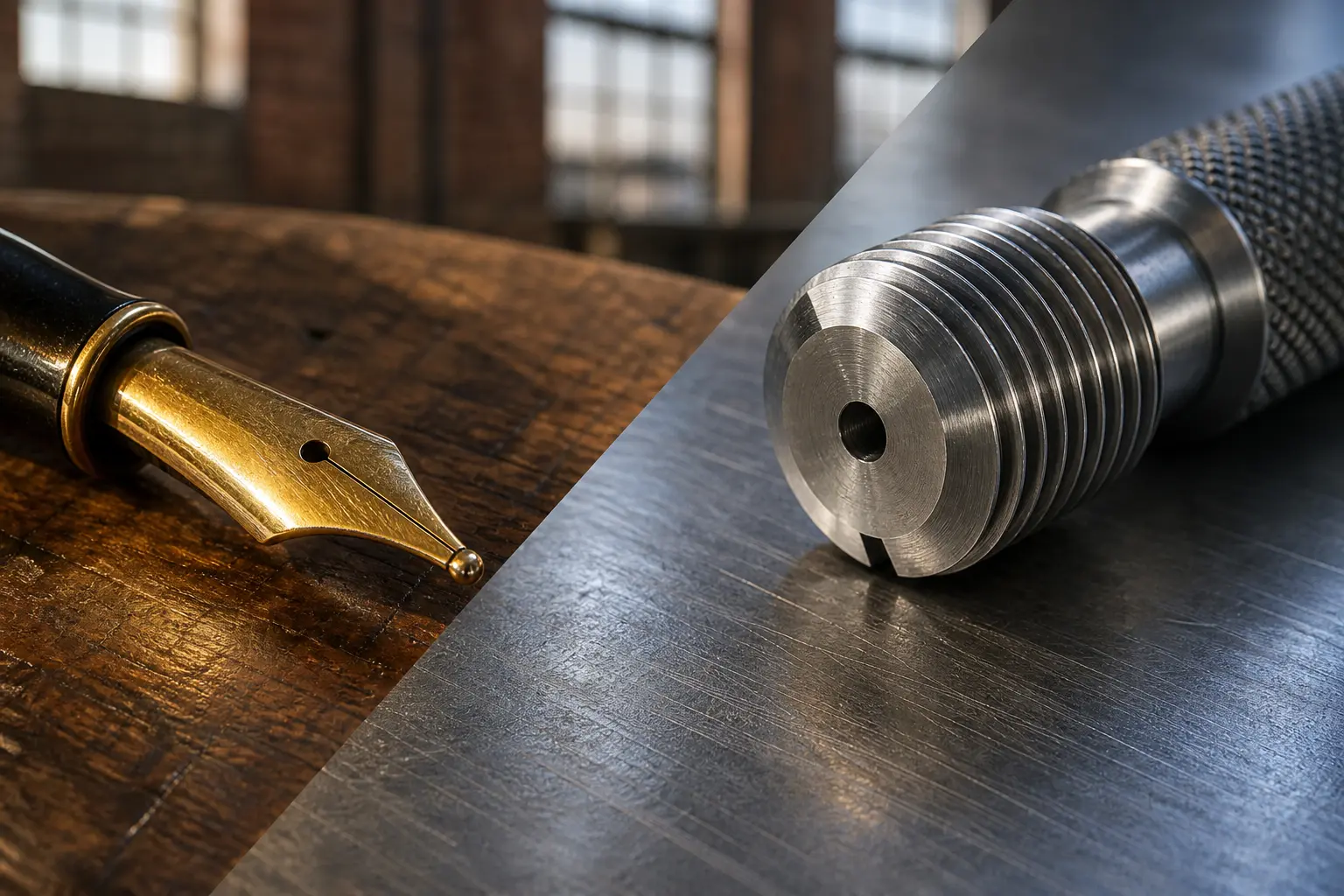
Morse’s gold-plating know-how led him to fountain pen nibs, the metal tip that touches the paper. Gold-plated nibs write smoother than plain metal ones. His company started plating nibs, then making them, then assembling entire pens. The result was the Morse Flo-Ball, marketed nationwide in the late 1940s and early 1950s as a status object with a gold-plated ball tip.
It sold for $10, about $125 in today’s dollars, with cheaper versions starting near $4. Many ended up in bank lobbies on gold chains. Morse kept enough gold on hand that he built a room-sized vault into the plant, with walls and a ceiling 24 to 36 inches thick, and bought the vault door itself from Henry Ford, who had used it at his Fairlane Estate in Dearborn.
A Ten-Cent Pen Ends an Era
The pen business was healthy until a French fountain pen salesman named Marcel Bich spent years developing a cheap, reliable stainless-steel nib and a new ink formula. In 1950 he launched the BIC Crystal ballpoint pen. It was disposable, consistent and a fraction of the cost of anything Morse or his competitors made.
The writing instrument industry did not adjust to the ballpoint. It got replaced by it. Luxury nib makers built their entire businesses on an assumption, that people would keep paying for a smoother, fancier way to put ink on paper, and the BIC Crystal broke that assumption in a single product launch.
A Korean War Contract Rewrites the Company’s Future
What saved Morse’s company was a contract that had nothing to do with pens. During the Korean War, from 1950 to 1953, the H.E. Morse Co. began making thread plug gages for the government, the tools that let mass production work at all.
Interchangeable parts require constant checking. A bolt made on one machine has to fit a nut made on a different machine, on a different day, without hand-fitting. Gages are how a factory floor verifies that. The idea traces back further than Henry Ford’s assembly line, through Eli Whitney’s 1798 musket contract and refinements at Harper’s Ferry, but Ford’s mass production is what made demand for precise, repeatable gaging explode.
Morse had to adapt his gold-plating process into chrome-plating, a harder technical problem because chrome is thicker than gold and thread gages need tighter tolerances than pen nibs. He solved it, and the result was a gage that lasted longer than what competitors were making. That single technology transfer, precision plating built for a luxury pen redirected into an industrial measuring tool, is the hinge the entire company still turns on.
The process today still runs on the same logic Morse worked out:
- Cut cylindrical steel stock into smaller blanks.
- Rough out the basic shape.
- Heat treat the steel so it holds size and resists wear.
- Grind the thread grooves into the surface.
- Lap the piece to refine the finish and final dimension.
- Chrome-plate it for hardness and a more lubricious surface.
Morse kept making pens through the 1950s while gages grew alongside them. He received several patents between 1951 and 1955 for pen components, including an ink cartridge design, using the law firm Burton and Parker, whose founders had once successfully defended Henry Ford in a patent fight over automobile engines. But demand for a longer-lasting gage, combined with BIC’s dominance of the pen market, eventually crowded out the pen side entirely. Morse won the local Free Enterprise Award as manufacturer of the year in 1961. He died of a heart attack in his office in 1967. By then the company’s identity had already shifted for good.
From Pen Nibs to SpaceX Tolerances
The gage business kept expanding after Morse’s death. In the 1970s, the American Petroleum Institute licensed the company to make master gages, a narrow and selective credential inside a much larger system. The API’s monogram program overall recognizes more than 4,300 organizations in 75 countries, which makes a two-company master-gage niche inside it genuinely rare. The company also began offering calibration services after the International Organization for Standardization set new global standards.
Larry Wysong, an engineer who had worked at Detroit Diesel before moving into Wall Street finance, bought the company and the Hemco Gage name from the Morse family in 1977. His son Chris joined as a materials manager in 1995; his daughter Renee focused on the family’s separate real estate holdings. The family added a precision machining and thermal spraying company, Plasma-Tec, in 1999. Chris became president of Hemco Gage in 2005, and he and Renee became minority co-owners in 2007. Between 2019 and 2020, the family sold off Plasma-Tec and the real estate business, leaving Renee Wilson and Chris Wysong as owners of Hemco Gage alone.
Who Actually Buys a Hemco Gage?
Hemco Gage sells small, customized batches of gages rather than mass runs, moving them through manufacturers’ representatives across the northern United States and Canada and directly to calibration laboratories. That is a specific answer to a specific question: aerospace, energy, medical device and heavy equipment makers who need a part checked to a tolerance most consumers never think about, sometimes to a hundred-thousandth of an inch.
| Industry | Example Customer | What Gets Checked |
|---|---|---|
| Aerospace | SpaceX | Dimensional tolerances on flight hardware components |
| Energy | Baker Hughes | Threaded oilfield equipment under API standards |
| Medical devices | Medtronic, Stryker Medical | Implant and surgical instrument tolerances |
| Heavy equipment and agriculture | Caterpillar, John Deere | Engine and hydraulic threaded components |
| Powersports and automotive | Harley-Davidson | Drivetrain and fastener threads |
Calibration and re-plating services now make up about 15% of Hemco Gage’s revenue, on top of the gage sales themselves. Competitors tend to specialize in high volumes of a narrow product line. Hemco Gage does the opposite, running small lots of customized feature gages, a niche that has kept it relevant to industries with wildly different parts but the same need: proof that a machine is still cutting to spec.
Behind the Gage, a Machinist Shortage Closes In
None of this work happens without people who can run the equipment, and that supply is shrinking. The trade Henry Morse’s chrome-plating breakthrough depends on, skilled machinists and toolmakers, is aging out faster than it is being replaced.
- 462,000 open manufacturing jobs across the United States as of March 2026, based on Bureau of Labor Statistics figures.
- 34,200 machinist and tool-and-die-maker openings projected every year through 2034.
- 2.1 million manufacturing jobs could go unfilled by 2030, according to Deloitte and The Manufacturing Institute.
Those numbers come from an industry analysis of the 2026 CNC machinist hiring crisis, and they land hardest on exactly the kind of work Hemco Gage does: small-batch, high-tolerance machining that cannot be filled by an unskilled hire on day one. West Michigan’s manufacturing base gives the region some cushion. The area counts 61 of the state’s 100 automotive suppliers and more industrial and mechanical engineers than any other state, but a deep regional bench does not fix an aging one.
Tariffs and Reshoring Point Back to Holland
There is a tailwind pulling the other direction. U.S. companies announced 244,000 reshoring and foreign direct investment jobs in 2024, the Reshoring Initiative’s own 2024 annual report on reshoring and FDI found, part of more than two million such jobs announced since 2010. Early 2025 projections dipped before settling near 240,000 for the year, as tariff policy pushed more companies to weigh bringing production home.
The U.S. can’t count on tariffs alone to restore its industrial leadership. It must level the cost playing field and build a skilled workforce to truly compete and win globally.
Harry Moser, president of the Reshoring Initiative, said that as the group tracked rising tariff pressure alongside a shrinking pool of qualified workers. He carried the same argument to Congress that November, when he testified before the House Committee on Small Business on reviving domestic manufacturing.
Hemco Gage has already run this exact playbook once, trading a dying consumer product for an unglamorous industrial tool nobody outside a machine shop thinks about. Eighty years after Henry Morse bought land next to a boat factory, the same building is still making the small steel parts that tell every other factory whether its machines are still telling the truth.
Frequently Asked Questions
What is a go/no-go gage?
Most thread and cylindrical gages have two ends. The go end has to fit into or over the part being tested; the no-go end is not supposed to fit. If both ends behave as designed, the part is within tolerance. It is a pass-fail check, not a precise measurement, which is why hard gages remain faster on a factory floor than a full digital scan for routine production checks.
What does it actually take to hold an API monogram license?
A manufacturer has to run a quality management system compliant with API Spec Q1 for at least four months before applying, document that system in a quality manual, and pass an on-site audit of both its processes and product designs. Licenses are renewed through follow-up audits roughly every three years, and API can suspend a license if a facility’s manufacturing capability slips.
Are fountain pens still made today?
Yes, though as a much smaller category than in Henry Morse’s era. Fountain pens survive mainly as a luxury and collector’s niche rather than the everyday business accessory they were before the ballpoint pen, largely produced now for buyers who want the writing experience rather than convenience.
How bad is the machinist shortage right now?
Beyond the national job-opening figures, staffing data shows more than half of manufacturers report difficulty hiring qualified CNC operators, and the median age of a CNC machine operator in the U.S. is now 55. That combination, an aging workforce and a thin pipeline behind it, is what makes replacement harder than the raw job-opening numbers alone suggest.