Google unveiled Googlebook on May 12, 2026, at the Android Show: I/O Edition, fifteen years and a day after the first Chromebook shipped, and pitched it as the first laptop platform purpose-built for Gemini Intelligence, the AI layer the company now wraps around every premium Android device. Google’s Googlebook announcement post confirmed Acer, ASUS, Dell, HP, and Lenovo as launch partners, chips from Intel, Qualcomm, and MediaTek inside the lineup, and a fall 2026 ship date.
The pitch lands cleanly in a keynote slide. The problem starts when you put two silicon architectures, three chip vendors, one unreleased operating system, and a rumored thousand-dollar starting price into the same product line and ask Gemini to feel identical on every unit.
What Google Showed on May 12
The Googlebook proposition rests on three Gemini Intelligence features showcased at the keynote, each pitched as native to the operating system rather than bolted on through a chatbot window. The same Gemini Intelligence layer that Google extended across phones, watches, and cars at the event also forms the foundation of the laptop experience, a continuity argument our earlier piece on the Android AI rollout traced in detail.
- Magic Pointer, built with Google DeepMind, surfaces contextual suggestions when the cursor wiggles over a screen element. Examples shown on stage included pulling a meeting date out of a Gmail thread and simulating a sofa inside a room photograph.
- Create your Widget assembles a personalized dashboard on demand, drawing from Gmail, Google Calendar, and the open web.
- Quick Access pulls files from a paired Android phone into the laptop session without a transfer step.
Acer, ASUS, Dell, HP, and Lenovo are confirmed launch partners. The first devices arrive in fall 2026. Each unit carries what Google’s marketing calls a glowbar, a lighting element the company described as both functional and aesthetic without sharing a working spec. Pricing was the conspicuous absence on stage; trade press reporting after the show put the starting price around a thousand dollars, a number Google itself never stamped on any slide.
The Multi-Chip Bet Has Two Architectures and Three Vendors
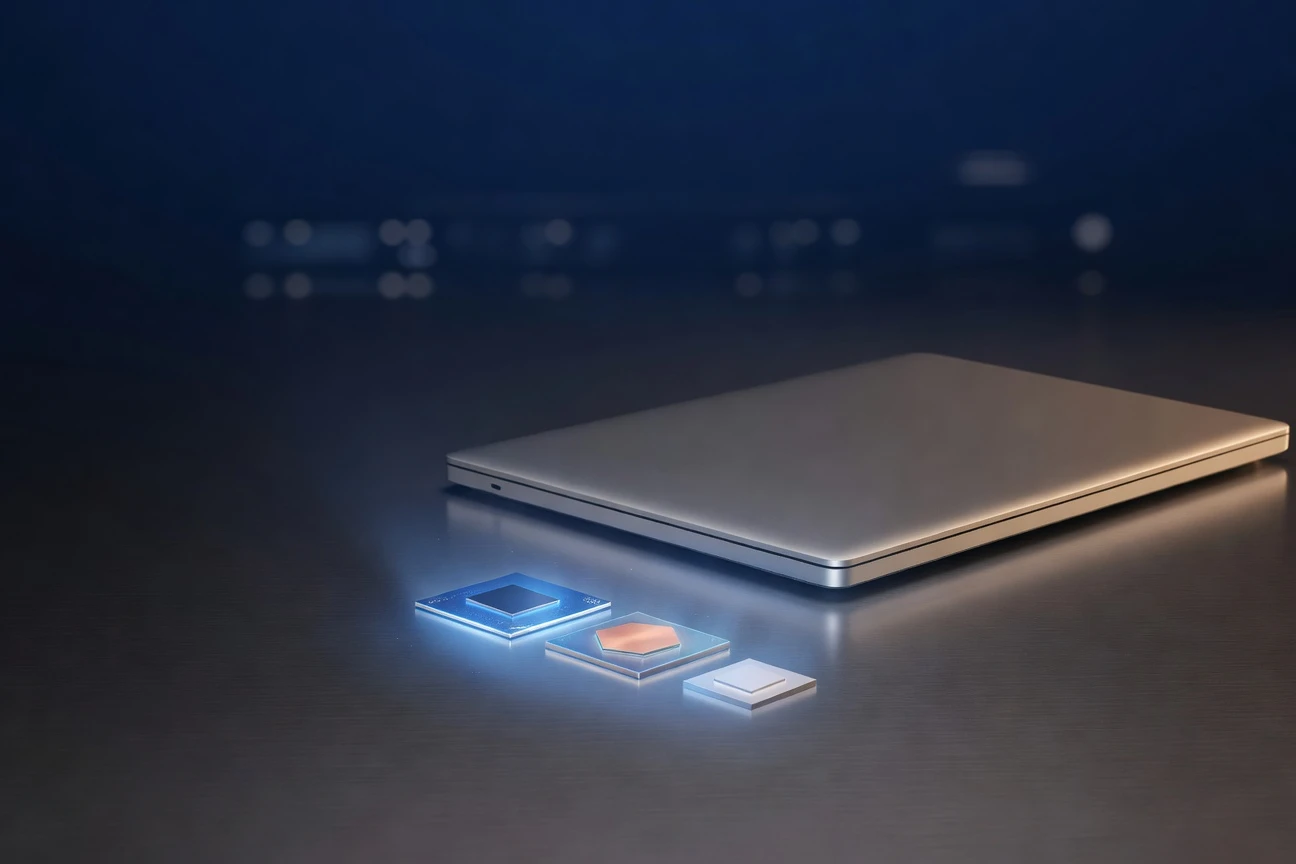
Apple ships a single silicon family across its consumer line. Google does not. Googlebook will use Intel for x86, Qualcomm for ARM, and MediaTek for the budget ARM tier, two different silicon architectures from three chip vendors that do not share an instruction set, a neural processor design, or a unified driver model. All three are expected to feed one Gemini layer.
The published NPU (neural processing unit, the on-chip accelerator that handles AI math) ceilings on the launch silicon tell the gap story:
- 40 TOPS combined from Intel’s entry-level Wildcat Lake chips, totalled across NPU, CPU, and GPU rather than on a single dedicated block.
- 45 TOPS from the NPU alone on the Qualcomm Snapdragon X Plus, per Qualcomm’s Snapdragon X Plus product brief.
- No published NPU spec for the MediaTek budget ARM tier that powered prior entry-level Chromebooks.
The five-point gap between Intel’s 40 TOPS and Qualcomm’s 45 TOPS sounds narrow on paper. The architecture beneath those numbers is not. Qualcomm’s figure comes from a dedicated Hexagon NPU on a single die; Intel’s comes from work spread across NPU, CPU, and GPU, which trades efficiency for total throughput. Localized AI workloads behave very differently on a unified NPU than on a split pipeline, and battery life follows the gap.
MediaTek occupies the unknown tier. Its budget ARM chips powered ChromeOS Plus tablets and entry-level Chromebooks through 2024 and 2025, and they lack a published NPU spec that lines up with the Snapdragon ceiling. Google’s stated answer is to either keep flagship Gemini features confined to higher-priced SKUs or offload them to the cloud on cheaper ones, which introduces latency. Neither path is the unified Gemini promise the keynote made.
Apple’s Single-Silicon Glue Holds
Apple’s cross-device handoff works because every consumer Apple device runs the same ARM family, from the iPhone 17 Pro to the M5 MacBook Air to the new MacBook Neo. Same instruction set, same memory model, same Neural Engine block. A clipboard copied on the phone lands on the laptop with no translation layer; an iMessage thread keeps state because both endpoints speak the same silicon. Copy a string on the iPhone, paste it on the Mac without thinking about which device is which; that is the experience Google is trying to replicate, and it works on Apple devices because Apple controls every chip in the loop.
Googlebook has chosen the harder version of the same idea. The platform is supposed to deliver phone-to-laptop file pickup, app continuity, and Gemini context handoff, but the laptop end will sometimes be x86 and sometimes ARM, talking to an Android phone that is always ARM. Engineering around that gap is not impossible. The Windows on ARM emulation project has spent half a decade trying, with app compatibility still treated as a moving target rather than a closed problem, and Microsoft holds more direct influence over Qualcomm’s roadmap than Google has demonstrated across three vendors at once.
The $599 Floor Google Has to Clear
Apple priced the cheap Mac at $599 in March 2026. Apple’s MacBook Neo launch newsroom page details the A18 Pro silicon proven across two iPhone generations, the aluminum chassis, and a 13-inch Liquid Retina panel at 2,408 by 1,506 pixels. Education buyers pay $499. The launch ran pre-orders from March 4 to the March 11 in-store date, and early reviews called it a category disruption in the affordable-laptop tier.
That number is not a competitor to Googlebook on the spec sheet, since Google’s launch is still five to six months out. It is a competitor in the buying-decision sense. Anyone weighing a thousand-dollar Googlebook this fall will sit beside an Apple machine already on shelves, and the question ‘what does the extra four hundred dollars buy me’ has to land an answer better than ‘unproven AI features.’
| Competitor | Price | Strength | Googlebook’s vulnerability |
|---|---|---|---|
| Apple MacBook Neo | $599 | Sub-$600 price disruption, unified A18 Pro silicon family | Googlebook rumored at $1,000, nearly double for unproven AI |
| Apple MacBook Air (M5) | $1,099 | Years of proven performance, legendary battery efficiency, mature ecosystem | At the same price band, Google asks buyers to skip a proven benchmark for a new platform |
| Microsoft Copilot+ PCs | ~$1,000 | Deep enterprise roots, established Windows ecosystem, mature desktop productivity | Googlebook relies heavily on Android apps blown up on a desktop environment |
Microsoft’s Copilot+ PC line sits in the same thousand-dollar zone Google’s pricing now lives in. Those machines have been on shelves since 2024, with Snapdragon X Elite or X Plus chips, Windows on ARM, and a longer roster of working AI features than Google has demonstrated. The compatibility ceiling for x86 apps under Windows on ARM is still a public hurdle, but Windows install base, enterprise procurement workflows, and Office integration are advantages Googlebook will not match by the fall ship date.
The squeeze is structural. At $599, Apple takes the cost-disciplined buyer. At $1,099, Apple takes the buyer who wants a mature platform with five years of MacBook Air iteration behind it. At roughly a thousand dollars, Microsoft takes the buyer who needs Windows compatibility and enterprise IT support.
Googlebook arrives in the seam that is left, which is buyers who want Android continuity on a laptop screen and trust Google to deliver Gemini Intelligence consistently across three chip vendors before any of the rivals close their own AI gaps.
Chromebooks Already Showed How This Goes Wrong
When ChromeOS added Android app support on Intel-based Chromebooks in 2017, the experience landed rough. Apps that ran clean on a phone burned battery on the laptop, dropped frames during scroll, and in some cases refused to install. Google smoothed the worst edges over multiple updates, but the underlying architecture mismatch between Android’s ARM-first runtime and Intel x86 silicon never went fully away. It just became less visible.
- Accelerated battery drain on Intel Chromebooks running Android apps
- Frame drops and input latency on touch-driven Android workflows
- Installation refusals on a non-trivial share of Play Store titles
- Inconsistent file system behaviour between the ChromeOS layer and the Android container
Googlebook is being asked to repeat that experiment under heavier load. Where Chromebooks ran Android apps for compatibility, Googlebooks will run them as the native experience, with Gemini Intelligence as the binding layer that demands tight silicon access to behave responsively. The performance failure mode is now the product’s headline feature.
Multiply that by three chip vendors with non-uniform NPUs and the version-skew problem is structurally bigger. A buyer holding a MediaTek-powered Acer next to a Snapdragon-powered Lenovo could see Magic Pointer behave one way on one device and another way on the other. Google’s only defenses are aggressive minimum hardware requirements per OEM partner, or cloud offload that ships latency to the user.
The Aluminium OS Leak Showed an Empty Shell
Hours before the keynote, a 16-minute hands-on video of Aluminium OS, the internal codename for the Googlebook operating system, leaked through a Telegram-based aggregator and an associated YouTube channel. The footage showed an Android 17 build carrying a May 2026 security patch, running inside a UTM virtual machine on an M4 Pro MacBook Pro. The desktop shell looked finished. The Gemini layer that anchors the entire keynote was not in the build.
No Magic Pointer. No Create your Widget. No Quick Access. The desktop environment looked like a polished take on Samsung’s DeX phone-to-desktop mode, with web wrappers around Google’s first-party apps and no keyboard or mouse optimization beyond what a phone in desktop mode already does.
The leaker called the current Aluminium OS experience an upgraded version of Samsung DeX instead of an actual desktop-class operating system.
That phrasing came from the leaker’s own write-up posted alongside the video, and it matches what reviewers familiar with DeX have said for years: the launcher works, the window manager works, the productivity layer above the launcher is the part that still needs writing. Google can fairly argue that a pre-release build inside a virtual machine is not a fair benchmark for what ships in October. The argument cuts both ways. The same logic concedes that the AI layer the entire keynote was built around is not yet functional on the operating system the laptops will run, and only two engineering quarters separate the leaked build from a retail launch.
The Chromebook Line Doesn’t Just Disappear
Google has committed to continued Chromebook and Chromebook Plus development through 2027, with existing devices receiving updates for their promised support windows. Some Chromebooks will be eligible for a firmware-level transition into the Googlebook software stack; others will not. Buyers walking into a Best Buy this October will see new Chromebooks next to new Googlebooks next to the existing MacBook Neo, all in overlapping price bands, with Gemini branding on two of Google’s product lines and Android branding on one.
If Google can hold Gemini Intelligence to a consistent floor across Intel, Qualcomm, and MediaTek silicon by the fall ship date, and if it can price Googlebook close enough to the rival aluminum machine that the AI premium reads as fair rather than steep, the second laptop bet stands a chance of working where the first one barely did. If either condition slips, the buyer who shrugged at the keynote will reach for the $599 Apple device already on the shelf.