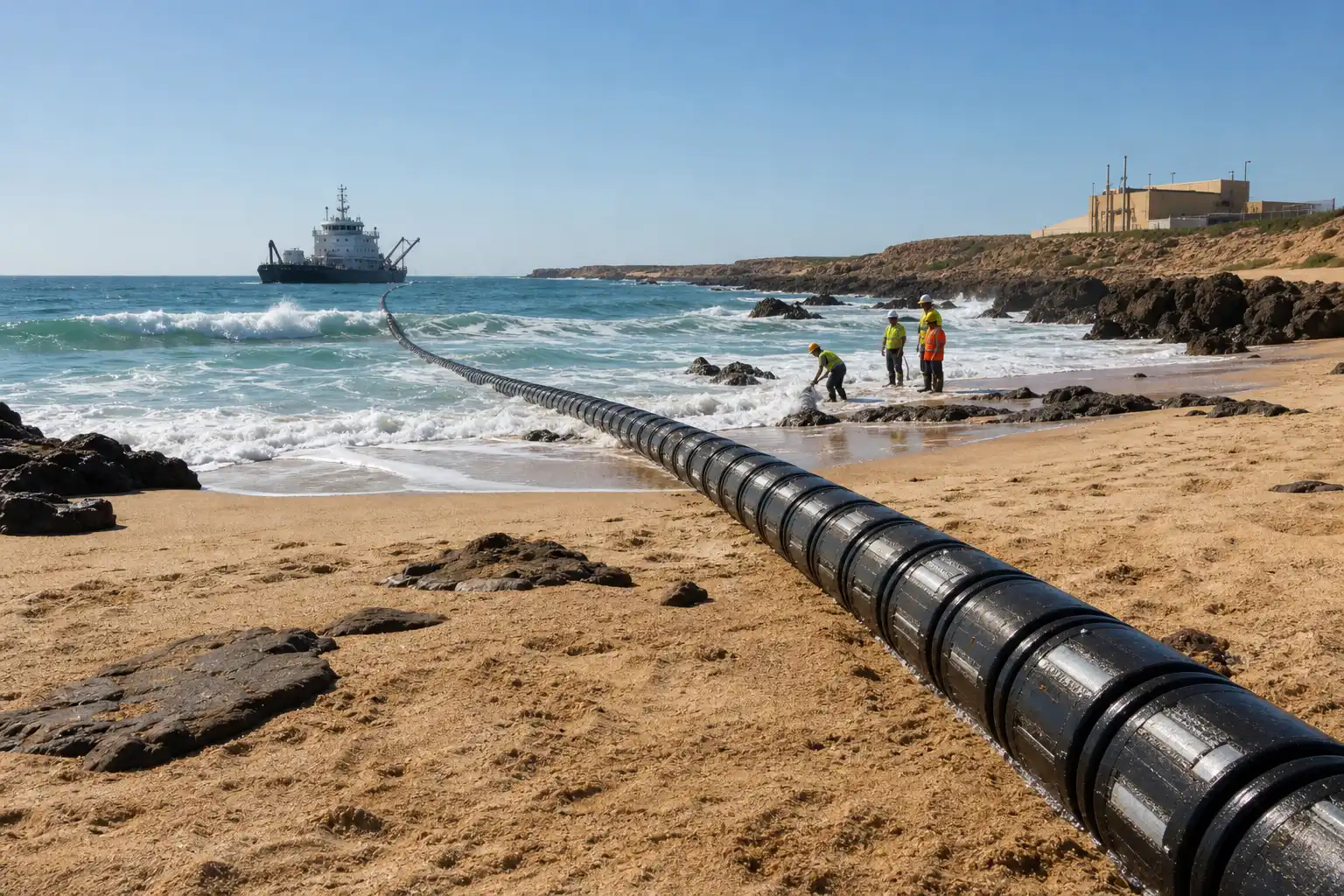
Google switched on a new subsea cable linking Portugal to the United States on Tuesday, its fourth major intercontinental line to reach the same stretch of Atlantic coast. The cable, named Nuvem after the Portuguese word for cloud, runs roughly 7,000 kilometers (4,350 miles) from Sines to Myrtle Beach, South Carolina, by way of Bermuda and the Azores. It carries 16 fiber pairs built for a combined 384 terabits per second.
Portugal’s government is calling the project a win for European digital sovereignty. The cable, and the AI data campus it feeds a few miles inland, are financed and owned entirely by American companies.
A Cable With Exactly One Owner
Nuvem is not a shared asset in the way older transatlantic systems were built. According to regulatory filings, the system is controlled by Starfish Infrastructure Inc., a wholly owned subsidiary of Google LLC incorporated in Delaware, with the segment running through international waters held by a Singapore-based affiliate called Sea Fan Singapore Infrastructure. Google paid for the cable, designed it, and will run it alone.
That is a break from how the industry worked for decades. Microsoft’s MAREA cable, which crosses the Atlantic to Spain, is jointly owned with Meta and the Spanish carrier Telxius under what the industry calls an “Open Cable System,” built so several companies could split both the cost and the capacity. Nuvem skips that arrangement entirely.
The system also gives Bermuda its first-ever direct transatlantic fiber connection and adds a branch to São Miguel in the Azores, turning a mid-Atlantic stopover into a permanent node between three continents.
What we know:
- Nuvem spans about 7,000 kilometers between Sines and Myrtle Beach, with branches to Bermuda and the Azores.
- The system carries 16 fiber pairs rated at roughly 24 terabits per second each, for a combined design capacity near 384 terabits per second.
- Google, through Starfish Infrastructure, holds full ownership of the cable’s U.S. segment, according to regulatory filings.
What’s unconfirmed:
- The exact date Nuvem enters commercial service. Industry trackers point to the second half of 2026, but Google has not confirmed a fixed date.
- How much of the cable’s total capacity Google plans to keep for its own cloud and AI operations versus sell or lease to other carriers.
Neither question is trivial. Both determine how much of this new pipe actually reaches European businesses that aren’t Google.
How Four Companies Took Over the Ocean Floor
Nuvem is one entry in a much longer list. Industry trackers cited by PYMNTS and The Register count Google as a part or sole owner of around 33 subsea cables worldwide, more than any telecom carrier on the planet. Meta holds stakes in more than a dozen, Microsoft has interests in about five, and Amazon has four, including its first fully independent project, a Maryland-to-Ireland system called Fastnet.
Ten years ago, none of that was true. Subsea cables were built by consortiums of telecom operators and state-linked carriers who split both the cost and the risk. International capacity deployed by content networks nearly quadrupled between 2019 and 2023, reaching 3.6 petabits per second, as the same handful of cloud companies began financing the pipes that carry their own traffic.
| Company | Subsea Cables Owned or Part-Owned | Notable System |
|---|---|---|
| Around 33 | Nuvem (Portugal-US); Equiano (Portugal-South Africa) | |
| Meta | More than a dozen | 2Africa; the $10 billion Waterworth system announced in 2025 |
| Microsoft | About 5 | MAREA, co-owned with Meta and Telxius |
| Amazon | 4 | Fastnet, Maryland to Ireland, due by 2028 |
The same instinct now shows up one layer up the stack, in chips. Alphabet’s OpenAI relationship has already started tapping Google’s own processors for training capacity, another case of a hyperscaler choosing to own the layer beneath its product rather than buy it from someone else. The cable business and the chip business are the same bet, made twice.
A $10 Billion Campus Waits Inland
About 90 kilometers inland from where Nuvem comes ashore sits Start Campus, a 1.2-gigawatt data center development built on the site of a decommissioned coal plant. Microsoft’s vice chair and president, Brad Smith, announced during Lisbon’s Web Summit in November 2025 that Microsoft would invest $10 billion in the campus, one of the company’s largest single commitments anywhere in Europe. Start Campus welcomed Microsoft’s announcement to invest $10 billion in the SINES data campus.
Nscale, the AI infrastructure firm that builds out the site alongside Microsoft, added to that in May 2026 with a further €695 million ($812.6 million) investment covering shared infrastructure and a new 200-megawatt building, on top of an earlier deployment of more than 12,600 Nvidia chips. Nscale committed to delivering more than 66,000 Nvidia Rubin GPUs to the site starting in late 2027.
Building on a proven foundation, the expanded deployment in Sines, Portugal, creates one of the most advanced environments in Europe for high-density AI infrastructure.
Josh Payne, Nscale’s founder and chief executive, said that in announcing the deal.
- $10 billion: Microsoft’s committed investment in Start Campus, announced in November 2025.
- 1.2 gigawatts: the planned capacity of the full six-building campus once construction finishes.
- €8.5 billion (about $9.9 billion): the estimated total build cost, which developers told New Project Media would make it Portugal’s largest-ever single foreign direct investment.
- Zero: the campus’s target water-usage score, reached by cooling with seawater pulled through pipes left behind by the coal plant it replaced.
The campus draws that seawater from the Atlantic and returns it about one degree warmer, reusing infrastructure nobody had to build from scratch.
Does an American-Owned Cable Count as European Sovereignty?
Portugal’s State Reform and Innovation Minister, Gonçalo Matias, says Nuvem strengthens Europe’s digital resilience and sovereignty. Yet the cable is entirely American-owned, the campus it feeds is backed by American capital, and the European Union is separately trying to cut its reliance on the same handful of companies for cloud services.
At the landing ceremony in Sines, Matias said, “Portugal is becoming what geography always invited us to be,” framing the country as the meeting point of Europe, Africa and the Americas. Giorgia Abeltino, Google Cloud’s head of government affairs and public policy for Europe, the Middle East and Africa, described Nuvem as part of a broader push to invest in the physical infrastructure behind the digital economy.
Brussels’ posture toward Google is not simple gratitude. EU regulators ordered changes to how Android surfaces AI rivals just months before this cable landed, even as national governments courted the same company’s infrastructure money. American hyperscalers currently account for roughly 70 percent of European cloud infrastructure revenue, a dependence the EU has tried to chip away at through its own sovereign cloud contracts.
Washington treats cable ownership as a security question the moment the country on the other end isn’t an ally.
So we’re taking actions right now to make it difficult or effectively prohibiting the ability to connect undersea cables directly from the U.S. to a foreign adversary nation.
Brendan Carr, chair of the Federal Communications Commission, told CNBC, describing the agency’s tightened rules on foreign-built subsea infrastructure. Portugal’s ministers are applying a friendlier label to the same kind of dependency the FCC treats as a risk when the supplier isn’t American.
Cheap Renewable Power Sealed the Deal
None of this happens without electricity, and Portugal’s pitch rests on having more of it, cheaper, than its rivals. Renewables supplied 87.5 percent of the country’s electricity in 2024, according to Eurostat, the EU’s statistics office, the same year Start Campus’s first building came online.
Start Campus locked in its 1.2-gigawatt grid connection early, before Europe’s queue of data center projects grew long enough for regulators to intervene elsewhere. Denmark’s grid operator, Energinet, paused new connections after demand overwhelmed a system with only 398 megawatts of total data center capacity nationwide, The Next Web reported. In April, OpenAI paused its Stargate project in the United Kingdom, citing electricity prices it said ran roughly four times higher than in the United States.
| Cable | Links Sines To | Length | Design Capacity | Status |
|---|---|---|---|---|
| Nuvem | Myrtle Beach, US (via Bermuda, Azores) | ~7,000 km | ~384 Tbps | Landed July 2026; service targeted for second half of 2026 |
| Equiano | South Africa (via West Africa) | ~15,000 km | ~144 Tbps | In service |
Sines already carries EllaLink’s cable to Brazil, and Nuvem lands there this year. Reporting from DataCenter Dynamics lists Medusa, Olisipo and a New CAM Ring among the systems still to come, adding to a stretch of coastline that a coal plant used to power on its own.
Frequently Asked Questions
Why did Google land Nuvem in Myrtle Beach instead of a bigger US hub?
Google steered Nuvem away from the traditional landing hubs in New York, New Jersey and Virginia Beach, which are already congested with older systems, and chose Myrtle Beach’s DC BLOX landing station instead, turning the South Carolina coast into a new international gateway for future cables too.
What does Nuvem’s 384 terabits per second design capacity actually mean?
That figure is the cable’s theoretical maximum once every fiber pair is fully lit. Each of Nuvem’s 16 pairs is rated for about 24 terabits per second, and operators typically activate capacity in stages tied to demand rather than switching on the full total at once, which is one reason Google hasn’t said how much will be live at launch.
What other subsea cables are tech giants building right now?
Amazon Web Services is building Fastnet, its first fully independent cable, running from Maryland to Ireland at over 320 terabits per second and due in service by 2028. Microsoft has filed plans for cables between Ireland and Wales, and Meta announced a $10 billion round-the-world system called Waterworth in February 2025.
How much additional renewable power is Portugal lining up for data centers?
More than 2.6 gigawatts of new hydro, solar and wind capacity are under development in Portugal on top of what already feeds the grid, positioning the country to keep supplying power-hungry campuses like Sines as they expand through the rest of the decade.
What other subsea cables are planned for Sines?
Beyond EllaLink and Nuvem, industry reporting points to Medusa, the New CAM Ring and Olisipo as additional systems set to land at Sines in the coming years, adding to a cluster that is turning the former coal town into one of Europe’s busiest cable landing points.