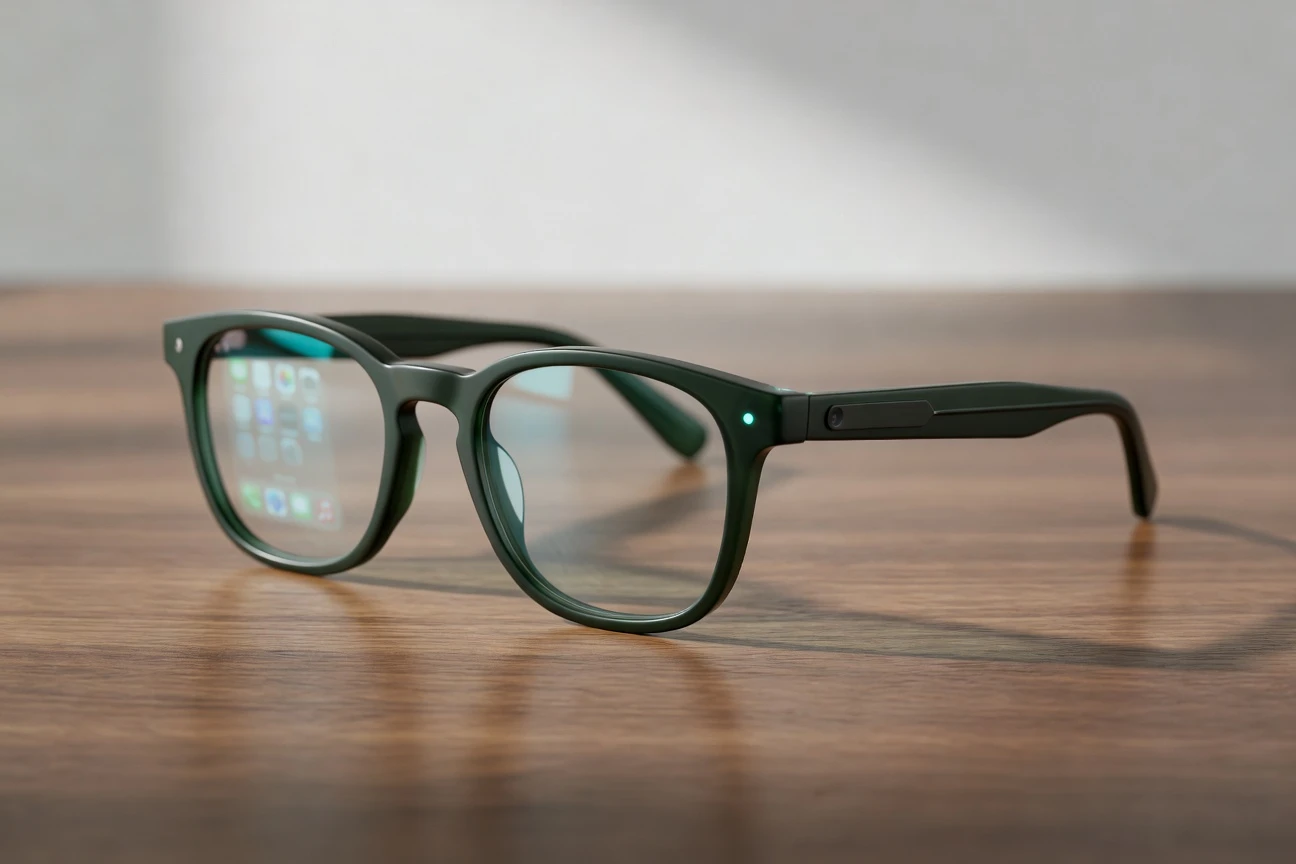
Google opened its developer keynote in Mountain View on Tuesday with a product that is supposed to slip onto a face, not draw attention to itself. The audio glasses unveiled at Google I/O 2026, built on Android XR (Google’s extended-reality operating system, jointly developed with Samsung Electronics and chipmaker Qualcomm), arrive in fall through fashion partners Gentle Monster and Warby Parker. They have no display. They have a microphone, a speaker, a camera, and a permanent line to Gemini, Google’s conversational AI model.
That hardware list is the easy part to cover. The harder story sits underneath: if a wearer can order a coffee, summon a ride, translate a sign, or get walking directions by speaking into the frame, the smartphone app icon, mobile software’s organizing unit since 2008, starts to look optional for an expanding share of tasks.
Google’s Audio Glasses Land This Fall With Premium Fashion Partners
Shahram Izadi, vice president and general manager of XR at Google, walked the I/O audience through two design samples on stage: a black Gentle Monster frame with the South Korean label’s sharper geometry, and a dark green Warby Parker frame in the American retailer’s more conservative shape. Both run Android XR. Both pair with Android and iOS phones. Both ship inside the partners’ full eyewear collections later in the year, not as standalone Google-branded SKUs.
That distribution choice is the headline shift from Google Glass, the 2012 prototype that became the company’s most public hardware embarrassment. The original device looked like a research apparatus and was sold direct as an Explorer Edition for $1,500. The new ones look like glasses people already buy, sold through stores people already walk into. The eyewear partnership template is borrowed wholesale from EssilorLuxottica’s Ray-Ban Meta program, which spent two years proving that fashion distribution is what unlocks the category.
The on-device demonstrations targeted the kind of commodity tasks that today require a phone in hand. Walking directions read out turn by turn, with the wearer’s head free. A photo of a flyer parsed into a calendar entry. A spoken request through the Android XR third-party app SDK placed an order on DoorDash and queued an Uber, with the phone staying in a pocket. Real-time translation handled a Mandarin sentence into English in roughly the latency a polite pause would cover.
| Spec | Audio glasses (fall) | Display glasses (TBD) |
|---|---|---|
| Output | Speaker, no screen | In-lens micro-display |
| Input | Voice, camera, touch temple | Voice, camera, gesture |
| Partners shown | Gentle Monster, Warby Parker | Not announced |
| Platform | Android XR with Gemini | Android XR with Gemini |
| Phone pairing | Android and iOS | Expected Android and iOS |
Google did not announce a price. It also did not commit to a country list beyond “limited markets” for the first launch window. Both omissions are deliberate; the eyewear partners price their own SKUs and control their own retail footprints, which lets Google avoid the inventory exposure that sank the first Glass cycle.
The Voice Layer That Skips the App Icon
For seventeen years the app icon has been the unit of mobile commerce. A user wants coffee, taps a square, sees promotions, browses choices, completes a transaction. Every tap is a discovery surface; every discovery surface is rented out as recommendation slots and paid placements. That entire revenue stack assumes the app gets opened.
The DoorDash demo at I/O bypasses that assumption. The wearer said the order out loud. Gemini composed it. The food provider received the transaction. No icon was tapped, no carousel was scrolled, no promoted listing was viewed. The app remains involved as a back-end, but the consumer-facing real estate that monetizes the app, the icon, the home tab, the upsell carousel, the recommendation rail, never enters the flow.
The voice assistant market that Gartner forecasts at $11.2 billion by year-end, growing at a compound 32% annually since 2021, has until now been bolted to phones and speakers that sit on a counter. Strapped to a face and tied to a model that can chain multi-step actions across third-party services, the same voice layer turns into something else: an interface that competes with the app grid for the user’s first action of the day.
Google’s own Gemini Intelligence rollout across Android, announced two weeks before I/O, was the software half of this push. The glasses are the hardware half. Together they signal a bet that conversational requests will absorb a growing slice of the tasks people currently complete inside individual apps.
Meta Still Owns 72% of the Shelf
Google is not the incumbent in this category. Meta is. Through its EssilorLuxottica partnership, Meta sold more than 7 million Ray-Ban smart glasses in 2025, triple its prior-year sum and a figure that surprised even bullish analysts at Counterpoint and IDC.
The category math from IDC’s most recent XR shipment update reads as follows:
- 72.2% of the global smart-glasses market sat with Meta at the close of last year, supported almost entirely by the Ray-Ban and Oakley product families.
- 14.5 million total XR units shipped in 2025, up 41.6% year on year, with smart glasses crossing half of that mix for the first time.
- 33.5% is the growth IDC forecasts for the broader XR shipment pool this year, with display-equipped glasses expected to gain meaningful share by next year.
- 10 million units is the production target Meta and EssilorLuxottica have set for this year, with capacity provisioning extending toward 20 million to 30 million if demand holds.
Google is therefore arriving roughly two product cycles behind. Mark Zuckerberg’s appearance at the Met Gala two weeks ago, alongside reporting of EssilorLuxottica’s broader luxury push, signaled that Meta is busy widening its fashion bench beyond Ray-Ban. The competitive vector for Google is not first-mover advantage. It is software depth: the partner roster that Android XR can plug into is structurally larger than what Meta’s closed stack reaches today.
What an Eyewear Era Costs the App Developer Economy
If the glasses-plus-voice combination becomes routine, the entities exposed are not phone makers. They are the companies whose business depends on the user’s attention being inside an app long enough to monetize it.
The categories most directly in the firing line:
- Recommendation-driven marketplaces. DoorDash, Uber Eats, Instacart, Amazon Fresh. The promoted-placement business inside these apps relies on the consumer scrolling. A voice order routes around the carousel entirely.
- Ride-share and travel apps. Uber’s surge pricing, Lyft’s loyalty prompts, Booking.com’s urgency banners all assume the user is reading a screen. Spoken “book me the next flight to Chicago” demotes those layers to back-end pricing logic.
- Ad-supported utility apps. Weather, navigation, calculator, currency converter; categories that monetize via banner inventory. Asking the glasses removes the banner.
- Discovery-led publishers. News aggregators, content recommenders, podcast directories. A wearer who asks Gemini “what’s happening with the Reeves Budget today” gets the answer without ever loading a publication.
The counter-case is real and worth weighing. Subscription apps, which now account for the bulk of mobile spend (RevenueCat data shows apps launched before 2020 still generate 69% of subscription revenue), are insulated; their value is in software a user already paid for. Banking, healthcare, and identity apps remain anchored to screens for compliance and authentication reasons. Many of the demos Google ran still required the phone to confirm the transaction. The icon is not dead. It is being thinned.
The Privacy Question That Killed Glass Is Still Open
Both the Google and Meta glasses now include a forward-facing camera. Both can capture photos and short video on a spoken command. The cultural reception to that capability in 2012 was hostile enough to generate the word glasshole; the reception in 2026 is muted by the simple fact that recording in public spaces is now ambient. Doorbell cameras, dashcams, body cameras, and the smartphone in every pocket have already crossed that threshold.
That does not mean the new devices are free of friction. EU regulators have signaled fresh interest in always-on wearable cameras under the AI Act’s emotion-recognition and biometric-processing provisions. UK and German consumer-protection authorities have asked Meta for documentation on the indicator light visibility on the Ray-Ban units; identical questions are likely to land at Google’s door within the launch quarter.
Google’s mitigation, per the I/O documentation, is a hardware capture-indicator LED and an audible chime when the camera engages. Whether those signals carry in a crowded subway car is a question hardware reviewers, not the keynote audience, will answer.
The 2027 Display Glasses and Apple’s Pivot
Audio glasses are the first half of the Android XR roadmap. Display glasses, with an in-lens micro-display capable of overlaying navigation, captions, and Gemini’s visual outputs onto the user’s field of view, are the second half. Google did not give them a 2026 release date. The internal target most commonly cited in supply-chain reporting is 2027.
That timing puts Google on a collision course with Apple. Apple’s own glasses program is now widely reported to be targeting a 2027 launch as well, after the company pulled engineering staff off a planned Vision Pro redesign last October. Apple’s near-term play is reportedly display-less, audio-first, and built around contextual awareness rather than augmented-reality overlays; in other words, the same product Google is putting on shelves in five months.
Apple’s leverage in the category is the install base. With Apple’s 21% global smartphone share in early 2026, the company can pair glasses tightly to the iPhone, the AirPods stack, and the Watch in ways Google’s multi-OEM Android approach cannot match for the highest-value users. Snap, with Wayne Scullino’s recent hire from Apple to lead enterprise partnerships, is moving on the B2B flank. XReal, Viture, Mentra, Even Realities, Solos, and Engo are filling out the specialist niches.
If audio glasses sell at Meta’s run rate through fall and into the holiday quarter, Google’s bet on conversational interfaces gets a year of compounding data before Apple ships a competing wearable. If sales disappoint and Apple’s 2027 launch lands inside a friendlier price band with a tighter ecosystem, the same audio-first thesis becomes Apple’s to own. The next eighteen months decide which company writes the playbook the developer economy has to live inside.