FIFA’s Disciplinary Committee suspended Folarin Balogun’s red-card ban on Sunday and cleared him to face Belgium on Monday, a decision triggered by a phone call from U.S. President Donald Trump to FIFA president Gianni Infantino. The Royal Belgian Football Association says it is ‘astonished,’ has filed an appeal with FIFA, and has won the right to argue its case before kickoff. The ruling’s significance stretches well beyond Monday’s round-of-16 match in Seattle, with coaches from England, Norway, and Portugal, plus UEFA and former FIFA president Sepp Blatter, all spending Sunday night naming what the reversal has now put in play.
FIFA’s move uses Article 27 of the FIFA Disciplinary Code, a clause the committee has applied to red cards in qualifying games but had never used inside a World Cup before Sunday. Trump called Infantino on Thursday and publicly thanked FIFA on Truth Social after the ruling, calling the ban’s reversal ‘a great injustice.’ Belgium’s appeal will be heard by an arbitrator from outside UEFA and CONCACAF, in what The Athletic described as the first time a future opponent has been made a party to a disciplinary case in tournament play.
What FIFA Actually Decided
The ruling arrived Sunday morning through FIFA’s online portal, with U.S. Soccer learning of it at 10:31 a.m. EDT. The committee set the one-year probation at the lowest setting permitted under Article 27. FIFA’s Disciplinary Committee‘s order requires Balogun to start the match Monday night, with the original red card sitting on his record until the probation ends.
Article 27 lets the committee ‘fully or partially suspend the implementation of a disciplinary measure’ and bind it to ‘a probationary period of one to four years.’ The committee, in its Sunday ruling, set a one-year probation and built in a single trigger that returns the one-match ban to Balogun’s record without further process. The committee included no public reasoning for the original reversal beyond its short published notice. U.S. Soccer said it had been ‘engaged’ with FIFA through the deliberations but had not filed a formal appeal. The federation added: ‘We accept the decision of the disciplinary committee and are pleased that Folarin Balogun is eligible to compete tomorrow,’ per FIFA’s Article 27 ruling on Balogun.
If Folarin Balogun commits another infringement of a similar nature and gravity during the probationary period, the suspension shall be revoked and the sanction enforced without prejudice to any additional sanction imposed for the new infringement.
FIFA’s Disciplinary Committee, in its Sunday ruling, framed the trigger without further explanation for the underlying reversal. Argentina’s Nicolás Otamendi and Ecuador’s Moisés Caicedo each had one-match qualifying-stage bans deferred in April, freeing them to play opening games at this World Cup. Cristiano Ronaldo served one match of his three-game November qualifier ban before the committee put the rest on probation. Balogun’s case is the first such invocation at a World Cup finals match, and the first this tournament where the original red card came inside the competition itself.
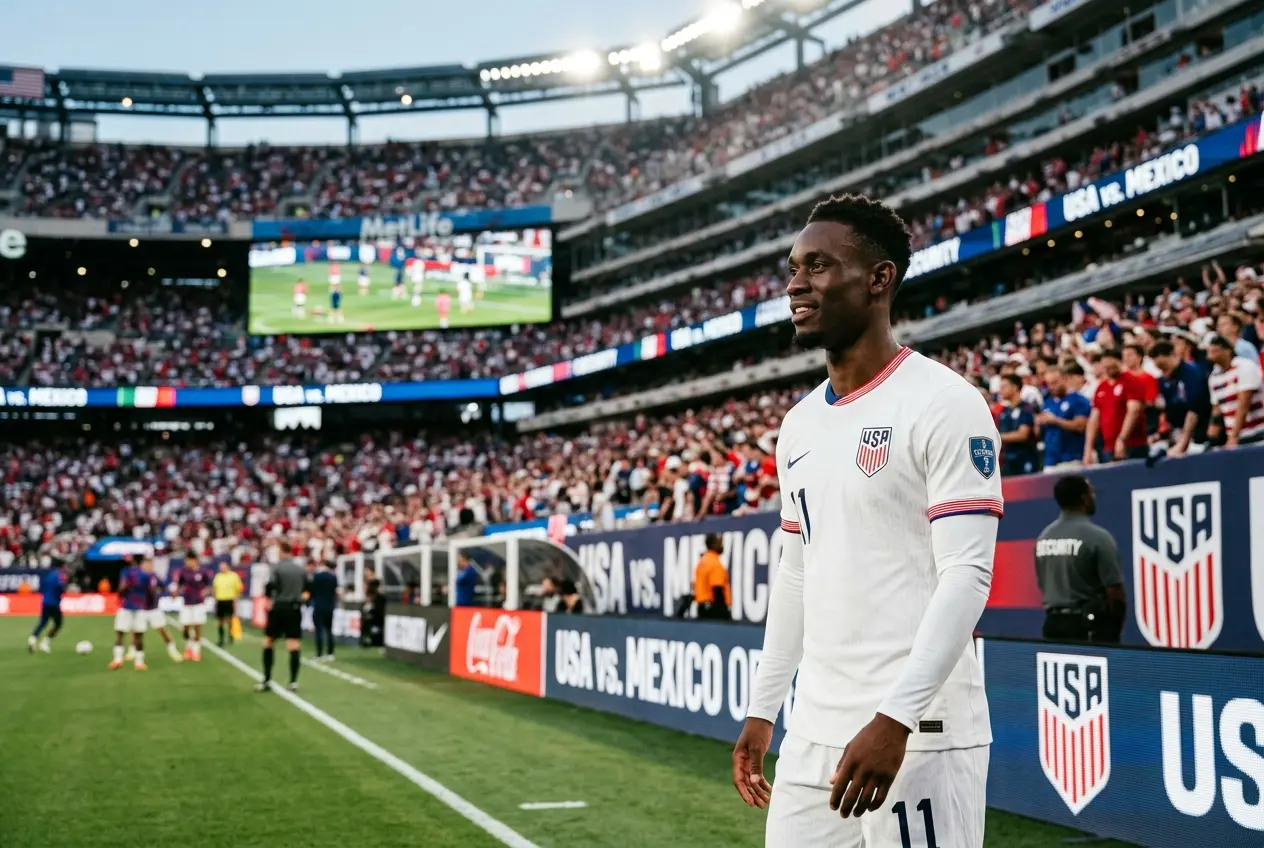
The Phone Call From Washington
U.S. President Donald Trump phoned FIFA president Gianni Infantino last Thursday about Folarin Balogun’s red card, according to a person familiar with the call who spoke on condition of anonymity. Sources later told the Guardian he made three calls in total, beginning the day of the Bosnia match.
The outreach extended past Trump himself. U.S. Commerce Secretary Howard Lutnick and other White House officials also pressed FIFA to revisit the suspension, according to a report citing ABC News sources. After FIFA published Sunday’s ruling, Trump posted on Truth Social: ‘Thank you to FIFA for doing what was right, and reversing a great injustice!’ A spokesperson for U.S. Soccer told reporters the federation had been ‘engaged’ with FIFA through the deliberations.
Belgium’s foreign minister Maxime Prevot questioned that account hours after the FIFA ruling, the move the committee made by invoking Article 27 of the FIFA Disciplinary Code. ‘If a phone call is really the reason for this incomprehensible decision, it would be a blatant violation of the most basic rules of football and sport,’ he said. Former FIFA president Sepp Blatter wrote on X that ‘Red cards are not overturned by political phone calls’ and ‘football must never become a playground for political power.’
The U.S. team learned of the ruling on the team bus Sunday morning, on the way from the team hotel to training at the University of Washington’s Husky Soccer Stadium. Defender Chris Richards described the scene to reporters: ‘Some guys are playing Clash Royale, some guys were just in the back listening music, and then think somewhere in between that, we heard all the reports. My family probably sent me eight tweets.’ Christian Pulisic told reporters he was impressed by how his teammate had handled himself. Pulisic called the red card ‘extremely harsh’ and said Balogun ‘deserves to be playing in this game.’ U.S. Soccer accepted the ruling within hours of its publication.
The Red Card, and Why VAR Made It
The contact happened in the 64th minute at Santa Clara, with the U.S. already on its way to a 2-0 round-of-32 win over Bosnia-Herzegovina. Balogun’s foot stepped on the ankle of Bosnian defender Tarik Muharemović as the two tangled contesting a ball. Brazilian referee Raphael Claus initially played on with no foul called. The video assistant referee then recommended a review after examining slow-motion replay and still images of the contact, and Claus reversed course and showed a straight red for serious foul play.
The use of slow-motion and stills is the part of the process both Pochettino and FIFA’s own protocol have since argued was misapplied. VAR protocol is supposed to limit slow-motion replay to ‘facts’ such as the point of contact, with normal-speed video reserved for the ‘intensity’ of a challenge. Pochettino called the original decision ‘a normal action in football that happened by accident’ and said his team was ‘completely punished’ by playing the final half-hour with ten men. Balogun accepted the card at the time, telling reporters on Friday: ‘I never want to react out of anger and out of emotion.’ He added: ‘There’s still lots of people we’re inspiring, little kids, boys and girls who are watching. We have to show them the correct way to handle things even when you think it’s unjust.’
Belgium Calls It ‘Astonished.’ Now It’s Appealing.
The Royal Belgian Football Association (RBFA) said on Sunday it was ‘astonished’ by FIFA’s decision. The federation pointed to two FIFA rules it argues FIFA bypassed in the same statement: Article 66.4 of the FIFA Disciplinary Code states a red card triggers an automatic one-match suspension, and Article 10.5 of the FIFA World Cup 2026 Competition Regulations says any player sent off through a direct or indirect red card ‘will automatically be suspended from their team’s subsequent match.’
Belgium’s federation accused FIFA of contradicting both provisions. ‘The same rule is reiterated at every FIFA World Cup 2026 Match Coordination Meeting prior to each match and is included in all FIFA World Cup 2026 workshop presentations,’ the RBFA statement reads. The body also argued that the FIFA rule cannot override suspensions that automatically flow from a red card during the tournament itself. The RBFA’s statement closed by saying it was ‘investigating all potential options’ to challenge the call.
I didn’t know that 5 July was equal to 1 April [April Fools’ Day] at Fifa. The federation does not defend itself, it does not defend the national team. We defend football in general. We defend its integrity, its ethics.
Belgium head coach Rudi Garcia, at his pre-match news conference Sunday, called the FIFA move an April Fools’ Day prank at the World Cup. The Athletic reported Sunday night that FIFA granted the RBFA’s request to appeal, a procedural step in which a yet-to-play opponent became a party to a disciplinary case.
Garcia declined to say whether Belgium would take any appeal to the Court of Arbitration for Sport if FIFA rejected it. He said the RBFA’s position was about football’s rules, not the match’s outcome. ‘I think it’s the first time in the history of the World Cup that there is this kind of decision,’ Garcia said. UEFA, the governing body for European national teams, said FIFA had ‘crossed a red line’ by canceling an automatic suspension during a tournament. ‘When the certainty of rules is no longer guaranteed by its guardians, the integrity of the game is at stake,’ UEFA’s statement read, warning that the precedent ‘creates a precedent in the ongoing tournament, where similar situations will now require an equal treatment, to the detriment of the competition.’
Where Every Coach Just Saw the Line Move
England’s Thomas Tuchel took the FIFA ruling straight to the new questions it opens. ‘Where does this start and where does this end now?’ he asked at his post-match news conference after England beat Mexico 3-2 on Saturday. Tuchel named two cards from that game that were not appealable before Sunday: a first-minute yellow for England’s Declan Rice, and the red card given to Jarell Quansah for a sliding challenge on Mexico’s Jesús Gallardo.
Tuchel said the ruling left him unable to answer his own players about consistency. ‘Do we appeal if a yellow card is not a yellow card? Do we think it is not a red card or who thinks it?’ he asked. He added: ‘Do we get this back?’ about Rice’s yellow, and asked whether France ‘get the yellow card back for [Michael] Olise which was not a yellow card.’ Quansah’s red was the 13th player sending-off at the 2026 World Cup, and every one of the other twelve players sent off in the tournament served at least one game of suspension.
Norway head coach Ståle Solbakken, whose side faces England in a Saturday quarterfinal, did not soften his verdict. ‘That’s a big mistake by FIFA,’ he told reporters. ‘He got a red card, VAR confirmed that, that means you’re suspended.’ Solbakken laid out the next question plainly: ‘What about the next red card? What happens then? Is there going to be some committee somewhere that is going to take that card away?’ Glenn Micallef, the European Union’s commissioner for sport, said on social media that decisions on sport ‘belong to sporting bodies, not politicians’ and warned of ‘the weaponisation of sport for political purposes.’
The 1962 Line, and What the Tournament Opens Now
Of the 188 other red cards at the World Cup, only one carried no suspension: Brazil’s Garrincha in 1962. Garrincha was sent off in the 83rd minute of Brazil’s semifinal win over host Chile for kicking an opponent. A lobbying campaign that included Chile’s President Jorge Alessandri got the red card quietly set aside before the final against Czechoslovakia, and Brazil won that match for its second straight title.
- November 2025. Cristiano Ronaldo served the opener of a three-match qualifier ban for a red card against the Republic of Ireland. FIFA deferred the final two games to probation.
- April 2026. One-match bans for Argentina’s Nicolás Otamendi and Ecuador’s Moisés Caicedo, both red-carded in qualifiers, were deferred under the same provision.
- July 5, 2026. Balogun’s one-game World Cup suspension was set aside for a one-year probation, the first such ruling inside the finals.
The lever FIFA pulled Sunday has been pulled this tournament cycle for red cards in qualifiers, never in tournament play until now. In November, Ronaldo’s three-match qualifier ban was deferred after the opening match was served. In April, one-match bans on Argentina’s Nicolás Otamendi and Ecuador’s Moisés Caicedo were deferred for red cards in qualifiers. UEFA, the European game’s governing body, called the move ‘unprecedented, incomprehensible and unjustifiable’ and said it ‘creates a precedent in the ongoing tournament, where similar situations will now require an equal treatment, to the detriment of the competition.’
Former FIFA president Sepp Blatter, who was replaced by Infantino in 2016 after a corruption scandal, asked one short question on X: ‘Quo vadis, Fifa?’ His longer note was sharper: ‘Red cards are not overturned by political phone calls. They are overturned by rules, evidence and independent bodies.’ Blatter also wrote that ‘if a US President intervenes with the Fifa president, and a player is suddenly cleared before a World Cup knockout match, the question is unavoidable,’ and that ‘football must never become a playground for political power.’
On the field Monday, nothing changes about the matchup itself. The U.S. faces Belgium at Seattle Stadium with Balogun cleared to start and the host chasing its first men’s World Cup quarterfinal since 2002. Belgium’s appeal is the only mechanism that could still remove him before kickoff. The case would move to the Court of Arbitration for Sport’s ad hoc division if FIFA’s disciplinary committee stands by Sunday’s ruling. U.S. head coach Mauricio Pochettino summed up the American position: ‘Ultimately, we aren’t victims, but we aren’t the villains of this story either.’
Match by match, the lever now sits in reach of every team willing to use it. UEFA’s statement and Blatter’s post both name the same fear, that the next call on the next field will be challenged the same way. Tuchel asked the second question Saturday night: ‘Where does this end? Where does it stop?’
Frequently Asked Questions
Why did FIFA lift Folarin Balogun’s red-card ban?
FIFA’s Disciplinary Committee invoked Article 27 of the FIFA Disciplinary Code on Sunday, the rule FIFA used in November to take two games of Cristiano Ronaldo’s three-match qualifier ban off his schedule. The committee set Balogun’s one-match ban aside for a one-year probationary period. A red card of similar nature and gravity in the next twelve months would trigger an automatic reimposition of the original sanction.
What is Article 27 of the FIFA Disciplinary Code?
Article 27 is the section of the FIFA Disciplinary Code that lets a FIFA judicial body fully or partially set aside a disciplinary measure and replace it with a probationary period of one to four years. FIFA used it this tournament cycle for Cristiano Ronaldo, Nicolás Otamendi, and Moisés Caicedo, all for red cards in qualifying matches, never a finals game until Sunday.
Has FIFA ever reversed a World Cup red-card suspension before?
Once, by NPR’s count. Brazil’s Garrincha was sent off in the 83rd minute of the 1962 semifinal against host Chile but was allowed to play in the final against Czechoslovakia after a lobbying campaign that included Chile’s President at the time, Jorge Alessandri. The 1962 ruling predated today’s automatic one-match ban.
Can Belgium still keep Balogun off the field on Monday?
Belgium won the right to appeal. The Athletic reported late Sunday that FIFA granted the RBFA’s request, with both federations asked to submit written arguments by 5:00 a.m. PT Monday. If FIFA’s disciplinary committee rejects the appeal, the case can move to a Court of Arbitration for Sport ad hoc panel built for tournament appeals. A decision before kickoff at Seattle Stadium is not guaranteed.
What did Donald Trump actually do about the red card?
Trump called FIFA president Gianni Infantino about the suspension, NPR reported, asking FIFA to understand the red-card reasoning. He made three calls in total, according to the Guardian. U.S. Commerce Secretary Howard Lutnick and other White House officials were also said to be involved in the outreach. Trump thanked FIFA publicly on Truth Social after the ruling: ‘Thank you to FIFA for doing what was right, and reversing a great injustice!’