Lenders in Estonia’s private Facebook loan groups charge an average annual rate near 600 percent, more than thirteen times the country’s legal ceiling, a University of Tartu study finds. Researchers Kristjan Pulk and Laura Inno spent months trying to get either side of these deals to talk.
It survives because lenders never sue and borrowers stay too afraid of public shame to say no.
Banks Say No, Strangers Online Say Yes
During the study’s observation window, Estonia’s Estonian-language Facebook loan groups counted 45,000 members combined. The largest single group had 14,000. Only 25 to 30 people inside all of them were actually lending money. Everyone else was scrolling, asking, or watching.
Pulk and Inno, researchers at the University of Tartu, published their findings in the journal Trends in Organized Crime, part of a project the Estonian Research Council funds to study consumer credit stress. Getting anyone to talk turned into a finding of its own. The pair contacted 125 borrowers and 12 agreed to interviews. Of 24 lenders they approached, five talked, alongside five debt counselors who work with people already stuck in these loans.
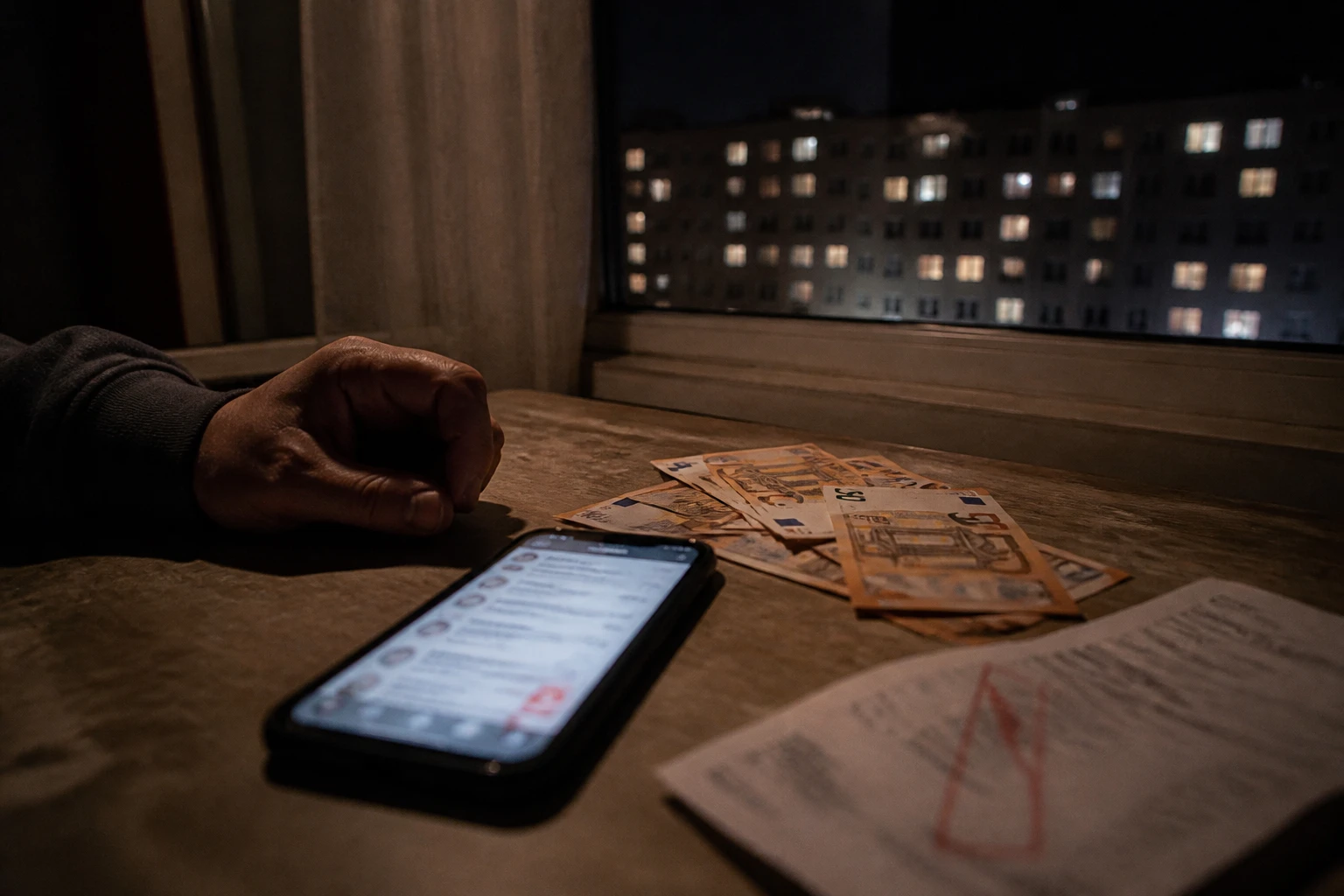
Borrowers gave a simple, recurring reason for showing up in these groups: they could no longer get an appointment with a bank. Lenders, for their part, openly frame the business as filling a gap left by banks that reject financially excluded customers. Other borrowers said they came for speed. A Facebook message can produce cash in hours. A bank loan takes paperwork, credit checks, and time some people don’t have.
From a Photo ID to a Public Post
Lenders don’t hand out money blind. Most ask for a photo of the borrower’s ID and a recent bank statement before agreeing to anything, a rough version of the underwriting a bank would run. The system still has holes. Researchers found cases of identity theft, where someone borrowed using another person’s documents, and loans issued to people who lacked the legal capacity to sign a binding contract in the first place.
A typical deal moves through the same stages, whether the lender is friendly about it or not:
- A borrower messages a known lender directly, or posts a request inside a Facebook loan group.
- The lender asks for a photo ID and a bank statement to check identity and income.
- Money moves fast, often within hours, tied to a short repayment window and a flat fee that works out to an annual rate near 600 percent.
- A late payment triggers a private message demanding payment, with no mention of court.
- If the debtor still doesn’t pay, the lender posts their photo and private messages inside the group for other members to see.
That process never involves a lawyer, a filed contract, or a court date, unless everything goes wrong.
One in Three Loans Never Gets Repaid
The numbers describe a business that shouldn’t survive on paper.
- 45,000 members belong to Estonia’s Facebook loan groups, though only 25 to 30 people actively lend money.
- Nearly 600 percent is the average annual rate lenders charge, against a legal ceiling of 45 percent.
- 75 percent of borrowers failed to repay in the riskiest lender’s portfolio; other lenders write off one in three loans.
- 12 of 125 borrowers contacted by researchers agreed to talk, along with 5 of 24 lenders.
Charging 600 percent covers a lot of bad debt. A lender who gets repaid on two loans out of three, at that rate, can still come out ahead of a bank charging single digit rates on all of them. That arithmetic, more than any threat, is what keeps new lenders joining groups that already count thousands of members.
Courts Are the One Place Lenders Won’t Go
When a payment is late, there’s no summons, no official notice, nothing filed with a court. Instead, the lender posts the borrower’s photo and their private messages inside the group, for other members, and sometimes friends and family, to see. The study describes fear of that exposure as the entire enforcement mechanism. It works. People pay sums they were never legally required to hand over, because they don’t know Estonian law voids a contract priced this far above market rates.
Lenders have their own reason to stay clear of a courtroom. Suing a borrower would put the loan’s real terms in front of a judge, who could throw out the whole contract and, in the process, expose an operation with no license, no oversight, and no legal right to collect a cent of interest above the cap.
Estonia Already Fought This War
This isn’t Estonia’s first round with triple digit lending. In 2009, lawmakers moved against instant text message loan firms after some pushed annual rates past 1,000 percent on tiny short term loans. Legal scholars Karin Sein and Urmas Volens, writing in Juridica International, documented just how extreme it got: Yes Credit, one SMS loan firm, charged 1,355 percent on a 300 euro loan (roughly 320 dollars); Monetti charged 792 percent; SMS-Laen charged 545 percent.
Parliament didn’t write a flat number into the law back then. It let judges void any consumer credit contract priced at more than three times the average rate tracked by Eesti Pank, Estonia’s central bank.
| Lender or Rule | Annual Interest Rate |
|---|---|
| Yes Credit, SMS loan (2014) | 1,355% |
| Monetti, SMS loan (2014) | 792% |
| SMS-Laen, SMS loan (2014) | 545% |
| 2009 legal doctrine | Void above 3x market average |
| Facebook shadow lenders (2026 study average) | Nearly 600% |
| Current legal ceiling | 45% |
The 45 percent ceiling in place today grew out of that same legal approach: a court empowered to erase a bad contract, rather than a flat rate written into statute from day one.
Why Didn’t the 2009 Fix Reach Facebook?
Because Estonia’s 2009 fix only works once a contract lands in front of a judge, who can then void it for charging far above the market rate, and Facebook’s lenders have built a business that structurally avoids ever getting near a courtroom in the first place.
Voiding a usurious loan requires a case: someone suing, or being sued. Facebook’s lenders avoid that entirely by collecting through shame instead, which keeps the whole relationship outside any file a court could ever review. Borrowers have just as little reason to bring a case. Suing would mean naming themselves publicly as someone who took an illegal loan, the very exposure the whole system threatens them with in the first place.
That mutual avoidance keeps a law written for courtrooms away from a business that has engineered its way out of ever entering one.
Frequently Asked Questions
Is Borrowing from a Facebook Loan Group Illegal in Estonia?
Taking the loan itself isn’t a crime for the borrower. Running the lending operation without a license, and charging rates that breach the country’s unconscionability threshold, is what makes these groups illegal. Estonian law treats a consumer credit contract priced at multiples of the market rate as void, meaning a court could strike the debt entirely rather than just lower it. Few borrowers ever test that in practice, since testing it means suing the person threatening to expose them.
Why Can’t These Borrowers Just Get a Bank Loan?
Most already tried. Interviewees told researchers they turned to Facebook after they could no longer get an appointment with a bank, often following a missed payment, unstable income, or a job that doesn’t fit standard underwriting. Estonia is also folding nearly a million existing loans, leases and debts into a single national credit register by 2029, a change ERR News reports will let lenders scrutinize applicants more closely, doing little to widen the door back into legal credit for people already shut out.
What Happens if a Borrower Cannot Repay?
Nothing happens in court, because neither side wants to go there. The lender messages the debtor privately, then posts their photo and private messages inside the group if they stay quiet. Debt counselors interviewed for the study said fear of that exposure, not any legal threat, is usually what gets a balance paid. Estonia’s Consumer Protection and Technical Regulatory Authority, reachable through the economic ministry’s consumer protection guidance for borrowers, is the closest thing to an official escalation path, though the study found few borrowers ever use it.
Do Estonia’s Loan Sharks Ever Face Prosecution?
The study doesn’t document a single prosecution. Both sides have reasons to avoid the legal system: lenders because a court case would nullify their contracts and expose an unlicensed business, borrowers because reporting a lender risks the very public shaming they’re trying to avoid. That mutual avoidance let a market with 45,000 combined group members run for years without one test case reaching a judge.
Is This an Estonia-Only Problem?
The researchers frame Facebook lending as a structural opening, not a local quirk. Any platform that allows closed groups, real identities, and instant payments creates the same conditions once formal credit tightens, meaning similar shadow markets likely exist wherever those three conditions line up. Estonia is simply the first place academics have mapped one in detail, through a grant funded project built specifically to study consumer credit stress.
Disclaimer: This article explains findings from an academic study and general consumer credit rules. It is not legal or financial advice. Anyone dealing with an informal or high interest loan in Estonia should consult a licensed attorney or the country’s consumer protection authority. Figures reflect the study and sources available as of publication in July 2026.