Australia’s corporate regulator squeezed a record $830 million (roughly US$580 million) in court-ordered penalties out of banks, super funds and financial firms in the year to June, its biggest enforcement haul ever. Two thirds of that figure came from just two cases, and the single largest slice, a $300.2 million penalty against a collapsed foreign exchange trader, is unlikely to ever be paid.
The Australian Securities and Investments Commission (ASIC) calls the number proof of tougher enforcement. Yet the penalty money bypasses the regulator’s own budget entirely, and the industry it oversees just absorbed a 31 per cent jump in the levy that funds ASIC’s work.
Two Cases Made Up Two Thirds of the Record
ASIC’s enforcement and regulatory update shows the first half of the 2025-26 financial year already set a six-month record on its own. Between July and December 2025, courts ordered $349.8 million in civil penalties, driven largely by a $250 million omnibus settlement with ANZ across multiple proceedings, alongside penalties against Cbus and RAMS Financial Group.
The second half of the year piled on more. Here is how the biggest individual penalties broke down.
| Company | Penalty | What Went Wrong |
|---|---|---|
| Union Standard International Group | $300.2 million | Systemic unconscionable conduct against retail CFD traders, 2018 to 2020 |
| ANZ | $250 million | Omnibus settlement across multiple proceedings, including a government bond issuance |
| HSBC Bank Australia | $35 million | Admitted failures in scam protection systems |
| Macquarie Securities | $35 million | Systemic failures that misreported millions of short sales |
| Westpac | $26 million | Widespread failures responding to customer hardship requests |
Mercer Super and several smaller funds also drew penalties this year, though without a single figure attached in ASIC’s public reporting. Even without them, $830 million is more than triple the previous annual civil penalty record of $229.9 million, set in the 2022 financial year, according to Freedom of Information data reported by Capital Brief earlier this month. That comparison is exactly why the concentration matters: strip out Union Standard and ANZ, and the remaining haul looks a lot closer to a normal year than a record one.
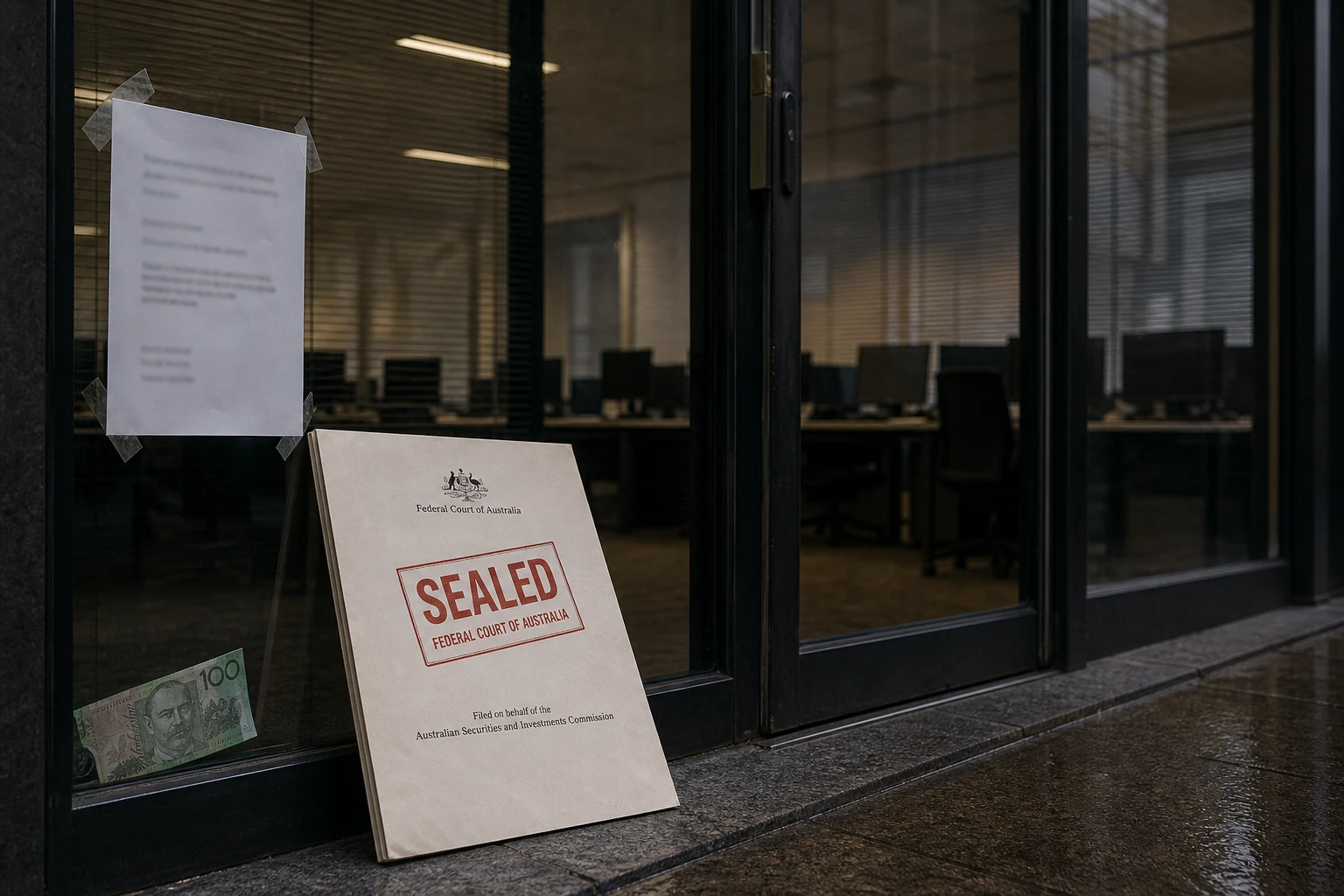
The $300 Million Penalty Against a Company That Died in 2020
Union Standard International Group traded as usgfx, funnelling retail clients, many based in China, into leveraged foreign exchange and CFD (contracts for difference) products through two authorised offshoots, EuropeFX and TradeFred. Customers of those two arms lost more than $83 million between 2018 and 2020, the Federal Court found.
ASIC filed its case in December 2020, months after Union Standard had already tipped into voluntary administration that July. Liquidators took over in September 2020. The Court did not find systemic unconscionable conduct until December 2024, and did not settle on a penalty until this June, nearly six years after the company folded.
High penalties are needed to secure effective deterrence.
Justice Michael Wigney said in the Federal Court in June, ordered $300.2 million in penalties against Union Standard and its two former authorised representatives.
Recovering any of it looks unlikely. Jason Harris, a professor of corporate law at the University of Sydney, put the odds at a “slim to none chance.” Some might ask why ASIC pursued a company “that was already dead,” Harris said, but the ruling still carries a genuine deterrent effect for anyone still trading.
Where Does the Fine Money Actually Go?
Court penalties from ASIC cases are not banked by ASIC. They go to the Commonwealth’s consolidated revenue, the government’s general account. ASIC’s own budget comes from a separate industry levy, one that just rose again for the firms it regulates, regardless of how much the regulator wins in court.
ASIC expects to recover $400.5 million in industry funding levies for the 2025-26 year, entirely separate from the $830 million in penalties it secured over the same period. Licensees that give personal financial advice to retail clients face a levy of $3,037 per adviser this year, on top of a $1,500 minimum, up from $2,314 a year earlier, a jump of 31 per cent, according to ASIC’s estimated industry levies for 2025-26.
The Financial Advice Association Australia says the timing looks bad. The group has flagged a 31 per cent jump in adviser levies landing in the same year ASIC is celebrating record fines, and argues penalty proceeds should offset what compliant advisers pay rather than vanish into consolidated revenue.
- ASIC – Chair Sarah Court frames the numbers as proof the regulator is deterring “real harm” and forcing accountability across the sector.
- Jason Harris – says the total is softer than it looks because the Union Standard penalty will likely never be collected, and slow case turnaround lets harm compound before ASIC intervenes.
- Financial Advice Association Australia – argues fine proceeds should offset the levy bill it says is unfairly loaded onto compliant advisers, rather than disappearing into general government revenue.
The federal budget added $18.5 million over four years to ASIC’s cyber and systems capability for 2026-27, budget papers reported by Financial Newswire show. Advisers say that does nothing for the levy bill itself.
Eleven Defendants, Two Found Liable
ASIC’s other major setback this year came from a case it had partly already lost. In March, the Federal Court dismissed the regulator’s claims against seven former non-executive directors of Star Entertainment Group, the casino operator engulfed in a money laundering scandal. Justice Michael Lee found they had not breached their duties, more than three years after ASIC sued all eleven of the casino’s directors and senior officers in December 2022.
Two defendants did not escape. Former chief executive Mathias Bekier and former general counsel Paula Martin were found to have breached their duties over how they handled money laundering risks tied to the Suncity gambling junket. In June, the Federal Court combined $1.1 million in personal penalties and disqualified them from managing companies for six and seven years respectively. Bekier and Martin were also ordered to cover 45 per cent of ASIC’s legal costs.
Three and a half years of litigation against eleven senior figures at one company produced two liability findings and a little over a million dollars in penalties, a fraction of what the case likely cost to run. Harris said this is the trade off of ASIC’s broad mandate. “ASIC has too much to do, and it doesn’t have enough resources,” he said, adding that the regulator “isn’t testing the law enough in new areas that are threats to the economy.”
$644 Million Back, Plus 25 Criminal Convictions
ASIC opened more than 250 new investigations over the year. It also secured $644 million in refunds, compensation and other remediation payments for tens of thousands of Australians harmed by misconduct, a separate pool of money from the court penalties above.
Criminal cases added another 25 convictions, including eleven prison terms. Three cases stood out.
- Rodney Forrest – former Sydney fund manager; the Federal Court’s full bench upheld his prison term in May over a $3 million insider trading scheme.
- Anthony Torre – former Perth financial adviser sentenced in January to six years’ jail for stealing more than $1 million from clients’ superannuation accounts.
- Remedy Housing officials – three individuals jailed in March for dishonesty offences tied to marketing interest-free mortgages.
Sarah Court, who took over as ASIC chair from Joe Longo in June, said the agency’s enforcement work is focused on misconduct causing real harm. She described the year’s results as “detecting misconduct sooner, preventing harm where we can and securing remediation,” rather than punishment alone.
What ASIC Chases Next
ASIC has already flagged where it is looking next. In November, the regulator named private credit a 2026 priority, alongside misleading pricing, insurance claims handling and superannuation trustee failures, on top of standing focus areas like insider trading and continuous disclosure breaches.
Digital assets are already drawing penalties too. In March, the Federal Court fined Oztures Trading, which trades as Binance Australia Derivatives, $10 million after it misclassified more than 85 per cent of its customer base over nine months, exposing 524 retail investors to high-risk crypto derivative products and more than $12 million in losses and fees.
ASIC’s next enforcement priorities are due in November. The next round of industry levy invoices, built on the same funding model advisers are already complaining about, goes out between January and March 2027.
Frequently Asked Questions
Why don’t ASIC’s court penalties reduce the industry funding levy?
By law, penalties ordered against companies in ASIC cases go to the Commonwealth’s consolidated revenue rather than to ASIC itself. ASIC’s operating budget is recovered separately through industry levies. Treasury reviewed the industry funding model between 2022 and 2023 and published recommendations in June 2023, but the basic structure, in which fine proceeds and levy funding stay separate, has not changed.
Why did ASIC lose its case against Star Entertainment’s non-executive directors?
Justice Michael Lee found the evidence did not show the seven non-executive directors fell below the legal standard expected of them, given the information available to them at the time and the risk of judging their decisions with hindsight. ASIC told the Federal Court in March it would not appeal that finding.
What is the longest prison sentence ASIC has ever secured?
The longest term remains the 14-year sentence handed to Perth businessman Chris Marco over fraud charges totalling $34.3 million connected to a Ponzi scheme, an ASIC-record term reported in late 2025.
Is the Union Standard penalty the biggest ASIC has ever won in a single case?
Yes. ASIC itself describes the $300.2 million penalty against Union Standard and its former authorised representatives as the highest amount ever secured in connection with a single ASIC matter, even though recovering it is considered unlikely.
Does the federal government fund any of ASIC’s own budget directly?
Mostly no. ASIC’s day to day regulatory costs are recovered from industry through levies rather than general taxation. The 2026-27 federal budget did add a smaller, separate allocation, $18.5 million over four years, specifically to uplift ASIC and APRA’s cyber and systems security capability, not core enforcement staffing.