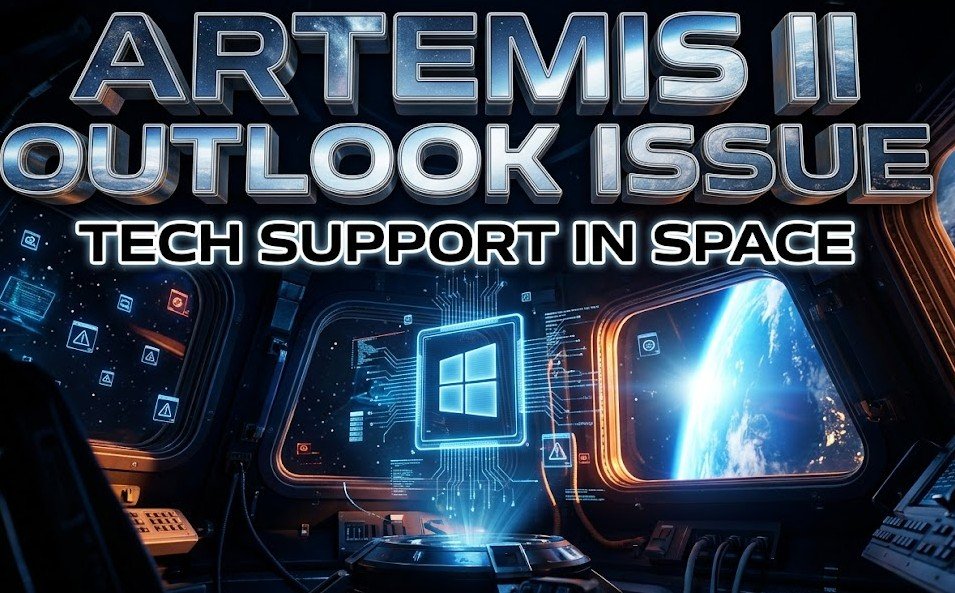
In a moment that made space history feel strikingly familiar, astronauts aboard NASA’s Artemis II mission encountered a technical problem that most office workers know all too well. Less than a day after blasting off for a 10‑day journey around the Moon, Commander Reid Wiseman radioed mission control to report that Microsoft Outlook on his computer just would not work. What should have been a smooth start became a global moment of both humor and reflection on the realities of modern technology, even 240,000 miles from Earth.
Relatable Glitch Hits Groundbreaking Artemis II Mission
Hours after the historic April 1 launch, Wiseman reported during a live communication with NASA’s Houston Mission Control that he had “two Microsoft Outlooks, and neither one of those are working.” The computers in question are ruggedized Microsoft Surface Pro devices called Personal Computing Devices used by crew for email, scheduling, and non‑mission‑critical tasks. When even an astronaut headed to the Moon runs into login and software problems, it quickly became a viral moment online, drawing amusement and empathy from people everywhere. The slip caught attention partly because it echoed challenges millions face with Outlook in everyday work settings.
Mission Control quickly acknowledged the issue and began remotely accessing Wiseman’s device in an attempt to fix the problem. Ground engineers, drawing on NASA’s deep space communication networks, were able to reconnect to the device, reload Outlook files, and restore functionality, though the application remained in offline mode — expected during spaceflight given the lack of constant internet connectivity. Flight Director Judd Frieling explained that this type of configuration issue is “not uncommon,” especially in environments where traditional networks are absent.
Inside the IT Huddle Between Earth and Space
The interaction between the crew and Houston revealed surprising insights into how astronauts rely on standard productivity software even in deep space. Far from being critical to flight control operations, these tools help astronauts manage personal communications, access routines, and stay organized on long missions. The glitch stemmed from having multiple Outlook instances installed, both failing to launch properly in the unique environment. Once technicians accessed the Surface tablet remotely, they worked to reset and streamline the software settings. Mission Control confirmed their progress, saying they had successfully resolved the software issues and let the commander know when they were done.
This episode also highlighted the sophisticated communications infrastructure that keeps humans connected across vast cosmic distances. NASA uses a global array of ground antennas and satellites in its Near Space Network and Deep Space Network to bridge the communication gap between Earth and missions venturing well beyond low Earth orbit. It is this continuous link that allows mission control to troubleshoot in real time, even for seemingly simple computing problems like an email client glitch.
Public Reaction Highlights Shared Frustration
News of the Outlook hiccup generated widespread reaction on social media platforms like X, Reddit, and Bluesky. Many users pointed out the irony that a sophisticated lunar mission would be slowed momentarily due to a software problem familiar to office workers, while others shared their own struggles with Outlook on Earth. Humor dominated much of the online commentary as people poked fun at the mission’s reliance on commercial email software so far from home. While some criticism of Microsoft‑related software reliability surfaced in online forums, tech experts reminded audiences that such office tools are supplemental and not part of critical flight systems.
The moment also underscored broader discussions about technology dependency in space. Although Artemis II’s primary mission systems run on specialized, rigorously tested hardware and software, commercial products like Microsoft Office components are included for convenience and familiarity. These tools are ruggedized and carefully vetted, but still sometimes behave unpredictably without stable network connections, especially when being used in a context beyond their usual Earth‑based environment.
A Minor Setback on a Monumental Journey
Aside from the Outlook issue, the Artemis II mission has proceeded largely as planned. The crew, which includes Wiseman alongside fellow NASA astronauts Victor Glover and Christina Koch, and Canadian Space Agency astronaut Jeremy Hansen, continues its mission to loop around the Moon before returning to Earth. While the email software hiccup could easily have been dismissed as a minor distraction, it highlighted the complexity of human space exploration in a way that resonates with everyday life.
The mission remains on track, with vital scientific observations, navigation tests, and deep space communications all progressing smoothly. The Outlook glitch did not impede mission‑critical operations, and was resolved swiftly thanks to the expertise of teams on Earth. Still, it offered a rare human moment in an otherwise extraordinary venture — a reminder that even astronauts sometimes need a little tech support to keep going.
As Artemis II continues its path around our celestial neighbor, this quirky bug remains a symbol of shared human experience, uniting viewers on Earth with the crew sailing through space. The humor and humanity of the situation have turned an IT hiccup into an inspiring story of problem‑solving and connectedness across the void.