The White House is quietly urging major U.S. banks to test Anthropic’s latest artificial intelligence model, Mythos, for critical financial operations. The move has triggered debate over government influence in private tech decisions and raised concerns about fairness in the fast-growing AI race inside Wall Street.
Quiet pressure from Washington on Wall Street AI use
Senior officials linked to the Trump administration have reportedly held private discussions with top banking executives, encouraging them to explore Anthropic’s Mythos AI for cybersecurity and compliance tasks.
The conversations involve coordination between the US Treasury Department and the Office of Science and Technology Policy, signaling a broader federal push to accelerate AI adoption in sensitive sectors like banking.
Officials are reportedly urging banks to use Mythos to detect vulnerabilities, flag fraud risks, and streamline compliance workflows across financial systems.
According to multiple reports, executives from major institutions including JPMorgan Chase, Goldman Sachs, Citigroup, Bank of America, and Morgan Stanley have already begun internal evaluations or pilot testing of the model.
A key meeting between Treasury Secretary Scott Bessent and Federal Reserve Chair Jerome Powell with bank leaders reportedly emphasized the importance of taking AI driven threats seriously and using advanced tools like Mythos to strengthen defenses.
Why Anthropic’s Mythos is at the center
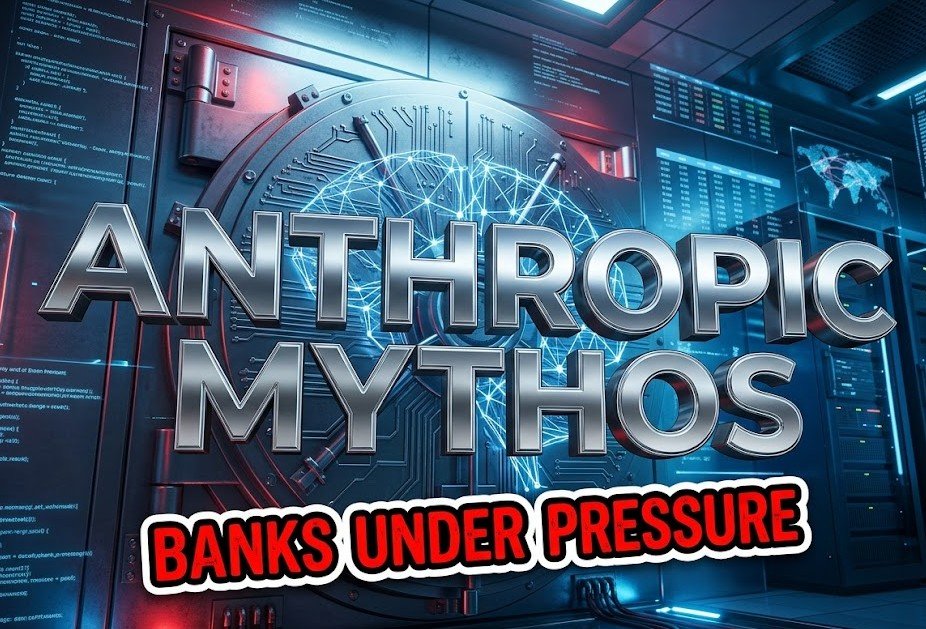
Anthropic’s Mythos model is designed specifically for enterprise and regulated industries, including banking and finance. Unlike earlier general purpose AI tools, Mythos is built with stronger auditability features and compliance focused capabilities.
The model can process large volumes of regulatory text, detect unusual transaction patterns, and generate detailed compliance reports. These are tasks that traditionally require large teams of analysts inside major banks.
Key features driving interest include:
- Advanced vulnerability detection in software systems
- Fraud pattern recognition across large transaction datasets
- Automated regulatory compliance reporting
- Audit friendly reasoning logs for oversight teams
Industry observers note that Mythos is being positioned not just as a productivity tool, but as a security layer for financial infrastructure.
However, its release has also been controversial. Reports suggest the model is so capable at identifying system vulnerabilities that it is being restricted to a limited set of partners for controlled use.
Rising concerns over government influence and fairness
The White House encouragement has sparked debate in financial and tech circles about whether government involvement is tilting the playing field in favor of one AI company.
Critics argue that informal pressure from federal agencies could influence procurement decisions in ways that disadvantage competing AI developers.
A central concern is whether banks are truly making independent technology choices or responding to policy driven expectations.
Key concerns raised by analysts
- Possible favoritism toward Anthropic in federal messaging
- Competitive disadvantage for other AI providers
- Blurred lines between regulation and market influence
- Risk of over reliance on a single AI model in finance
At the same time, supporters of the initiative say the approach is about national security and financial stability rather than corporate preference. They argue that banks need urgent tools to defend against increasingly advanced cyber threats.
Security risks and the cyber debate inside finance
The push for Mythos adoption comes as regulators and cybersecurity experts warn about the rising risks of AI driven attacks on financial systems.
Recent discussions across the US and allied countries highlight concerns that advanced AI models could both strengthen defenses and potentially expose new vulnerabilities if misused.
Officials have reportedly emphasized that banks must prepare for AI systems capable of discovering and exploiting hidden software weaknesses at scale.
Some banks see Mythos as a defensive breakthrough. Others worry about creating new dependency risks if one model becomes deeply embedded in core financial infrastructure.
A simple comparison emerging inside industry circles:
| Opportunity | Risk |
|---|---|
| Faster fraud detection | Over reliance on one AI vendor |
| Automated compliance reporting | Potential bias in model outputs |
| Improved cyber defense | New attack surface from AI integration |
| Reduced manual workload | Regulatory uncertainty |
A turning point for AI in global banking
The situation reflects a larger shift in how governments and financial institutions are approaching artificial intelligence. AI is no longer treated as an experimental tool but as core infrastructure for global finance.
Anthropic, already working closely with select technology partners, now finds itself at the center of a geopolitical and economic debate about how far governments should go in shaping AI adoption.
As banks continue pilot testing Mythos, the financial world is watching closely. The outcome could define how deeply AI becomes embedded in banking systems and whether public policy begins to directly influence private sector technology choices at scale.
For now, Wall Street is moving carefully, balancing innovation with caution. But the message from Washington is clear: AI is no longer optional in the future of finance, and Mythos is being positioned as one of the tools leading that transition.
The coming months will determine whether this government backed push becomes a model for secure AI adoption or a flashpoint in the debate over fairness, control, and the future of artificial intelligence in global markets.