
The AirPlus XEVA turbine is a 1.8 kW building-edge wind unit aimed at hospitals, data centers, colleges and council buildings that want generation close to demand. AirPlus Renewables says the patented Edge Wind Tech system is built for turbulent rooftop air and will be formally launched later this year with live deployment data from the UK and overseas.
The burden of proof is the story. Small wind has spent years losing roofs to solar, towers to planning delays and city centers to messy airflow. XEVA’s claim is that the edge of a building can become a power site, if the numbers survive outside the brochure.
The Product Is Small, the Claim Is Large
AirPlus Renewables, a new UK-based wind technology company, is pitching XEVA as a compact micro-wind system rather than a miniaturized farm turbine. The company says the cylindrical unit is designed for rooftops, remote communities, off-grid sites, deserts and arctic conditions, with output routed to batteries, grid-tied systems or real-time use points through the official XEVA turbine specification page.
The specification sheet matters because it makes XEVA testable. AirPlus lists a rated output, a cut-in speed, an operating wind range, noise data and a physical footprint. Those are the numbers building owners can compare with a roof survey, an inverter room, a maintenance contract and a planning file.
- 1.8 kW rated power output per unit.
- 2.5 meters per second listed cut-in wind speed.
- Less than 28 dB noise emission at 10 meters.
- 68 kg unit weight, with a 1.2m x 0.6m x 0.8m body.
Those numbers do not yet answer the commercial question. A rooftop turbine lives or dies on annual energy yield, not nameplate capacity. That is why AirPlus is promising real-time data from chosen sites rather than treating the launch event as a design reveal.
Why Rooftop Air Is the Whole Fight
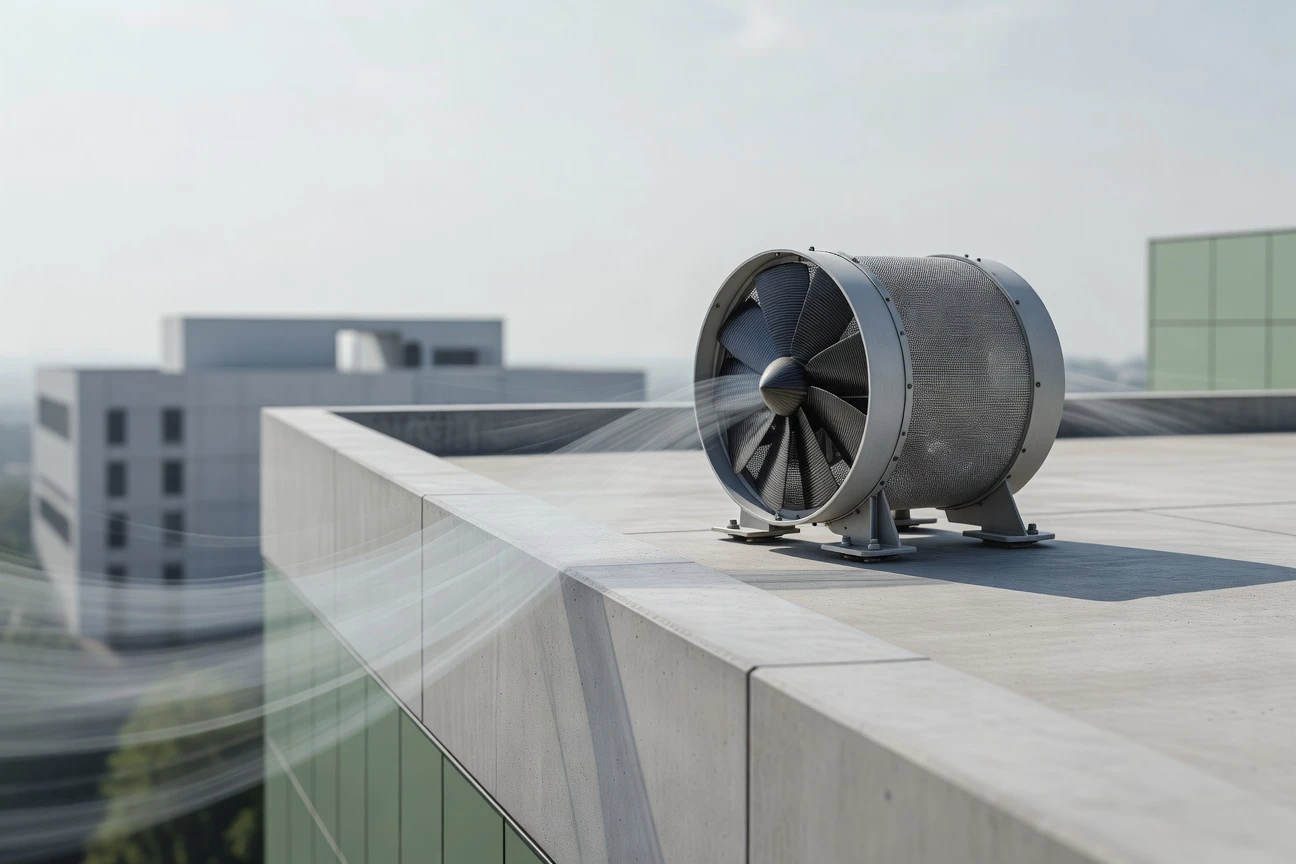
The building edge is attractive because airflow can speed up around rooflines. It is also dangerous marketing ground because city wind is uneven, obstructed and hard to model from a weather file. AirPlus says Edge Wind Tech is designed to capture turbulent and non-turbulent wind and to sit at rooftop edges where building aerodynamics can accelerate flow.
Academic work explains why that is a hard claim to prove. A University of Reading study on small wind turbine yield in Greater London found that detailed local understanding is needed because standard wind databases can overestimate urban wind speeds. The study found wind speeds above 4 meters per second in only 27% of London neighborhoods, with fewer than 10% of those higher-wind areas within 10 km of the city center.
More recent rooftop wind-tunnel work summarized by the American Institute of Physics found that vertical-axis wind turbine placement affects wind speeds, turbulence intensity and wake behavior on flat roofs. That points to the same conclusion: building-mounted wind is a siting problem before it is a hardware problem.
AirPlus Has a Three-Patent Roadmap
XEVA is the product ready for the spotlight, but AirPlus is presenting it as part of a wider decentralized energy platform. On AirPlus Renewables’ technology overview, the company describes three application paths: a static wind system, a mobile wind system and a flow-based hydro concept.
| AirPlus Product | Primary Use | IP Status Claimed by AirPlus | Site Logic |
|---|---|---|---|
| XEVA | Static wind generation | Patented | Rooftops, urban sites, remote installs and exposed building edges |
| XKOROST | Mobile wind units | Patent filed and pending | Transportable or marine-linked settings where fixed power is harder |
| XYQUA | Water and hydro applications | Patent to be filed | Flow-based generation where moving water replaces moving air |
The roadmap helps explain the language around Edge Wind Tech. AirPlus is borrowing from edge computing, where processing moves closer to the user, and applying that idea to energy. The bet is that smaller machines placed near load can avoid part of the grid bottleneck, even if they never match the scale economics of utility wind.
The Market Has Been Waiting for Proof
Distributed wind is not a new idea. The U.S. Department of Energy defines it as wind power installed near where electricity will be used, either on distribution systems or off-grid. Its distributed wind market report counted 1,110 MW of cumulative U.S. distributed wind capacity from more than 92,000 turbines across all states and several territories from 2003 through 2023.
The small-wind slice remains modest. Pacific Northwest National Laboratory, a U.S. national laboratory that prepared the full report, said small wind added 2.3 MW from 1,994 turbine units in 2023, representing $15.2 million of investment. Its full distributed wind report also said four reported small-wind project timelines ranged from 10 months to 4 years, with an average of nearly 2 years.
That history is the warning label attached to the AirPlus launch. A turbine that can be supplied assembled and lifted into place would attack one of the sector’s weak spots. The company expects the main product to take around 90 minutes to install, according to its launch material. But a fast install only matters if the pre-install work, permissions, structure checks, wiring and performance model also hold up.
Hospitals and Data Centers Give the Pitch Teeth
AirPlus has named Hull NHS Teaching Hospital among planned deployments, with other sites planned across the UK, the Maldives, Saudi Arabia, Ukraine, the USA and Canada. The spread is deliberate. A hospital roof, a coastal site, a desert site and a cold mountain setting test different versions of the same problem: whether a small machine can produce useful power where conventional wind logic says the site is awkward.
Data centers sharpen the second-order case. The International Energy Agency says data centers accounted for about 1.5% of global electricity consumption in 2024 and could rise to about 3% by 2030 in its base case. In the United States, the agency says data centers are on course to account for almost half of electricity demand growth to 2030, a point made in the IEA’s energy and artificial intelligence analysis.
XEVA will not power a hyperscale data center by itself. That is not the serious pitch. The serious pitch is that distributed generation can sit inside a wider stack of solar, batteries, grid supply and backup systems, especially for buildings whose electricity needs are rising faster than grid upgrades arrive.
- Hospitals need resilience, predictable operating costs and visible progress on estate emissions.
- Data centers need every credible local kilowatt they can integrate without adding grid delay.
- Councils and colleges control roof space and often face public pressure to cut energy bills.
- Island and coastal sites can test salt, storms and logistics where diesel displacement has real value.
Planning and Certification Can Slow the Roof
The UK planning backdrop is friendly only in narrow cases. The Planning Portal says a building-mounted wind turbine can be permitted development in England if all limits and conditions are met, including compliance with Microgeneration Certification Scheme standards or equivalent standards, restrictions on height, boundary distance and the number of installations. Those rules are listed in its building-mounted wind turbine planning guide.
Commercial buildings bring a different checklist. A hospital or council building has structural loading, vibration, access, roof membrane warranties, insurance and public safety questions before anyone talks about energy yield. A 68 kg unit is small by wind industry standards, but multiple units on a roof become a building services decision, not a gadget purchase.
A related Companies House record for AirPlus lists AirPlus (Renewables) XEVA Limited as an active private company incorporated on 21 May 2025. That makes the next phase important. New companies can move quickly, but public-sector and infrastructure buyers usually wait for field evidence, warranty clarity and service depth before they buy at scale.
The Launch Data Will Decide the Category
Jimish Patel, founder of AirPlus Renewables and co-inventor of the technology with Krupali Patel, is putting the company on a practical footing rather than a climate slogan. The strongest line in the launch material is not about blades. It is about access.
Energy should be cost-effective and accessible for anyone and everyone. For us, energy is a necessity, not a luxury.
Patel said XEVA was developed to bring power production closer to where it is needed, reduce dependence on the grid and use spaces organizations already have. That is a clean message for estates teams, especially if energy demand keeps rising and grid connections stay slow.
The launch event later this year therefore has one job. It must show output curves, downtime, wind conditions, noise readings, site photos and installation lessons from real buildings. The company does not need to prove that rooftop wind beats every other technology. It needs to prove that the building edge is a bankable site class.
If the field data shows quiet output in rough rooftop air, XEVA gives building owners a second on-site renewable tool. If it does not, the product returns to the long queue of rooftop wind ideas that worked best in renderings.