Apple’s first foldable iPhone is widely expected to debut in September 2026, alongside the iPhone 18 Pro in Apple’s fall lineup. Samsung, the established leader in book-style foldables, has scheduled a Galaxy Z Fold 8 launch for July 22, 2026. Counterpoint Research, in a report dated July 1, 2026, projects Apple to take 29% of foldable smartphone panel procurement in year one, behind Samsung’s 31%.
IDC’s Q1 2026 dataset makes the wider race tight at the top. Samsung held 21.2% of global smartphone shipments, Apple 21.0%, a gap IDC marks as a statistical tie. Apple’s late arrival in foldables lands in the one category forecast to grow against a market in its steepest annual decline.
A Foldable iPhone Takes Shape in Software
At WWDC 2026, Apple’s senior vice president of software engineering Craig Federighi walked developers through a Device Hub for simulating different screen configurations. He framed the shift in plain terms: design for a “dynamic range of sizes and aspect ratios” rather than a fixed device list.
Cindy Barrett, Apple’s senior engineering manager of system experience, took the message further at the Platforms State of the Union, telling developers that resizable iOS apps replace the old rule of designing “for specific devices and orientations.” The iOS 27 beta itself adds engineering evidence. A software researcher using the handle M1Astra pulled code strings the system uses to check whether a device is folded, plus labels that read hinge angle in degrees. Apple Service Utility, a tool that helps technicians repair devices, references a secondary display, a second layer of protective glass, and extra ambient light sensors in the beta build. Bloomberg’s Mark Gurman said the foldable is expected to “beat competitors in screen quality and durability” and to ship with a “less visible” crease, per his write-up covered by PCMag.
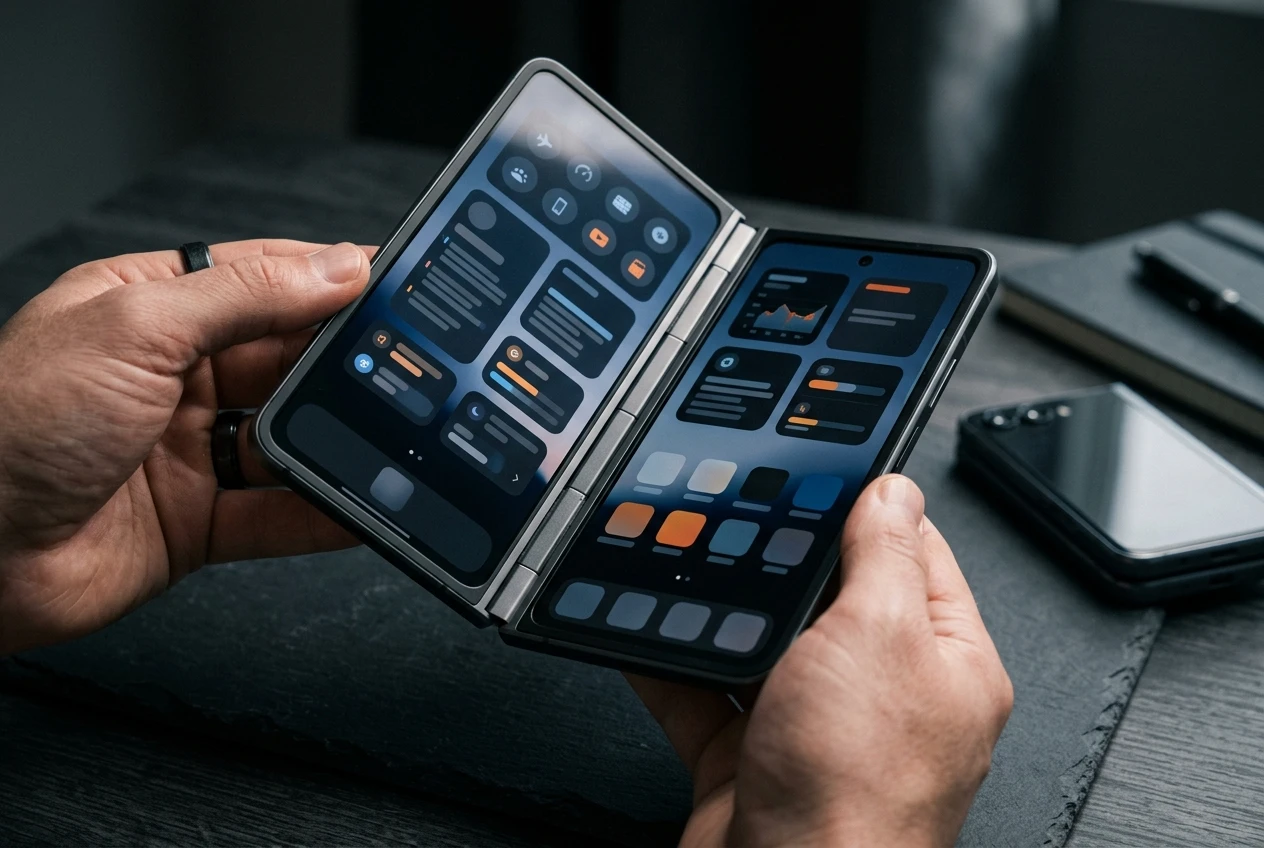
What Apple’s Hardware Is Said to Look Like
Apple has not announced a foldable iPhone. The public picture is built from supply-chain leaks that have circulated since 2024, with the heaviest detail from analyst Ming-Chi Kuo, Jeff Pu, and Weibo-based tipsters.
Kuo forecast a starting price above $2,000 with a fold profile of 4.5 to 4.8 mm when unfolded and 9 to 9.5 mm when closed. Pu, in his January note, projected a 7.8-inch internal screen and a 5.3-inch external screen. CAD drawings referenced by AppleInsider measured the interior panel at 7.76 inches with a resolution of 2,713 by 1,920. One Weibo leaker offered tier pricing of about $2,325 for the 256GB version, $2,645 for 512GB, and $2,905 for 1TB. Apple’s rumored panel partner is reportedly considering under-display Touch ID for the inner screen.
| Reported Specification | iPhone Fold (rumored) | Galaxy Z Fold 7 (released) | Galaxy Z Fold 8 (rumored) |
|---|---|---|---|
| Internal display | 7.76 inches (CAD) / 7.8 inches (Pu) | not stated in fetched sources | 8 inches |
| External display | 5.3 inches (Pu) / 5.5 inches (other leaks) | not stated in fetched sources | 6.5 inches |
| Thickness (unfolded) | 4.5 to 4.8 mm | 4.2 mm | not stated in fetched sources |
| Thickness (folded) | 9 to 9.5 mm | 8.9 mm | not stated in fetched sources |
| Starting price | above $2,000 | $2,000 | not stated in fetched sources |
The hinge has drawn most of the chatter. A January leaker note said the main casing will combine titanium and an improved version of the Liquidmetal alloy Apple once used for its SIM eject tool. A February leaker claim, that Apple’s hinge crease runs at about a quarter of the depth of the Galaxy Z Fold 7’s, has been repeatedly circulated. An April report said the hinge will use “chip-level high-molecular 3D printing technology.”
Samsung Display remains Apple’s exclusive panel supplier for the foldable. Apple has a three-year deal for foldable OLED panels running through 2029 or 2030, per a report referenced by AppleInsider. That is the same supplier Counterpoint points to for the bulk of the H2 panel ramp.
The Panel Shake-Up Behind the Launch
The supply chain tells the story before any device ships. Counterpoint’s July 1, 2026 release forecasts global foldable smartphone panel shipments of about 27.5 million units in 2026, up around 24% from 2025, with revenues from those panels expected to hit about $4.4 billion, up around 48% year-over-year. Shipments from Q3 and Q4 combined will account for around 64% of full-year shipments.
Counterpoint’s brand forecast puts Samsung on top at 31% of foldable panel procurement, Apple at around 29% in its first year, and Huawei at around 24%. SDC, Samsung Display, posted the clearest Q1 share gain among panel suppliers, rising to around 22% as Samsung, OPPO, and vivo padded orders. Counterpoint analyst Enze Qi noted that “in-fold has moved from a secondary form factor to the mainstream” this year, with clamshell demand declining. The full breakdown is laid out in the 2026 foldable smartphone panel shipment forecast.
BOE remained the Q1 2026 panel leader at around 45%, supported mainly by Huawei, though its share fell by about seven percentage points year-over-year. Q1 shipments declined 7% year-over-year to about 3.9 million panels.
Global Handset Shipments Reverse Course
Apple’s foldable arrives in a market that is shrinking for the first extended stretch in years. IDC’s June 23, 2026 release put 293.8 million units in Q1 2026, a 2.9% year-over-year decline that broke a 10-quarter run of growth. The driver is memory supply, with IDC describing 2026 as the year of the “steepest annual contraction in smartphone history.” Worldwide shipments are now forecast to fall 13.9% in 2026.
Apple and Samsung were the only two of the global top five to grow. IDC’s table puts Samsung at 62.4 million units in Q1 2026, a 21.2% share, with Apple at 61.8 million units and a 21.0% share, captured in Q1 2026 global smartphone shipment data. The two sit in a statistical tie by IDC’s tie rule. Senior research director Nabila Popal noted that Apple’s iPhone 17 series posted growth of over 30% in China, contributing to a 4.4% year-over-year increase in Apple’s global sales.
Higher prices across the market work in Apple’s favor. Popal says smartphone ASP is set to reach a record $550 in 2026, up $100 from the prior year. iOS is forecast to deliver its highest annual share ever at 22%, per the same release. IDC’s December 2025 foldable forecast expects Apple to capture over 22% unit share and 34% of foldable value in its first year, with an expected ASP of $2,400, as laid out in the December 2025 foldable forecast for Apple’s first-year share.
iPhone Air Holds the Compact Track
Apple’s compact 2026 lineup has at least one confirmed entry. The iPhone Air is the thinnest iPhone ever, weighing 165 grams with up to 27 hours of video playback, per the iPhone Air official specs page.
The Air ships with a 6.5-inch Super Retina XDR display, an 18-megapixel Center Stage front camera, and a 48-megapixel Fusion Main rear camera, with Apple Intelligence features running on iOS 27. Samsung plans to ship its own Z Fold 8 and Z Flip 8 at the same July 22 event, lining up a book-style and a clamshell against Apple’s lone book-style option. With the foldable iPhone still unconfirmed as of July 2026, iPhone Air remains the new handset buyers can pick up today.
Frequently Asked Questions
When will Apple release its first foldable iPhone?
Apple has not confirmed a date. The widely tracked timeline, per a Forbes report from June 15, 2026, points to a Wednesday, September 9 keynote, with the iPhone 18 Pro and Pro Max going on sale Friday, September 18. The foldable, possibly branded iPhone Ultra, is expected to be announced alongside them. The same Forbes piece notes the device may follow a few weeks later if production slips, echoing the 2017 gap between the iPhone 8 and the iPhone X.
What will Apple’s foldable cost?
Ming-Chi Kuo forecast in 2025 that the device would carry a price above $2,000, with the option of going above $2,500. A March 2026 Bloomberg report, cited by AppleInsider, continued to expect a price north of $2,000. Weibo leaks pointed to about $2,325 for 256GB, $2,645 for 512GB, and $2,905 for 1TB. IDC’s December 2025 foldable forecast expects an ASP of $2,400 for Apple in year one.
How does the iPhone Fold compare to the Galaxy Z Fold 8?
Apple’s foldable is rumored to use a 7.76-inch inner screen and a 5.3 to 5.5-inch outer screen, against an 8-inch inner and a 6.5-inch outer for the Z Fold 8. Apple is also said to weigh more when closed (9 to 9.5 mm vs the Z Fold 7’s 8.9 mm) but less when open (4.5 to 4.8 mm vs the Z Fold 7’s 4.2 mm). The two devices sit in different form-factor philosophies, with Apple’s design shorter and wider than Samsung’s taller Z Fold silhouette.
Will Apple’s foldable change the smartphone market?
IDC’s separate December 2025 forecast expects Apple to capture over 22% unit share and 34% of foldable value in its first year. Counterpoint’s panel forecast, dated July 1, 2026, puts Apple at 29% of foldable panel procurement in the same window. Neither number is settled, since the device is not yet on sale, but both place Apple inside the category’s top three from the start.