Last Sunday, open-source developer Gert Wollny pushed 59 commits to the AMD R600 Gallium3D driver, the open-source Linux graphics stack for Radeon HD 2000 and HD 6000 cards. The cards launched in 2007, when AMD was still doing business as ATI. Copilot did most of the typing.
The work landed in Mesa 26.2, the next release of the open-source 3D graphics library. AMD itself stopped releasing drivers for the same Radeon HD 2000 line in October 2013. Long after AMD walked away, a Microsoft AI tool, not AMD, is the one keeping that hardware’s open-source path modern. The cleanup landed as a single, public merge series refactoring the legacy driver that anyone can audit, and the AI’s role is on the front page of it.
The Refactor Lands in Mesa 26.2
Mesa 26.2 absorbed 59 commits to the AMD R600g driver on a Sunday, all aimed at cleaning up the sfn shader compiler inside the legacy open-source graphics driver. Mesa is the open-source implementation of OpenGL, Vulkan, and other graphics APIs that nearly every Linux distribution ships, and R600g is the part of Mesa that targets the hardware AMD launched in 2007.
Wollny, of Collabora, was direct about the AI’s role in his merge request. The credit line on the refactor is explicit, naming the tool and its mode, and the AI’s hand is visible in the project history, not buried in a footnote. Each individual patch in the series also flags Copilot’s contribution in its commit message, and that pattern of attribution is rare in open-source driver work. Wollny’s disclosure is now part of the permanent record of R600g.
The commits do not add a new feature or build a new architecture. They are refactors, the unglamorous structural work that makes a code base easier to maintain over time. For a driver AMD stopped updating in 2013, that is the kind of work that decides whether the next Mesa release still runs on a 2007 graphics card.
- 59 commits to the AMD R600g driver, all merged in one series
- Refactoring of the sfn shader compiler code and adjacent cleanups
- Each patch’s commit message credits Copilot (auto mode)
- Target: Mesa 26.2, the next major Mesa release
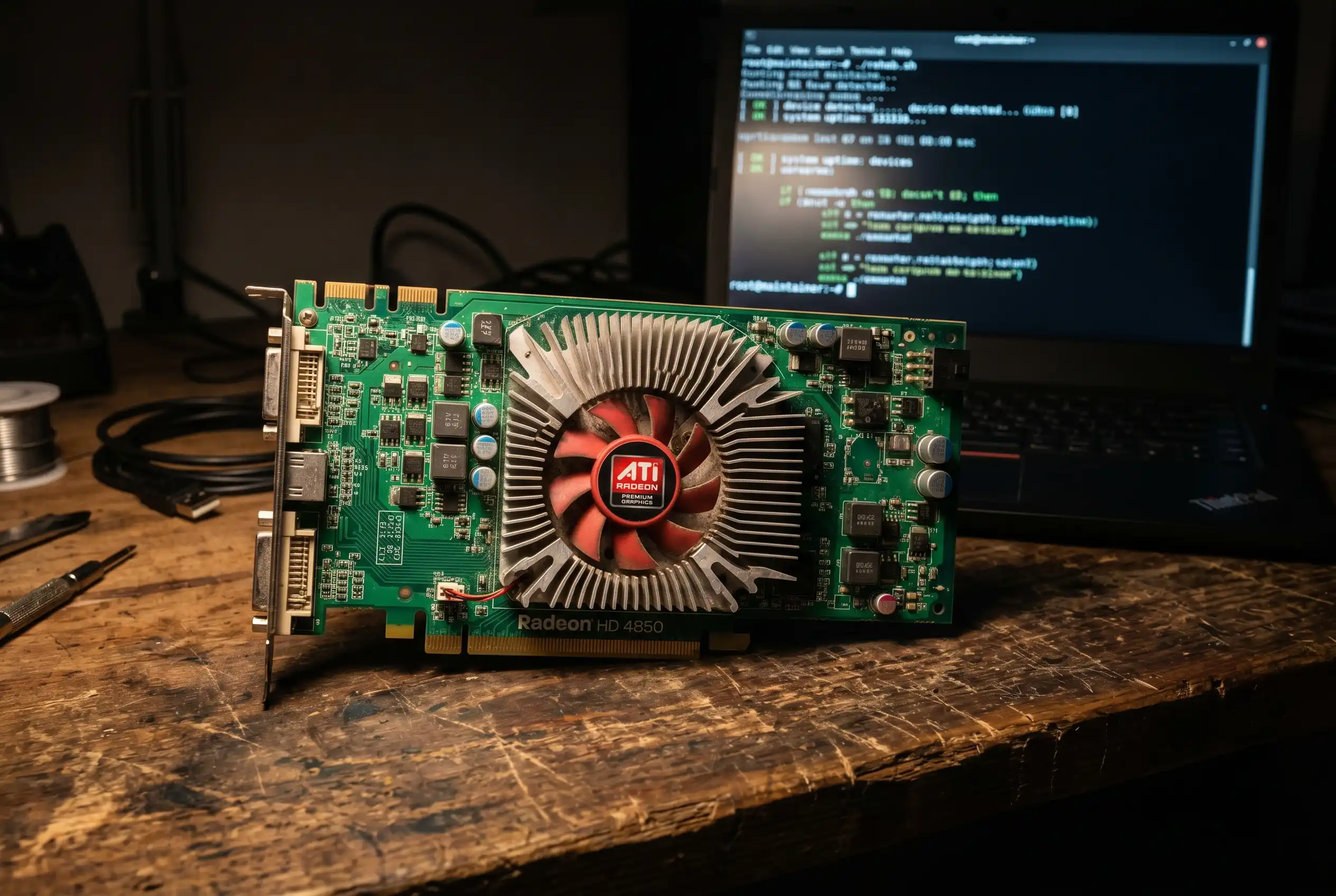
2007 Silicon and the 2013 Exit
AMD launched the Radeon HD 2000 series in 2007, when the company was still doing business as ATI. The R600 chip at the top of the stack powered the flagship Radeon HD 2900 XT, a card that PCMag reports ‘couldn’t quite compete with their Nvidia counterparts, but they were cost-effective.’ That mix of value pricing and second-tier performance has been an AMD trademark ever since.
AMD’s own legacy support page is more blunt. The vendor’s 2013 notice ending HD 2000 series driver work reads: ‘ATI Radeon HD 4000/ATI Mobility Radeon HD 4000, ATI Radeon HD 3000/ATI Mobility Radeon HD 3000, and ATI Radeon HD 2000/ATI Mobility Radeon HD 2000 Series Graphics reached peak performance optimization in October, 2013. No additional driver releases are planned for these products.’ That is a vendor walking out the door, not a roadmap delay.
The R600g driver in Mesa covers the Radeon HD 2000 through the Radeon HD 6000 series, several generations of graphics cards that were never designed for modern Linux. Mesa’s own project page for the R600 driver still describes R600 as ‘officially supported by AMD, and is one of two Linux drivers for the hardware.’ That is a snapshot of an era AMD was still willing to fund. Wollny’s commits are what that wording looks like today, with AMD’s October 2013 notice still live on the vendor’s site.
- 59 commits in one Mesa merge series
- 2007: year of the original Radeon HD 2000 launch
- October 2013: AMD’s last planned driver release for the line
- Mesa 26.2: the target release for Wollny’s work
- HD 2000 through HD 6000: generations R600g is asked to keep running
Wollny, Copilot, and a Driver AMD Abandoned
Wollny works at Collabora, the open-source consultancy. Phoronix has called him ‘among the few open-source developers left working on the AMD R600g driver’ and has described his broader effort to keep the driver alive as ‘near single handedly.’
His tool of choice is a tell. Wollny used GitHub Copilot in auto mode to grind through the refactor, and PCMag reports he describes the assistant, with dry understatement, as ‘an increasingly expensive coding partner.’ Copilot is a paid Microsoft product with rising per-seat tiers, so a hobbyist maintainer for obsolete hardware is paying market rate for AI assistance to keep 2007 silicon alive on a 2026 Linux kernel. That partnership is also a small case study in the end-to-end pitch for a single-vendor vibe coding stack, where the same vendor that sells the AI also runs the code-hosting and the editor integrations. The economics of that arrangement show up in the in-house coding model built for Copilot distribution, a bet the open-source R600 cleanup inherits for free.
The framing from Phoronix is sharper still: ‘whether you like it or not, the old open-source GPU driver support is being assisted by AI long after the upstream vendor has stopped working on this driver.’ That assistance is the reason the cleanup happened, and the reason the same cleanup is being read with extra care.
Wollny’s own description of the work, from his Mesa merge request, is the most honest summary of the deal.
This series does a lot of refactoring to make the sfn shader compiler code a bit cleaner. The refactoring was done with the help of Copilot (auto mode).
Gert Wollny, Mesa merge request, June 2026.
A Mesa-Wide Reckoning Over Legacy Drivers
The R600 cleanup is unfolding against a bigger argument about what Mesa owes to old hardware at all. On 1 May 2026, Mike Blumenkrantz of Valve’s Linux graphics team proposed in the proposal to split R600 into a Mesa legacy branch that would move R300, R600, Lima, virgl, svga, i915g, Nouveau NV30, NV50, and others off the mainline tree. The pitch: less-maintained drivers ‘more frequently hitting CI issues these days and causing pain points’ for the rest of the Mesa codebase.
The proposal drew on a 2021 precedent. The original Mesa Amber branch, which split out older ‘classic’ non-Gallium3D drivers like Radeon R100 and R200, has not seen any activity since January 2023, and no Amber release has been cut since 2022.
Other Mesa developers pushed back. A Phoronix follow-up found ‘a lack of consensus’ on creating Amber2, and that ‘it’s looking like there won’t be any new legacy driver branch in the near term.’ One alternative floated in the same thread: wait five years, then drop OpenGL support from Mesa entirely and lean on Vulkan plus API compatibility layers. For now, R600g stays in mainline Mesa, and Wollny’s Copilot-assisted commits are landing on it. That makes Wollny’s cleanup both the only one happening and the only one the rest of Mesa has to keep building on top of.
AI Code in a Legacy Codebase Demands Extra Care
Attributing Copilot is the easy half of disclosure. Reviewing what it produced is the harder half. PCMag’s coverage of the same merge is direct about the standard: ‘the precision required for these older drivers will mean developers need to carefully review any code produced by AI. LLMs are increasingly useful companions for small or individual coding teams, but making sure they’re doing a good job will be crucial to prevent them from breaking things they shouldn’t.’ The R600 case is a small, real-world test of that standard, in a codebase where a wrong shader-compiler edit does not announce itself.
The shader compiler is the part of R600g least forgiving of a careless edit. A refactor that reorders a register assignment or rewrites a control flow branch can pass Mesa’s CI for modern hardware and quietly produce wrong bytecode for an old Radeon HD card no one is benchmarking. In a modern kernel a regression surfaces in the next release notes; in a legacy graphics driver it can sit in a corner for years.
Wollny’s disclosure, in the merge request and in every patch, is the right norm. It lets a human reviewer know the diff is a candidate for a second look, and it gives the project a record of where the AI’s hand was.
Frequently Asked Questions
What is the AMD R600 Gallium3D driver?
The R600g driver is the open-source Linux implementation of OpenGL for AMD’s Radeon HD 2000 through HD 6000 series graphics cards. Mesa’s own project page still describes R600g as officially supported by AMD and ‘one of two Linux drivers for the hardware,’ wording that dates from an era AMD was still funding the line.
Why is GitHub Copilot being used on a 2007-era graphics driver?
Open-source developer Gert Wollny of Collabora used Copilot in auto mode to land 59 commits refactoring the sfn shader compiler inside R600g, with the work merged to Mesa 26.2. Phoronix reported the change, and Wollny’s merge request credits Copilot explicitly: ‘The refactoring was done with the help of Copilot (auto mode).’
When did AMD stop releasing drivers for the Radeon HD 2000 series?
AMD’s own legacy support notice states that the Radeon HD 2000, 3000, and 4000 series ‘reached peak performance optimization in October, 2013. No additional driver releases are planned for these products.’ Mainstream support ended with the Catalyst 13.1 driver package for Windows 8.
What is the proposed Amber2 branch, and what happened to it?
Mike Blumenkrantz of Valve’s Linux graphics team proposed on 1 May 2026 that Mesa move R300, R600, Lima, virgl, svga, i915g, NV30, and NV50 into a separate ‘Amber2’ legacy branch. Other Mesa developers were not convinced, and Phoronix reported that ‘it’s looking like there won’t be any new legacy driver branch in the near term.’ For now, R600g stays in mainline Mesa.
Is the AI-assisted R600 code safe?
Wollny’s commits disclose Copilot’s role in every patch, and the work is refactoring, not new feature code. The remaining concern is review depth: PCMag’s coverage of the merge notes that ‘the precision required for these older drivers will mean developers need to carefully review any code produced by AI.’ The first real test will be the next Mesa cycle.