Starlink began accepting residential orders in Vietnam in mid-August 2026, with household plans from about 1.13 million VND ($43) a month plus hardware near 8.7-10.3 million VND. The service arrives as a controlled five-year pilot capped at 600,000 terminals and required to push every bit of traffic through four licensed domestic gateway stations.
That architecture turns the connectivity gain into its own enclosure. Remote villages and fishing boats may finally get reliable links, yet the same design keeps the entire network inside Vietnam’s security perimeter just as new laws expand the tools of online control.
Orders Open Inside a Five-Year Pilot Cage
SpaceX’s local unit, Starlink Services Vietnam, started taking customer orders on 13 August. Commercial service followed within days. The company holds a rare full foreign-ownership waiver that ordinary telecom investors never receive.
Prime Ministerial Decision 659/QĐ-TTg of March 2025 created the pilot. It runs five years from licensing and must end before 1 January 2031. The hard ceiling is 600,000 subscriber terminals. Nguyen Anh Cuong, deputy head of the Telecommunications Authority, called the number both a monitoring limit and a technical threshold to hold roughly 100 Mbps per user under current satellite capacity.
The dual purpose matters. A smaller pool of terminals is easier for ministries to watch. It also keeps advertised speeds from collapsing if demand spikes in a few dense pockets. The cap is therefore both a security dial and an engineering brake.
Vietnam already had roughly 85.6 million internet users by end-2025, or 84.2 percent of the population. About 85 percent of households sit on fiber. Mobile broadband subscriptions exceed 110 million and 5G covers around 92 percent of people. Starlink is not filling an empty map. It is filling the hard-to-reach edges.
Those edges are real, yet they are thin relative to the national base. Even if the pilot sold every allowed terminal, the service would still touch only a fraction of households already online by other means. Scale is deliberate, not accidental.
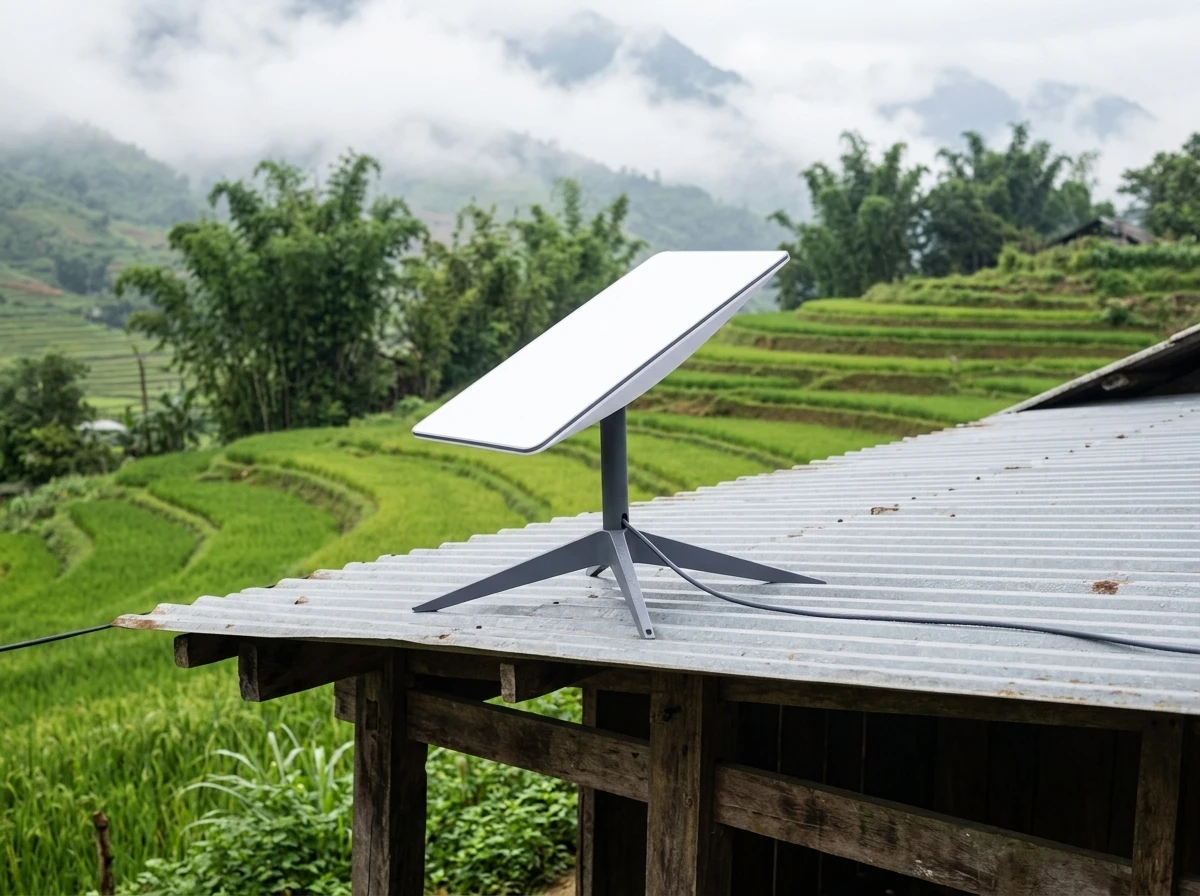
Four Gateways Lock Every Packet Inside the Country
The license forces Starlink to install and use four gateway earth stations on Vietnamese soil. Traffic from every licensed terminal must route through them before it touches the wider internet. The stations sit in Binh Nguyen commune (Phu Tho province, near Hanoi), Lien Chieu 2 ward (Da Nang), and Tang Nhon Phu and Tan Thuan wards (Ho Chi Minh City).
- Phu Tho gateway: northern coverage hub under Radio Frequency Department license
- Da Nang gateway: central corridor station on E- and Ka-band
- Two Ho Chi Minh City gateways: southern economic and maritime focus
- Joint oversight by Ministry of Science and Technology, Ministry of National Defence and Ministry of Public Security
An independent analysis by the Singapore Space Agency described the arrangement as a controlled aperture and four domestic gateways. “Vietnamese instinct is risk containment through enclosure,” the report noted. Unlike most other Southeast Asian Starlink markets, Vietnam refuses foreign or offshore gateways. The service is not a parallel pipe. It is a supervised spur of the existing public network.
Routing every session through domestic ground stations means lawful intercept tools, logging rules and content orders that already apply to fiber and mobile can reach satellite users without a special exception. The dish talks to orbit. The orbit still talks to Vietnam first.
The Monthly Bill Hits Rural Wallets Hard
Starlink lists a basic residential plan near 1.13 million VND a month for lower speeds and 1.71 million VND for the standard unlimited tier that advertises 135-305 Mbps down. Hardware runs 8.65 million VND for the Mini kit or 10.27 million VND for the Standard 4X, plus shipping near 579,000 VND. First-year cash outlay can clear 30 million VND.
| Option | Monthly cost (approx.) | Upfront hardware | Notes |
|---|---|---|---|
| Starlink residential (standard) | 1.71 million VND (~$65) | 8.7-10.3 million VND | Unlimited data, variable speeds |
| Typical fiber (FPT/VNPT/Viettel) | 195,000-359,000 VND | Low or zero | Urban and many rural towns |
| Rural average monthly income | ~5.2 million VND | – | National Statistics Office 2025 survey |
| DW-cited rural income (euro terms) | €259 | – | Same order of magnitude |
Against a rural average near 5.2 million VND a month, the standard plan alone can consume roughly a third of cash income before food, fuel or school fees. Add hardware and the first year becomes a capital decision, not a utility switch.
Khac Giang Nguyen, a visiting fellow at the ISEAS-Yusof Ishak Institute, told DW that without subsidies the service stays out of reach for many rural households. Its biggest practical role may be shared links for schools, clinics and local offices rather than individual homes. Cities already enjoy cheap fiber. The price wall means Starlink’s natural customers are boats, islands, industrial sites and better-off remote users.
Shared institutional links change the arithmetic. One dish split across a commune clinic or a district school spreads both the hardware bill and the monthly fee. That path fits the price structure better than a pure household rollout in low-income districts.
New Laws Expand the Bamboo Firewall in Parallel
While the Starlink pilot took shape, Vietnam kept tightening the legal cage around online speech. Decree 147 took effect in December 2024. It forces social platforms to verify users, retain data and remove content the authorities flag within 24 hours. A revised Cybersecurity Law took effect in July 2026. Implementing rules issued 19 August give the same 24-hour takedown clock and allow account restrictions for repeat violations. For the first time the law explicitly mentions building a “national firewall.”
- November 2024: Decree 147 published, user verification and rapid removal rules
- December 2024: Decree 147 enters force
- March 2025: Decision 659 opens the Starlink pilot under national-security conditions
- December 2025: National Assembly passes Cybersecurity Law 116/2025/QH15
- July 2026: New Cybersecurity Law takes effect
- 19 August 2026: Fresh implementing regulations on 24-hour removals and national firewall language
Freedom House’s latest assessment gave Vietnam a Freedom on the Net score of 22 out of 100 and labeled the internet “Not Free.” Only China and Myanmar scored lower in the Asia-Pacific group. Limits on content and violations of user rights drive the low mark. Foreign platforms already sit at the center of enforcement. Authorities said Facebook, YouTube and TikTok complied with more than 94 percent of government removal requests in the first half of 2026. Earlier years routinely saw 90 percent-plus compliance.
As Vietnam is an interesting market for Starlink and the service is on a trial period, the company will ensure that it sticks to the governmental regulations rather than offering the Vietnamese citizens technical options to circumvent censorship.
Alfred Gerstl, Southeast Asia expert, University of Vienna, speaking to DW
Gerstl added that Starlink will not open a breach in the Bamboo Firewall. The regime will keep digital sovereignty and is expected to expand censorship further.
The calendar is tight. Orders opened in mid-August 2026; the fresh implementing rules landed on 19 August. Satellite broadband entered a market whose removal clocks and firewall language had just been sharpened, not relaxed.
Trade Pressure Opened the Door, Security Closed the Windows
Hanoi approved the pilot in March 2025 while facing U.S. pressure over a large bilateral goods surplus. Analysts saw the Starlink green light, alongside tariff cuts on some American products, as part of an effort to ease tensions. The Singapore Space Agency analysis treats the ownership waiver and timing as a tariff hedge that accelerated an already-existing negotiation, not a pure connectivity gift. The security conditions stayed non-negotiable: domestic gateways, joint ministry supervision, and the 600,000 ceiling.
SpaceX accepted the terms. The company gets a high-ARPU niche market in maritime, offshore energy, enterprise continuity and remote government sites. Vietnam gets satellite backup that works when typhoons or landslides cut terrestrial links, plus time to build its own sovereign capacity.
The bargain is asymmetric by design. Commercial access and a rare ownership waiver moved on a trade timetable. The enclosure rules did not move with them. What opened for business stayed closed for unfiltered transit.
Backup Links for Islands and Storms, Not Free Speech
Officials pitch Starlink for mountainous districts, offshore islands and places where fiber economics fail. Viettel once estimated the hard-to-serve land footprint at roughly 23 percent of territory. The fishing fleet alone numbers about 80,000 registered vessels; more than 28,000 work offshore. Many already carry vessel-monitoring systems. Redundant satellite broadband is a natural next step for them and for coastal industrial parks.
| Segment | Scale already cited | Why Starlink fits |
|---|---|---|
| Hard-to-serve land | ~23% of territory (Viettel) | Fiber economics fail |
| Registered fishing vessels | ~80,000 | Mobile users beyond coastal towers |
| Offshore working boats | >28,000 | Already carry monitoring gear |
| Pilot terminal ceiling | 600,000 | Room for fleets, sites, shared hubs |
When floods or storms knock out towers and cables, a dish that talks straight to orbit keeps clinics, local offices and rescue units online. That is a concrete public-safety gain. It does not change who decides which websites load or which posts stay up. Better connectivity does not automatically mean greater freedom of speech, Khac Giang Nguyen noted. The architecture and the new laws ensure the two stay separate.
On X, early reaction mixed celebration of village and island coverage with quiet recognition that Vietnam extracted full control before flipping the switch. Comparisons to Thailand, still negotiating ownership and technology-transfer rules, underline how cleanly Hanoi closed the deal on its own terms.
Maritime and Remote Sites Draw the First Demand
Price and geography push the early market toward users who already pay a premium for any link at all. Offshore boats, island posts and industrial sites fit that profile better than a typical highland household living on the rural average wage.
Vessel-monitoring gear already on many boats lowers the cultural and technical barrier. Crews that report position by satellite can treat broadband as an upgrade on a familiar path, not a leap into unknown hardware. Coastal industrial parks face a similar logic when terrestrial redundancy is thin.
- Fishing and offshore work needing continuous links beyond tower range
- Island communities where a single cut cable isolates the whole settlement
- Enterprise and government sites that budget for continuity, not the cheapest megabyte
- Schools and clinics that can share one terminal across many users
None of those uses requires a breach in content rules. They require uptime when storms hit and coverage where fiber never arrived. The pilot’s design serves that demand while leaving enforcement paths intact.
How Enclosure and the Pilot Cap Work Together
The four gateways and the 600,000-terminal ceiling reinforce each other. Gateways keep traffic inside the domestic security perimeter. The cap keeps the user base small enough to monitor and small enough to protect per-user speeds near the 100 Mbps technical threshold officials described.
Joint oversight by the Ministry of Science and Technology, the Ministry of National Defence and the Ministry of Public Security ties spectrum, defence and policing interests to the same infrastructure. A foreign-owned network still answers to three domestic principals at the ground stations.
Compared with markets that allow offshore gateways, Vietnam’s model trades some routing flexibility for full visibility. Compared with Thailand’s still-open talks on ownership and technology transfer, Vietnam’s closed terms show what Hanoi treated as non-negotiable from the start.
Alfred Gerstl’s reading matches that structure: on a trial period in an attractive market, the company is expected to follow governmental regulations rather than offer tools to route around censorship. Enclosure is the product feature regulators required, not a side effect.
The 2031 Sunset Will Test the Leash
The pilot ends before 1 January 2031. At that point Hanoi can renew on similar or tighter terms, raise the cap, or shift toward domestic GEO capacity and non-U.S. LEO options. The Singapore Space Agency base case expects renewal under the same enclosure logic: the real long game is the sovereign capability Vietnam builds while Starlink operates inside the fence.
Five years is long enough to map real demand on boats, islands and remote posts. It is also long enough to test whether domestic industry can field alternatives that keep the same security model without a U.S. operator at the center of the commercial offer.
For now the service is live, expensive, and fully visible to the ministries that licensed it. Vietnamese users in the highlands and on the water gain another way online. They do not gain an internet beyond the reach of the Vietnamese state.