New Jersey’s motor vehicle agency accidentally registered about 6,600 noncitizens to vote, Gov. Mikie Sherrill said Tuesday. A software error caused it, not the people themselves. Roughly 400 of them went on to cast ballots between 2023 and 2024.
The Justice Department wants the names of all 6,600 anyway, including thousands who never voted at all. Its letter to Sherrill’s office asks for birth dates, nationalities, home addresses and registration records for people whose only apparent offense was answering a driver’s license form honestly.
A Keypad Answer the System Ignored
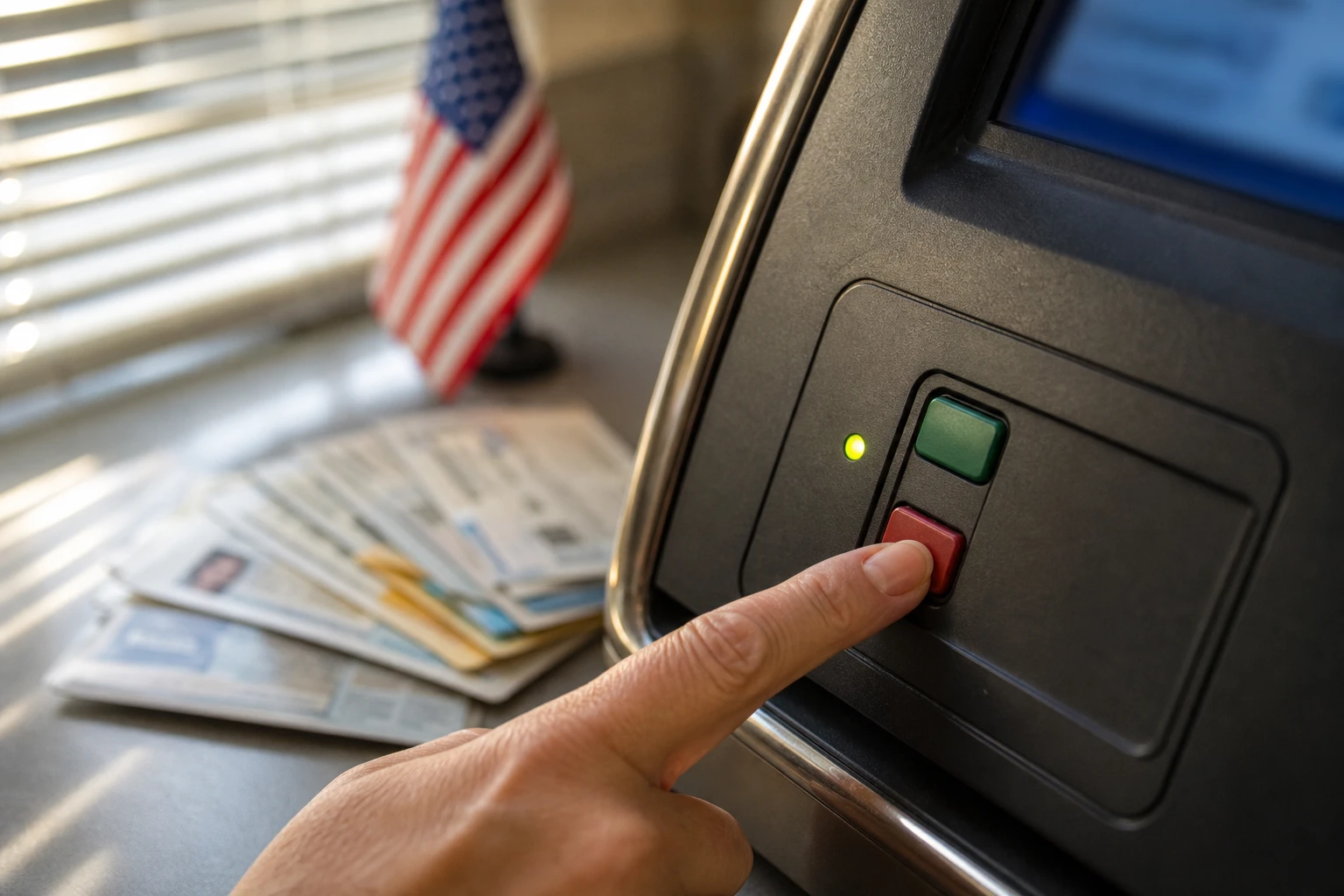
The error ran from June 2023 to June 2024, Sherrill said, entirely under her predecessor, Democratic Gov. Phil Murphy. New Jerseyans applying for a driver’s license or state ID were asked, on a keypad, whether they were U.S. citizens.
Those who answered no were registered to vote anyway. “These individuals answered ‘no’ when asked on a keypad whether they were a U.S. citizen when applying for drivers’ licenses and identification cards, but through no fault of their own, the system registered them anyway,” Sherrill said.
The registrations landed across the political map. Some were listed as Democrats, some as Republicans, others as unaffiliated, and they were scattered across the state, according to Sherrill.
Sherrill took office in January and said she learned of the failure only last week. “I am appalled by the reckless failures that allowed this to happen and the lack of transparency shown by those in charge at the time,” she said. She’s ordered her chief counsel to investigate and the roughly 6,600 names removed from the rolls.
Washington’s Two Different Numbers
Sherrill said she learned about the software failure on a Wednesday. Two days later, Homeland Security Secretary Markwayne Mullin sent his own letter claiming New Jersey had 35,152 noncitizens on its voter rolls, a figure more than five times Sherrill’s count.
The Department of Homeland Security gave the state two weeks to confirm its “intentions to collaborate with DHS in order to ensure free, fair, and honest elections.” Sherrill’s office asked Mullin for evidence behind that number and “heard nothing back,” she said.
President Donald Trump had used a primetime address from the White House the week before to press Congress on the SAVE America Act, which would add photo ID and proof of citizenship requirements to voter registration. White House spokeswoman Abigail Jackson said New Jersey’s disclosure “underscores the absolute necessity of the SAVE America Act.” “Democrats and their media allies have repeatedly said it is impossible for noncitizens to register to vote, let alone cast a ballot,” Jackson said. “Time and again, they have been proven wrong.”
Sherrill pushed back directly. “Donald Trump has zero credibility on the issue of election integrity,” she said, adding that while his administration “tries to weaponize elections for political gain,” she is “ensuring we protect our elections.”
What we know:
- Roughly 6,600 people were registered after telling the Motor Vehicle Commission they were not citizens, and about 400 of them voted between 2023 and 2024.
- The Justice Department has demanded identifying data on all 6,600 people within five business days, according to Democracy Docket, a legal news outlet that tracks election litigation.
What’s unconfirmed:
- DHS’s separate claim of 35,152 noncitizens on New Jersey’s rolls, which Sherrill’s office says it cannot verify.
- Which elections the roughly 400 voters took part in, or whether the outcome of any race changed.
- Whether any of the mistakenly registered noncitizens will face immigration consequences for an error that wasn’t theirs.
Local disputes over handing personal data to federal authorities aren’t new to New Jersey’s neighbors, either. Leon County, Florida’s fight over letting ICE tap license plate camera data drew similar objections earlier this year.
The People Who Did Nothing Wrong
Subtract the roughly 400 who voted from the 6,600 total, and about 6,200 people never cast a ballot at all. They answered a government form honestly and were registered anyway. Now their names sit inside a federal investigation.
- Full legal names, dates of birth and nationalities for all 6,600 people
- Home addresses and the dates and locations where each person registered
- For the roughly 400 who voted: when and where they cast a ballot
- Certifications and signatures attached to any mail-in ballots they submitted
Assistant Attorney General Harmeet Dhillon, who leads the Justice Department’s Civil Rights Division, made the request in a letter demanding names, birth dates and addresses posted to X. “Ensuring that U.S. citizens’ votes are not illegally diluted by noncitizens’ votes is of paramount importance,” Dhillon wrote to Sherrill.
Sherrill said she’s worried the disclosure could put those wrongly registered noncitizens at risk over their immigration status, even though they broke no law by telling the state they weren’t citizens. Her fear isn’t abstract. Immigration pressure is already squeezing other groups, including the Haitian temporary protected status holders in Georgia who are pressing Congress as their protections hang in court.
It would be the utmost in hypocrisy for the state to charge them when it’s our fault.
Sherrill said in her Tuesday statement, referring to the people the Motor Vehicle Commission’s own system registered by mistake.
A Vendor’s Reach Across State Lines
Idemia, the company whose software ran New Jersey’s registration system, pushed back on responsibility. In an unsigned statement, the Reston, Virginia-based firm said its “role is to transmit information through the motor vehicle system” and that New Jersey’s Division of Elections is “ultimately responsible for verifying eligibility to vote.”
That distinction matters because Idemia’s identity technology runs far beyond New Jersey. The company holds a newly redesigned license and ID contract with California, part of a relationship with the state that spans decades. It began producing Texas driver’s licenses and ID cards last year and supplies Arizona’s digital license platform.
New Jersey is done with the vendor regardless. Sherrill said the state has begun replacing Idemia with Thales, a French technology company, and Rosalie Johnson, the Motor Vehicle Commission’s chief administrator, said the new system isn’t expected to launch until next year.
How Does New Jersey’s Error Compare With Oregon and California?
New Jersey’s mistake is the largest of its kind reported in recent years, but administrative errors that register noncitizens do happen elsewhere. Oregon found more than 1,200 mistaken registrations in 2024, and California flagged about 1,500 back in 2018. In both of those cases, the number of people who actually voted stayed small.
| State | Year Disclosed | Noncitizens Registered | Confirmed Votes Cast |
|---|---|---|---|
| New Jersey | 2026 (error dated 2023-2024) | About 6,600 | About 400 |
| Oregon | 2024 | 1,200+ | 9 |
| California | 2018 | About 1,500 | Not publicly specified |
Experts say this kind of error happens rarely, given that the country has nearly 300 million registered voters. Even so, New Jersey’s tally runs several times larger than Oregon’s or California’s, and its investigation is unfolding under far more political pressure than either of those did.
A Legal Campaign the Justice Department Keeps Losing
New Jersey is already fighting the Trump administration in court over a related demand. The department sued the state earlier this year for refusing to turn over its complete, unredacted voter registration list, including addresses, birth dates and partial Social Security numbers. Dhillon’s letter said the new disclosure would serve as “an additional basis” for that demand, and that the department would notify the court handling the case.
The broader campaign hasn’t gone well for the department elsewhere. Democracy Docket reported the Justice Department has lost 16 straight district court cases seeking unredacted statewide voter files, with no judge yet ordering a state to hand one over.
The SAVE America Act, meanwhile, remains stuck. The bill requires documentary proof of citizenship to register for a federal election and would open election workers to criminal penalties for registering applicants who lack it. The House has passed versions of it repeatedly, and Republican leaders have also tried attaching it to must-pass defense spending legislation to pressure the Senate. It has cleared the House but has yet to pass the Senate despite several attempts.
Voting rights groups warn the documentary proof requirement would create its own error problem. The Brennan Center for Justice found more than 21 million voting age citizens lack ready access to a birth certificate or passport, the documents the act would require. The push for citizenship verification isn’t confined to voter rolls, either. The administration has separately floated a plan to force banks to check account holders’ citizenship status.
Thales’s new system isn’t expected to launch until next year. Until then, New Jersey’s voter rolls keep running on the same software that let 6,600 people onto them by mistake.
Frequently Asked Questions
Can Noncitizens Legally Vote in Any U.S. Elections?
Federal law bars noncitizens from registering or voting in federal and state elections, which is what New Jersey’s case involves. A small number of U.S. localities allow noncitizens to vote in narrowly defined local contests, such as certain school board races, but those programs are separate from the statewide rolls at issue here.
What Penalties Can Noncitizens Face for Registering or Voting by Mistake?
Federal law makes it a crime for a noncitizen to register or vote in a federal election, with potential fines, prison time and immigration consequences including deportation. Prosecutions are rare when the registration resulted from a government system error rather than an intentional false claim of citizenship, which is the scenario Sherrill has described in New Jersey.
Is New Jersey Ending Automatic Voter Registration at the DMV?
No. New Jersey Republicans have called for scrapping automatic registration at motor vehicle offices entirely, but Sherrill’s administration has only committed to replacing the software vendor and fixing the specific error, not ending the program that registers eligible voters through DMV visits.
Would the SAVE Act Have Prevented New Jersey’s Error?
Not directly. The bill’s core requirement is documentary proof of citizenship submitted at registration, a paperwork check rather than a fix for a backend software bug that overrode a citizenship answer already entered correctly on a keypad. Critics argue it targets a different failure point than the one New Jersey experienced.