
BUSINESS
Georgia Haitian Families Lost TPS After the Mullin Ruling
Haiti TPS ended July 27 after Mullin v. Doe, leaving Georgia Haitian families on invalid work cards Congress has not restored.

Haiti’s Temporary Protected Status ended on July 27, 2026, after a 6-3 Supreme Court ruling took most challenges to that cutoff out of the courts.
Georgia advocates had already gone to the state Capitol and asked Congress to write those protections into statute. The designation is now gone. Work cards tied to it are invalid. Weekly removal flights to Cap-Haitien have started.
A Friday Rally at the Georgia Capitol
The Haitian Bridge Alliance, a San Diego-based immigrant-rights group, set a nationwide day of action for July 9, 14 days after the justices spoke, with gatherings from San Diego to Boston, Miami, Chicago, and Washington. Atlanta’s piece of that push landed the next day, a Friday, on the Capitol steps, as U.S. Citizenship and Immigration Services posted a short work-permit notice that some in the crowd still hoped might buy time.
Judith Delus Montgomery, an immigration attorney with Atlanta Family Immigration Law, told the crowd that TPS itself is a congressional creation and that only Congress could put the status beyond a secretary’s reach.
Our hope is that Congress is going to step in. This is a rallying cry for Congress to finally take action because TPS was created by Congress. We need them to take a stance.
Judith Delus Montgomery, immigration attorney, at the Georgia Capitol
Guerline Jozef, executive director of the Haitian Bridge Alliance, had already put the same ask in plainer terms: “This is the time to show up. This is the time to call your senator.” The July rally at the Georgia Capitol was aimed at a delegation that already sat on both sides of a Haiti bill, including Sen. Raphael Warnock, a cosponsor of the Senate companion, and Rep. Rich McCormick, one of 10 House Republicans who had voted in April to force a three-year Haiti designation.
Montgomery said many members of Georgia’s Haitian and Syrian communities still feared a future cutoff even if a notice bought a few more weeks. She also said the administration’s posture toward Haitian TPS “is based in racism,” a constitutional claim the Supreme Court had already said was unlikely to succeed. That legal fight is still on a district-court docket. The status is not.
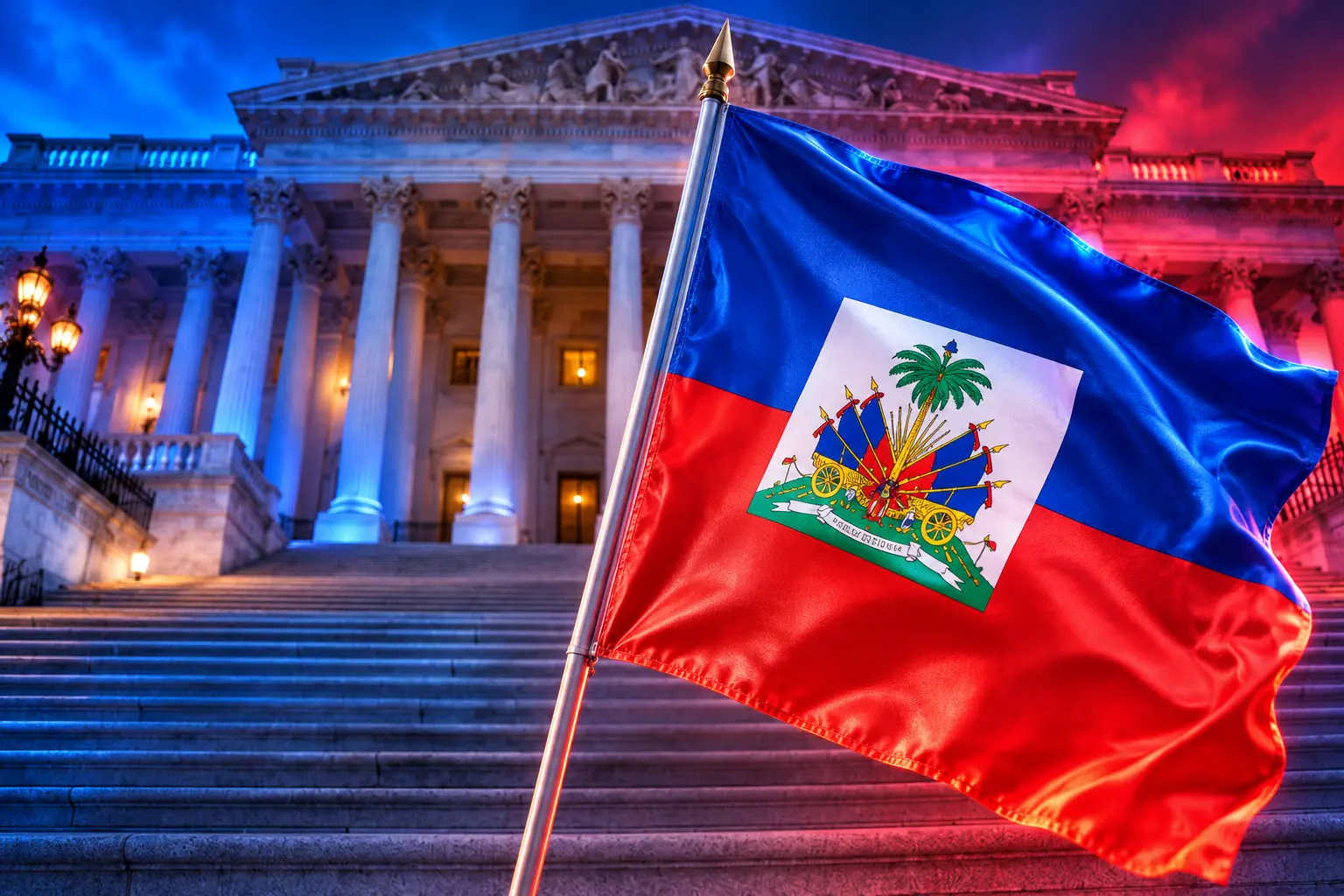
Mullin v. Doe Left Termination to the Secretary
The case, argued April 29 and decided June 25, consolidated challenges to Homeland Security’s 2025 cutoffs for Haiti and Syria. Secretary Kristi Noem had found both countries no longer met the statutory test, publishing Haiti’s termination at 90 Fed. Reg. 54733 on Nov. 28, 2025, with an effective date of Feb. 3, 2026, and a Syria notice at 90 Fed. Reg. 45398. U.S. District Judge Ana C. Reyes in Washington stayed the Haiti cutoff on Feb. 2 in Miot v. Trump. A New York court had already paused Syria’s.
Justice Samuel Alito wrote that 8 U.S.C. §1254a(b)(5)(A) allows “no judicial review of any determination” on the designation, extension, or termination of a foreign state. “The TPS statute plainly bars consideration of respondents’ non-constitutional claims,” he wrote. The Court also held that Haitian plaintiffs were unlikely to win an equal protection claim that race drove Haiti’s cutoff, pointing to a race-neutral account: the administration opposes how TPS has been used and has moved to end designations as they come up for renewal. Justice Elena Kagan dissented, joined by Justices Sonia Sotomayor and Ketanji Brown Jackson.
Haiti first received TPS in 2010 after a 7.0 earthquake. Syria’s designation dated to 2012. Sixteen years of Haiti renewals sat behind the political fight that followed the ruling, and behind Sen. Eric Schmitt’s later claim that Washington had redefined “temporary.”
THE CLOCK AFTER MULLIN
- Nov. 28, 2025: Homeland Security publishes the Haiti TPS termination notice, set to take effect Feb. 3, 2026.
- Feb. 2, 2026: Judge Reyes stays the Haiti termination in Miot v. Trump.
- April 16, 2026: The House passes H.R. 1689, directing a Haiti designation through April 20, 2029.
- April 29, 2026: The Supreme Court hears Mullin v. Doe, consolidated with Trump v. Miot.
- June 25, 2026: The Court rules 6-3 that judges may not review most TPS termination claims.
- July 10, 2026: USCIS tells employers Haitian TPS work permits remain valid through July 24 under the remaining court order.
- July 22, 2026: Schmitt objects to unanimous consent on the House Haiti bill.
- July 27, 2026: USCIS treats Haiti and Syria TPS as ended; A12 and C19 cards are no longer valid.
- Aug. 5, 2026: Reyes confirms her stay is gone after an Aug. 4 D.C. Circuit mandate, and keeps discovery open.
The holding left constitutional claims technically alive and stripped the Administrative Procedure Act challenges that had stopped prior cutoffs. Lower-court pauses that had carried Haitian and Syrian work permits through the spring no longer had a Supreme Court floor under them.
What the July 10 Notice Covered
On July 10, USCIS told employers that Haitian TPS employment authorization documents remained valid through July 24 under the remaining district-court order. The agency called that limited relief until lower courts aligned with Mullin. Payroll offices were told to enter “as per court order” and the July 24 date on Form I-9.
That Friday patch is what met the Atlanta rally. It kept cards alive for two weeks. It did not redesignate Haiti, open a new registration window, or restore judicial review. On July 29, USCIS posted a superseding alert: the Haiti TPS designation is terminated, effective July 27, and A12 and C19 cards issued to Haitian TPS holders are no longer valid. A matching Syria alert used the same effective date.
Judge Reyes, on Aug. 5, wrote that her February stay was no longer in effect once the D.C. Circuit sent Miot back for proceedings consistent with Mullin. She denied the government’s request to pause discovery. Fritz Emmanuel Lesly Miot’s case continues. Haiti’s designation does not. Homeland Security General Counsel James Percival said the protections had already expired when the Supreme Court’s mandate issued July 27, and that Reyes’s order merely acknowledged that.
224 House Votes, Then One Senate Objection
Before the justices ruled, the House had already passed H.R. 1689, introduced by Rep. Laura Gillen, a Democrat from a Long Island district with a large Haitian community. The bill would require the secretary to designate Haiti for TPS through April 20, 2029. Senators Edward Markey and Lisa Blunt Rochester, with Chuck Schumer and 16 colleagues including Warnock, brought a Senate companion, S. 4814, in June.
On July 22, Markey asked unanimous consent to pass the House bill. Schmitt objected. “Washington has invented a new definition of temporary. It means permanent,” he said. “Haitian TPS was supposed to be just 18 months when it began in 2010. Sixteen years later, 350,000 Haitians are still here.” He called the United States “not a global refugee camp” and said voters had endorsed an end to the program.
Washington has invented a new definition of temporary. It means permanent. Haitian TPS was supposed to be just 18 months when it began in 2010. Sixteen years later, 350,000 Haitians are still here.
Sen. Eric Schmitt, R-Mo., on the Senate floor
Rep. Mike Lawler, a New York Republican who voted for H.R. 1689, split with that view on the same afternoon the Court ruled. He said he did not dispute a president’s power to end TPS, and that he still opposed ending Haitian status while gangs control large parts of the country and the State Department keeps a Level 4 “do not travel” advisory in place. He also said a sudden cutoff would hit hospitals, nursing homes, and disability-care staffing.
While I have never disputed the ability of the President to end Temporary Protected Status (TPS), I strongly disagree with ending Haitian TPS at this time.
First, the situation on the ground in Haiti is a humanitarian and political disaster and continues to warrant an extension.… https://t.co/MRKsa19prQ
— Mike Lawler (@lawler4ny) June 25, 2026
The staffing argument is now the fight. Hospitals and home-care agencies built schedules around a status the 1990 statute always called temporary. That dependence is why some members want more time, and why others say the 16-year run is the reason to stop using TPS as a standing labor program. Alexandra Audate, an Atlanta-area immigration attorney, said Haitian workers had filled many elder-care jobs in Georgia and that U.S. citizen clients in their 90s were losing caregivers.
WHERE THE BILLS STAND
| Measure | What it would do | Where it stands |
|---|---|---|
| H.R. 1689 | Require a Haiti TPS designation through April 20, 2029 | House passed 224 to 204 on April 16, 2026, with 10 Republicans, including McCormick of Georgia and Lawler of New York |
| S. 4814 | Senate companion for a three-year Haiti designation | Introduced June 17, 2026, by Markey and Blunt Rochester; unanimous consent blocked July 22 |
| TPS Review Act | Restore judicial review of terminations and keep status in place during litigation | Announced after Mullin by Rep. Debbie Wasserman Schultz; no floor vote |
A later, broader attempt by Sen. Chris Van Hollen to move green cards for TPS holders also drew a Schmitt objection on July 29. Neither Haiti bill has reached a Senate majority vote. Warnock remains on the companion. McCormick’s House vote has no Senate echo from Georgia’s other senator on a recorded floor roll call.
WHERE OFFICIALS DISAGREE
- Lawler: Haiti remains unsafe under a Level 4 advisory, and he says a large share of Haitian TPS holders work in health care, so any cutoff should leave work permits in place while cases are heard.
- Schmitt: Sixteen years of renewals show TPS is being used as a path to stay, and the Court’s ruling should be carried out rather than rewritten on the floor.
- Noem’s 2025 finding: After consulting other agencies, she determined Haiti and Syria no longer met the statutory conditions for designation, the conclusion USCIS later executed.
Replies to Lawler’s post made the same staffing point as an argument against another extension: if whole wards rest on a temporary status, the hiring model is the problem. That is now the live congressional dispute, because Mullin left almost no other forum.
Gwinnett Churches Now Plan for Returns
Metro Atlanta holds the country’s fifth-largest Haitian population, about 14,500 people in the metro area by Atlanta Regional Council figures and more than 42,000 statewide on Census counts. Not all of them held TPS. A National Immigration Forum compilation listed 50,110 TPS holders in Georgia of every nationality as of March 31, 2025, among 1.3 million people nationwide who held the status that spring.
Enjyvely Senatus said lunch and delivery traffic at his father’s Decatur restaurant, Manje Lakay, dropped by about half after Haitian TPS ended. “Both deliveries and walk-ins have been pretty much cut in half,” he said. Customers who used to stop on a lunch break were staying home, he added, because jobs had been cut and cash had tightened.
The Deportation Data Project, which had records through July, found ICE personnel arresting around 10 Haitian citizens living in Georgia each month across the first seven months of 2026. Community leaders told local pastors the pace rose after late June. The monthly count is still small next to the national Haitian TPS population. The work-card cutoff is not. Employers must reverify A12 and C19 cards that USCIS says are no longer valid, which is how a restaurant’s lunch line thins before a removal flight is booked.
Rev. Jean Billy Beaufils, president of the Georgia Haitian Leadership Coalition, has been organizing around Haitian TPS since 2017. He said many people still have nothing to return to from the 2010 quake, and that almost every Haitian congregation in the metro now has a family in the mix.
We have seen more and more leaders come to put their heads together because almost every church in Atlanta and around the metro has someone or a family impacted by the TPS decision.
Rev. Jean Billy Beaufils, president, Georgia Haitian Leadership Coalition
One of those congregations is Good Samaritan Haitian Alliance Church in Lawrenceville, a Gwinnett church that has grown over 30 years into one of the metro’s largest Haitian parishes. Rev. Mardochee Pardieu, who leads its response ministries, helps families find housing and work, learn English, and get health care. “Daily we receive the news that so and so has been in court or in an ICE appointment and they are being braceleted,” he said.
WHAT ATLANTA CHURCHES ARE DOING NOW
- Local networks: Beaufils and the Haitian Evangelical Clergy of Georgia have widened their roster of pastors so congregations can share case news and legal referrals.
- Haiti-side contacts: The same clergy group is linking with organizations in Haiti that can meet people after a removal flight lands.
- Parish services: Pardieu’s team still runs housing, job, English, computer, and clinic help for families who have lost work permits and for those who remain.
Beaufils called the June ruling devastating for TPS holders and for U.S. citizens and green-card holders in the same pews. Cassandra Charles, a Haitian American civil rights attorney in Atlanta, said people who have spent the last 16 years working and raising children here are now in an uncertain space. The churches cannot restore a designation. They are preparing for who gets a monitor, who loses a shift, and who gets a plane.
Weekly Flights Into Cap-Haitien
The Haitian Bridge Alliance said a July 16 flight carried 111 people into Cap-Haitien, and that U.S. officials had told Haiti to expect at least two flights a week after TPS expired. Trackers later described a Thursday rhythm from Alexandria, La., beginning Aug. 20. Haiti’s National Office for Migration counted 529 people on the first six of those post-cutoff flights, including 39 on Sept. 24. A seventh flight, GXA6121, landed Oct. 1.
That pace is a weekly drip against a Haitian TPS population the Court fight put in the hundreds of thousands. It is still a scheduled pipeline into a country the State Department tells U.S. citizens to leave. HBA, Human Rights Watch, and Amnesty International took that mismatch to a Senate briefing on Sept. 28. The bills they want remain the same ones Schmitt blocked in July.
THE POST-CUTOFF COUNT
- Syrian TPS holders: About 6,000 people lost the companion designation on the same July 27 effective date.
- Georgia ICE arrests: Around 10 Haitian citizens a month in the state from January through July, per the Deportation Data Project, with pastors reporting a faster clip after late June.
- Counted removals: Haiti’s National Office for Migration tallied 529 people on six flights after the cutoff; the Oct. 1 aircraft was a seventh and did not yet carry a public passenger total in the tracker log.
- Work documents: USCIS says Haitian and Syrian A12 and C19 employment cards are no longer valid, which is the I-9 problem facing Georgia employers first.
A seventh removal flight landed at Cap-Haitien on Oct. 1. H.R. 1689 and S. 4814 are still sitting in the Senate. Judge Reyes still has a discovery schedule. She no longer has a stay.
Disclaimer: This article is news reporting and analysis of court rulings, agency notices, and public statements about Temporary Protected Status. It is informational only and is not legal advice, is not an assessment of any person’s immigration case, and is not a recommendation to file, withdraw, or delay any application. Readers who hold TPS, a related work permit, or another form of humanitarian status, or who employ workers with those documents, should consult a licensed immigration attorney or accredited representative before acting on dates, card validity, or filing options. Figures, docket statuses, and agency instructions reflect the cited government notices, court orders, and statements as published and can change with new Federal Register notices, court orders, or legislation.

The Court Revisits the Climate Nuisance Door It Left Open

ChatGPT Now Compiles Live Interfaces With GPT-6

A Tanker Attack Moves the War Into Qatar’s Waters

Personio Buys Circula to Own the DATEV Channel

Bluesky Files for .bsky and Enters the Registry Queue

Microsoft’s 96% Cyber Score Sits at 86.3% on the Board

Musk’s $914 Billion Lead Is a Public SpaceX Bet

Free Live Sports Streaming in 2026: What to Watch Without Cable

The Odyssey’s IMAX Film Run Hit a 41-Theater Limit

Endgame Encore’s $86 Million Trial for Infinity Vision
-
 NEWS3 months ago
Microsoft’s 96% Cyber Score Sits at 86.3% on the Board
-
 BUSINESS5 months ago
Musk’s $914 Billion Lead Is a Public SpaceX Bet
-
 SPORTS4 months ago
Free Live Sports Streaming in 2026: What to Watch Without Cable
-
 ENTERTAINMENT3 months ago
The Odyssey’s IMAX Film Run Hit a 41-Theater Limit
-
 ENTERTAINMENT4 months ago
Endgame Encore’s $86 Million Trial for Infinity Vision
-

 ENTERTAINMENT2 years ago
Andrew Garfield’s Spider-Man Films Are No Longer Free
-

 NEWS5 months ago
Singapore’s 3×3 and Surfing Debuts Miss the Medal Stand
-

 NEWS7 months ago
White Sands Footprints Put People in Ice Age New Mexico