America turns 250 on July 4, 2026, and the marquee federal events land in New York Harbor, on the National Mall and inside a UFC cage at the White House. Philadelphia, where the Second Continental Congress adopted the Declaration of Independence in 1776, hosts a yearlong slate of festivals, fireworks, parades and the long-delayed reopening of the First Bank of the United States on July 1 after a $43 million restoration, per the National Park Service.
That program is the inheritance of a city that financed the Revolution and then invented most of the financial plumbing the rest of the country still uses. Philadelphia was the largest city in the United States when the Constitution was ratified in 1789, the seat of the federal government through 1800, and the headquarters of the first commercial bank, the first federally chartered central bank, the first organized stock exchange, the first mutual savings bank, the first savings and loan association, and the first federally chartered national bank. Almost none of those institutions remain under Philadelphia roofs today, and the financiers whose personal fortunes underwrote American independence barely appear in the semiquincentennial program.
Philadelphia Banked the Revolution Into Existence
On May 17, 1781, the Superintendent of Finance Robert Morris laid out a plan for a national bank to keep the Continental Army supplied. Congress chartered the Bank of North America on December 31, 1781, and the institution opened its doors on January 7, 1782, at 307 Chestnut Street in Philadelphia, according to the Federal Reserve Bank of Richmond’s 2026 economic history series. The bank functioned as the nation’s first true commercial bank and its first congressionally chartered national bank.
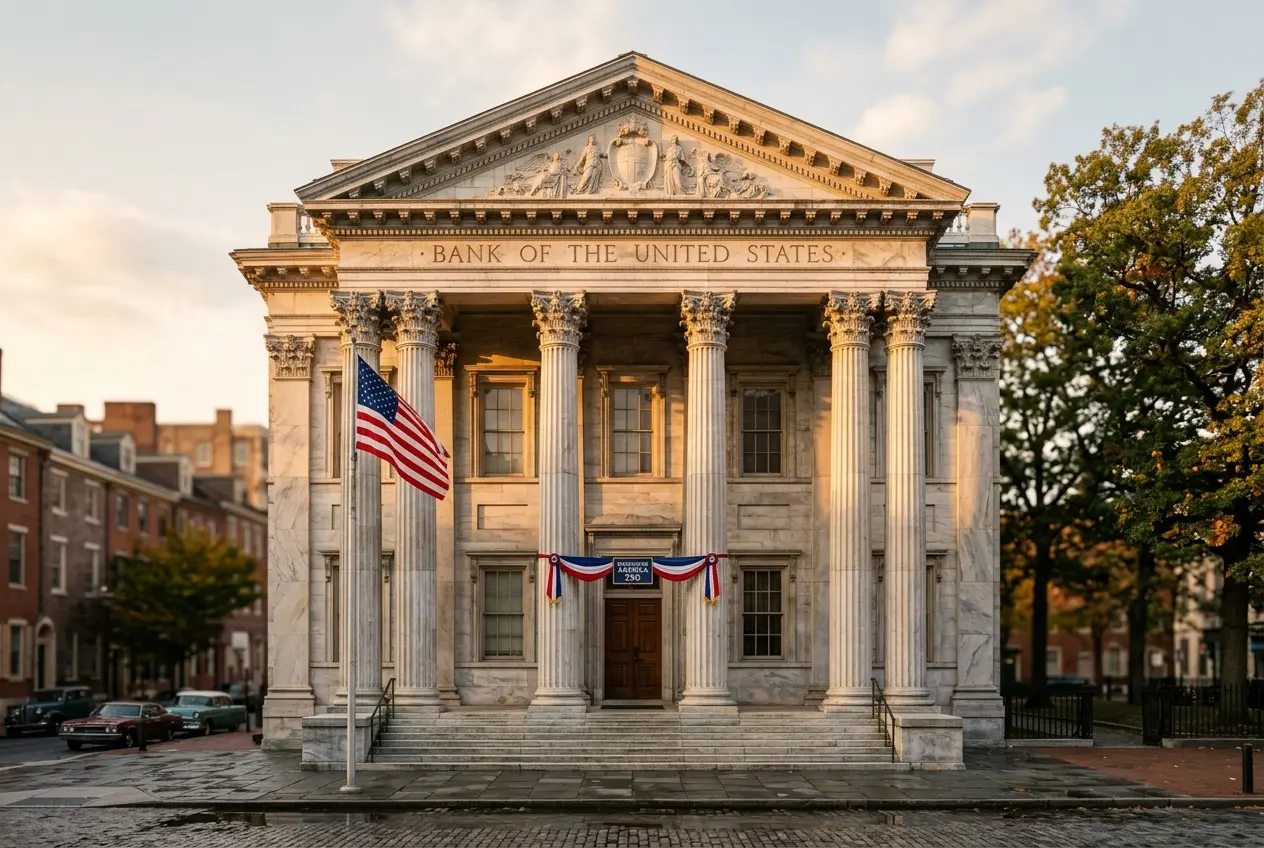
A decade later, Treasury Secretary Alexander Hamilton pushed through what became the First Bank of the United States. Congress chartered it on February 25, 1791, and the bank opened for business in Philadelphia on December 12, 1791, with a 20-year charter and a capital stock of $10 million. Branches followed in Boston, New York, Charleston and Baltimore, giving the federal government for the first time an instrument to manage war debt, hold federal deposits and issue a uniform currency.
Philadelphia was where Hamilton’s experiment lived. The same building that had housed the Bank of North America then anchored the central bank. Brokers and merchants in the city financed regiments, supplied the army, and brokered the loans that kept the war alive alongside financiers such as Morris and, later, Stephen Girard, the French-born merchant and banker who underwrote much of the War of 1812 and whose estate would fund Girard College. The institutions and the men behind them turned a fragile new republic into a creditworthy borrower.
Six Firsts That Built American Banking
No other American city in the late 18th and 19th centuries matched Philadelphia’s run of financial firsts. In about 80 years the city produced the founding documents of modern American banking, each of them later absorbed, copied or supplanted.
| Year | Institution | What it was the first to do | What the name traces to today |
|---|---|---|---|
| 1781 | Bank of North America | First commercial bank and first congressionally chartered national bank in the United States | Charter lineage ended; its building was succeeded by the First Bank of the United States at the same Chestnut Street site |
| 1790 | Philadelphia Board of Brokers | First organized stock exchange in the country, predating the New York Stock Exchange | Still operates today as the Nasdaq PHLX options market |
| 1791 | First Bank of the United States | First federally chartered central bank | Building at 120 S. 3rd St. reopened as a museum on July 1, 2026 |
| 1816 | Second Bank of the United States | Second federally chartered central bank, chartered under President James Madison in April 1816 | Building preserved on Chestnut Street as a portrait gallery |
| 1816 | Philadelphia Saving Fund Society (PSFS) | First savings bank to organize and do business in the United States | Seized by the FDIC on December 11, 1992; assets sold to Mellon Financial for US $335 million; name retired by 2001 |
| 1831 | Oxford Provident Building Association | First savings and loan association, formed in Frankford, Philadelphia | Converted to a stock company and eventually merged into later institutions |
| 1863 | First National Bank of Philadelphia | First federally chartered national bank under the new Office of the Comptroller of the Currency; received charter number 1 on June 20, 1863 | Today held by Wells Fargo, which acquired Wachovia in 2008 and traces the charter through First Pennsy, CoreStates, First Union and Wachovia |
The rows together explain why Philadelphia is described as the birthplace of American banking. The 1863 charter matters especially because it was the first one the Treasury’s new Office of the Comptroller of the Currency ever issued, the first national bank charter, issued June 20, 1863, to financier Jay Cooke’s Philadelphia institution. That single charter number, originally held by a Pennsylvania bank to help finance the Union Army, is now the foundation of Wells Fargo’s oldest national charter.
How the Cradle Lost the Crown
By the 1850s Wall Street had overtaken Philadelphia for good, and it never gave the lead back. The shift took a generation and a stack of self-inflicted wounds, as catalogued by John Steele Gordon for the ABA Banking Journal in December 2024.
The federal government’s slow drift south took capital with it: Jeffersonians killed the First Bank’s recharter in 1811, and Andrew Jackson destroyed the Second Bank in 1836, removing two of the largest pools of capital Philadelphia ever hosted. In 1825 New York opened the Erie Canal through the only gap in the Appalachians, rerouting western commerce from the Mississippi and New Orleans through the Hudson and Manhattan. In the Panic of 1837 Pennsylvania defaulted on a $20 million state debt, devastating the reserves of big Philadelphia banks that had loaded up on Pennsylvania bonds, while New York banks on $2 million of state debt survived on Erie Canal tolls. Samuel Morse’s telegraph, commercialized in the 1840s, let buyers and sellers reach the largest market in real time, and the largest market was now on the Hudson.
Local Banks Disappeared One by One
By the late 20th century the names that had dominated Philadelphia’s skyline, First Pennsylvania, Girard, Provident National, Philadelphia National, were already gone. What followed was a cascade of mergers that ended with no major commercial bank headquartered in the city.
- April 1998, Charlotte-based First Union acquired CoreStates Financial Corporation, then Philadelphia’s biggest locally headquartered bank holding company.
- September 1, 2001, First Union merged with Wachovia Corporation and adopted the Wachovia name, dropping First Union from every branch sign and statement.
- December 11, 1992, federal regulators seized the 176-year-old Philadelphia Saving Fund Society and sold its remaining assets to Mellon Financial for US $335 million; the PSFS name survived on Pittsburgh branches only until 2001.
- March 2008, Toronto-Dominion Bank completed its acquisition of Commerce Bancorp of Cherry Hill, New Jersey, the bank founded in 1973 by Vernon Hill, a former Burger King franchisee who branded every branch as a store and gave away lollipops and dog biscuits to compete on friendliness.
- December 31, 2008, Wells Fargo acquired Wachovia, ending the Wachovia name and pushing the remnants of CoreStates, First Pennsylvania and Philadelphia National into a San Francisco holding company; the original 1863 charter number 1 the 1781 chartering of the Bank of North America was the upstream event that ran through every step.
Through every step, the criticism locals leveled at First Union, service, hours, fees, decisions made in Charlotte that Philadelphians learned about on television, was blunt enough that the bank picked up a nickname. The deal that produced that nickname is the one that put the city’s last big local bank inside a Charlotte building. When First Union in 2001 picked the Wachovia name, it dropped its own; when Wachovia failed and was absorbed by Wells Fargo in 2008, the Charlotte and Philadelphia identities both ended up on Wells Fargo’s California headquarters.
What the 250th Actually Looks Like
Washington, New York and Philadelphia are the three U.S. cities repeatedly named in federal semiquincentennial legislation as “leading cities,” and the program reflects that ordering. Washington hosts the Great American State Fair on the National Mall, a UFC Freedom 250 card at the White House, the Freedom 250 Grand Prix, military parades and a string of made-for-television spectacles. New York stages Sail250 in New York Harbor on July 4, an international fleet review billed as the largest in U.S. history with about 60 ships from 30 countries, plus a one-off Times Square ball drop on July 3, 2026, counting down to midnight in every U.S. time zone, and the Macy’s 4th of July Fireworks.
Philadelphia’s marquee moment of the week is the reopening of the First Bank of the United States on July 1, 2026, after a multi-year, $43 million restoration led by Independence National Historical Park and the Independence Historical Trust. Federal funding of $39.3 million came through the Great American Outdoors Act Legacy Restoration Fund, with an additional $4.5 million from the Trust. “For more than two centuries, the First Bank building has stood as a symbol of the nation’s transition from revolution to republic,” said Steve Sims, superintendent of Independence National Historical Park, in the May 2026 reopening announcement. The Trust’s communications director, Tom Caramanico, framed the partnership as “public investment and private philanthropy working together in service of preservation and public access.” Around the city, Visit Philly is running a yearlong “the $43 million restoration of the First Bank building” anchored by the reopened landmark.
A Banking Colony on the Delaware
Philadelphia is the sixth most populous city in the United States, with no major commercial bank listed among its largest corporate employers. The charters that its financiers created are operated from Charlotte, San Francisco, Toronto and Pittsburgh, and the names Philadelphians used to bank under have been folded into out-of-state brands.
What New York kept that Philadelphia lost is the headquarters. The New York banks still write checks and trade securities from Manhattan blocks named for their founders. Philadelphia’s skyline once carried comparable names, First Pennsylvania at 15th and Chestnut, Girard at Broad and Walnut, Philadelphia National at Broad and Chestnut, and today those addresses hold retailers, restaurants and apartments rather than banks. The 1790 the 1790 founding of the Philadelphia Board of Brokers still trades options as Nasdaq PHLX, but the floor where brokers once gathered is part of a Florida-based exchange.
The July 1 reopening of the First Bank of the United States puts the marble building where Hamilton’s experiment first lived back on the Independence Park campus at the same moment the program also acknowledges the 1876 Centennial, the 1926 Sesquicentennial and the 1976 Bicentennial, per the NPS reopening announcement. The building’s installation now treats the financial founding as part of the same civic story as the Declaration, and the absence of programming around the financiers whose personal fortunes funded the war is the part of the program the city still has not booked.
Frequently Asked Questions
What was the first bank in the United States?
The Bank of North America, chartered on December 31, 1781, on a plan submitted by Superintendent of Finance Robert Morris on May 17 of that year. It opened for business on January 7, 1782, at 307 Chestnut Street in Philadelphia and operated as the nation’s first commercial bank and its first congressionally chartered national bank.
When did Philadelphia lose its financial primacy?
The shift took roughly 1836 through 1850, driven by the destruction of the Second Bank of the United States, the 1825 opening of the Erie Canal, the 1837 panic and the spread of the telegraph. By the 1850s Wall Street was the only market that mattered.
What is the First Bank of the United States, and is it open to the public?
It was the first federally chartered central bank, chartered on February 25, 1791, by Congress and signed by President George Washington on Treasury Secretary Alexander Hamilton’s recommendation. Its marble building at 120 S. 3rd St. in Philadelphia reopened to the public on July 1, 2026, after a $43 million restoration paid for by the National Park Service and the Independence Historical Trust.
Are any major banks still headquartered in Philadelphia?
No. The CoreStates → First Union (1998) → Wachovia (2001) → Wells Fargo (2008) chain, and the independent Commerce Bancorp → TD Bank (2008) deal, ended with every large Philadelphia commercial bank charter run from another city.
What banking firsts happened in Philadelphia?
Between 1781 and 1863 Philadelphia launched the first commercial bank, the first organized stock exchange, the first federally chartered central bank, the second federally chartered central bank, the first mutual savings bank, the first savings and loan association and the first federally chartered national bank.
What does the 250th anniversary have to do with banking?
Federal legislation designates Boston, New York, Philadelphia and Charleston as the “leading cities” for semiquincentennial events. Philadelphia’s marquee event of the week is the July 1 reopening of the First Bank of the United States, and the city’s yearlong program includes a “52 Weeks of Firsts” civic series that runs alongside the larger national events in Washington and New York.