Google’s first new smart speaker in six years landed on store shelves on June 25, 2026, priced at $99 under a new name: the Google Home Speaker. The launch came days after Google confirmed it had ended production of both the Nest Mini and the Nest Audio. Existing Nest owners will keep receiving software updates and security patches, but the entry-level and mid-tier speakers are gone from Google’s official lineup. In their place is one device meant to replace both, and a side-by-side look at the hardware shows why Google’s own $99 price point now buys less audio hardware than it did six years ago.
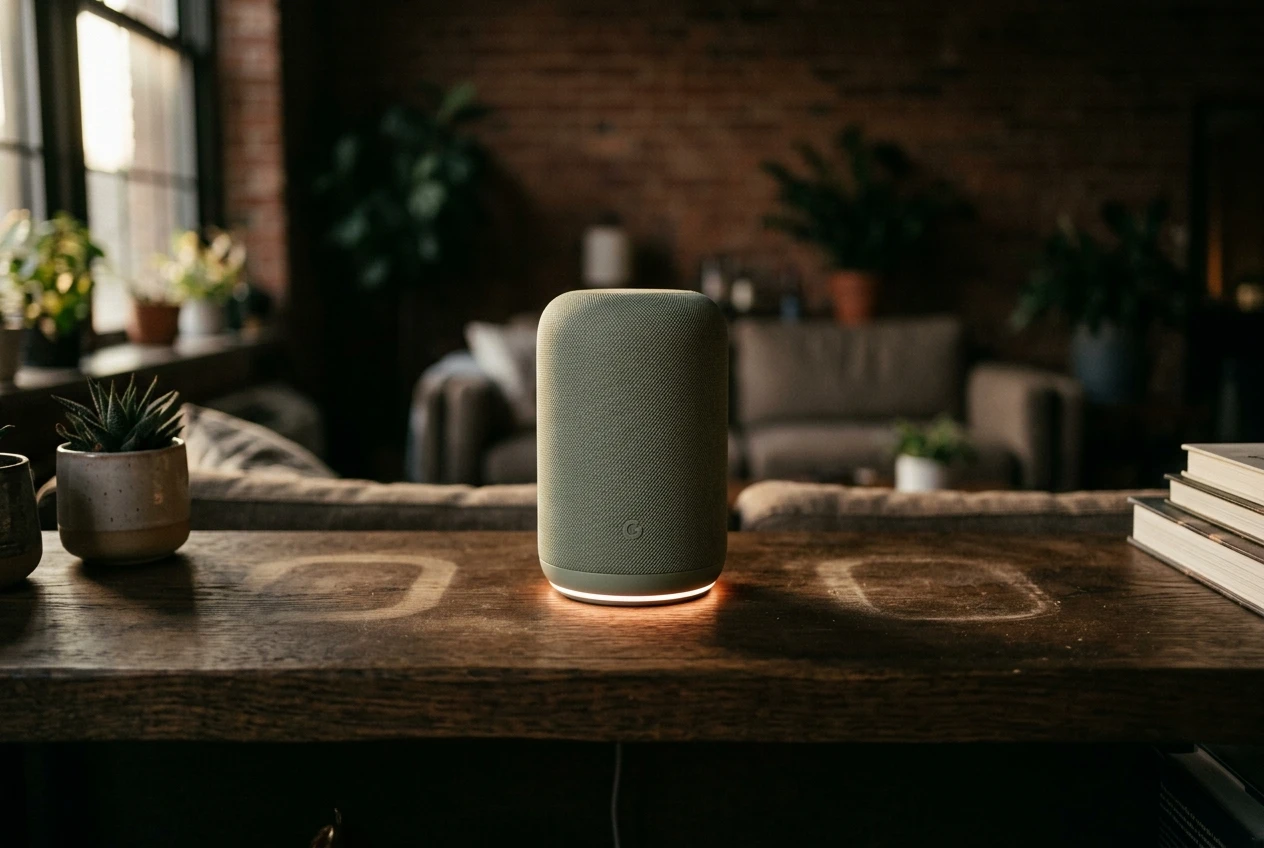
The new speaker has a single 58mm full-range driver firing 360-degree audio, with Gemini built in for conversational voice control. The Nest Audio it replaces, at the same $99 launch price, shipped in 2020 with a 75mm woofer and a 19mm tweeter. Google’s own marketing leans on the line that the Home Speaker delivers “2.5 times the bass” of the Nest Mini, a comparison that sidesteps the more flattering rival it could have made at the same shelf price. The Home Speaker is available to pre-order now and ships on June 25, per Google Home Speaker launch details and pricing. Available colors include Porcelain, Hazel, Jade, and Berry, with Jade and Berry exclusive to the US market.
What Google Launched, and What It Killed
The Google Home Speaker went up for pre-order the same day Google ended production of its two older speakers, and shipped to stores on June 25. It carries a 58mm driver, three far-field microphones, a neural processing unit for on-device sound isolation, and a Matter controller that can manage smart home devices without an extra hub. The light ring beneath the speaker glows to show when Gemini is listening, thinking, or responding, replacing the four hidden dots that the Nest Audio used.
On June 17, Google confirmed to TechAdvisor that production of the Nest Mini and Nest Audio had ended, per the end of Nest Mini and Nest Audio production. A company spokesperson framed the cuts as portfolio cleanup: “As we continue to build the future of the smart home, we are refining our portfolio of Google Home and Nest devices. As part of this evolution, we have ended production of the Google Nest Mini and Google Nest Audio.” Google added that “Existing Nest Mini and Nest Audio devices will continue to be fully supported with regular software updates, security patches, and customer care.” For buyers walking into the Google Store today, the Nest Mini and Nest Audio are no longer on the shelf.
The Nest Mini launched in 2019 with a 40mm driver and a $49 retail price, eventually adding Gemini support. The Nest Audio arrived in 2020 with a dual-driver design and the same $99 price point the Home Speaker carries today.
The Hardware Downgrade Google Doesn’t Publicize
Google’s “2.5 times the bass” line is measured against the Nest Mini, not the Nest Audio: the Home Speaker’s 58mm driver is more than twice the surface area of the 40mm driver inside the older puck, and bass output scales with cone area. The marketing team picked the comparison that flatters the new product. The comparison that matters at the same $99 price point tells a different story.
The Nest Audio, launched in 2020, paired a 75mm woofer with a 19mm tweeter: a woofer handles low frequencies; a tweeter handles the highs. The Home Speaker has neither dedicated driver. It has one 58mm full-range unit asked to do the work of two, balanced by software tuning. ZDNet’s Maria Diaz put it plainly after her 48-hour test of the new speaker: “Considering that the new Google Home Speaker sits squarely in the same $100 price range as the Nest Audio, I’d say the concern is valid.”
Android Police’s Jon Gilbert spelled out the same numbers the day the Home Speaker shipped: “Not only is the Nest Audio’s driver nearly twice as big as the Home Speaker’s, but its 19mm tweeter is completely missing on the Home Speaker.” He summed up the result: “the Home Speaker might have 360° audio, but it won’t offer the same oomph as the Nest Audio.”
Six years apart, same MSRP, one fewer driver. The Home Speaker asks buyers to trade a dedicated tweeter and a larger woofer for a single 58mm full-range cone and a 360-degree output pattern. The spec sheet is worse in every category that an audio-first buyer cares about.
| Speaker | Launch price | Driver setup | Status |
|---|---|---|---|
| Nest Mini (2019) | $49 | 40mm single driver | Production ended June 2026 |
| Nest Audio (2020) | $99 | 75mm woofer and 19mm tweeter | Production ended June 2026 |
| Google Home Speaker (2026) | $99 | 58mm full-range driver | On sale |
Why One Driver Cannot Match Two
Audio engineers split woofers and tweeters for a reason: a 58mm full-range cone cannot move as much air at low frequencies as a dedicated 75mm woofer, and without a separate tweeter the highs get rolled off to keep the driver from distorting. The result is a flatter, more uniform sound that fills a room in every direction.
The Home Speaker’s pitch is 360-degree output, which has its own use case. A speaker placed in the middle of a room reaches every listener equally, and pairing two units creates a stereo pair, or links them with a Google TV Streamer for spatial surround. For a speaker parked against a wall in a kitchen or bedroom, the 360-degree design is largely wasted. Most buyers place smart speakers in corners, where a front-firing design like the Nest Audio projects more directly at the listener than a 360-degree driver that loses half its output to the wall behind it.
Independent reviewers heard the gap. ZDNet’s Maria Diaz, comparing the Home Speaker to the Apple HomePod mini in her 48-hour test (see the 48-hour audio test of the new Home Speaker), said Google’s speaker “falls a bit flat on audio and can’t beat Apple’s microphone performance and quality.” Android Police framed the trade as a category shift: “The Home Speaker feels like a throwback to the original Google Home speaker, which was marketed as a Google Assistant-first, audio-second device.” Google has built a voice-first speaker at a price that used to buy a music-first one.
The Same Pattern Is Coming for Smart Displays
The speaker consolidation has a near-term sequel that Google has not announced, only hinted at. In May 2026, references to a “Google Home Display” appeared in the code of the Google Home app for iOS, spotted by app researcher @aaronp613 from MacRumors, with naming that tracks the Home Speaker: drop the Nest badge, lean on Google Home branding, ship one new device where two or three used to live.
The smart display lineup Google would need to streamline is already showing cracks: Google has not launched a new Nest Hub since the second generation arrived in 2021, while the Nest Hub Max, larger and older, is still on sale. The Pixel Tablet, launched as a 2023 experiment, doubles as a smart display when docked, and Joe Maring at Android Authority reported in June 2026 that the device is out of stock at the Google Store. Google Home Chief Product Officer Anish Kattukaran did say late last year that Google is still committed to smart displays and would have more to share “soon” as Gemini integration deepens, per the Google Home Display leak from May 2026.
What $99 Gets You in 2026
The Home Speaker is a workable device on its own terms. The Gemini integration is the strongest of any voice assistant shipping in a smart speaker today, and Maria Diaz wrote that “Conversations in general with the Google speaker feel more natural than any other smart device I’ve tested in my home.”
The hardware is where the value comparison breaks. Where the Nest Audio had dedicated drivers for highs and lows, the Home Speaker has one driver. Where the Nest Mini cost half as much, the Home Speaker has no cheaper sibling on Google’s shelf, and Google’s premium features are gated behind a Google Home Premium subscription at $10 per month for the Standard tier or $20 per month for the Premium tier.
Every Home Speaker ships with a six-month Standard trial. After the trial, the Gemini features that differentiate this speaker start to look like a recurring bill rather than a free upgrade. The Home Speaker can be a useful hub without the subscription. The AI pitch that drove the marketing is the AI behind the paywall.
There is also a microphone trade-off during music playback. ZDNet found that “I struggled to get the Google Home Speaker to listen to me when I played music, even when I turned it down to two-thirds of the way up,” making it a real friction point for a voice-first device.
The Strategy Behind the Speakers
The Home Speaker has genuine strengths. Gemini works, the Matter controller is useful, and the industrial design is fresh after a six-year gap with no new Google smart speakers. Joe Maring at Android Authority, who runs his own house on Google Home from a Nest Hub to a Pixel Tablet, framed the launch as a warning sign rather than a win.
I want Google Home to succeed, but if this is the future we’re looking at, I don’t see that happening.
If the leaked Google Home Display follows the same template as the Home Speaker, it would land in a portfolio with no alternatives. The Home Speaker showed how that ends: one price point, one hardware spec, one Gemini path. The Nest Mini and Nest Audio are gone. Their successors are the Home Speaker, and only the Home Speaker.