BMW has built its two millionth all-electric vehicle, a Tansanit Blue i5 M60 xDrive sedan that rolled off the line at Plant Dingolfing and is on its way to a customer in Spain. The milestone, announced on May 5, 2026, lands in the middle of a quieter shift at the same factory, where the cars coming off the lines are now being sold as home batteries as well as commuters. The home-pivot story is the work being done under the same roof that made the count.
That second role is what the round number understates. BMW and SOLARWATT said in May 2026 that the SOLARWATT Manager home energy system will integrate the BMW iX3 and the new BMW i3 with the rest of a household’s energy kit, with a market launch for that Vehicle-to-Home tie-in planned for late 2026 in Germany, Austria, and the Netherlands. The pivot runs on bidirectional charging, the ability for an EV to send power back out as well as pull it in. The customers who can actually use it are still a narrow group: two Neue Klasse models, three countries, and a buyer willing to wire up a BMW Wallbox Professional and a compatible home battery. The savings on offer today are pinned to grid interaction, not home interaction, and the home-pitch remains a marketing promise until the SOLARWATT Manager ships.
Two Million Down, the Sales Pitch Is Shifting
BMW’s two millionth all-electric vehicle is a production number with a sales-floor shadow. The same Dingolfing line that stamped out the milestone i5 is now stamping out cars that BMW is selling on the promise of doing more than driving: storing solar power, feeding a house through a blackout, and earning a few euros from a smart tariff. The pivot turns the EV from a one-way appliance into a piece of home infrastructure. None of that is in the i5’s press photo, but it is the work the brand is selling behind it. The factory and the showroom are talking about the same car, and they are not saying the same thing.
The Lower Bavarian plant is now the centre of gravity for the brand’s electric story. In less than five years it has become the BMW Group’s widest-range BEV factory, building the iX, the i5 sedan and touring, and the i7. Its scale, and its share of the group’s total BEV output, are what BMW is using to back a different kind of sale. The two million is the proof point; the SOLARWATT deal is the next chapter.
- Late 2026 SOLARWATT HEMS V2H market launch
- 3 first markets: Germany, Austria, the Netherlands
- Up to 720 Euro per year BMW-E.ON V2G bonus
- Up to 14,000 km per year at no charging cost for an iX3 driver in Germany
- 2 Neue Klasse models with bidirectional hardware: BMW iX3 and the new BMW i3
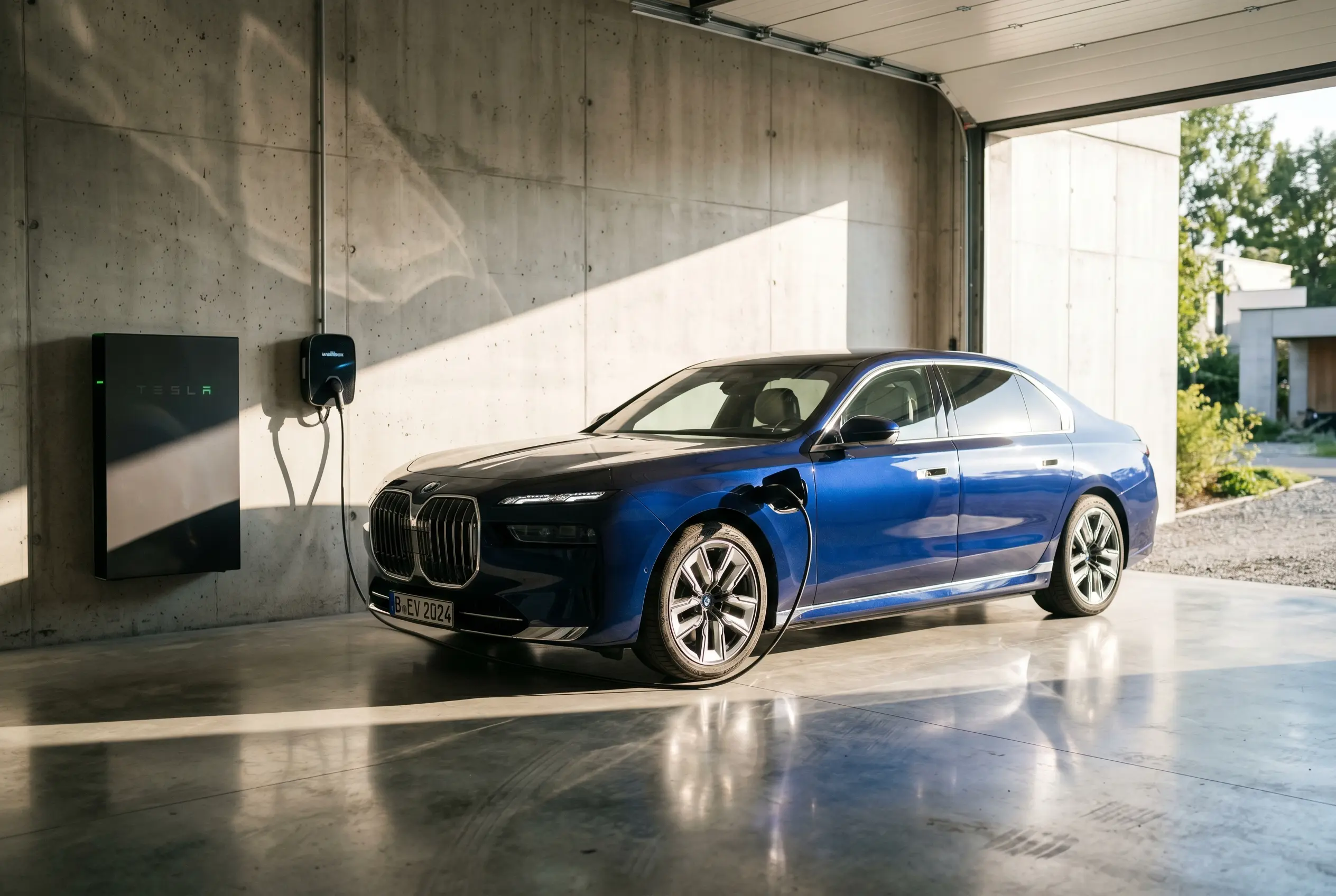
The i5 in Tansanit Blue and the Plant That Built It
The car that took the count to two million was a BMW i5 M60 xDrive sedan finished in Tansanit Blue, the BMW Group’s own press release on the milestone i5 in Tansanit Blue says. It was assembled at Plant Dingolfing, the Lower Bavarian site that has built the widest range of BEV models inside the BMW Group since it began all-electric production in 2021 with the BMW iX. The anniversary i5 is on its way to a customer in Spain. The same plant builds the i5 sedan and touring, the i7, and the iX, the widest BEV lineup anywhere in the group’s production network. BMW says Germany is the world’s second-largest production location for electric cars, a position its Dingolfing plant has helped build. The i5 M60 xDrive is rated at 19.5 to 19.4 kWh per 100 km on the WLTP cycle, with zero tailpipe CO2, the company’s own disclosure shows.
The numbers behind the milestone are tight. Since 2021, the Lower Bavarian site has produced more than 320,000 all-electric vehicles for the brand. Almost every sixth of the BMW Group’s total of two million BEVs comes from the same plant. In 2025 alone, more than a quarter of the vehicles built there were all-electric, the highest BEV share anywhere in the group’s German production network. That is the production base that the energy-pivot story is being sold on. The Dingolfing line does more than make the most EVs in the network; it makes the most EVs per model, and now it is being asked to make a different kind of car as well.
That output runs on a single mixed line, with combustion, hybrid, and electric models rolling off together. BMW calls the approach technology-open, and says at least one all-electric model now rolls off the line at every German BMW Group plant. E-mobility has become the new normal across the company’s production network, the press release said, and the Dingolfing plant sits at the centre of it.
The Bidirectional Turn, Started Months Before the Headlines
The home-battery story is older than the May 2026 announcement, and the bidirectional charging capability that powers it is not new to the BMW roadmap. The automaker first laid out the V2H, V2G, and V2L functions in March 2024, with the Neue Klasse positioned as the next step in BMW’s charging push after a cost-optimised E.ON partnership, per a 2024 BMW outline of Vehicle-to-Home, Grid, and Load. Frank Weber, BMW’s board member for development, framed the move at the time as the foundation for an integrated home charging system built on the My BMW App and a BMW DC Wallbox Professional. The 2024 outline gave the hardware time to mature before the iX3 and i3 reached customers. Two years on, that outline is being delivered in a different shape than the original.
The commercial V2G went live months before the SOLARWATT announcement. BMW and E.ON have made Germany’s first commercial Vehicle-to-Grid product available to order since early 2026, with private customers buying the BMW Wallbox Professional, the E.ON OKoStrom Home and Drive V2G tariff, the E.ON V2G Plus feed-in contract, and a smart meter as a bundle. The package pays up to 720 Euro per year for plugging in, regardless of whether the car is actually charging or discharging, and reimburses 40 Euro cents per kWh for every kilowatt-hour the iX3 sends back to the grid, per a BMW-E.ON V2G launch press release. The My BMW App carries the controls, and an E.ON algorithm jointly developed with BMW automates the charge and discharge cycles.
An iX3 driver in Germany can cover up to 14,000 km a year at no charging cost, BMW says. The first 100 iX3 customers who sign an E.ON V2G tariff get a 700 Euro discount on the Wallbox Professional, with the voucher valid until the end of 2026.
| Function | What it does | Status in May 2026 |
|---|---|---|
| V2H (Vehicle-to-Home) | Powers your home from the car’s battery | Planned for late 2026 in Germany, Austria, the Netherlands via SOLARWATT HEMS, BMW iX3 and i3 only |
| V2G (Vehicle-to-Grid) | Sends the car’s energy back to the public grid | Live in Germany via BMW-E.ON V2G package since early 2026, BMW iX3 only |
| V2L (Vehicle-to-Load) | Runs appliances and gear from the car’s battery | Available with Neue Klasse models, via the BMW Wallbox Professional or the car’s own outlet |
Filip Thon, CEO of E.ON Germany, framed the V2G launch as a way for private customers to tap into the potential of electric vehicles as flexible power storage. BMW’s own framing was sharper. The Neue Klasse line, Krieg wrote, is the moment when BMW vehicles start to act as energy storage in their own right.
With the Neue Klasse, BMW vehicles become an active part of the energy ecosystem for the first time. Their technology enables intelligent storage and return of energy to the grid, reducing customer costs while strengthening the use of renewable energy.
Marcus Krieg, head of new business models at BMW Group, said that in the company’s V2G announcement in early 2026. E.ON runs the grid-side economics, SOLARWATT runs the home-side coordination, and the iX3 and i3 are the first two Neue Klasse models to do either.
How the SOLARWATT Manager HEMS Hooks the Car to the House
The SOLARWATT Manager HEMS is the software that pulls the BMW iX3 and BMW i3 into a household energy network alongside the home’s photovoltaic system, its fixed battery storage, and every appliance that draws power. BMW and SOLARWATT said in May 2026 that the integration would launch late next year, with a phased rollout leading up to a market debut in Germany, Austria, and the Netherlands. The car, in this setup, stops being just transport; it is another storage unit on the wall, with a battery measured in tens of kilowatt-hours instead of the 5 to 15 of a typical home wall battery. The economics depend on the homeowner’s existing solar and storage kit, but the wiring is the same in every case.
The system runs on a stack that no single vendor owns. The SOLARWATT Manager HEMS handles the central coordination, with the bidirectional BMW Wallbox Professional as the physical link that can pull power in and push it back to the home. The My BMW App and the SOLARWATT Home app split the customer controls between them, depending on the function: charging windows, discharge thresholds, and minimum battery for the next trip. SOLARWATT designed the Manager as an open platform, so a homeowner with a third-party home battery can fold the BMW into the same network without ripping out the storage he or she already has, a coordination problem that has surfaced in Australia’s home battery installation and smart home data. The system supports dynamic electricity tariffs and solar forecasts to time the charge and discharge cycles to the cheapest, greenest hours. Drivers keep full control of the minimum charge level they need for the next trip, with the My BMW App holding the final say.
- Coordinates the BMW iX3 or i3 with the home PV system, home battery, and Wallbox Professional
- Optimises charge and discharge cycles around dynamic electricity tariffs and solar forecasts
- Splits customer controls between the My BMW App and the SOLARWATT Home app
- Runs on SOLARWATT’s open platform, accepting third-party home storage
- Keeps the driver’s mobility target ahead of the home’s energy needs, with the My BMW App holding the final say
The economics for an owner with rooftop solar are the heart of the pitch. SOLARWATT positions the EV as a buffer that lets a household use more of its own solar, store the surplus for evening use, and shrink the bill from the grid.
Drivers of a Neue Klasse electric car like the BMW iX3 can use the additional storage to make even more efficient use of self-generated solar power, increase self-consumption, and thus reduce their reliance on expensive grid electricity. For many homeowners, the prospect of expanding an existing home battery storage system with an electric car is highly attractive. This significantly increases the benefits of one’s own PV system, lowers electricity costs, and makes the home even less dependent on purchasing electricity from the grid.
Peter Bachmann, SOLARWATT’s Chief Product Officer, said that in the joint announcement this month. The hardware history behind his pitch goes back to a 2021 home storage system built around a battery module with components also used in BMW Group electric vehicles. The successor product, the SOLARWATT Battery vision, has been on sale since 2025, with its housing and design by BMW Designworks USA, the group’s design arm.
The Gaps the Rollout Leaves Open
The narrow part of the story is the rollout. As of May 2026, only the BMW iX3 and the new BMW i3 carry the bidirectional hardware, both Neue Klasse models, with the iX3 the first to ship and the i3 set to follow as production ramps. The V2H integration via the SOLARWATT HEMS is limited at launch to three countries: Germany, Austria, and the Netherlands, all of which already have BMW’s home-charging footprint and supportive tariff structures. Customers outside those markets who buy a Neue Klasse EV get the hardware but not the home coordination layer BMW and SOLARWATT are wiring up, at least for now. V2G via the E.ON tariff is even narrower, with the commercial V2G product only on offer in Germany today, and only for iX3 drivers who also take the E.ON OKoStrom Home and Drive V2G tariff and the E.ON V2G Plus feed-in contract. The V2L function, the car’s ability to power appliances directly through a vehicle outlet, ships with the Neue Klasse and works in any market the car is sold in. The combined late 2026 launch window is the first concrete delivery date for the home-pivot story, paired with phased rollouts running through the rest of the year.
The kit list for any of it to work is a long one. A buyer needs the bidirectional BMW Wallbox Professional, an E.ON V2G tariff for grid interaction, a SOLARWATT Manager HEMS for home interaction, a smart meter, and a compatible home battery or PV system. The My BMW App and the SOLARWATT Home app both need to be installed and kept current. The hardware and the apps work only on the newest generation of BMW’s EV architecture, the 6th generation eDrive, so a current i4, iX, i5, or i7 owner has no upgrade path to the new energy functions. The savings on offer today are framed around grid interaction, not home interaction, and the V2H pitch remains a marketing promise until the SOLARWATT Manager ships in Germany in late 2026.
What BMW Hasn’t Put on a Slide
BMW has not published a number for how much a typical German Neue Klasse owner will save or earn per year under the V2H setup, or for how the SOLARWATT HEMS splits the savings with the customer. The 720 Euro V2G figure is the cleanest economic anchor the company has released, and it is pegged to grid interaction, not home interaction. The 14,000 km free-driving figure is also qualified, and BMW prints the conditions in the fine print.
The 14,000 km assumes a BMW iX3 50 xDrive at 15.1 to 17.9 kWh per 100 km, with the bonus covering 2,184 kWh of charging a year, BMW says. The 700 Euro wallbox discount is only for the first 100 iX3 customers, and the voucher is valid until December 31, 2026, or while stocks last. The V2G feed-in is paid only when the car is plugged in and V2G is active, not whenever the car is in the garage. The combined effect is a generous introductory offer, not a steady-state return, and the savings outside the launch window are not yet priced.
The home-battery pivot still has hard edges. SOLARWATT Manager sits on top of a home storage system that has to be installed, configured, and serviced; the BMW does not replace it. The V2H and V2G functions only deliver the savings on the Neue Klasse’s 6th generation eDrive, so the iX3 and i3 are the test fleet as well as the first beneficiaries. BMW and SOLARWATT have named Intersolar and the rest of the 2026 trade-show circuit as the next public milestones for the partnership. The companies have been collaborating on electromobility and home storage since 2013, which means the current pivot is the second decade of the same conversation, not a sudden change. Marcus Krieg, BMW’s head of new business models, has said the flexibility of EV batteries integrated into energy markets and households could relieve strain on power grids and make additional storage capacity available quickly and cost-effectively. The pitch is a longer game than the May announcements suggest, and the V2H launch in late 2026 will be the first real test of whether the home-pivot story holds up under commercial conditions.
Frequently Asked Questions
Which BMW models support bidirectional charging today?
The BMW iX3 and the new BMW i3, both Neue Klasse models on BMW’s 6th generation eDrive. Other Neue Klasse models are expected to follow as they launch. Older BMW EVs, including the i4, iX, i5, and i7 built before the Neue Klasse, do not have the bidirectional hardware and have no upgrade path announced.
What is the SOLARWATT Manager HEMS?
SOLARWATT Manager is the home energy management system that BMW and SOLARWATT will use to coordinate a BMW iX3 or i3 with the home’s photovoltaic system, the home battery storage, and the bidirectional BMW Wallbox Professional. It controls when the car charges, when it discharges into the home, and when it sits idle, with customer controls split between the My BMW App and the SOLARWATT Home app.
When does the BMW V2H rollout start in Germany?
The SOLARWATT HEMS integration is planned for market launch in late 2026, with Germany, Austria, and the Netherlands the first three markets. Phased implementation continues through the year, with Intersolar (The Smarter E) named as a public milestone.
How much can BMW V2G customers earn in Germany?
BMW and E.ON’s commercial V2G package pays up to 720 Euro per year for plugging in, plus 40 Euro cents per kWh for energy fed back to the grid. The first 100 BMW iX3 customers get a 700 Euro discount on the Wallbox Professional, and an iX3 driver in Germany can cover up to 14,000 km a year at no charging cost, according to BMW.
Was the BMW i5 in Tansanit Blue really the two millionth EV?
Yes. A BMW i5 M60 xDrive sedan in Tansanit Blue, assembled at Plant Dingolfing on May 5, 2026, was the two millionth all-electric vehicle produced by the BMW Group, according to the company’s own press release. The car is on its way to a customer in Spain.