Australia home battery demand has outgrown the simple rebate story. The Clean Energy Regulator says more than 193,000 valid batteries were installed in the first six months of the Cheaper Home Batteries Program, adding 4.6 gigawatt hours of storage, while the harder question is now how homes, cars, appliances and the grid will be controlled together through the Clean Energy Regulator’s December quarter carbon market report.
That makes the next phase less glamorous than the battery rush that came before it. Subsidies can pull hardware into garages. They do not make a solar inverter, a wall battery, an electric vehicle charger, a hot water system, a retailer and a network all speak the same language.
The Battery Boom Moved Faster Than the House
The federal subsidy did what subsidies are built to do. It cut the price signal hard enough to change household behavior, then forced installers, retailers and regulators to catch up. The regulator now expects 350,000 to 520,000 batteries to be installed through 2026, equal to another 8 to 12 gigawatt hours of capacity.
That number matters because a home battery is not just another appliance. A typical fridge has one job. A battery can soak up midday solar, feed the house at night, export into a virtual power plant, reduce peak network strain or sit idle because the owner has never opened the app.
- More than 193,000 valid batteries were installed in 2025 after the program began.
- 4.6 GWh of household battery capacity was added in that period.
- 350,000 to 520,000 further installations are projected by the regulator for 2026.
- Renewables supplied 43.7 percent of electricity in the National Electricity Market in 2025.
The hidden pressure point is installer capacity. The same report said rooftop solar softened for part of 2025 as the workforce shifted toward battery jobs. A boom in storage can help the grid, but it can also bottleneck the trades and software needed to make that storage useful.
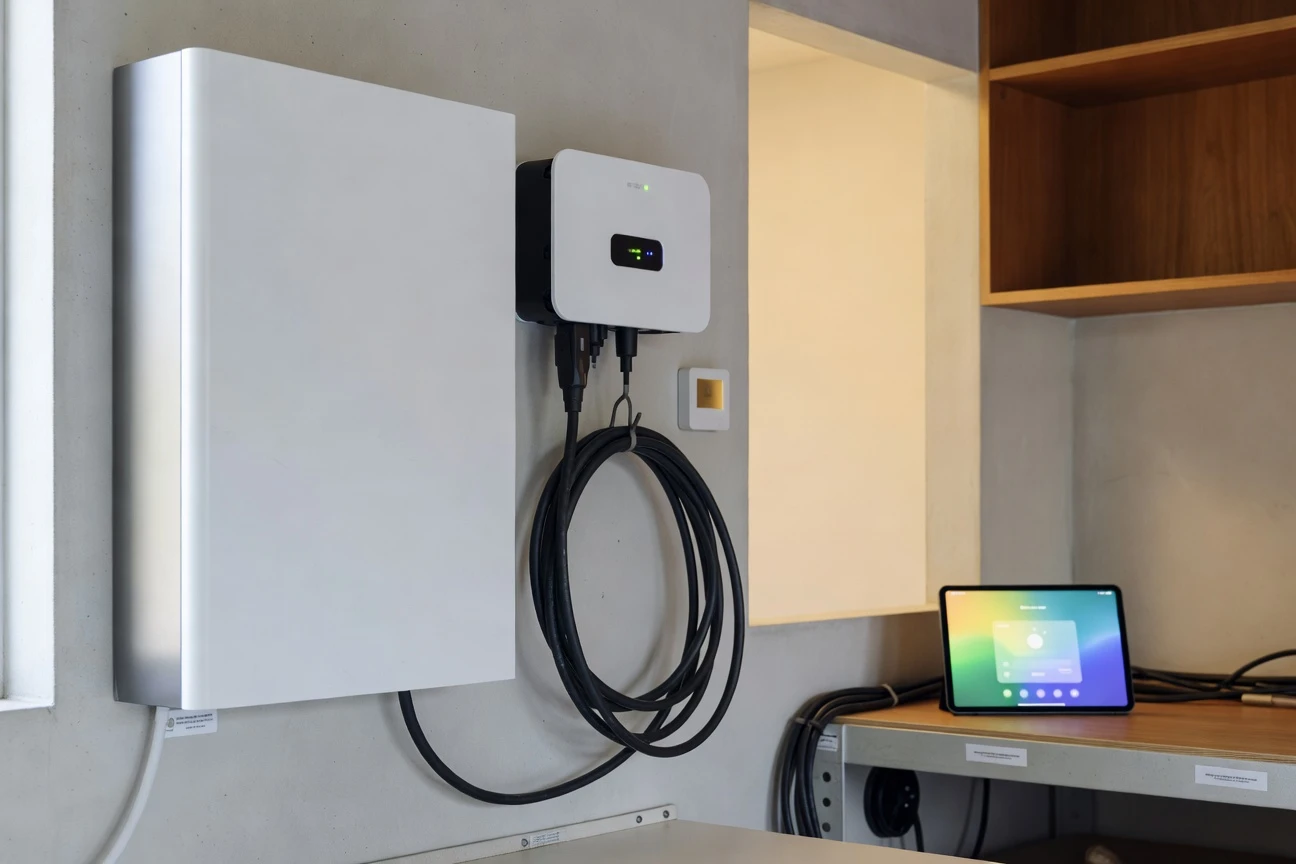
The Rebate Created a Control Market
The Department of Climate Change, Energy, the Environment and Water says the program still supports batteries between 5 and 100 kilowatt hours (kWh, a measure of stored energy capacity), with small-scale technology certificates (STCs, tradeable certificates that create the discount value) available for the first 50 kWh of usable capacity. The Cheaper Home Batteries eligibility rules also require on-grid batteries to be technically capable of joining a virtual power plant (VPP, a coordinated fleet of household batteries that can act like one power source).
That last requirement is the hinge. Households do not have to join a VPP, but their equipment has to be capable of it. So the subsidy is not only buying storage. It is quietly selecting for batteries that can be remotely controlled.
| Technology | What It Does | Market Status | Main Bottleneck |
|---|---|---|---|
| Home battery | Stores rooftop solar for evening use or export | Subsidised and scaling fast | Installer capacity and smart control |
| EV with vehicle-to-load | Powers appliances from the car | Available on some models | Limited household integration |
| EV with vehicle-to-home or grid | Sends energy into a house or network | Standards improved, product rollout uneven | Charger approval and warranty confidence |
| Home energy management system | Coordinates solar, battery, car and appliances | Trial stage for many households | Interoperability across brands |
Program settings changed again on May 1, 2026, after the government moved to tier the certificate calculation by battery size. The Clean Energy Regulator said the goal was to keep the discount at about 30 percent across system sizes as battery prices fall, according to the solar battery rebate changes notice.
Portable batteries and electric vehicles are not eligible under the household battery program. That line matters because the car in the driveway may soon become the bigger storage asset.
EV Batteries Stretch the Definition of Home Storage
Electric vehicles (EVs, battery-powered cars that can also act as stored energy assets) complicate the home battery story. Many household wall batteries sit in the 10 to 30 kWh range. A long-range EV can hold far more energy than that, which makes the car tempting as a backup source, a solar sponge and, in some cases, a grid asset.
The federal government’s vehicle-to-everything guidance separates the use cases. Vehicle-to-load (V2L, powering tools or appliances from a car) is the simple one. Vehicle-to-home (V2H, sending energy into a house) and vehicle-to-grid (V2G, exporting energy into the network) need compatible vehicles, approved equipment and clear manufacturer support.
Warranty anxiety is not a minor consumer objection. If a family is asked to cycle the most expensive battery they own for household savings, it wants to know whether the car maker will still honor the battery warranty. Jeremy Sung, head of policy at the Energy Efficiency Council, said more manufacturers are becoming comfortable with trials, but the mass market still needs plain, written assurances.
This is where the hardware story touches earlier battery shifts in other industries. Phone makers have been cautious about newer cell chemistries for similar reasons, as Mind Cron covered in its piece on silicon-carbon batteries and device risk. Energy storage scales only when buyers believe the battery will last.
Energy Masters Turns the Problem Into Choreography
South Australia is testing the missing middle. SA Power Networks is leading Energy Masters, a 500-household pilot backed by the Australian Renewable Energy Agency, to trial flexible appliances and home energy management technology. The official Energy Masters demand flexibility pilot is designed to show whether a house can shift energy use without making the resident feel like a grid operator.
The project is not only about batteries. It includes smart appliances, retail offers, tariff structures and home energy management systems (HEMS, software and hardware that coordinate energy devices in the home). Its lesson is blunt: a flexible home is a system, not a pile of clever gadgets.
- Air-conditioning can pre-cool a home when solar output is high.
- Hot water can heat when energy is cheap or abundant.
- EV charging can move away from network peaks.
- A battery can decide whether to feed the home, charge, or export.
That coordination is where the money may shift next. If most homes cannot tune those decisions themselves, the market will need installers, software providers and retailers that can make the system run quietly in the background.
A related pattern is appearing beyond the home. Mind Cron recently looked at electric vessels as floating grid batteries, another case where storage becomes valuable only when it can respond to a wider network need.
The App Stack Became the New Pain Point
We’re in a bit of the Wild West because a lot of companies that, say, specialise in solar inverters, realise that the next frontier is then getting into a whole of home ecosystem of devices.
Sung said that because the household interface is fragmenting. Solar inverters have apps. Batteries have apps. Cars have charging apps. Air conditioners, blinds, smart switches and energy retailers often bring their own control layer too.
The difference between a cloud-based app and local control can be material. If a manufacturer’s app reports data with a delay, it may be fine for checking yesterday’s solar output. It is less useful for a home trying to respond to a fast-moving price signal. Application programming interface (API, a software connection that lets systems exchange data) access and local device communication are becoming household energy features, not hobbyist extras.
For consumers, the buying question is moving from battery size to control quality. Before signing, households should ask:
- Can the controller see the solar inverter, battery, EV charger and major appliances in one place?
- Does the system still work if the internet connection drops?
- Can data be read locally, or only through a manufacturer’s cloud account?
- Will the installer document VPP capability, warranty limits and upgrade paths?
The hard part is coordination, and that is not the pitch most battery ads lead with.
Standards Are Now Part of the Product
The Clean Energy Council says the updated inverter product standard AS/NZS 4777.2:2020 Amd 2:2024 came into effect on August 23, 2025. Its approved inverter and communication product lists now sit at the center of rebate eligibility, grid connection and future smart-device communication.
One protocol to watch is the Common Smart Inverter Profile – Australia (CSIP-AUS, a communications standard that helps networks talk securely with inverters and related devices). Another is Matter, the smart-home standard backed by the Connectivity Standards Alliance and major platforms such as Google, Apple and Amazon. The alliance says the Matter smart home standard is intended to help devices work across voice assistants and home platforms.
Those standards will not remove every friction point. Energy devices carry higher stakes than light bulbs. A smart switch that fails is irritating. A battery, EV charger or hot water unit responding badly to a price signal can affect bills, comfort, warranties and grid demand.
Standards are now part of the product. The household battery boom has already arrived; if control layers mature, the next market belongs to the companies that make the house behave like one energy asset. If they do not, Australia will have filled garages with storage while leaving families to manage the system one app at a time.