Flipper One Linux computer is Flipper Devices’ attempt to turn the viral Flipper Zero idea into a pocket Arm machine for Internet Protocol (IP) networking, modular radios and local artificial intelligence work. The company published the plan on May 21, 2026, saying the device will run Linux, use RK3576 hardware and invite public development before release.
Specs such as 5G and satellite will get attention, but the harder test sits lower in the stack: open support on a fresh Linux kernel instead of the frozen vendor software that haunts many Arm boards. That turns Flipper One into a public engineering campaign as much as a gadget launch.
The Device Moves Flipper up the Network Stack
Flipper’s own Flipper One development plan draws a bright line between the new device and Flipper Zero. The older product plays with short-range and local access-control signals. The new one targets IP networks, wired links, Wi-Fi, cellular modules and satellite connections.
That matters because the public image of Flipper was built around near-field communication (NFC, short-range card communication), radio-frequency identification (RFID, card and tag systems), infrared remotes and Sub-1 GHz radio. Flipper One shifts the company toward routers, bridges, packet capture and field computing.
| Device | Core Layer | Built-In Focus | Computing Model | Expansion Path |
|---|---|---|---|---|
| Flipper Zero | Offline access-control and local radio signals | NFC, RFID, Sub-1 GHz, infrared and iButton | Microcontroller based handheld | General-purpose input/output (GPIO, pins for hardware add-ons) and accessories |
| Flipper One | IP-connected networks and high-speed links | Ethernet, Wi-Fi 6E, USB networking, M.2 modules and Linux tools | Arm Linux computer with a separate low-power controller | M.2, GPIO, USB, Ethernet and swappable mechanical parts |
The difference also changes the user. A Zero owner can test a badge reader or learn how a TV remote works. A One owner is more likely to carry a network tap, a travel router, a small Linux terminal and a test rig in one body. That is a wider promise, and a much easier promise to overbuild.
The Linux Promise Carries the Hardest Engineering Debt
The most ambitious part of Flipper One is not the orange case or the ports. It is the claim that the device should work with mainline Linux, meaning kernel releases from the upstream Linux project rather than a vendor’s private fork. Flipper’s RK3576 mainline support notes say the goal is to avoid board support package (BSP, a vendor software bundle tied to one board and chip setup) lock-in.
That is an old Arm hardware problem in a new wrapper. Many single-board computers launch with exciting specs, then age badly because their vendor kernel falls behind. Flipper wants the RK3576 system-on-chip (SoC, a processor that combines CPU, graphics and other blocks) to keep pace with upstream software.
Collabora, the open-source software consultancy working with Flipper, says its RK3576 upstream work with Flipper has major components working, while power management, USB-C DisplayPort Alt Mode, hardware video decoding and the neural processing unit (NPU, a chip block built for AI math) still need work. One binary piece also remains in the boot chain: the DDR trainer, which initializes memory early in startup.
Mainline support is the product’s spine. If Flipper gets it right, the device could age more like a small Linux computer than a sealed appliance. If the gaps linger, the most interesting promise becomes another maintenance burden for users who already own too many odd boards.
The Hardware Spec Reads Like a Pocket Router With a Screen
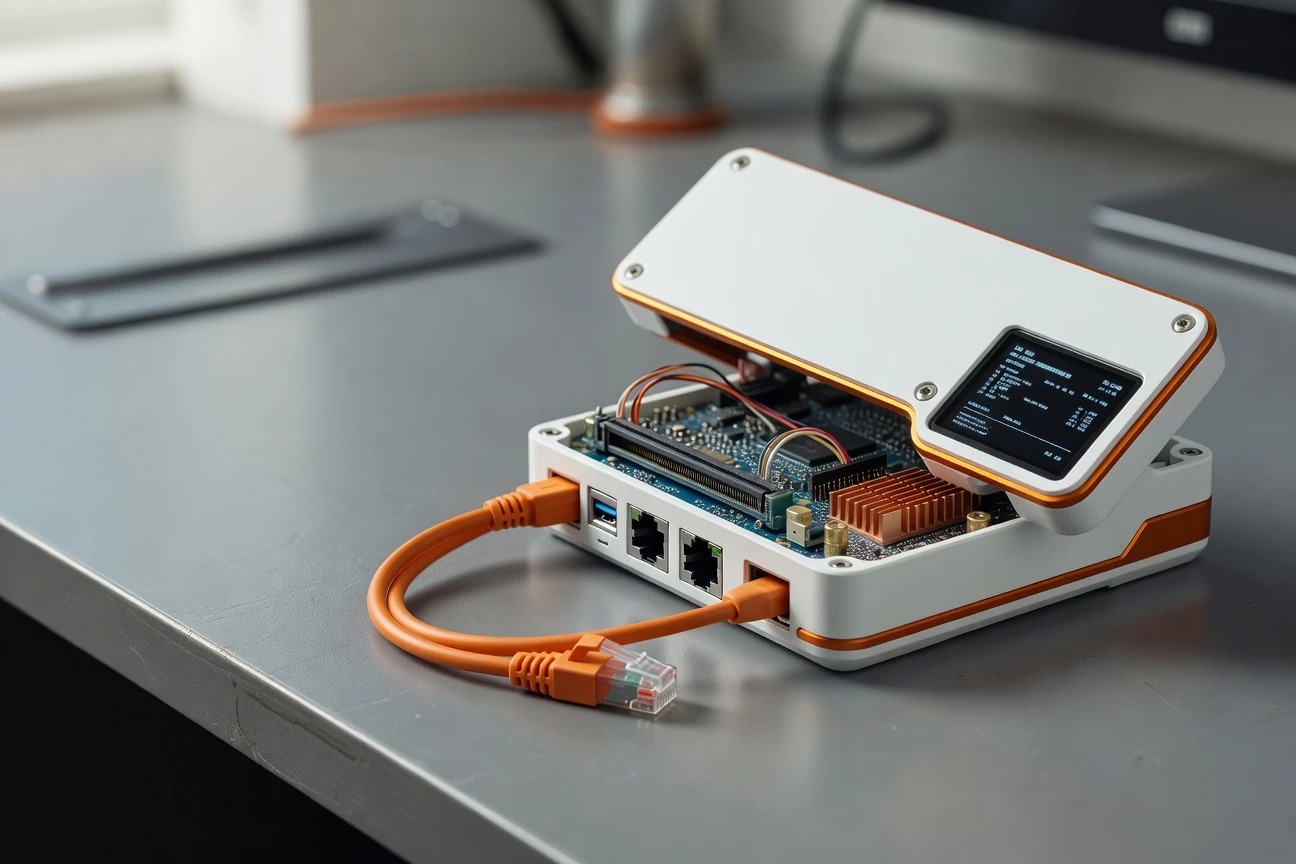
Flipper’s Flipper One technical specification says the device is under active development and that specs may change. Even with that warning, the outline is unusually dense for a handheld: an 8-core Rockchip RK3576 processor, a Raspberry Pi RP2350 microcontroller unit (MCU, a smaller chip that handles control tasks), LPDDR5 memory, UFS storage and multiple high-speed ports.
- 8-core CPU: four Arm Cortex-A72 cores and four Cortex-A53 cores, rated up to 2.2 GHz in Flipper’s current spec.
- 8 GB RAM: enough for a real Linux userspace, not just a tiny firmware shell.
- 64 GB storage: internal UFS 2.2 storage, with a microSD slot listed separately.
- Two Gigabit Ethernet ports: the detail that makes the device feel closer to a pocket network appliance than a toy.
The separate MCU is the clever part. The RK3576 runs Linux and handles graphics, networking, USB, PCIe and heavier applications. The RP2350 manages power, display, buttons, touchpad and boot control. In plain English, the screen and controls can still do useful work when the main Linux computer is asleep or off.
That split gives Flipper One a reason to exist beyond being a small single-board computer in a case. Plenty of makers can bolt a display to a Raspberry Pi. Far fewer ship a handheld with a low-power control plane, routed buttons, power modes, Ethernet, Wi-Fi and module bays designed together from the start.
Community Labor Is Part of the Product Plan
The launch message is unusually candid for hardware. Flipper says the device has been rebuilt from scratch several times and that the project is financially and technically hard. Its Flipper One developer portal is set up as a public wiki for hardware, Linux, MCU firmware, user interface, testing and documentation.
Flipper One is a deeply personal project.
Pavel Zhovner, who authored the company announcement, used that line near the end of the post while describing a pocket Linux multi-tool concept he had considered for years. He also said there are about 1 million Flipper Zero devices in people’s hands, giving the company a large pool of potential testers, critics and contributors.
The public work list is not cosmetic. Flipper is asking for help in areas that decide whether the device becomes dependable:
- Kernel and boot work for the RK3576, including upstream patches and driver review.
- MCU firmware for power, display, input handling and CPU boot control.
- Small-screen Linux interface work through FlipCTL, the menu layer Flipper wants for command-line tools.
- Testing for Wi-Fi behavior, M.2 modems, power draw, graphics output and networking modes.
- Mechanical feedback for back plates, antenna rails and module mounting.
That openness has a cost. Contributors can speed up the work, but they can also expose half-built ideas before they are ready for ordinary buyers. Flipper seems to accept that trade because the alternative is a closed device whose best promise depends on open software.
The M.2 Bay Makes the Risk Bigger
The module system is where Flipper One’s appeal and risk meet. M.2 is a physical card standard, not a single kind of connection. Flipper says its Key-B slot is meant to support PCI Express, USB, SATA, serial, I2C and SIM signals, depending on the module. That could mean cellular modems, satellite modules, software-defined radio (SDR, radio work done mostly in software), storage or AI accelerators.
- 5G Module
- A cellular modem could turn the device into a field router, test endpoint or backup connection box.
- Satellite NTN
- Non-Terrestrial Networks (NTN, cellular standards extended through satellites or airborne platforms) could give Flipper One a niche in remote testing and emergency connectivity experiments.
- SDR Module
- An SDR card would move the device closer to radio analysis, but power, heat and antenna design become harder.
NTN is not a random buzzword. 3GPP, the standards body behind mobile network specifications, has documented Non-Terrestrial Networks in 5G standards, including satellite access work across recent releases. Flipper is pitching the device as a way for engineers and enthusiasts to test that kind of infrastructure with real modules.
The catch is certification, carriers and module support. A generic M.2 bay does not magically make every modem stable, legal or efficient in every country. If Flipper can narrow the supported module list without killing the tinkering spirit, the bay becomes a strength. If support stays too broad, it becomes a forum full of edge cases.
A Product Launch Without a Product Clock
Flipper Devices Inc., the company behind Zero, says on its company history page that the original Kickstarter campaign raised $4.8 million and that the community around Zero reached more than half a million people. The current store lists Flipper Zero as a $199 access-control multi-tool, which gives readers a familiar baseline. Flipper One does not yet have the same retail clarity.
As of May 22, 2026, Flipper’s public materials reviewed here do not provide a final release date, preorder page or final price. They provide a technical direction, public documentation and a request for help. That is enough for developers to start judging the architecture. It is not enough for ordinary buyers to decide whether to wait.
Still, the bet is sharper than a normal hardware teaser. Flipper is using its Zero audience to recruit people into an Arm Linux maintenance problem that most consumer gadget companies hide. If the developer portal fills with useful patches and test results, Flipper One could become the rare hacker handheld that grows after launch. If it stalls, the most honest part of the announcement will have been the warning that the project is hard.
Frequently Asked Questions
Is Flipper One a Replacement for Flipper Zero?
Flipper describes Flipper One as a separate category from Flipper Zero rather than a replacement. Zero focuses on local access-control and radio protocols, while One is aimed at IP networking, Linux tools and modular high-speed hardware.
What Can Flipper One Connect To?
Flipper’s current materials list two Gigabit Ethernet ports, Wi-Fi 6E, USB Ethernet and an M.2 expansion slot for modules such as cellular modems, satellite modems, storage, SDR hardware or AI accelerators.
Does Flipper One Run Normal Linux?
Flipper One is designed around Linux and a mainline-first goal, but some hardware blocks still need upstream work. The company and Collabora list remaining gaps such as NPU support, hardware video decoding and parts of USB-C DisplayPort behavior.
When Will Flipper One Be Released?
Flipper has not published a final retail release date in the public materials reviewed as of May 22, 2026. The announcement is focused on opening development, sharing documentation and recruiting contributors before a consumer launch.
Why Does Mainline Linux Matter for Flipper One?
Mainline Linux support matters because it can let a device keep receiving modern kernel support without depending on a frozen vendor software bundle. For Flipper One, that support is central to the promise of a long-lived open Arm computer.