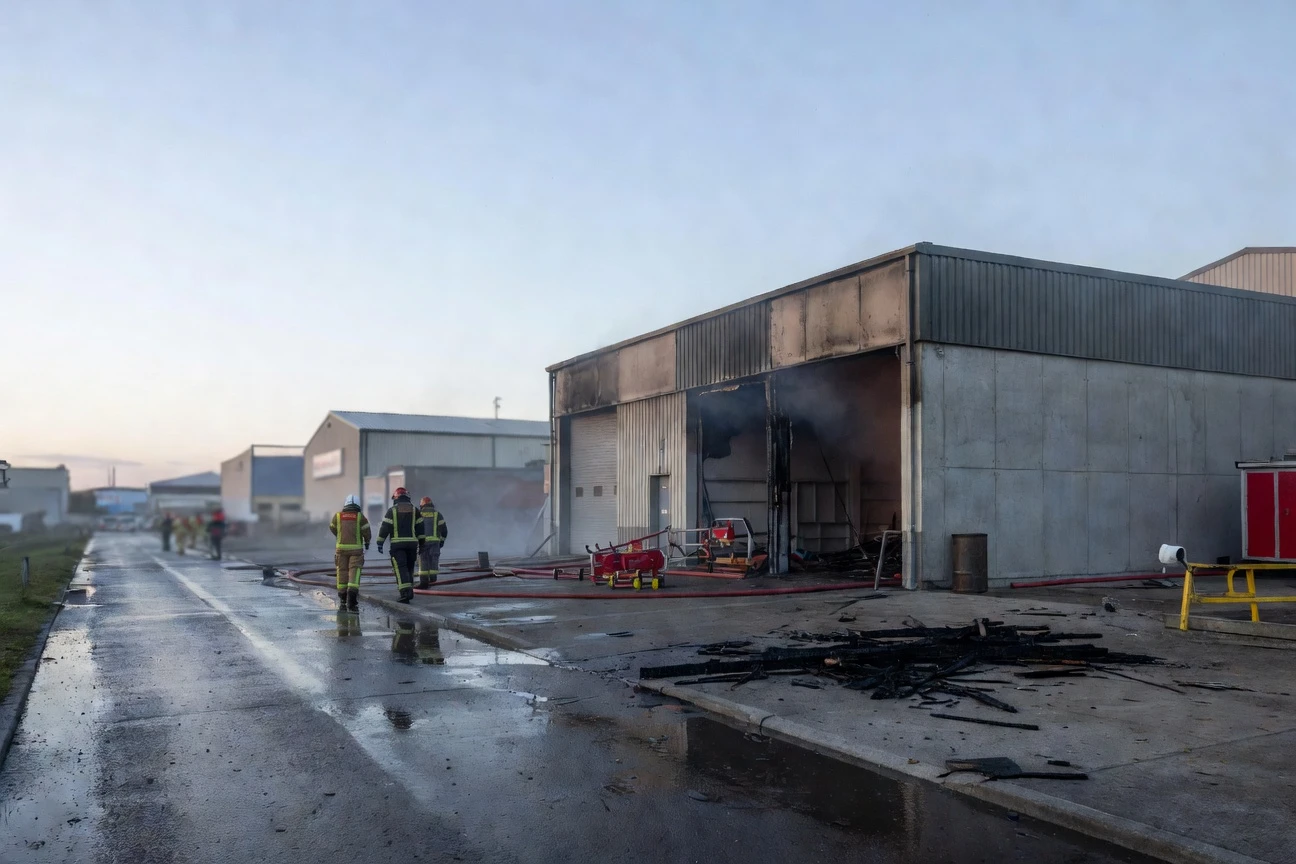
A Donegal fire has left Cherrymore Kitchens & Bedrooms closed at its Donegal Town headquarters after 58 firefighters tackled a late-night blaze that largely destroyed a storage area and sent smoke through other parts of the building. No injuries have been reported, and the family-run manufacturer said no personnel were on site when the fire broke out.
The damage lands at an awkward moment for a business marking 30 years in trade, with a production model built around its Donegal factory, direct stock, and showrooms across the west of Ireland. The first test is safety and damage assessment. The second is whether customers, staff, and suppliers can be kept moving while the main site is checked.
The Night Drew in Six Fire Units
Donegal County Council, the local authority responsible for the county fire service, said emergency services responded after a 999 call at 22:46 local time on Thursday night. The first crew from Donegal Town found a well-established fire and called for support from Ballyshannon, Bundoran, Killybegs, Stranorlar, and Letterkenny.
The fire was centred on a storage area containing large quantities of wood used in the company’s production process, according to the council account. That area was largely destroyed. Other parts of the building sustained smoke damage, while crews remained on scene on Friday morning to damp down the site.
- 58 firefighters attended the Cherrymore blaze at its height.
- Six fire units were drawn from Donegal Town and five surrounding stations.
- 22:46 was the local-time 999 call recorded by the council.
An Garda Síochána, Ireland’s police service, described the matter as an ongoing incident. That wording matters because it keeps the cause outside the public record for now. Until the technical inspection is complete, the solid facts are the response, the damage, the absence of reported injuries, and the closure of the Donegal Town premises.
Cherrymore’s Factory Model Raises the Stakes
Cherrymore is more than a local showroom with a workshop attached. On the company’s manufacturing history page, the firm says its manufacturing business was established in 1996, with its headquarters in Donegal and showrooms in Castlebar and Oranmore. It also says its Irish factories produce thousands of kitchen cabinets each week.
That model was built for control: design, production, stock, and delivery stay close enough for the company to offer customers a direct route from order to installation. It is a strength when the system is intact. When a storage area burns, the same concentration can turn one local incident into a wider scheduling problem.
| Location | Role in the Business | What the Fire Changes |
|---|---|---|
| Donegal Town | Headquarters, showroom, factory, and storage base | Premises closed while damage is assessed |
| Castlebar | Customer showroom listed by Cherrymore | Separate sales presence remains part of the public footprint |
| Oranmore | Customer showroom in Galway | Separate design and sales channel outside the damaged site |
The company lists the Donegal Town showroom at Ardlenagh, Lurganboy, with weekday and Saturday opening hours on the official showroom contact page. That is the customer-facing side of the story: appointments, orders, and after-sales questions now meet a temporary closure at the site that anchors the brand.
For staff, the company statement that everyone was safe is the essential fact. For the local economy, the next fact will be operational: how much production can resume, how quickly stock can be checked, and whether work can be shifted through other parts of the business while the Donegal building is assessed.
Wood Storage Turns Damage Into Delay
Industrial fire stories often become insurance stories first, then logistics stories. In a kitchen and bedroom manufacturing business, timber, plywood, chipboard, fittings, finishes, packaging, and finished or partly finished orders all sit in the same commercial chain. If the fire is contained to storage, the loss may still ripple through cutting schedules, delivery slots, installation dates, and replacement orders.
Irish workplace safety guidance from the Health and Safety Authority says employers must identify hazards, assess risks, and record them in a Safety Statement; its workplace fire prevention guidance also breaks fire prevention into prevention, detection and warning, escape, and firefighting. In a wood-heavy business, fuel is the inventory, so separating damaged material from usable stock becomes part of the recovery job.
- Staff need clarity on access to the site, temporary reporting arrangements, and when normal production work can resume.
- Customers need order-by-order updates, especially where cabinets, doors, or fittings were already in production or storage.
- Suppliers need revised delivery instructions if damaged stock has to be replaced or incoming loads cannot be received at the usual bay.
- Emergency crews and investigators need a stable, safe structure before the business can make firm promises.
The nearby Donegal Waste site was thanked by the company for support during the incident. That detail is easy to miss, but it says something about how these events work outside big cities: neighbouring firms, water supply, machinery, access roads, and local knowledge can matter before any formal recovery plan begins.
A Rural Fire Service Stretched Across the County
The response also shows the scale of the county system. Donegal County Council says Donegal’s retained fire service description covers 16 fire stations, more than 150 trained firefighters, and about 1,000 emergency calls a year. Retained means crews are on call in their communities and mobilise when alerted.
That structure is common in rural Ireland, where a major commercial fire can quickly pull personnel and equipment from several towns. The Cherrymore response drew firefighters from the immediate Donegal Town unit and from five other stations, creating a moving map of cover across south and west Donegal as the incident developed.
Nationally, fire brigades attended almost 20,000 fires in 2024 across domestic buildings, industrial facilities, vehicles, outdoor sites, and other locations, according to national fire attendance statistics published by Ireland’s Department of Housing, Local Government and Heritage. Cherrymore now joins that broader category of industrial and commercial fires where the human outcome can be good and the business impact still severe.
The Planning File Adds a Timing Problem
There is another complication in the calendar. Donegal County Council’s March planning applications list recorded an application by Cherrymore Wholesale Kitchens Limited for construction of an extension to the front and side of the existing factory and showroom building at Ardlenagh and Lurganboy.
The listed proposal included an extension to the existing workshop, ancillary storage space, and associated site development works. The application was received on March 9. That does not tell us anything about the cause of the fire, and it should not be read that way. It does show that, before the blaze, the company was already thinking in terms of more workshop and storage capacity.
That makes recovery planning less straightforward. A business can rebuild like-for-like, redesign damaged areas, alter storage practices, or fold recovery into a wider capital plan. Each route has a different mix of insurance, planning, building control, fire safety certification, and customer disruption.
The planning file also gives the fire a sharper economic edge. Cherrymore was not a fading operator with an empty shed; it was a long-running manufacturer with active premises, public showroom hours, a current planning process, and a local chamber calling attention to its anniversary year. Damage to that kind of firm is felt through wages, subcontractors, fitters, hauliers, and households waiting on work.
Recovery Now Runs Through Customers and Staff
Cherrymore’s immediate public line has been careful: the Donegal Town premises will remain closed while the company assesses the extent of the damage, everyone is safe, and further updates will follow. That is the right order. A quick reopening promise made before structural, electrical, smoke, and stock checks would be worth less than a slower answer that holds.
The next public signal will likely come through practical details rather than grand statements: where customers should direct queries, whether Castlebar or Oranmore can absorb appointments, how staff are being redeployed, and when the Donegal site can reopen in any form. If those updates arrive quickly, the fire becomes a hard interruption. If they do not, the storage-area blaze becomes a production problem with a longer tail.