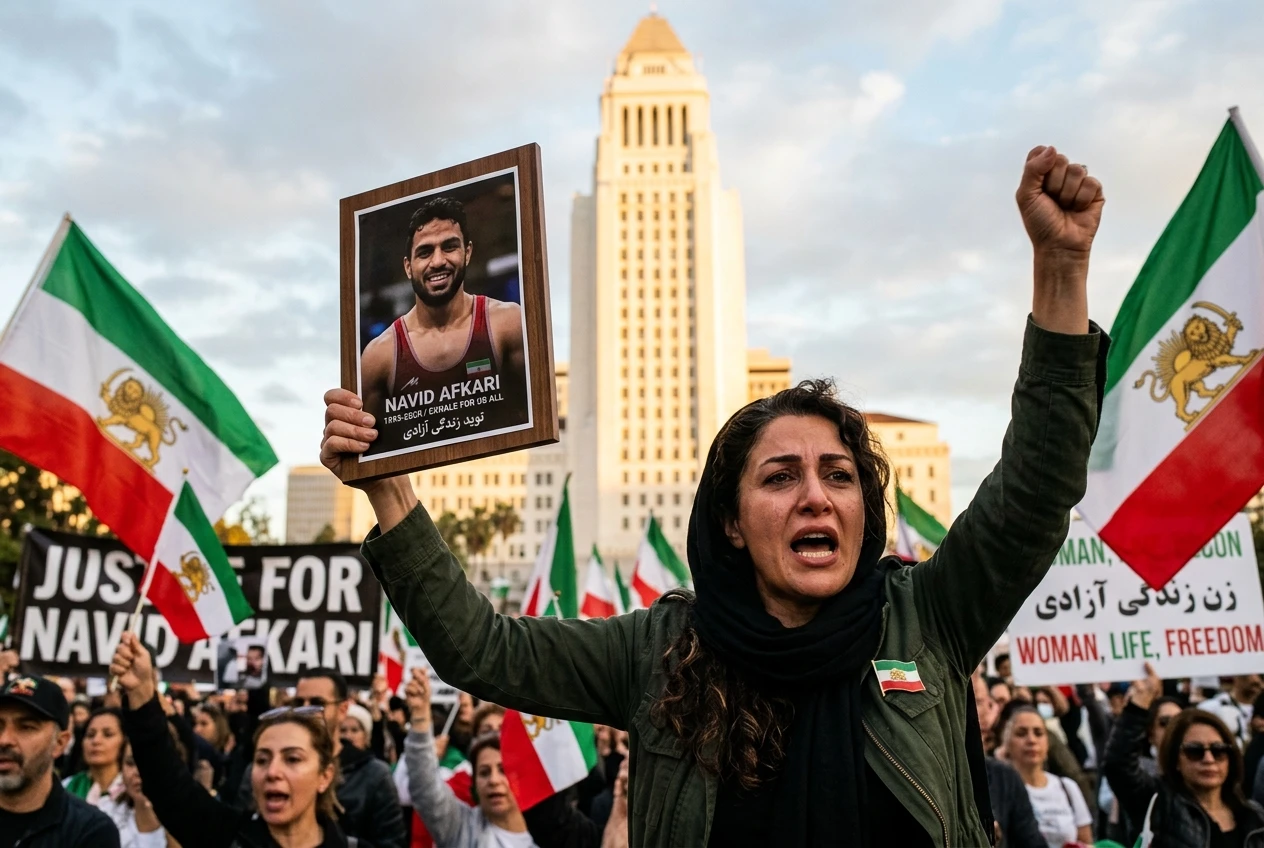
Protesters gathered in front of Los Angeles City Hall on Wednesday and demanded that FIFA expel Iran from the 2026 World Cup, accusing Tehran of using the tournament to launder the image of a government that has killed tens of thousands of dissidents since 1979. The rally took place five days before Iran faces New Zealand at SoFi Stadium on Monday in its opening Group G match. Photographs of Iranian athletes who, protesters said, died in government custody were taped to the railings of an improvised outdoor gallery. Former Iran national team players stood on the steps and mourned colleagues they said had been taken after crossing the regime.
The crowd shared one demand and divided sharply on another. Some protesters called the squad the ayatollahs’ team, controlled by the Islamic Revolutionary Guards Corps. Others said the players were young men trying to survive under a government that punishes those who push back.
The L.A. Rally Against Iran’s World Cup Place
The protest unfolded on the south side of City Hall on a Wednesday afternoon, drawing Iranian-Americans from across the city that organisers called home to one of the largest Iranian communities outside Iran. The target was FIFA, not the players on the pitch, and the framing was a human rights one, not a sporting one. Speakers described Iran’s participation as a gift to a government that had just put down a nationwide uprising. The event was organised with the National Council of Resistance of Iran, which has called publicly for Iran to be barred from the tournament, as detailed in the wire report on the City Hall rally.
Photographs of Iranian athletes who, according to the organisers, died in government custody lined the railings outside the building. The display sat beside a podium from which former Iran internationals spoke about teammates they said had paid for dissent with their freedom or their lives. After the speeches the crowd marched through the park beside the building, chanting for regime change in Tehran.
The rally came five days before Iran faces New Zealand at SoFi Stadium in Inglewood on Monday, the tournament’s most politically charged opening fixture. Iran then plays Belgium at the same stadium on June 21, before travelling to Seattle to face Egypt on June 26. Los Angeles law enforcement announced on June 1 that it would deploy additional staffing for Iran’s matches in the city, a posture that reflects the security backdrop. The squad’s first two group games in Los Angeles put it on a stage the diaspora in the city has watched grow more charged for months. Every Iran match in the city will be played out under a spotlight the regime, the players, and the diaspora all have a stake in.
The Sportswashing Charge Since 1979
The accusation that ties the protest together is that Iran uses the World Cup to launder its record. Protesters call it sportswashing, a term that has become the rally’s organising word. The charge has two layers, one reaching back to 1979 and one tied to the protests of January.
The longer charge reaches back to the 1979 Islamic Revolution and the tens of thousands of dissidents killed since. The shorter charge is more recent. State officials acknowledged several thousand casualties from the anti-government protests of January and February, while activist groups and medical sources documented mass shootings, overwhelmed hospitals, and leaked mortuary records indicating the true scale of the violence, according to the BBC. Protesters at City Hall pointed to a list of dead they said includes hundreds of athletes. The framing at the rally tied those deaths to the squad that will take the field on Monday, and asked whether FIFA should be the body that decides what gets laundered on its biggest stage.
The opposition has made the case inside FIFA’s own machinery. The NCRI’s U.S. office held a press conference and photo exhibition in Los Angeles on the same day as the City Hall rally, at 11:00 PDT, with testimony from former national team members and athletes. In a Fox News report on June 10, the NCRI alleged that Iran used its soccer clubs to spy on citizens, with facial-recognition cameras, seat-by-seat ID mapping, and security officials embedded in clubs. The NCRI called on FIFA to “uphold its statutes and ensure that international sporting events are not used for political repression or propaganda,” per the NCRI-US call for FIFA to bar Iran.
The charge is not new. Opposition groups backing the rally pressed FIFA in the months before kickoff with similar arguments, and the diaspora in Los Angeles has been framing the tournament in human rights terms since the group draw. The City Hall protest was the first major public mobilisation inside the host city, not the opening shot of a longer campaign. FIFA and Iran’s national team did not immediately respond to Reuters’ request for comment, which means the latest round of demands was made into a silence.
Speakers on the Steps
Three voices did most of the work on the steps. Ryan Salami, a 21-year-old American-born Iranian-American whose parents both fled Iran, framed Iran’s presence at the tournament as a piece of regime image work. Asghar Adibi, who wore the Iran shirt in 1970, accused the current side of being controlled by the Islamic Revolutionary Guards Corps. Peymaneh Shafi, who said she became an opponent of the Iranian government after gunmen shot her teacher in front of her, gestured at the photographs behind the podium as the only athletes worth calling by that name. The three did not agree on the players, and the disagreements are part of the story.
Bringing them here and having them play basically presents a calm face to the world, when in fact back home there is no calmness, there’s only execution and suffering that the regime has brought.
Salami said the line in front of L.A. City Hall on Wednesday. Adibi, who was a member of the Iran national team in 1970, called the current side ayatollahs’ team and said it was wrong to allow an organisation that “kills people, tortures people, to have a team representing them.” Shafi closed by pointing at the photos of dead athletes and saying, “These are the real athletes.” The three voices together sum up the charge that Iran’s presence at the World Cup is a service to a government that has killed a generation of dissenters.
The Split the Crowd Could Not Settle
The central debate at the rally was not whether to expel Iran. It was what to do about the players. Protesters agreed the regime in Tehran should not get the World Cup stage. They split on whether the squad is part of the regime, a tool of it, or young men caught in the middle.
Salami sat on the sympathetic end. He told the rally that he understood players who need to “stay silent and obedient” because they have to avoid the fate of previous players who pushed back. Another protester, who would not give her name, took the hardest line and said the IRGC would only put loyal followers on the team because the guards would not want any risk of defections. On her reading, the squad should be seen as little better than collaborators. The two positions could not be reconciled on the steps of City Hall on Wednesday, and the rally ended without a settled view.
Shafi took the hardest line of the three named speakers. “They are all attached to the regime in some way,” she said, and then pointed at the photographs of the dead and said, “These are the real athletes.” The framing draws a clean line between the players who will take the field on Monday and the players the rally is for.
The same fault line showed up outside SoFi Stadium in the days before the rally, where the BBC spoke to a second cluster of protesters. Roozbeh Farahanipour, an Iranian-American activist who fled Iran in 2000, told the BBC that “the Iranian team is not playing. The Islamic Republic’s team is.” He then said he respected the players as athletes but, on the uniform, “they represent the regime.” A second protester, Tannaz Parsi, got emotional about the squad. “This is not an easy thing for us to do, demonstrating against our people. These are our kids,” she said, referring to the players. “But they put their hands with the Islamic republic.” The two voices sketch the same split the City Hall rally exposed, between those who see the players as victims of the regime’s selection process and those who see them as a piece of the regime’s projection.
The split, in other words, is the heart of the story. The demand to expel Iran from the World Cup is a public, legal demand that FIFA can answer yes or no on. The argument about the players is a moral one that FIFA cannot answer, and the diaspora is also divided on. Both arguments will travel to SoFi Stadium on Monday, even if the players on the pitch never hear them.
Three Voices, Three Views on Iran’s Players
| Protester | Position on the players |
|---|---|
| Ryan Salami, 21, American-born | Sympathised with players who stay silent and obedient to avoid the fate of those who pushed back |
| Unnamed protester, hard line | IRGC would select only loyalists to prevent defections, so the squad should be seen as collaborators |
| Peymaneh Shafi | All attached to the regime in some way; the real athletes are the dead in the photographs |
Will Iran Walk Off the Pitch?
The match-day question is whether Iran will take the field at all if the protest inside the stadium crosses a line. The Iranian team has said it will stop playing if banned flags or critical slogans appear in matches, citing Sports Minister Ahmad Donyamali. FIFA has not said whether it will tolerate the political displays the diaspora is planning, including the pre-1979 Lion and Sun flag that has been a regular presence at Iranian matches abroad. The match is scheduled to go ahead, and the city has staffed for it. The walkout threat is the regime’s leverage inside the stadium, and it is the one piece of the dispute Iran controls directly. The build-up has also seen the 8% World Cup ticket allocation revoked from Iranian fans.
FIFA’s position on the protest is silence. The body did not immediately respond to Reuters’ request for comment on the City Hall rally, and it has not responded to the NCRI’s June 2 statement calling on the body to “uphold its statutes.” The silence is consistent with FIFA’s posture through the build-up, which has been to keep Iran’s slot in the tournament and to police political expression in the stands.
- FIFA has not publicly responded to the City Hall rally or to the NCRI’s June 2 statement.
- Iran has said it will stop playing if banned flags or critical slogans appear during its matches.
- FIFA has banned the pre-1979 Lion and Sun flag inside World Cup stadiums, classifying it as a political symbol under tournament rules.
The crowd in Los Angeles is not waiting for FIFA to take a position. Iranian-Americans have said they will try to display the lion-and-sun flag inside SoFi Stadium, the same flag FIFA has banned as a political symbol. The diaspora has form on this. Nasrin Saifi, who arrived in the U.S. one year before the Iranian revolution at age 17, smuggled a T-shirt bearing the flag past security at the 1998 World Cup match in Lyon, France. She said she plans to try again at SoFi on Monday, though she is not sure she will use her ticket for the match. The standoff between the diaspora and the regime will now play out on the field, in the stands, and at the gates, as covered in the Lion and Sun flag FIFA has banned and Iran’s revoked World Cup ticket allocation.
Monday at SoFi
Iran opens its World Cup on Monday against New Zealand at SoFi Stadium in Inglewood, with kickoff scheduled for the most-watched fixture of the group stage by the diaspora. Belgium is next, in the same stadium on June 21. The third group match, against Egypt, is in Seattle on June 26.
Los Angeles law enforcement announced on June 1 that it would deploy additional staffing for Iran’s matches in the city, a posture that reflects the security backdrop around the team. The first match is also the first live collision between the protest and the squad, and it will test whether the regime’s walkout threat is real. If Iran takes the field, the squad will be playing a match the diaspora has been arguing about for months, and the rally on the steps of City Hall will be the loudest voice in the stands. The opposition has made its case in front of FIFA. FIFA has not answered. The match is the next deadline, and the federation officials who were blocked from entering the US, as detailed in the 14 federation officials denied US entry, will be watching from across the border in Tijuana.
Frequently Asked Questions
Why are Iranian-Americans protesting Iran at the 2026 World Cup?
Protesters at the Los Angeles City Hall rally on June 10, 2026, said Iran uses the World Cup to launder, in their word, the image of a government that has killed tens of thousands of dissidents since the 1979 Islamic Revolution and many thousands more in the anti-government protests of January and February 2026. They called on FIFA to expel Iran from the tournament.
What has FIFA said about the protest?
FIFA did not immediately respond to Reuters’ request for comment on the City Hall rally, and it has not publicly addressed the National Council of Resistance of Iran’s June 2 statement calling on the body to bar Iran from the tournament.
What is the Lion and Sun flag, and why is FIFA banning it?
The Lion and Sun was Iran’s flag before the 1979 Islamic Revolution, and it remains a symbol of resistance to the current regime for many in the diaspora. FIFA has classified it as a political symbol under tournament rules and prohibited fans from flying it inside World Cup stadiums.
When does Iran play its first World Cup match?
Iran faces New Zealand at SoFi Stadium in Inglewood, California, on Monday, June 15. Its second group match is against Belgium at the same stadium on June 21, followed by a third match against Egypt in Seattle on June 26.
Who organised the Los Angeles protest?
The rally was held with the National Council of Resistance of Iran, the opposition group that has publicly called for Iran to be barred from the tournament. The NCRI’s U.S. office also held a press conference and photo exhibition in Los Angeles on the same day, at 11:00 PDT.