Nvidia chief executive Jensen Huang held up a new processor on stage at Computex in Taipei on Monday and told the room the personal computer had just been reinvented. The chip is the RTX Spark superchip, Nvidia’s first processor built to run Microsoft Windows, pairing a 20-core Arm-based central processing unit with a Blackwell graphics engine and delivering about 1 petaflop of AI performance. Microsoft will ship it first inside a new Surface Laptop Ultra this autumn, alongside machines from Dell, HP, Lenovo, ASUS and MSI.
The pitch is that Nvidia, the company whose chips power most of the world’s AI data centers, is finally bringing that horsepower to the laptop. The catch is one that rarely makes the keynote: Windows running on Arm chips has been sold as the future before, repeatedly, and the thing that kept holding it back was never the size of the numbers on the slide.
Nvidia and Microsoft Put a 1-Petaflop Arm Chip on the Computex Stage
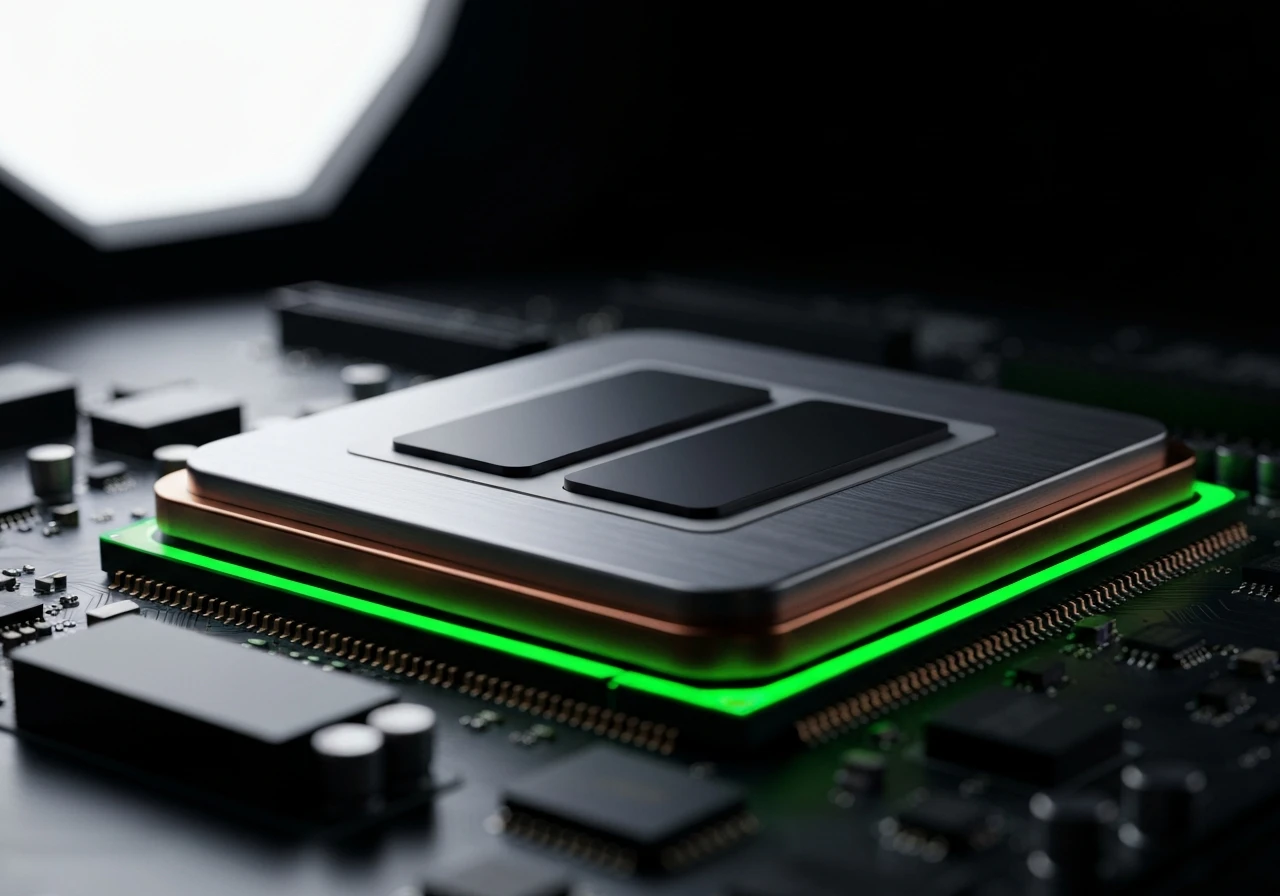
The RTX Spark, known through months of leaks as the N1X, is a single package built on a 3-nanometer process that stitches two pieces together. One die handles the 20 Arm processor cores. The other is a Blackwell graphics processor carrying the same shader count as Nvidia’s desktop GeForce RTX 5070. They talk to each other over Nvidia’s NVLink C2C, a chip-to-chip link rated at up to 300 gigabytes per second.
Nvidia laid out the headline figures in its Computex RTX Spark platform announcement, and they are large for a thin-and-light laptop class of device:
- 1 petaflop of claimed AI compute, a figure normally associated with server racks rather than notebooks.
- 6,144 CUDA cores, the parallel-processing units Nvidia uses for graphics and AI, matching a mainstream desktop gaming card.
- 20 Arm CPU cores, split between performance and efficiency clusters.
- 128GB of unified memory at the top configuration, shared between the processor and graphics.
Microsoft’s contribution is the Surface Laptop Ultra, which its Surface team described as the most powerful Surface the company has built. Devices reach buyers this fall, with Acer and GIGABYTE joining the launch partners later.
The First Surface Also Ran an Nvidia Arm Chip
There is a long memory in this announcement, and it is not a flattering one. The very first Surface, the Surface RT that Microsoft revealed in June 2012, ran an Arm processor too. That chip was an Nvidia Tegra 3.
It went badly. The Surface RT ran Windows RT, a locked-down version of the operating system that could not run traditional desktop programs at all, and shoppers stayed away. In July 2013 Microsoft took a one-time charge of $900 million to write down unsold Surface RT inventory. A second-generation model with an Nvidia Tegra 4 followed that autumn and sold no better.
So when Huang frames Nvidia and Windows as a fresh start, he is returning to the scene of one of the industry’s costlier hardware misfires. The hardware in 2012 was not the reason the product failed. The software you could actually run on it was.
That distinction matters, because it has repeated itself almost every time Windows and Arm have been paired since.
Four Times Microsoft Declared a New Era on Arm
Counting the RTX Spark, the industry has now framed Arm as the future of Windows on at least five separate occasions across 14 years. The pattern is consistent: a faster chip arrives, the marketing escalates, and mainstream adoption stalls.
- 2012, Windows RT on the Surface RT, powered by Nvidia’s Tegra 3. No desktop app support, near-total commercial failure.
- 2017, the “Always Connected PC” push, with Windows 10 on Arm running on Qualcomm’s Snapdragon 835 and emulating older software slowly.
- 2019, the Surface Pro X on a custom Microsoft and Qualcomm chip called the SQ1, praised for design and hampered by app gaps.
- 2024, the Copilot+ PC line on Qualcomm’s Snapdragon X Elite, the most credible attempt yet, which still did not trigger the mass switch Microsoft wanted.
Each step closed the raw-performance gap with Intel and AMD. None of them changed the fact that Windows on Arm sits at roughly a tenth of the PC market, and almost all of that share belongs to a company that does not sell Windows machines at all.
The Constraint Was Never the Silicon
If you want to understand why the RTX Spark could repeat history, look at what stopped the previous attempts. It was rarely the chip.
The x86 Software Problem
Most Windows software in the world is still compiled for x86, the instruction set Intel and AMD use. An Arm chip cannot run those programs directly, so Windows leans on an emulation layer, now called Prism, to translate them on the fly. Emulation has improved sharply, and Microsoft has updated Prism for the RTX Spark’s design, but translated code can still run slower or break on niche tools, drivers and games. Microsoft’s own guidance on Windows on Arm app compatibility still warns that some applications and hardware peripherals may not work as expected.
Price, Battery, and the Enterprise Wait
The earlier Arm laptops also asked buyers to pay premium prices for a machine that might not run a favorite program, while Intel and AMD kept shipping cheaper, no-surprises alternatives. Corporate buyers, who account for a huge slice of Windows sales, move slowly and hate compatibility risk. That inertia is why a chip can win every benchmark and still lose the market.
Market data underlines the gap. Arm-based processors hold around 10% of PC shipments, and Apple accounts for the overwhelming majority of that, according to Apple’s US PC shipment share data and broader industry tracking. Qualcomm’s Snapdragon X push, for all its hype, barely moved the needle, and some analysts noted x86 chips actually clawed back share afterward.
The lesson from a decade of launches is blunt. Better silicon is necessary, but it has never been sufficient.
What Nvidia Brings That Qualcomm Couldn’t
There are real reasons to treat this attempt differently, and most of them come down to Nvidia’s particular strengths rather than the Arm label.
The biggest is CUDA (Compute Unified Device Architecture, Nvidia’s parallel-computing software platform), the toolset that already runs most of the world’s AI and creative workloads. Bringing CUDA to a Windows laptop means developers who already build for Nvidia hardware have far less to rewrite, which directly attacks the software gap that sank earlier Arm machines. Nvidia also brings gaming credibility, including DLSS upscaling and a GPU class no Snapdragon part could match. The company’s rise on gaming and AI demand is built on exactly this combination.
The PC is being reinvented. With RTX Spark and Microsoft Windows, you ask, and the PC does the work.
That line came from Huang at the Computex keynote, and it points at the second selling point: on-device AI agents. Microsoft is pairing the launch with software meant to let AI assistants carry out tasks locally on the machine rather than in the cloud, which is where a petaflop of local compute starts to matter.
The structural change underneath all of it is that Qualcomm’s exclusive deal to supply Arm chips for Windows, in place since 2016, expired in early 2024. That is why Nvidia, AMD and MediaTek can now enter at all. The platform is open for the first time, which is genuinely new.
Apple’s M5 Sets the Bar Nvidia Has to Clear
The competitor that actually proved Arm can win on the desktop is not in the Windows camp. Apple switched its Macs to its own Arm-based silicon in 2020 and now controls roughly 90% of all Arm-based PCs. In March 2026 it pushed further with the M5 Pro and M5 Max MacBook Pro launch, built on a design that fuses CPU and GPU dies much like Nvidia’s new part does.
Here is how the three serious Arm PC platforms stack up heading into the autumn:
| Platform | Maker | CPU | AI / graphics claim | Availability |
|---|---|---|---|---|
| RTX Spark (N1X) | Nvidia | 20 Arm cores | 6,144 CUDA cores, about 1 petaflop AI | This fall |
| Snapdragon X Elite | Qualcomm | 12 Oryon cores | 45 TOPS neural engine | Since 2024 |
| M5 Max | Apple | Arm cores, fused dies | Apple GPU plus Neural Engine | Since March 2026 |
Apple’s advantage was never just the chip either. It controlled the operating system, the apps and the developers, and it forced the whole Mac ecosystem onto Arm in one coordinated move. Microsoft cannot do that with a Windows world full of third-party software and decades of legacy programs, which is the same wall it has hit before. Even rivals are circling the AI-chip prize, including Apple’s in-house AI chip effort aimed at cloud workloads. If the RTX Spark machines ship this autumn at a sane price and run the apps people actually use without surprises, the fifth new era might finally stick. If they ship fast, expensive and fussy about software, the slide deck will read the same in two years as it did in 2012.
Frequently Asked Questions
What is the Nvidia RTX Spark superchip?
It is Nvidia’s first processor designed to run Windows, combining a 20-core Arm CPU and a Blackwell graphics engine in one package with up to 128GB of unified memory and about 1 petaflop of claimed AI performance. It was previously rumored under the codename N1X.
When will Nvidia-powered Windows laptops go on sale?
Nvidia says devices arrive this autumn. Launch partners include Microsoft Surface, Dell, HP, Lenovo, ASUS and MSI, with Acer and GIGABYTE following later. Exact prices and on-sale dates per model were not detailed at the keynote.
Will the RTX Spark run regular Windows programs?
Yes, through a mix of native Arm apps and Microsoft’s Prism emulation layer, which translates x86 software written for Intel and AMD chips. Emulation has improved, but some older programs, drivers and games can still run slower or fail.
Does the Nvidia chip replace Qualcomm’s Snapdragon X?
No, it joins it. Qualcomm’s exclusive right to supply Arm chips for Windows expired in early 2024, which is why Nvidia, AMD and MediaTek can now ship competing Windows on Arm processors.
How does it compare with Apple’s M5 Mac?
On paper the RTX Spark offers far more graphics and AI compute than any Arm Windows chip before it, while Apple’s M5 Max benefits from a tightly controlled software ecosystem already fully moved to Arm. Real-world comparisons will depend on independent testing once shipping laptops arrive.