
BUSINESS
Vietnam’s FDI Licenses Jump 34.9% While Cash Lags
Vietnam booked $24.81 billion in FDI licenses in five months, up 34.9%, while disbursed cash rose 9.6% and Vietnamese firms sent a record wave abroad.

Vietnam booked $24.81 billion in registered foreign direct investment in January-May 2026, up 34.9%, while cash that actually arrived rose 9.6% to $9.75 billion. The National Statistics Office under the Ministry of Finance recorded 1,576 new projects whose pledged capital more than doubled even as their count rose only 1.7%.
Existing plants told a quieter story. Additional capital into 415 operating projects fell 32.1% to $5.78 billion, and Vietnamese firms launched 85 overseas projects worth $760.8 million, 2.8 times the year-earlier total. On October 3 the office put nine-month licenses at $50.36 billion, up 76.4%, with disbursement still only 12.1% higher at $21.07 billion.
New Licenses More Than Doubled in Value
The five-month print mixes three pipes, and they did not move together. New licenses supplied $14.84 billion. Expansions of plants already on the books added $5.78 billion. Capital contributions and share purchases, the merger route, reached $4.19 billion, up 46.7%.
FIVE-MONTH FDI BY PIPE
| Pipe | Amount | Share of $24.81B |
|---|---|---|
| New projects (1,576) | $14.84 billion | 59.8% |
| Additional capital (415 projects) | $5.78 billion | 23.3% |
| Contributions and share purchases | $4.19 billion | 16.9% |
| Total registered | $24.81 billion | 100% |
Processing and manufacturing took $9.64 billion of the new licenses, or 65%. Electricity, gas, water and air-conditioning projects took $2.45 billion, or 16.5%, and every other sector split $2.75 billion. Fold in the extra money for existing plants and manufacturing’s share of new-plus-additional capital is $14.52 billion, or 70.4% of that $20.62 billion combined pot. The office’s registered foreign investment of $24.81 billion is the headline; the mix underneath is a few large factories and a thinner expansion budget.
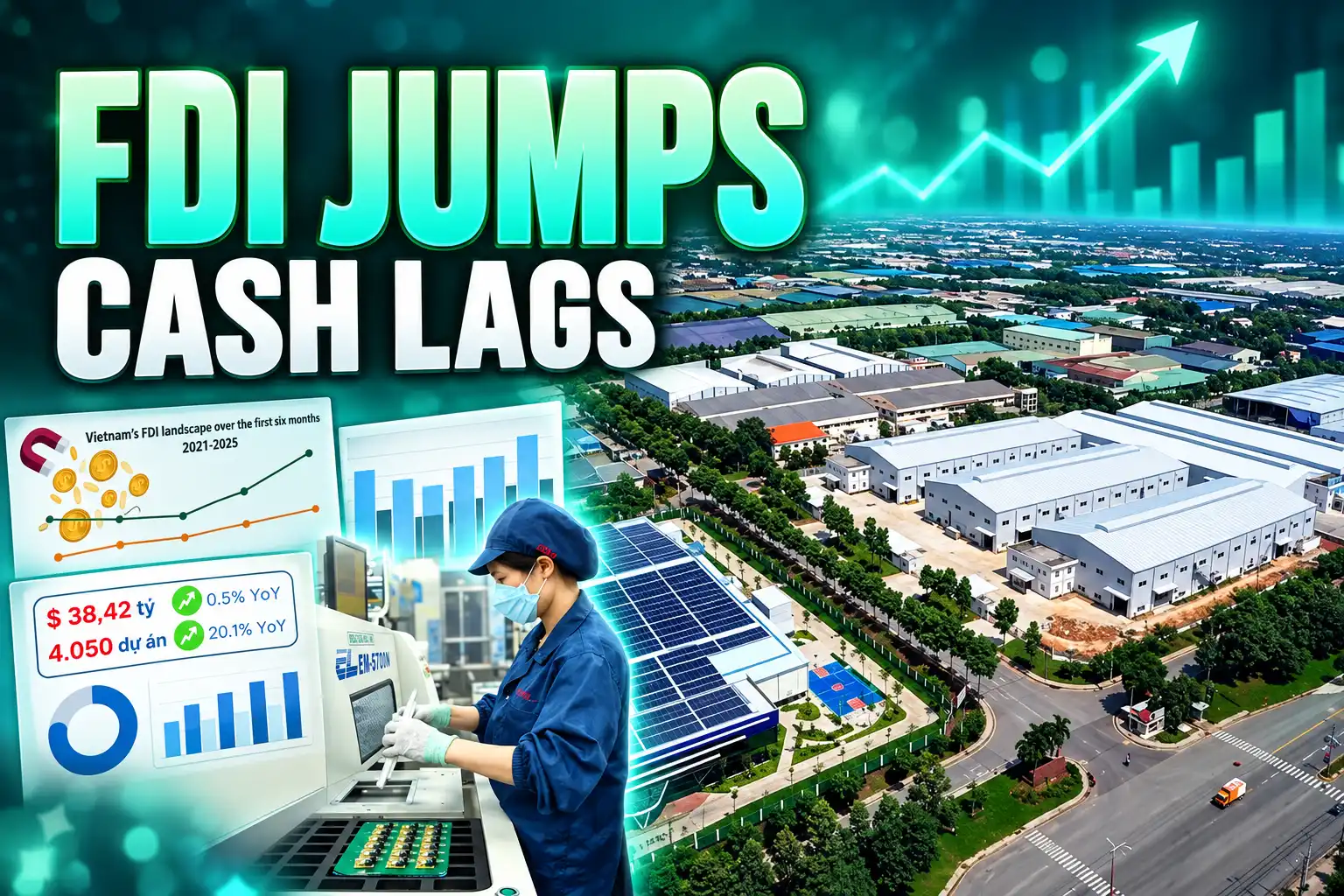
The Highest Five-Month Cash Print in Five Years
Disbursed FDI, the money that hits equipment, land and payroll, was estimated at $9.75 billion, up 9.6% and the strongest January-May total in five years. That still left only 39.3% of the registered pile converted into cash by the end of May.
THE PLEDGE-CASH SPLIT
- Registered capital: $24.81 billion, up 34.9% from January-May 2025.
- Disbursed capital: $9.75 billion, up 9.6%, a five-year high for the period.
- Conversion ratio: 39.3% of the licensed total had been spent by May 31.
- Expansion pledges: $5.78 billion into 415 live projects, down 32.1%.
Of the cash that did arrive, manufacturing absorbed $8.06 billion, or 82.7%. Real estate took $716.5 million, or 7.3%, and power and air-conditioning distribution took $356.6 million, or 3.7%. The license boom is real. So is the lag between a certificate and a running line. Owners who track these prints keep circling the same point: a license does not hire anyone until the money is in the plant.
Singapore Accounted for Nearly Half of New FDI
Fifty-eight countries and territories booked new projects in the five months. Three of them dominated the new-license column, and the largest is a booking centre as much as a factory builder.
NEW LICENSES BY SOURCE, JANUARY-MAY 2026
| Source | New capital | Share of $14.84B |
|---|---|---|
| Singapore | $6.8 billion | 45.9% |
| South Korea | $4.22 billion | 28.4% |
| China | $1.79 billion | 12.1% |
| Japan | $712.6 million | 4.8% |
| Hong Kong | $397.3 million | 2.7% |
| Netherlands | $380.3 million | 2.6% |
Singapore, South Korea and China together accounted for 86.4% of newly registered capital. Japan, Hong Kong and the Netherlands filled most of the rest. A late-2025 government investment briefing put the live stock at 44,801 valid foreign-invested projects from 153 countries, with registered capital of about $525.86 billion. The five-month wave sat on that base, then concentrated it further through Singapore vehicles and Korean manufacturers.
Laos Took a Quarter of Outbound Capital
While Hanoi courted inbound licenses, Vietnamese companies were writing their own. The office counted 85 new overseas projects at $760.8 million, 2.8 times the year-earlier figure, plus 10 capital increases of $33.8 million, down 18.7%. Combined outbound capital reached $794.6 million, 2.5 times higher, across 33 countries and territories.
WHERE THE OUTBOUND MONEY WENT
- Laos: $199.5 million, or 25.1% of the $794.6 million total.
- Kyrgyzstan: $149.9 million, or 18.9%.
- United Kingdom: $82.8 million, or 10.4%.
- Next in line: Kazakhstan $36 million, Cambodia $32.9 million, the United States $31.9 million, British Virgin Islands $30.1 million.
Construction led the outbound mix at $178.8 million, or 22.5%. Electricity, gas, steam and air-conditioning supply followed at $163.8 million, or 20.6%, then transportation and warehousing at $150.5 million, or 18.9%. The same five months that produced Vietnam’s loudest inbound license total also produced a regional investor: Vietnamese cash moving into Lao construction and power, Central Asian projects, and a London line, while foreign cash was still only partly on the ground at home.
Foreign Factories Shipped 79.8% of Exports
Goods exports in the five months reached $215.66 billion, up 19.5%. The foreign-invested sector, including crude oil, supplied $172.16 billion of that, up 24.7%, or 79.8%. Domestic firms shipped $43.5 billion, up 2.5%, or 20.2%.
That gap is the daily face of the license boom. Foreign plants are the ones filling containers, and they are doing it faster than Vietnamese exporters. The Vietnam Investment Promotion Portal, citing the statistics office, put an official FDI exports forecast at $390-410 billion for 2026, after $365.72 billion in 2025, up 26.4%. Nguyen Duy Linh, chief executive of Saigon-Hanoi Securities, called the inbound capital and trade figures a positive for the economy. The export split still leaves domestic firms as a fifth of the ledger, which is the same pattern of foreign plants capturing most export value that has dogged the high-tech build-out.
How Vietnam’s 2026 FDI Print Grew After May
The May release was not the peak of the year. Each later print widened the gap between licenses and cash, then added a new booking hub.
THE 2026 FDI PRINTS
- March 31, 2026: First-quarter registered capital reaches $15.2 billion, up 42.9%, with Singapore at 52% of new licenses.
- May 31, 2026: Five-month registered capital hits $24.81 billion, up 34.9%; disbursement $9.75 billion, up 9.6%.
- June 30, 2026: First-half registered capital reaches $34.65 billion, up 61%.
- August 31, 2026: Eight-month registered capital reaches $40.63 billion, up 55.4%; disbursement $17.25 billion, up 12%.
- September 30, 2026: Nine-month registered capital reaches $50.36 billion, up 76.4%; disbursement $21.07 billion, up 12.1%, another five-year high.
By September 30 the office had licensed 3,108 new projects at $29.24 billion, up 6.2% in count and 2.4 times in value. Previously licensed projects added $14.15 billion across 948 expansions, up 25.1%, a rebound from the five-month contraction. Share purchases and capital contributions reached $6.97 billion across 2,335 deals, up 44.0%. Conversion of the nine-month pile into cash sat at 41.8%, barely firmer than May’s 39.3%.
A $4.99 Billion Line From Luxembourg
The nine-month source list is where the booking-centre story hardens. Newly registered capital still ran through Singapore, at $9.26 billion, or 31.7%. South Korea followed at $5.70 billion, or 19.5%. Then Luxembourg, which did not feature in the five-month top six, appeared at $4.99 billion, or 17.1% of new licenses. Singapore and Luxembourg together booked 48.7% of that $29.24 billion new-license column. Hong Kong added $3.01 billion (10.3%), China $2.27 billion (7.8%), Japan $1.56 billion (5.3%) and the Netherlands $438.5 million (1.5%), among 79 sources.
On a total-registered basis, which folds in expansions and share deals, Singapore led at $12.85 billion, ahead of South Korea at $9.75 billion and Hong Kong at $5.41 billion. Ho Chi Minh City took $18.23 billion, or 36.2% of the $50.36 billion national pile, followed by Thai Nguyen at $8 billion, Bac Ninh at $4.27 billion and Hanoi at $4.13 billion. Manufacturing still took 82.6% of nine-month disbursement, or $17.4 billion, with real estate at $1.59 billion and power at $723.4 million. Combined new-plus-additional capital in manufacturing was $21.82 billion, or 50.3%, as a $5.14 billion transport and storage line diluted the sector’s share of new licenses to 45.8%.
Vietnamese firms kept going the other way. Nine-month outbound capital reached $2.77 billion, 3.3 times the 2025 pace, including $1.28 billion across 121 new projects, up 80.9%, and $1.49 billion of expansions, 10.8 times higher. Laos remained first at $669 million, or 24.1%, then Cambodia at $486.5 million, India at $357.2 million and Indonesia at $340.2 million, across 36 destinations.
The strong inflow came despite a recent slowdown in global investment flows amid geopolitical uncertainty and US tariff policies, indicating continued foreign investor confidence in Vietnam.
Foreign Investment Agency, Ministry of Finance, nine-month 2026 briefing
The agency’s line treats the license total as proof of nerve. The cash column is still the slower machine: $21.07 billion spent against $50.36 billion pledged, with expansions only recovering after a 32.1% drop in the first five months, and with foreign plants already shipping 79.8% of the country’s goods. The certificates are piling up in Singapore, Seoul and now Luxembourg. The test through the rest of 2026 is how many of them turn into payrolls in Bac Ninh, Thai Nguyen and Ho Chi Minh City before Vietnamese capital finishes another lap through Laos.

The Court Revisits the Climate Nuisance Door It Left Open

ChatGPT Now Compiles Live Interfaces With GPT-6

A Tanker Attack Moves the War Into Qatar’s Waters

Personio Buys Circula to Own the DATEV Channel

Bluesky Files for .bsky and Enters the Registry Queue

Musk’s $914 Billion Lead Is a Public SpaceX Bet

Microsoft’s 96% Cyber Score Sits at 86.3% on the Board

Free Live Sports Streaming in 2026: What to Watch Without Cable

Andrew Garfield’s Spider-Man Films Are No Longer Free

Endgame Encore’s $86 Million Trial for Infinity Vision
-
 BUSINESS4 months ago
Musk’s $914 Billion Lead Is a Public SpaceX Bet
-
 NEWS2 months ago
Microsoft’s 96% Cyber Score Sits at 86.3% on the Board
-
 SPORTS3 months ago
Free Live Sports Streaming in 2026: What to Watch Without Cable
-
 ENTERTAINMENT2 years ago
Andrew Garfield’s Spider-Man Films Are No Longer Free
-
 ENTERTAINMENT3 months ago
Endgame Encore’s $86 Million Trial for Infinity Vision
-

 ENTERTAINMENT1 month ago
Sterling Point Holds No. 2 on Prime Video After 32 Days
-

 NEWS4 months ago
Singapore’s 3×3 and Surfing Debuts Miss the Medal Stand
-

 NEWS1 month ago
G20 Cheers AI Investment After Bailey’s Frontier Cyber Warning