Agricultural traders in Saint Vincent and the Grenadines say converting drafts and payments earned in Trinidad and Tobago has again turned into a multi-stop banking ordeal that locks up their cash for days or longer. The latest public appeal, published 16 August 2026, describes a “Mary Go Around” of repeated visits and unanswered inquiries that stalls payments to local farmers and freezes the next export cycle.
The complaint is not new. It tracks a pattern of temporary banking patches that have failed to deliver reliable TT-to-EC conversion for more than a decade.
The Latest Merry-Go-Round at SVG Banks
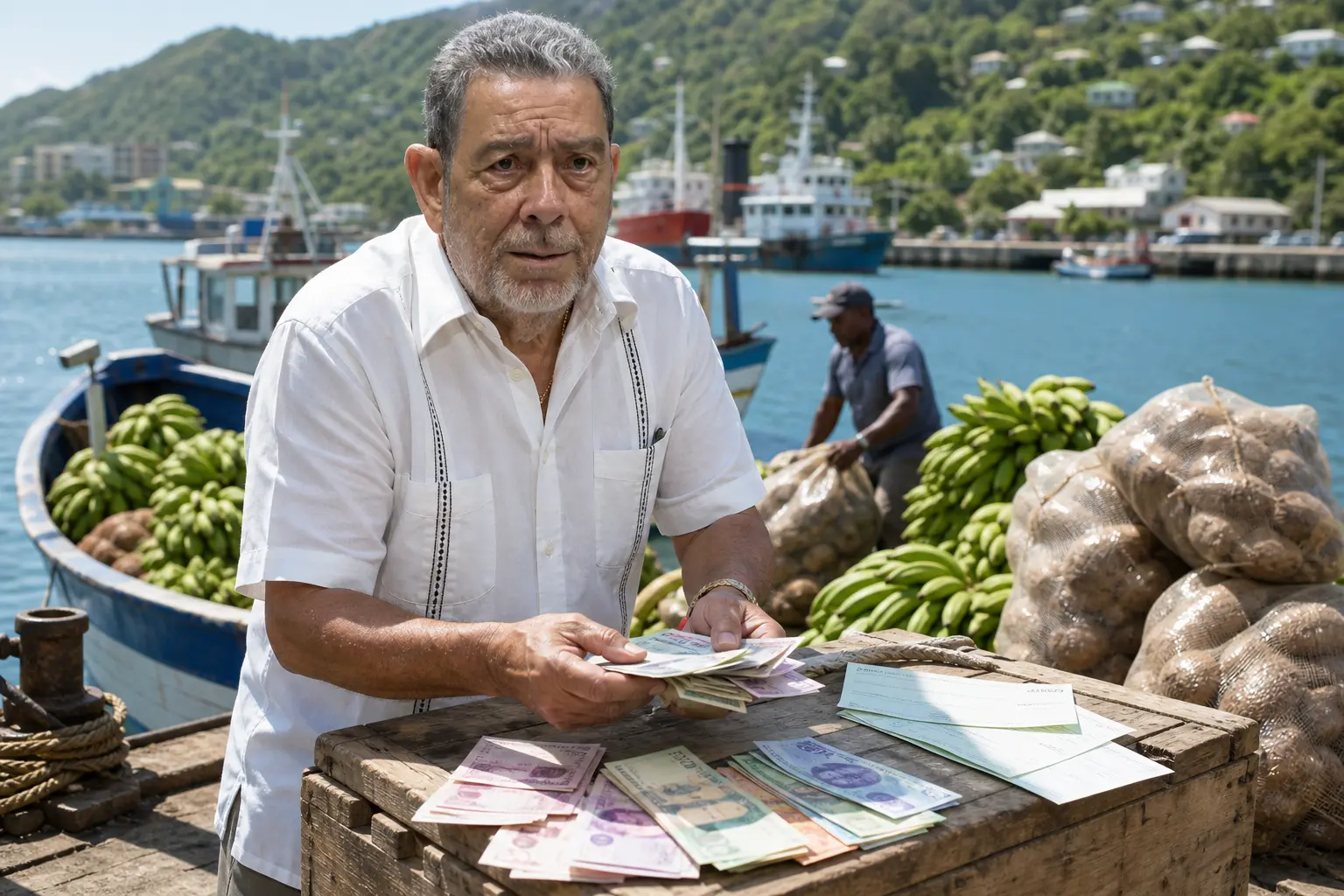
Traders buy produce from Vincentian farmers, ship it to Trinidad, sell it, and return with drafts or payments they must convert into Eastern Caribbean dollars to settle accounts and reload. When banks delay or bounce them between branches, the cash that should flow back to farms stays trapped.
One trader letter spells out the chain reaction in plain terms. Farmers wait for payment. Traders cannot buy the next load. Customers lose supply. The whole agricultural sector feels the squeeze. The letter notes that some officials have described the banking snarl as “not the Ministry’s problem,” even though the blockage hits agriculture directly.
- Core demand: a workable conversion system, not special favours
- Immediate victims: unpaid farmers and cash-strapped traders
- Secondary hit: reduced export volumes and weaker regional market access
- Stated goal: joint action by banks, the Ministry of Agriculture and other agencies
The frustration is structural. Legitimate trade depends on the money turning over quickly. When it does not, the next shipment simply does not leave.
How the 2018 ECCB Pilot Was Supposed to End It
Similar complaints peaked in 2017 and 2018. Vincentian “traffickers” could not turn TT dollars into usable EC cash. Prime Minister Ralph Gonsalves publicly raised the issue and threatened legal steps. A temporary facility at the Bank of St. Vincent and the Grenadines was created. Then the Eastern Caribbean Central Bank and the Central Bank of Trinidad and Tobago announced a pilot.
- 1 November 2018: ECCB-CBTT pilot begins with BOSVG as the channel for certified traders
- Notes limit: ECCB buys TT cash notes up to TT$20,000 weekly (the legal export/import cash threshold)
- Drafts limit: up to TT$2 million monthly in TT-dollar manager’s cheques and drafts
- Fee cut: BOSVG commission drops from 5 percent to 3 percent, with a promised one-month review
- Compliance: only authorised traders; full AML/CFT checks required
The pilot was framed as a six-month trial. Traders would get immediate EC value from BOSVG. The central banks would clear the TT exposure weekly. For a time the arrangement eased the worst queues. It did not eliminate the underlying shortage of hard currency that Trinidad banks and buyers could (or would) allocate to small agricultural imports from the OECS.
Gonsalves Numbers and the Monopoly-Money Flashpoint
By mid-2025 the friction was back in the open. Gonsalves told local radio that SVG pays Trinidad more than US$65 million a year in hard currency for petroleum products and manufactured goods. In return, he said, Trinidad could not find less than a “miserly” US$4 million in foreign exchange to pay for Vincentian agricultural products.
If you get TT dollars and you bring the TT dollars here, what are you going to do with it. I say the thing is like monopoly money.
Prime Minister Ralph Gonsalves made the comparison during an OECS Assembly speech and later defended it after Trinidad Energy Minister Roodal Moonilal objected. Gonsalves stressed he was not picking a fight with the new Port of Spain government. He simply wanted a payment mechanism that works. He noted that BOSVG can absorb only a limited volume of TT dollars before its own exposure becomes a problem.
| Flow | Approximate annual value | Currency reality |
|---|---|---|
| SVG payments to Trinidad (fuel, manufactures) | Over US$65 million | Hard foreign currency |
| Trinidad payments for SVG agri produce | Under US$4 million sought | Often TTD drafts hard to convert |
| EC dollar peg | XCD 2.70 = USD 1 | Fixed since 1976 |
| Recent ECCB TTD mid-rate | Approx. 0.40 XCD per TTD | Varies daily on official board |
The EC dollar pegged to the US dollar since 1976 gives the ECCU currency union stability that Trinidad’s floating and controlled TTD environment does not automatically share. That stability is useful at home. It does not automatically create a liquid two-way market for the drafts traders bring back.
Farmers Sit at the Unpaid End of the Chain
Every delayed draft is a delayed farm payment. Traders repeatedly buy from the same small producers of bananas, root crops, vegetables and other goods that find buyers in Trinidad markets. When the return cash is late, farmers cannot buy inputs, hire labour or plan the next crop cycle.
The trader letter puts the stakes without flourish. Behind every draft is a farmer waiting. Behind every delayed transaction is a trader trying to keep a thin-margin business alive. Behind every stalled shipment is a regional supply link that depends on money moving both ways.
- Local farmers lose cash flow and confidence to plant for export
- Traders lose working capital and may abandon the Trinidad route
- SVG loses a ready regional market for perishable produce
- CARICOM’s single-market rhetoric collides with everyday payment friction
This is the second-order damage that outlasts any single banking queue. Temporary absorption facilities help until the volume of TTD paper exceeds what local banks will hold. Then the merry-go-round starts again.
Why the Temporary Fixes Keep Breaking Down
The 2018 pilot reduced commissions and created a clearing channel. It did not change the fundamental scarcity of hard currency that Trinidad’s own foreign-exchange system has faced for years. Nor did it create a permanent, uncapped obligation for either central bank to underwrite small-scale agricultural trade.
Banks in SVG face their own liquidity and risk limits. Accepting large volumes of TTD drafts exposes them to conversion risk and opportunity cost. Officials can correctly say that day-to-day banking operations sit outside the Ministry of Agriculture. That statement does nothing for the farmer who supplied the produce three weeks earlier and still has not been paid.
The pattern is historical. Facility announced. Limits set. Relief felt. Volume grows or Trinidad forex tightens. Queues return. Political speeches follow. Another temporary arrangement is discussed. The Caribbean Association of Banks summary of the 2018 dispute already framed the core problem the same way: Vincentian sellers paid in TTD that could not be readily turned into XCD.
Crowd conversation around the 2025 monopoly-money exchange showed the same split. Some Trinidad voices treated the complaint as an attack on their currency management. Vincentian voices treated it as a simple practical barrier that keeps recurring. The practical barrier is what the latest trader letter describes on the ground in 2026.
What Banks and Ministries Still Control
Traders are not asking for a free lunch. They want predictable conversion of legitimate trade proceeds so the next truck can be loaded. That requires banks to process drafts without multi-day runarounds, a clear certification process for regular traders, and enough absorption capacity or central-bank backstop that ordinary volumes do not overwhelm the system.
What we know
- Draft and payment conversion delays are again being reported by SVG traders in August 2026
- The 2018 ECCB-BOSVG pilot set explicit weekly and monthly TTD limits that were never intended as permanent open-ended support
- Gonsalves has repeatedly cited the US$65 million versus under US$4 million imbalance
- The EC dollar remains firmly pegged; the recent ECCB Trinidad and Tobago dollar rate sits near 0.40 XCD
What remains unconfirmed
- Exact current daily or weekly volumes of TTD drafts being presented at SVG banks
- Whether any revised central-bank arrangement has been quietly extended or allowed to lapse
- Specific internal bank policies that produce the multi-branch “Mary Go Around”
Commercial banks set their own appetite for foreign-currency paper. The Bank of St Vincent currency converter tools exist for retail rates, yet the traders’ complaint is about drafts and bulk trade proceeds, not tourist cash. Regulators can require transparent processing standards. Ministries can convene the table the traders are asking for. None of those steps require rewriting CARICOM treaties. They do require treating payment friction as a trade problem rather than a pure banking inconvenience.
Elsewhere, banks already price risk and opportunity differently across sectors; the same logic that produces uneven credit access for different industries can leave small agricultural exporters at the back of the conversion queue. See how that dynamic plays out in how banks price risk differently across sectors.
The latest letter ends with a simple request: sit down, listen, fix the process before more damage lands on farmers and the export cycle. After more than eight years of the same complaint cycle, the cost of another temporary patch is already visible in unpaid fields and stalled trucks.