
ENTERTAINMENT
The Spider-Noir Finale Joins Welles’s Hall of Mirrors Lineage
Nicolas Cage tied the Spider-Noir mirror shootout to Welles and Bruce Lee, a 1948 trick the cancelled series used as its last image.

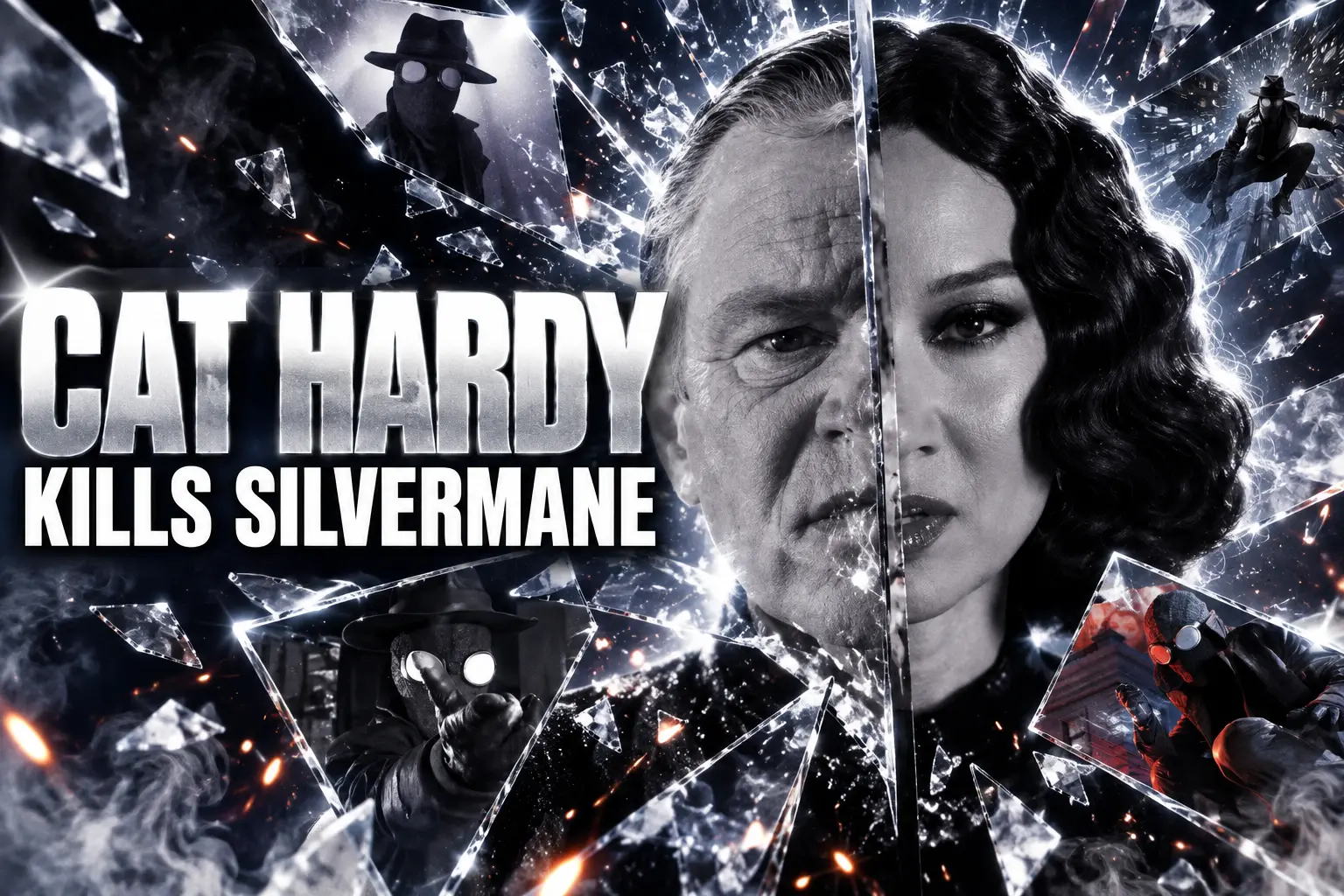
Cat Hardy kills Silvermane in a hall of mirrors in the Spider-Noir finale, and Nicolas Cage traced that glass to Orson Welles and Bruce Lee. The eight-episode Prime Video run, set in 1930s New York, puts the gun in a lounge singer’s hand, not the man in the mask.
The sequence sits in episode 8, “The Man in the Mask,” which arrived with the rest of the season on May 27, 2026, after an MGM+ linear start on May 25. Cage said the Welles film is “very apparent,” then added that he also loves the hall of mirrors at the end of Enter the Dragon, “and that’s all borrowing from Welles.”
The Shootout Under the Alcove
Felicia “Cat” Hardy, played by Li Jun Li, has spent the season trying to kill Irish crime boss Finn Byrne, known as Silvermane and played by Brendan Gleeson, after he had her fiancé murdered. In the finale she follows him out of his Alcove nightclub and into a mirrored room while Ben Reilly, Nicolas Cage’s private eye, is busy in the street as the Spider.
Several doubles of Cat and Silvermane share the frame at once, and it is hard to tell which body is flesh. They fire, the glass goes in pieces, and Cat is the one still standing. Gleeson said Silvermane is “almost subconsciously pushing her to do it,” and that “he wants to go out in style.”
Oren Uziel wrote the hour. Greg Yaitanes directed the finale, the last of two episodes he shot, including “Nobody’s Hero.” Jack Huston, who plays Flint, also known as Sandman, is the grandson of John Huston, the director of The Maltese Falcon and Key Largo, so the series was already living inside that family of rooms before anyone booked a pane of glass.
2,912 Square Feet of Mirror Glass
Welles staged the parent scene for The Lady from Shanghai, which opened in the United States on June 9, 1948, after a shoot that ran from 1946 into 1947. Michael O’Hara, Welles’s sailor, ends in a Magic Mirror Maze with Elsa Bannister, Rita Hayworth, and her husband Arthur Bannister, Everett Sloane. They shoot until the reflections die and only one person is left to walk out.
Columbia built that maze on Stages 8 and 9. American Cinematographer, writing in August 1948, logged the glass, the slide, and the pit in studio measurements that still read like a stunt budget.
THE COLUMBIA FUNHOUSE SET
| Piece | Spec |
|---|---|
| Mirror maze | 2,912 square feet of glass |
| Plate-glass panes | 80 mirrors, each 7 by 4 feet |
| Distortion panes | 24 mirrors, same size |
| Zigzag slide | 125 feet, from the stage roof |
| Landing pit | 80 feet long, 40 wide, 20 deep |
Charles Lawton Jr. was the director of photography. Several of the straight mirrors were two-way, so the crew could shoot through the non-reflecting side; other times they drilled holes in the glass. Special-effects veteran Lawrence Butler, who had worked on Things to Come and The Thief of Bagdad, helped design the maze. Art director Stephen Goosson patterned the larger funhouse on The Cabinet of Dr. Caligari. Welles himself spent more than a week on the set from 10:30 at night until 5 in the morning, painting it by hand.
Playland-at-the-Beach in San Francisco supplied the exteriors. The interiors, including that 2,912 square feet of reflecting surface, were a soundstage job. Columbia later cut about an hour from Welles’s rough cut and trimmed the Caligari funhouse hard. The hall of mirrors climax stayed almost whole, except for music Welles hated.
He had already walked a man past opposing mirrors at the end of Citizen Kane, so that Kane’s face repeated into the dark. The Shanghai maze pushed the same gag until the copies started shooting each other.
Cage Traced the Maze to Bruce Lee
Cage’s second title is the hinge. Enter the Dragon, from 1973, puts Bruce Lee and the crime boss Han in a room paneled with mirrors, and Lee smashes the glass until the real man is left. Director Robert Clouse later said the maze was not in the original script. The camera kept appearing in every bounce, so the crew hid it.
That fight is the bridge between Welles’s gunfight and every later copy that thinks it invented the trick. The Man with the Golden Gun, from 1974, dropped James Bond into a maze of his own. Woody Allen’s Manhattan Murder Mystery, from 1993, went further and projected The Lady from Shanghai onto the mirrors, so the audience was watching a quote of a quote.
THE MAZE ON FILM
- June 9, 1948: The Lady from Shanghai opens in the U.S. with the Magic Mirror Maze shootout still in the cut.
- 1973: Enter the Dragon restages the room as a fistfight; Lee breaks the glass to find Han.
- 1974: The Man with the Golden Gun borrows the maze for a Bond finale.
- 1993: Manhattan Murder Mystery throws Welles’s own film across the mirrors.
- May 27, 2026: Spider-Noir puts Cat Hardy and Silvermane in the glass on Prime Video.
Cage was not claiming a secret. He was placing Spider-Noir on a line that already ran through kung fu and Bond, and he named Welles as the source of the whole stack. The show’s own title had already told viewers which decade it wanted to live in. The maze is how that decade’s grammar reaches a 2026 superhero hour without a lecture.
Kill the Homage, Welles Told Students
Would Welles have liked the quote? In February 1982 he sat with film students in Paris, the same trip on which he received the Légion d’honneur, and he went after directors who would rather watch movies than look at life.
The more virgin our eyes are, the more we have to say. The most detestable habit in all modern cinema is the homage. I don’t want to see another goddamn homage in anybody’s movie. There are enough of them which are unconscious.
Orson Welles, 1982 talk at the Cinémathèque française
He also said you must see films, and you must see great films. The 1982 talk at the Cinémathèque française, filmed by Pierre-André Boutang and Guy Seligmann, is the full hour of that argument, not a pull-quote. He wanted new eyes. He also knew his own set pieces would be among the films later rooms kept stealing.
Spider-Noir does the thing he named and despised. It does it in a season that already offers an Authentic Black and White cut beside a color one, which is a second, quieter homage: the maze can be watched in the gray scale Welles shot, or in a saturated superhero grade he never saw.
Why the Finale Hands the Gun to Cat
Because the maze is a test of who is real, and Cat Hardy, not the man in the mask, is the character who has spent the season playing parts. Welles used the glass to split Elsa Bannister from her own image until husband and wife shot the copies to pieces. Yaitanes’s finale hands that job to Li Jun Li, and she is the one left standing.
In Shanghai, O’Hara survives the funhouse and walks away from the wreck. In Spider-Noir, Ben does the same Bogart move in another register, giving Flint the last of the antidote so Flint and Cat can leave together, then opening a new office with secretary Janet Ruiz, played by Karen Rodriguez. The masked hero does not get the Welles kill. The singer does.
WHERE THE TWO MAZES PART
- Who fires: Elsa and Arthur Bannister shoot each other; Cat Hardy is the one who lands the shot on Silvermane.
- Who walks: O’Hara leaves the broken room; Ben leaves the woman and keeps the mask.
- What the glass means: Welles used it to crack a marriage built on lies; the series uses it to end a boss’s hold on a woman who has been performing for him.
Robbie Robertson, Lamorne Morris, even spends part of the hour in the Spider suit, a fake face on a fake face, before Ben has to own the job. A show called Spider-Noir that ends “The Man in the Mask” inside infinite copies is not borrowing a pretty kill. It is finishing an argument about doubles that started when Welles built the room.
That argument is cleaner in black and white. Color on this production can show the edges of a set; the gray scale hides them, which is why the Authentic Black and White pass is the cut that lets the maze sit next to 1948 without the superhero lighting giving the trick away.
Eleven Nominations Did Not Buy Season 2
Prime Video ended the series on September 4, 2026. The season had 11 Emmy nominations, the most of any Prime Video series that year, and five of those turned into wins two days later. Nielsen Streaming Content Ratings logged 2.6 billion viewing minutes in the first six weeks. Rotten Tomatoes posted 92 percent from critics and 90 percent from audiences. None of that bought a second season.
THE SEASON’S LAST LEDGER
- Run: Eight episodes, then a no on season 2.
- Awards: 11 Emmy nominations, five wins after the cancellation.
- Reach: 2.6 billion minutes in six weeks, per Nielsen Streaming Content Ratings.
- Score: 92 percent critics and 90 percent audience on Rotten Tomatoes.
Cage, asked about coming back, said he did not know, and that the eight hours “work on its own.” Uziel later said a second season, if he had his druthers, would have left New York for another city’s noir, maybe Los Angeles or Europe, with 1933 sliding toward the next war. Amazon and Sony Pictures Television are still developing other titles from Sony’s Spider-Man characters. This one is closed.
Darran Tiernan, the main director of photography, said the company started from black and white and was then asked for a color version as well. Oscar-nominated Peter Deming came in for a stretch. Viewers can still pick the True Hue technology that emulates Technicolor or the Authentic Black and White pass. The maze is the last new image the series will stage, and it is a 1948 room with a 2026 woman holding the gun.
Frequently Asked Questions
Who Photographed The Lady From Shanghai?
Charles Lawton Jr. was the credited director of photography, with uncredited work from Rudolph Maté after Lawton fell ill. Camera operator Irving Klein rode the 125-foot slide on his stomach with Lawton, the camera on a mat shaped to the chute, to get Welles’s point of view as he went down. Assistant Richard H. Kline, later an Oscar-nominated cinematographer, is in the camera reports from the Mexico and studio work.
What Did Columbia Cut From Welles’s Funhouse?
The broader funhouse, slide, dragon’s head, and twin 35-foot turntables were cut from a full reel down to a few minutes. The hall of mirrors climax was left almost intact, but the studio laid a reprise of the song “Please Don’t Kiss Me” over the last beats, a cue Welles called obvious to the point of vulgarity. He had wanted the finish to live on gunfire and breaking glass.
How Did Enter the Dragon Hide the Camera?
Robert Clouse had a closet about six feet square built, covered in mirrors, with a hole for the lens, and the camera crew sat inside it so they would not appear in the walls. About $8,000 of mirrors, two truckloads, went into the set, which took three days to build and two days to shoot for a fight that runs about five minutes.
Is Spider-Noir Still Streaming After the Cancellation?
Yes. Prime Video still carries all eight episodes in Authentic Black and White and True-Hue Full Color. MGM+ had the linear premiere on May 25, 2026, and the global drop followed on May 27. Darran Tiernan photographed six episodes; Peter Deming, who shot Mulholland Drive, photographed two.

The Court Revisits the Climate Nuisance Door It Left Open

ChatGPT Now Compiles Live Interfaces With GPT-6

A Tanker Attack Moves the War Into Qatar’s Waters

Personio Buys Circula to Own the DATEV Channel

Bluesky Files for .bsky and Enters the Registry Queue

Musk’s $914 Billion Lead Is a Public SpaceX Bet

Microsoft’s 96% Cyber Score Sits at 86.3% on the Board

Endgame Encore’s $86 Million Trial for Infinity Vision

Free Live Sports Streaming in 2026: What to Watch Without Cable

Andrew Garfield’s Spider-Man Films Are No Longer Free
-
 BUSINESS4 months ago
Musk’s $914 Billion Lead Is a Public SpaceX Bet
-
 NEWS2 months ago
Microsoft’s 96% Cyber Score Sits at 86.3% on the Board
-
 SPORTS3 months ago
Free Live Sports Streaming in 2026: What to Watch Without Cable
-
 ENTERTAINMENT3 months ago
Endgame Encore’s $86 Million Trial for Infinity Vision
-
 ENTERTAINMENT2 years ago
Andrew Garfield’s Spider-Man Films Are No Longer Free
-

 NEWS4 months ago
Singapore’s 3×3 and Surfing Debuts Miss the Medal Stand
-

 ENTERTAINMENT1 month ago
Sterling Point Holds No. 2 on Prime Video After 32 Days
-

 NEWS6 months ago
White Sands Footprints Put People in Ice Age New Mexico