The 2026 memory chip shortage, nicknamed RAMageddon, is doing something odd to the gadget aisle: it is pushing the price of laptops and phones up while the RAM inside them stays flat or shrinks. The reason sits upstream. Four of the biggest US technology firms have earmarked roughly $650 billion to build artificial-intelligence data centers this year, and those data centers are now swallowing most of the world’s memory output.
That capex headline has been told plenty of times. The part that reaches your wallet is quieter. By the time the spending works through the supply chain, a mainstream laptop could cost up to 40% more, the cheapest PCs could disappear, and your next flagship phone may ship with the same memory as last year’s model.
Why Memory Prices Are Climbing
Memory makers can sell the same kind of silicon to two very different buyers. One is you, fitting out a laptop or phone. The other is a hyperscaler filling a warehouse with AI servers, paying more and ordering in volumes the consumer market cannot match. The factories have followed the money.
Data centers now take an estimated 70% of the memory chips produced worldwide, with high-bandwidth memory (HBM, the stacked DRAM that feeds AI accelerators) eating a growing share of wafer capacity that would otherwise make ordinary RAM. TrendForce, a Taiwan-based memory research firm, says suppliers are reallocating capacity toward HBM and server applications and applying what it calls catch-up pricing across every product line.
The demand is sitting on top of an investment wave with no recent parallel. Alphabet, Amazon, Meta and Microsoft have together guided to about $650 billion in capital spending for 2026, a jump of roughly 67% on the $381 billion the same four spent a year earlier, according to Bloomberg’s tally of Big Tech’s 2026 capital-spending guidance. Most of that money buys data-center gear, and a chunk of it competes directly with consumers for DRAM (dynamic random-access memory, the working memory in every PC and phone).
- 70% of global memory production is now going to data centers rather than consumer devices.
- $650 billion in 2026 capex from four firms, up from $381 billion in 2025.
- Late 2027 or 2028 is the earliest TrendForce expects meaningful new memory capacity to arrive.
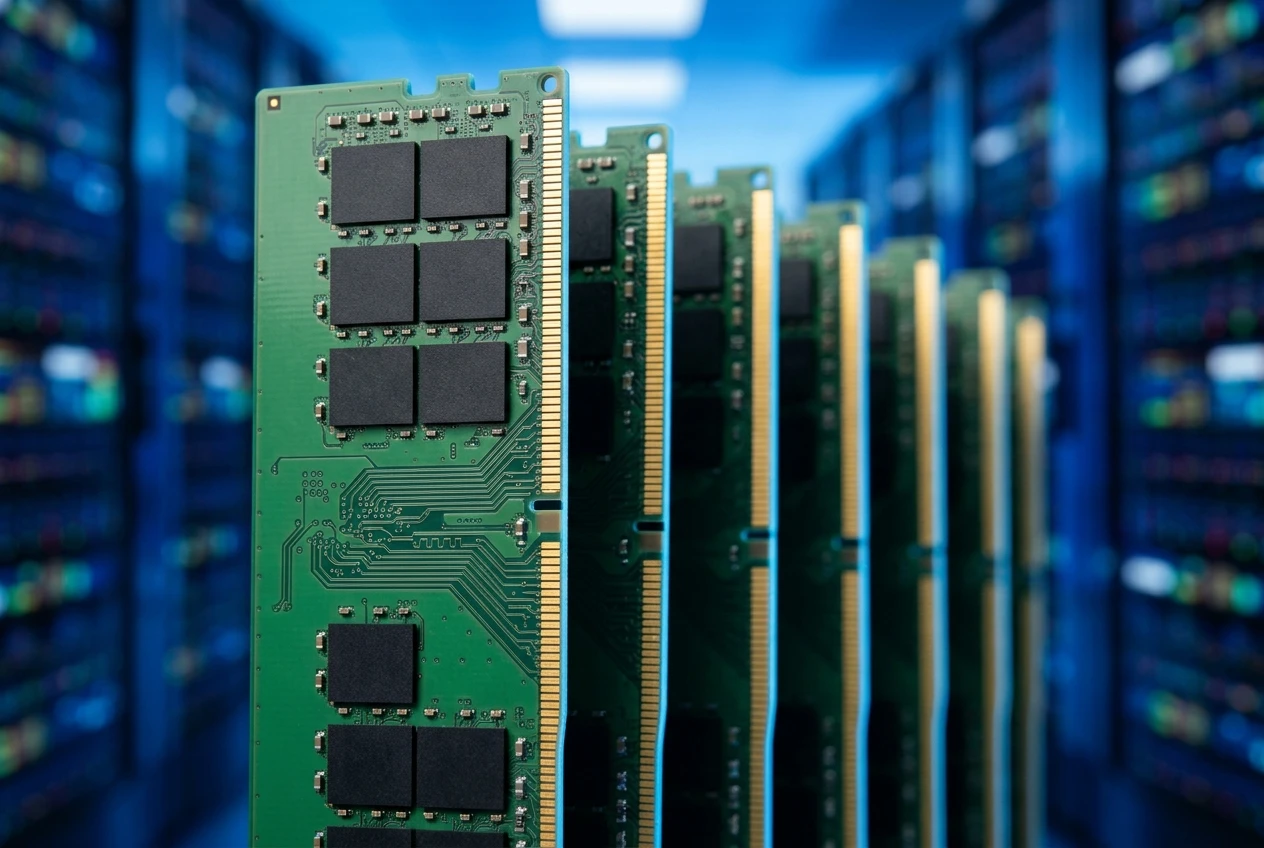
The Price Math for Your Next Laptop
The numbers behind the squeeze are blunt. TrendForce puts the increase in conventional DRAM contract prices at 90% to 95% quarter-over-quarter in the first quarter of 2026, followed by a further 58% to 63% in the second, with NAND flash (the storage memory inside SSDs) climbing 70% to 75% in the same April-to-June window. Those are wholesale moves, and they flow into retail with a lag.
For finished devices, that shows up in the bill of materials. HP’s finance chief has said memory and storage climbed from 15% to 18% of the company’s PC build cost to about 35% in 2026. TrendForce estimates a mainstream laptop that typically sells for around £667 could rise by as much as 40% over the year once dearer motherboards and other parts are added on top.
The research firm IDC has modelled how that lands on the two biggest consumer markets. Its figures separate a moderate scenario from a harsher one, and neither is gentle.
| Market | Price rise (moderate) | Price rise (pessimistic) | Shipment change in 2026 |
|---|---|---|---|
| Smartphones | +3% to 5% | +6% to 8% | down 2.9% to 5.2% |
| PCs | +4% to 6% | +6% to 8% | down 4.9% to 8.9% |
You can read those as average selling price (ASP) increases across the whole market. The pain is not spread evenly, and the buyers with the least room to absorb it sit at the bottom of the range.
Budget Phone Makers Take the Hardest Hit
The vendors most exposed are the ones who built their business on thin margins and low sticker prices. When a component that was a fifth of the build cost suddenly costs far more, there is nowhere to hide it except the price tag.
IDC names the firms in the firing line and does not soften it. “Manufacturers, whose business is mainly in the low end of the market, are likely to suffer significantly,” the firm wrote in its analysis of the memory shortage’s impact on phones and PCs. The companies it lists run on margins too slim to swallow the increase:
- TCL and Transsion, whose cheap Android handsets dominate entry-level and emerging-market sales.
- Xiaomi, Realme, Oppo, Vivo and Honor, the value-focused brands that have spent years competing on specs per dollar.
- Lenovo and Huawei, broad-line makers with significant volume in budget tiers.
IDC’s view is that these vendors “will have no other option but to pass the cost (or part) to end-users.” At the other end, Apple and Samsung are described as structurally hedged: their cash reserves and long-term supply deals let them lock in memory 12 to 24 months ahead, so they can hold the line on flagship pricing while smaller rivals cannot. The shortage, in other words, widens the gap between who can ride it out and who cannot.
The Sub-$500 PC Is on Borrowed Time
The clearest long-term casualty is the cheap computer. Gartner, the research and advisory firm, has put a date on it.
Ultimately, we expect the sub-$500 entry-level PC segment will disappear by 2028.
That call came from Ranjit Atwal, a senior director analyst at Gartner. His reasoning is arithmetic. Memory made up about 16% of a PC’s total cost in 2025; Gartner expects that to push toward 23% as prices climb, with RAM and SSD costs rising around 130% by the end of 2026. At that point a vendor selling a laptop for under $500 has no margin left to give, so the product simply stops being made.
The near-term damage is already visible in shipment forecasts. Gartner projects worldwide PC shipments falling about 10.4% in 2026, and reckons higher prices will delay the point where AI-capable PCs reach half the market until 2028. The budget shopper does not get a worse laptop for the same price. The shelf they were shopping on gets removed.
Why Flagship Phones Are Stuck at 12GB
There is a sharp irony in where this hits the phone market. For two years the industry sold “AI smartphones” on the promise of on-device intelligence, the kind of feature that needs more RAM, not less. The same data-center build-out that powers those AI models is now draining the memory supply those phones rely on.
So the upgrade cycle has stalled. IDC expects new flagship models in 2026 to hold at 12GB of RAM for their Pro tiers rather than stepping up to 16GB, breaking a long-running habit of annual memory bumps. The marketing still points one way; the spec sheet has quietly stopped moving.
For the buyer, that means paying more for a phone that, on paper, does not advance on the one it replaces. The 12GB that read as a step up last year is the ceiling this year, and the features that were meant to justify the next jump have to fit inside it.
The Bill Most Buyers Didn’t Order
The people writing the checks for this are not the ones who decided to build it. Big Tech’s AI bet is being funded, in part, by the higher prices ordinary buyers pay at the register, and there is growing doubt inside the industry about whether the spending pays off even for the companies doing it.
Uber offers a sense of the scale. The company burned through its entire 2026 budget for AI coding tools within four months, as engineer adoption of tools like Claude Code climbed to between 84% and 95%, with per-engineer API costs running $500 to $2,000 a month, according to Fortune’s reporting on Uber’s AI tool spending. Its own operating chief has openly questioned whether the outlay is worth it. When the firms closest to the technology are unsure of the return, the consumer footing part of the bill has even less reason to be confident.
None of this eases quickly. TrendForce does not expect meaningful new memory capacity to come online until late 2027 or 2028 in its second-quarter contract-price outlook, the same window Gartner uses for the budget PC’s exit. Until those fabs are running, the prices hold where they are.
Frequently Asked Questions
Why are RAM and laptop prices going up in 2026?
Memory makers are diverting DRAM and NAND production toward high-margin AI data-center orders, leaving less for consumer devices. With four Big Tech firms guiding to roughly $650 billion in 2026 capital spending and data centers now consuming about 70% of memory output, contract prices for DRAM rose 90% to 95% in the first quarter alone, and those costs are passing through to finished laptops and phones.
What is RAMageddon?
RAMageddon is the nickname for the 2026 memory chip shortage, a period when AI-driven demand has made RAM so scarce and expensive that device makers are raising prices and, in some cases, reducing the memory they fit. The term captures both the price spike and the awkward decisions vendors are making to cope with it.
How much more will a laptop cost in 2026?
IDC models PC price increases of 4% to 6% in a moderate scenario and 6% to 8% in a harsher one, measured as average selling price across the whole market. For specific mainstream models, TrendForce estimates a laptop normally selling around £667 could rise by as much as 40% once memory and other dearer parts are added.
Will my next phone have less RAM?
Possibly less than you expected. IDC says 2026 flagship Pro models are likely to stay at 12GB rather than moving up to 16GB, ending the usual yearly memory increase. Budget phones face the bigger squeeze, since their thin margins leave makers little choice but to pass memory costs to buyers.
When will memory prices come back down?
Not soon. TrendForce does not expect meaningful new memory capacity until late 2027 or 2028, because building new fabrication plants takes years. Until that supply arrives, the shortage and elevated pricing are expected to persist across DRAM and NAND.
Should I buy a laptop now or wait?
If you need a machine in the entry-level tier, buying sooner carries logic, because Gartner expects the sub-$500 PC segment to disappear by 2028 and prices to keep rising through 2026. Waiting for a cheaper deal works against the current trend rather than with it.