Amazon is selling the 128GB Obsidian Google Pixel 10a for £409 in a limited-time offer that runs until June 22, undercutting the official Google Store by £20 and the £499 launch price by £91. It is the first time Google’s newest phone has been marked below £430 at any major UK retailer, and it resets the case for a handset this publication called overpriced when it arrived in March.
For shoppers after the very latest Pixel and the longest software support window, this is the deal to act on before Amazon’s deadline closes it off.
The Amazon Deal and the June 22 Deadline
On the official Google Store, the Pixel 10a is reduced from £499 to £429, the same price Amazon is asking for the Berry, Lavender and Fog colourways. The £409 price is reserved for the Obsidian, or black, 128GB model, with Amazon taking a further £20 off the colour-matching store price. That makes the total saving on a phone released in March 2026 a £91 discount off the launch figure.
Amazon’s listing is flagged as “selling fast”, a stock warning the retailer uses when inventory starts to thin, and the offer is set to end on June 22. Shoppers outside that six-day window, or who want a colour other than Obsidian, will be back to paying at least £429 for the cheapest configuration. Pixel 10a stock at the £409 price has been disappearing in waves since Amazon posted the cut earlier this month, and the retailer has not signalled a follow-up offer.
The Pixel 10a is the newest phone in the Pixel line, not a clearance of last year’s model, which is what makes the price unusual. Buyers at £409 are still getting the March 2026 release, the same seven-year support window as the £849 Pixel 10 Pro XL, and the same Android 16 software that ships on the flagship. The maths is what changed; the phone did not.
What £409 Buys You
The Pixel 10a is built around Google’s Tensor G4 chipset, the same silicon that powered last year’s Pixel 9 and Pixel 9a. It is paired with 8GB of LPDDR5X RAM and either 128GB or 256GB of UFS 3.1 storage, and it ships with Android 16 and the new Material 3 Expressive interface out of the box.
For a mid-range phone in 2026, the spec sheet is unusually tidy. The 6.3-inch pOLED display runs at 60-120Hz and hits a peak brightness of 3,000 nits, which is 11% brighter than the Pixel 9a panel and enough to read in direct summer sun. Corning Gorilla Glass 7i covers the screen, and the bezels are nearly 10% thinner than the 9a. Inside the 5,100mAh battery sits a 5,100 mAh cell, the largest in the entire Pixel 10 lineup, and Google has bumped wired charging to 30W with 10W Qi wireless on top. PCMag’s review unit ran for 12 hours and 15 minutes in its standardised battery test, a comfortable day of heavy use for most people.
The Tensor G4 is a generation behind the Tensor G5 inside the Pixel 10 and Pixel 10 Pro, but the Pixel 10a gets one piece of current-generation hardware the 9a never had: the Exynos 5400 modem, the same modem the rest of the Pixel 10 series uses. That unlocks Satellite SOS, the ability to contact emergency services via satellite when there is no cellular signal, a feature reserved for the flagship line until now.
On the software side, the Pixel 10a ships with the same AI features as the more expensive Pixels, including Camera Coach, a Gemini-powered in-camera guide that walks users through framing and composition step by step, and conversational photo editing in Google Photos, where users can dictate changes they want made to an image. Most of the perks the marketing leans on arrive intact, including the Pixel 10a’s launch specs and March 5, 2026 release date, which confirms the chip, modem and display configuration. Google’s seven-year Pixel update policy for the 10a covers every phone from the Pixel 8 onward, including the 10a, which is the single most important stat for anyone planning to keep a phone past 2030. Google’s commitment means the 10a will still be receiving Android OS upgrades and security patches in March 2033, longer than most people keep a phone. For a deeper look at which Pixel features are worth chasing, which Pixel exclusive features are actually worth the upgrade is a useful companion read.
The Flat-Back Design and What the Cameras Can Do
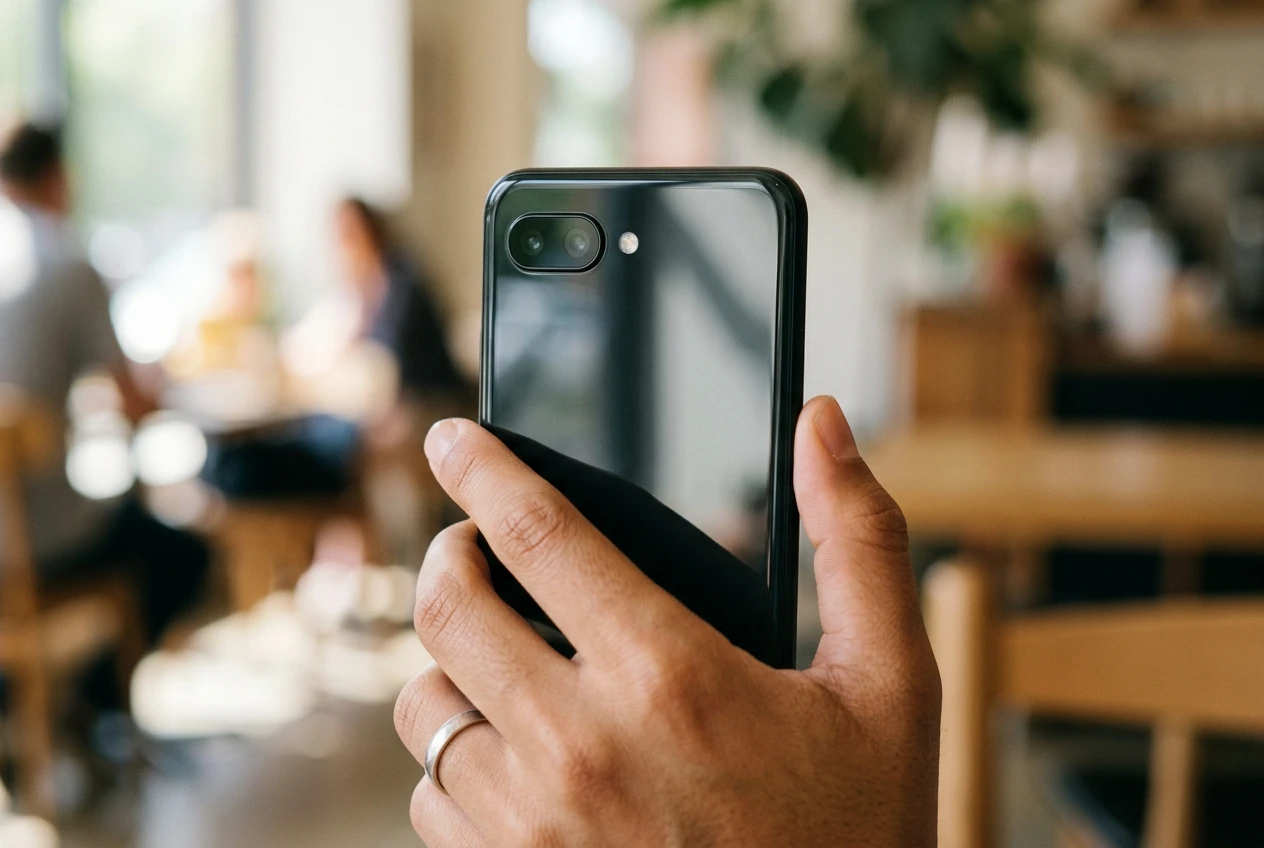
The single most striking thing about the Pixel 10a is the back. The dual camera sits entirely flush with the rear glass, no thin protrusion, no raised bar, no wobble when the phone is laid face up on a desk. It is the first smartphone this publication has tested in years with absolutely no camera bump, and it changes the day-to-day feel of the phone in a way the spec sheet does not capture. The handset slides into a pocket without snagging, lies flat on a wireless charger, and stops rocking when tapped on a table.
The cameras themselves use the same sensors as the Pixel 9a: a 48-megapixel main lens with f/1.7 aperture and optical image stabilisation, paired with a 13-megapixel f/2.2 ultrawide. There is no dedicated telephoto, and no 5x periscope like the Pro XL has. The main lens, however, is the part of the camera system that does most of the work, and it produces stills that are very close in quality to the Pixel 10 Pro XL, the current top of the range, for a fraction of the price. Colours are the familiar Pixel look, contrasty and well-balanced, with the kind of night-mode processing that has defined the line for years. The ultrawide is competent in good light and acceptable in low light, but it is the part of the system that flags the price. For a sense of where the 10a sits in the wider 2026 Android field, how the 10a compares to seven 2026 flagships on cameras and AI lays out the trade-offs across the year.
Storage and colour finish out the main choices. The Pixel 10a comes in four colours: Berry, Lavender, Fog and Obsidian, with the 128GB Obsidian the only configuration in the £409 Amazon deal. Buyers who want a colour other than black, or who want 256GB of storage, pay the £429 store-matching price. The phone is IP68 water-resistant, weighs 180g and ships with a Titan M2 security module, the same secure element that protects payments and biometric data on the flagship Pixels.
Why the March Launch Criticism Has Softened
When the Pixel 10a launched in March at £499, the criticism was simple. The phone upgraded so little from the Pixel 9a, same chip, same main camera, similar battery, that the £499 sticker looked more like a flagship-style mark-up than a mid-range price. The 9a cost £499 at its own launch a year earlier and was, by March 2026, available for about £400 on sale, so paying £499 for a near-identical 2026 update was a hard sell.
At £409, the calculation flips. The 9a at £400 is the better value only until a buyer looks at the support window. The 9a ships with the same Android 16 software, but Google’s seven-year support promise for the 10a runs to March 2033, a year longer than the 9a’s. The 10a also adds the Exynos 5400 modem with Satellite SOS, a feature the 9a cannot run. The flat-back design is not a software update, but it is the most visible day-to-day upgrade on the 10a and the part most reviewers flagged as the reason to choose it over the older phone. The review at the time called the launch price the only meaningful weakness; that weakness is the part Amazon has fixed.
My main criticism at launch was the price of £499. At £409, the Pixel 10a could be worth it, as buyers will be getting the very latest Pixel and therefore the very longest software update schedule.
The Closest Rival at £379
The strongest alternative at this price is the Nothing Phone 4a, which sells for £379 with 256GB of storage, double what the Pixel 10a offers at the Amazon deal price. For that £30 saving, the Nothing Phone 4a brings a real telephoto lens the Pixel 10a does not have, a 50-megapixel periscope unit with 3.5x optical zoom, paired with a 50-megapixel main and an 8-megapixel ultrawide. It charges faster, with 50W wired charging that Nothing rates at 50% in 22 minutes and a full charge in 64 minutes, against the Pixel’s 30W. The back of the phone carries Nothing’s signature transparent design with 63 mini-LEDs in 6 individually addressable zones, a feature reviewers either love or find gimmicky.
Where the Nothing loses ground is software support. The Nothing Phone 4a is promised 3 major Android upgrades, which from its March 2026 launch takes it to Android 19, plus security patches on top. The Pixel 10a’s seven-year commitment runs to March 2033, four more years of OS coverage than the Nothing. The Pixel also gets Google’s full AI suite, including Camera Coach and conversational photo editing, while the Nothing Phone 4a uses Nothing OS 4.1, a leaner skin with its own AI features but a smaller set overall. Buyers who care about camera versatility and faster charging should look at the Nothing; buyers who care about longevity and Google’s AI should stay with the Pixel.
On raw specs, the full Nothing Phone 4a specifications sheet confirms the Snapdragon 7s Gen 4 chipset, a 6.78-inch AMOLED panel, a 5,080mAh battery and IP64 splash resistance, all useful context for the side-by-side read below.
| Spec | Pixel 10a | Nothing Phone 4a |
|---|---|---|
| Price (lowest listed) | £409 | £379 |
| Chip | Google Tensor G4 | Snapdragon 7s Gen 4 |
| Display | 6.3-inch pOLED, 60-120Hz, 3,000 nits peak | 6.78-inch AMOLED, 120Hz, 4,500 nits peak |
| Main camera | 48MP, f/1.7, OIS | 50MP, f/1.9, OIS |
| Telephoto | None | 50MP periscope, 3.5x optical zoom |
| Battery | 5,100mAh | 5,080mAh |
| Wired charging | 30W | 50W |
| Android upgrades promised | 7 years (to March 2033) | 3 major upgrades |
Pixel 10a vs. Pixel 10 Pro XL at £849
The phone the Pixel 10a is most often compared with is not the Nothing Phone 4a, it is the Pixel 10 Pro XL, the current top of the Pixel range. The Pro XL is on sale at Argos for £849, down from a £1,199 sticker. That puts a £440 gap between the two Pixels, and the question is what that £440 buys.
The honest answer is cameras. The Pro XL’s main lens, telephoto and ultrawide sit a clear step above the Pixel 10a’s, and the Pro XL is the only Pixel with a 5x periscope telephoto. The Tensor G5 chip also runs more on-device AI than the G4 in the 10a, which lets a few features such as Magic Cue and parts of the on-device Gemini suite run locally rather than in the cloud. For almost everything else, the Pixel 10a keeps up. It runs the same Android 16, the same Material 3 Expressive, and most of the same AI perks including Camera Coach and conversational editing. For most buyers, the £440 buys more camera than they need, which is exactly the gap the Amazon deal is built around.
Frequently Asked Questions
When does the Amazon Pixel 10a deal end?
Amazon’s £409 offer on the 128GB Obsidian Pixel 10a is set to end on June 22, 2026, with the listing flagged as “selling fast.” The £429 price on the Berry, Lavender and Fog colours is not subject to the same deadline, but the £20 Obsidian discount is.
Is the Pixel 10a worth buying at £409?
At £409, the Pixel 10a is the strongest value in the 2026 Pixel line. The £499 launch price was the main weakness in early reviews, and the Amazon deal fixes that without touching the phone itself, which still ships with the March 2026 release, the seven-year support promise, and the flat-back design that sets the 10a apart from the 9a.
How long will the Pixel 10a get software updates?
Google’s own Pixel support page lists the Pixel 10a as a 7-year device, the same window as the rest of the Pixel 8 lineup and beyond. From its March 5, 2026 release, that takes OS and security support through to March 2033, longer than any comparable mid-range Android phone on the market in 2026.
Should I buy the Pixel 10a or the Nothing Phone 4a?
The Pixel 10a wins on software support, the AI suite and the flat-back design. The Nothing Phone 4a wins on storage (256GB for £379), a real telephoto camera with 3.5x optical zoom, and 50W wired charging. Buyers who plan to keep a phone past 2030 should pick the Pixel; buyers who want the most hardware per pound right now should look at the Nothing.
What colors does the Pixel 10a come in?
The Pixel 10a is sold in four colours: Berry, Lavender, Fog and Obsidian. The £409 Amazon deal is on the 128GB Obsidian only. The Berry, Lavender and Fog 128GB models sit at £429, the same price as the Google Store.