Half the Outer Banks restaurants tested for shrimp origin this June served imported or farm-raised product. Ten of those 11 restaurants told customers it was local or wild-caught American shrimp anyway, according to genetic testing results released this month.
The lab behind those results is not a government agency or a university watchdog. It is bankrolled by the domestic shrimp industry itself, an industry that has lost nearly half its market value since 2021 and is fighting imports in Congress, at the Supreme Court and now, restaurant table by restaurant table, on the Outer Banks.
Eleven Menus Matched the Plate, Eleven Didn’t
SeaD Consulting, short for Seafood Development Consulting, sampled shrimp dishes at 22 Outer Banks restaurants between June 18 and June 23. The restaurants were pulled at random from a list of 44 the firm had already tested in December.
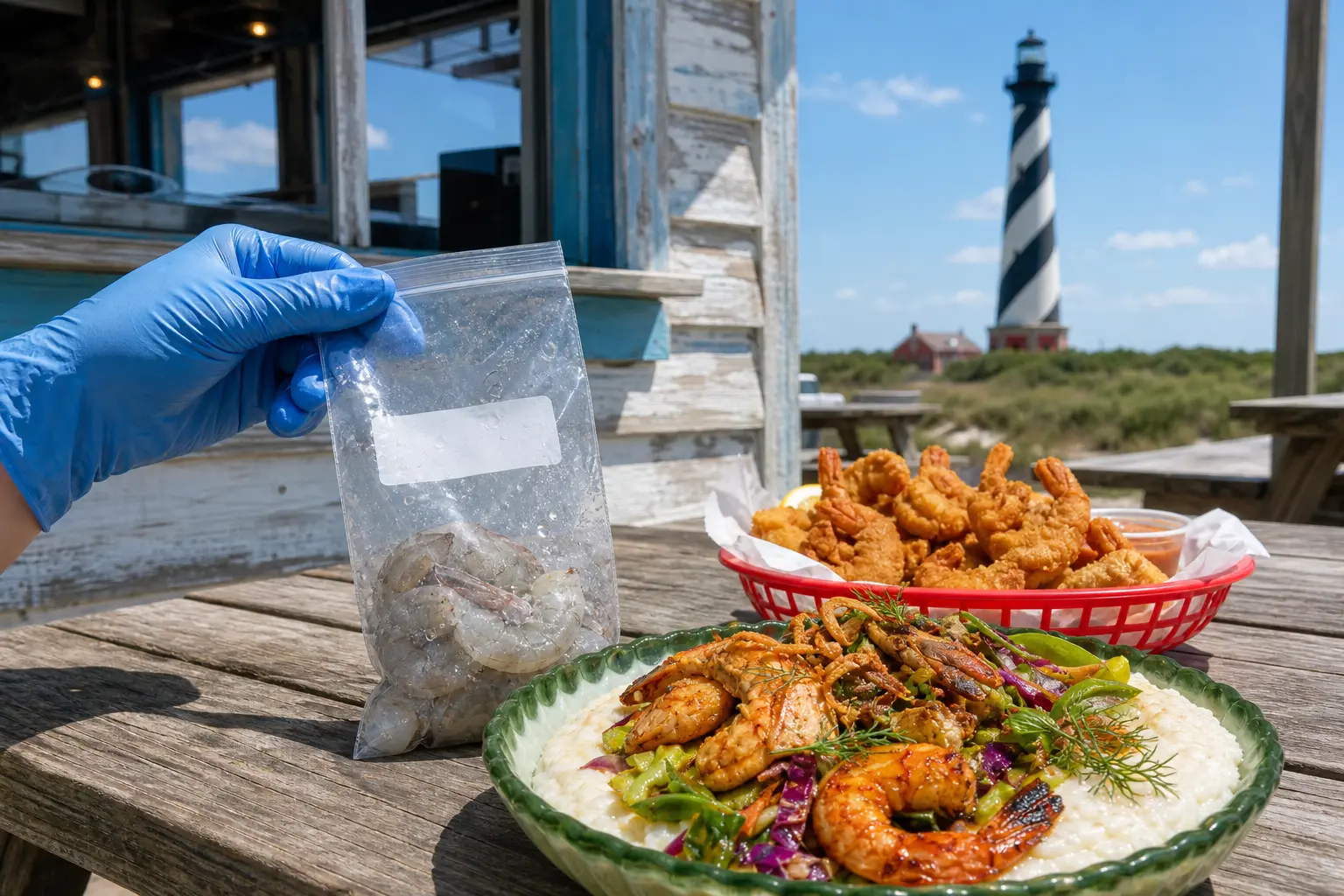
Erin Williams, chief operations officer and co-founder of SeaD Consulting, drove to each location and pulled a small sample from whatever shrimp dish was on the menu. Lab results, using a genetic test the firm developed with Florida State University, came back split down the middle.
- 50% of the June sample, 11 of 22 restaurants, served genuine American wild-caught shrimp
- 10 of 11 restaurants serving imported or farm-raised shrimp advertised it as local, North Carolina or wild-caught anyway
- 36% was the authenticity rate in December’s larger, 44-restaurant round
That is real movement. It is also still a coin flip on whether a menu tells the truth.
Some restaurants did not stop at a menu label, Williams said.
A lot of these restaurants tell you that it’s an American wild-caught product, whether they say local shrimp, North Carolina shrimp, and sometimes they’ll go as far into an elaborate, ‘We get it from the boats right down there off the dock.’
Williams said the story often falls apart under testing. “It comes together as a great story, but oftentimes, that’s not the case,” she said.
The Industry Bankrolling the Truth
SeaD Consulting works on behalf of the Southern Shrimp Alliance, a trade group representing shrimp fishermen and processors across eight warmwater shrimp states, including North Carolina. The group is not a disinterested referee. Its members are losing a trade war.
Imports now account for 94% of the shrimp consumed in the United States, and the flood of cheap product has crushed domestic prices. Since 2021, the group says the U.S. shrimp industry has lost nearly half its market value, forcing boats to tie up at the dock for good.
Founder and commercial fishery scientist Dave Williams said the genetic test, called the RIGHTTest, or Rapid ID Genetic High Accuracy Test, checks for Pacific whiteleg shrimp, a farmed species that does not exist naturally in the Gulf or off the Atlantic coast. Finding it means the shrimp on the plate did not come from an American boat.
“You’re not expecting to eat seafood that’s been grown in a pond in India or Ecuador,” Dave Williams said. “American wild-caught shrimp isn’t fed anything unnatural and doesn’t contain any form of antibiotics. But our main objective is to allow the consumer to make a choice.”
That trade fight has moved well beyond restaurant menus. The Trump administration imposed tariffs, antidumping duties and countervailing duties on shrimp from India, Vietnam, China and other exporters, and the legality of some of those emergency tariffs is now sitting before the Supreme Court in a case testing the president’s emergency tariff powers. The genetic testing on Outer Banks menus and the tariff fight in Washington are the same industry, fighting for survival on two different battlefields.
Why Does Fake Shrimp Cost the Same as Real?
Restaurants that got caught were not necessarily saving diners money. SeaD’s testers routinely found mislabeled dishes priced the same as, or higher than, genuine wild-caught shrimp on a neighboring menu. The motive is margin, not menu price.
“The economic factor is definitely an incentive,” Erin Williams said. “If you can pay less for a different type of shrimp and say it’s premium, you can charge more.”
Cost is not the only pressure pushing kitchens toward imports. Erin Williams said restaurants have also told her researchers that the domestic supply chain simply is not as convenient as calling a large distributor.
“The truth of the matter is, it takes a little bit of effort and having those connections to get that supply and know where to source it from,” she said. “And it’s sometimes easier to just go through a larger distributor.”
Three forces keep showing up in SeaD’s conversations with restaurant owners across every state it has tested.
- Margin, since cheap imported shrimp can be marked up and sold at local-caught prices
- Supply chain convenience, since one distributor call replaces building relationships with individual docks
- The story sells itself, since diners rarely ask for proof once a server mentions a dock down the road
Where the Law Runs Out
North Carolina has no law requiring restaurants to disclose whether their shrimp is imported, and none has been introduced in Raleigh, according to a National Fisherman review of state statutes published in mid-2025. Neighboring states have moved in the opposite direction, mostly after SeaD’s testing made local headlines.
Louisiana was first, adopting a disclosure law in 2008 and toughening it in 2025 to require restaurants to explicitly state whether seafood is domestic or foreign. Dave Williams said the state’s inauthenticity rate now sits at 25%, among the lowest SeaD has measured anywhere. Mississippi, Alabama and Texas have since passed their own versions, and South Carolina’s legislature approved a foreign-or-domestic labeling bill in June 2026 that now awaits the governor’s signature.
| Region | Shrimp Labeling Law | Latest SeaD Fraud Rate |
|---|---|---|
| Outer Banks, North Carolina | None on the books, none pending | 50% (June 2026), up from 36% authentic in December |
| Wilmington area, North Carolina | None on the books, none pending | 77% (April 2025) |
| Charleston, South Carolina | Passed June 2026, awaiting governor’s signature | 77% (February 2026), down from 90% in May 2025 |
| Louisiana statewide | Law since 2008, strengthened January 2025 | 25% |
A full state-by-state accounting of labeling laws kept by the Southern Shrimp Alliance shows the pattern holds almost everywhere it has tested: states with a disclosure law on the books post dramatically lower fraud rates than states without one.
The Same Result, City After City
The Outer Banks numbers are not an outlier. SeaD has now run this test in eight states, and the pattern repeats with grim consistency. In Charleston, its first pass in May 2025 found just 4 of 44 restaurants serving genuine wild-caught shrimp, a 90% fraud rate that made national news. A February 2026 retest found modest improvement, to 77% fraud. In Tampa, only two of 45 tested restaurants served real Gulf shrimp.
Wilmington, in the same state as the Outer Banks but a different region entirely, fared little better than Charleston when SeaD tested it in April 2025: 34 of 44 restaurants served mislabeled shrimp, and 25 of those explicitly told customers, on the menu or through staff, that it was local.
Public pressure in Charleston went further than a bad headline. The South Carolina Shrimpers Association sued dozens of unnamed restaurants for false advertising; a district court dismissed that case in November 2025. The legislature succeeded where the courthouse did not, passing its labeling bill seven months later.
Outer Banks Shrimpers Are Fighting on Two Fronts
The same coastal counties now showing up in SeaD’s fraud numbers spent last year fighting a separate threat to their industry. In June 2025, the North Carolina Senate amended a fisheries bill to ban inshore shrimp trawling within a mile and a half of the coast. The House declined to hear it, effectively killing the measure that same month, after commercial fishermen packed the state capital.
John Williams, executive director of the Southern Shrimp Alliance, described the fight in blunt terms afterward. “When a coordinated assault was launched to kill North Carolina’s shrimp industry with junk science, hundreds of dedicated fishermen and supporting businesses walked the halls of the state capital, meeting legislators face to face and sharing the truth about their livelihood,” he said in a statement reported by SeafoodSource’s coverage of the trawling fight.
Currituck County, part of the northern Outer Banks, weighed in directly. Its Board of Commissioners wrote to state lawmakers that the commercial fishing industry “contributes significantly to the health of our economy while also providing our hardworking local watermen with a means to financially support their businesses and their families.”
So the same watermen who beat back a trawling ban get no legal backstop when a restaurant a few miles inland sells their catch’s imported stand-in and calls it local. SeaD’s goal, Dave Williams said, is legislation that would “ensure that what the customer orders is what the customer gets.”
Erin Williams put it more plainly. “It’s promising to see that there’s change being made,” she said. “But for the sake of our coastal fishing communities and diners who go there to enjoy that, we’d like to see that improvement.”
Frequently Asked Questions
How Can Diners Verify Outer Banks Shrimp Is Really Local?
Ask the server to see the box the shrimp came in, since distributors are required to mark country of origin on wholesale packaging even where restaurants are not required to disclose it on the menu. The Southern Shrimp Alliance also posts a running list of restaurants its testers confirmed serving genuine American wild-caught shrimp, updated after each round of sampling.
Is Imported Farm-Raised Shrimp Unsafe to Eat?
Not inherently, though the regulatory picture differs by country. The Southern Shrimp Alliance contends that shrimp aquaculture in some exporting nations, particularly India, relies on antibiotics and fungicides banned in U.S. production, a claim tied to its broader push for tariffs rather than an FDA safety recall. American wild-caught shrimp carries no such antibiotic exposure because it is not farmed at all.
Did the South Carolina Shrimpers Lawsuit Ever Succeed?
No. A federal district court dismissed the association’s false-advertising lawsuit against a group of unnamed Charleston restaurants in November 2025. The legislature delivered what the courtroom did not, passing a foreign-or-domestic shrimp labeling bill the following June.
What’s the Difference Between Wild-Caught and Farm-Raised Shrimp?
Wild-caught shrimp are trawled from open water, mostly in the Gulf of Mexico and along the Atlantic coast, and eat a natural diet with no added antibiotics. Farm-raised shrimp, which make up the overwhelming majority of what Americans eat, are grown in ponds, largely in India, Ecuador, Indonesia and Vietnam, under farming conditions that vary widely by country and operation.