Canada’s banking regulator on June 19, 2026 lowered the capital buffer the country’s six largest lenders must hold against financial shocks for the first change since June 2023. The Office of the Superintendent of Financial Institutions trimmed the domestic stability buffer 50 basis points to 3.0% from 3.5%, effective immediately, freeing roughly $74 billion in excess capital across the Big Six: Royal Bank of Canada, TD Bank, Bank of Montreal, Bank of Nova Scotia, CIBC, and National Bank of Canada. The minimum common equity tier 1 ratio the lenders must now hold falls to 11.0% from 11.5%.
OSFI framed the cut as a vote of confidence in the banks’ loss-absorption capacity and as fuel for Prime Minister Mark Carney’s push to direct private credit into defence, infrastructure, and artificial intelligence. Mario Mendonca of TD Securities called the move a surprise, writing that OSFI had previously cast the buffer as a tool to ease in reaction to shocks, not to deploy ahead of them. The split between OSFI’s optimism and the buyback-versus-lending debate around that release is now the centre of gravity in the story.
OSFI Cuts Canada’s Bank Capital Buffer for First Time Since 2023
The DSB sits on top of the baseline capital the Big Six must hold, calibrated as a percentage of each bank’s risk-weighted assets. OSFI reviews the level twice a year, in June and December, and can adjust it at any time if conditions warrant. The June 19 decision lowered the level, narrowed the operating range from 0-4% to 0-3%, and took effect the same day, the first move at either the level or the range in three years. The decision, including the rationale and a direct statement from Superintendent Peter Routledge, sits in the OSFI release lowering the DSB to 3.0%.
For context, here is how the buffer has moved since it was created:
- The DSB was introduced in 2018 as a Pillar 2 capital buffer applied to the six domestic systemically important banks.
- OSFI lifted the DSB to 3.5% by June 2023 and held it unchanged through its December 2025 review, citing an economy faring “better than we had feared.”
- On June 19, 2026 OSFI cut the DSB to 3.0% and reduced the range to 0-3% from 0-4%, effective the same day.
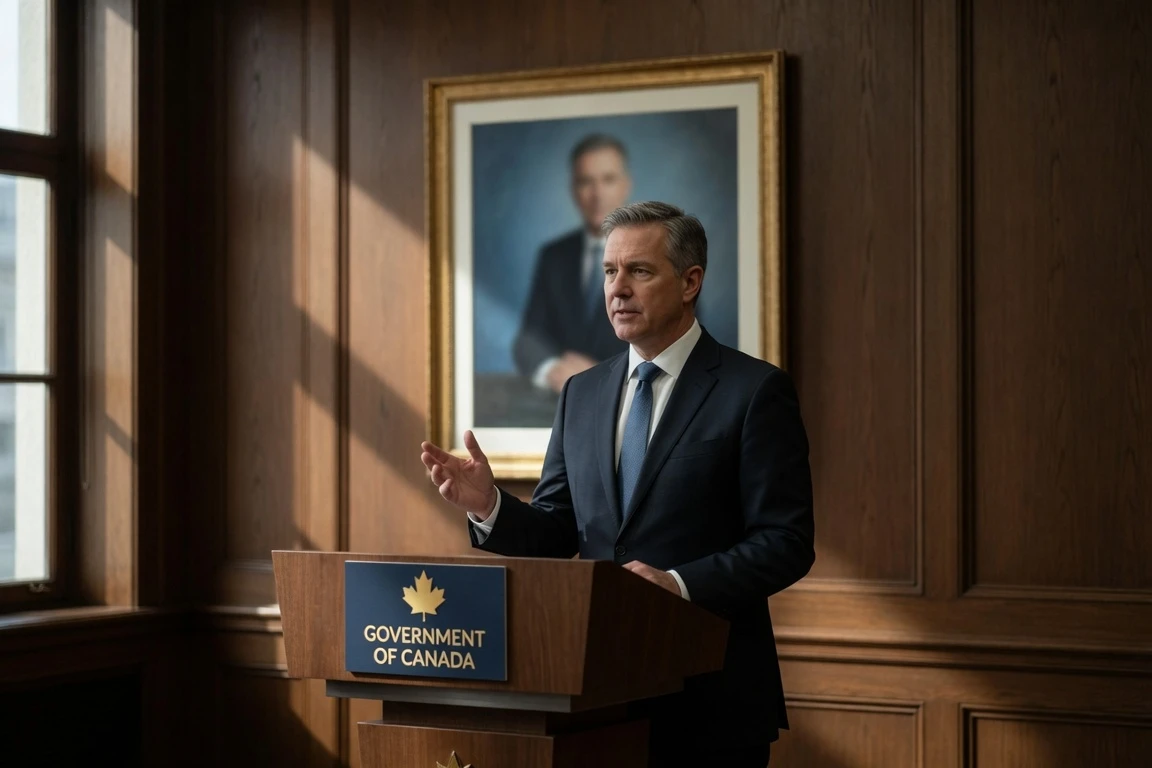
The $74 Billion Green Light
The dollar release is the heart of the announcement. OSFI’s release puts the sector’s cushion above the new supervisory expectation at an average of 13.5% common equity tier 1, well clear of the 11.0% minimum. The gap between those two numbers, applied to the Big Six’s combined risk-weighted assets, is what generates the capital freed up. OSFI pegs the cushion at roughly $74 billion, an amount Routledge summed up with a single word at his press conference: “green light.”
The regulator also translated the dollar number into an equivalent balance-sheet measure, framing the same cushion as headroom for a roughly $673 billion expansion in risk-weighted assets, the practical upper bound on new lending the freed capital could support. Whether the banks spend that headroom on commercial loans, on government infrastructure mandates, or on share buybacks is now the question that drives the rest of the debate.
The key numbers from OSFI’s release:
- New DSB level: 3.0% of risk-weighted assets (from 3.5%).
- New DSB range: 0% to 3% (from 0% to 4%).
- Capital cushion above the new minimum: roughly $74 billion.
- Risk-weighted-asset expansion equivalent: $673 billion.
- Sector average CET1 ratio: 13.5%; new supervisory expectation 11.0%.
OSFI followed the headline release with the formal DSB guidance letter to D-SIBs, which restates the change in the technical language the banks use for capital planning. The letter is the document each lender’s treasury and risk teams will file against in their next disclosures.
Analysts Called It a Surprise
The cut did not arrive on a consensus. Mario Mendonca of TD Securities Inc. wrote in a Friday note that the move ran against OSFI’s prior signal. “Prior messaging from OSFI pointed to the DSB as a reactionary tool to be lowered after economic risks materialized,” he said. “We had not envisioned OSFI would use the DSB as a proactive capital management tool.” That single word, proactive, is what frames the split among sell-side desks.
Mendonca went further, reading the timing as a hedge against the Canada-United States-Mexico Agreement renegotiation rather than a response to current credit losses. He added that the cut looks more like a mechanism to backstop the banking system before a contentious trade round than like an emergency brake on a deteriorating loan book. The Canadian Banking Association, the industry body that represents about 60 lenders including the Big Six, welcomed the move and said it would contribute to the country’s economic growth and competitiveness. Sébastien Mc Mahon, chief economist at iA Financial Group, told the Canadian Press he did not read the cut as a distress signal. “This does not look like a distress signal,” he said. “It’s more OSFI saying that the banks are strong, we see the economy going through some structural changes, and it’s time to support lending and investment through regulation.”
Which Banks Stand to Gain
Not every Big Six balance sheet benefits equally. Mendonca named Bank of Montreal and National Bank of Canada as the greatest beneficiaries, citing their higher commercial-loan mix. BMO also runs the lowest CET1 ratio in the group at 13%, the closest to the new 11.0% supervisory expectation and therefore the bank with the most relative room to deploy freed capital into commercial lending.
The flip side is the buyback question. Gabriel Dechaine, an analyst at National Bank of Canada (the markets arm of one of the lenders, distinct from the bank itself), wrote that investors should not expect repurchase programs to follow. The capital release is meant to support the banks’ ability to boost the economy, he said, and the broader deregulation theme must extend to other industrial sectors if the capital is to do its job. Mc Mahon echoed that test from the other side of the debate: if the freed capital ends up funding buybacks, demand for credit is still weak, and if it ends up in commercial loan growth, the policy has done what OSFI appears to want.
The Case Against the Cut
The release also reopens an older argument that the DSB itself distorts the market. A 2025 Globe and Mail commentary by regulatory compliance consultant John Turley-Ewart argued the buffer should be retired. The argument rests on three points that the June 19 cut does not touch.
- The DSB applies only to the Big Six, so smaller lenders do not get a corresponding capital release and must use a different, often more onerous, regime.
- Banks recover the carrying cost of the surplus capital they hold in higher fees and lending rates, a cost that eventually lands on borrowers.
- A one-size-fits-all DSB treats every bank’s stress-test result as identical, an approach that other jurisdictions have moved away from in favour of tailored stress capital buffers.
For readers tracking the consumer-lending angle, the smaller-bank friction shows up in places like Canada’s bank watchdog flagging risky condo mortgage valuations, where the regulator’s risk lens applies to lenders that the DSB release leaves out. The full commentary, including Turley-Ewart’s call to scrap the DSB in favour of a Federal Reserve-style stress capital buffer, lives in a 2025 Globe and Mail commentary arguing the DSB should go.
Where the Money Is Expected to Flow
OSFI’s release names four opportunity areas where the regulator wants the freed capital deployed. The list is short, on-message, and tied to the same structural shifts the regulator cited when it cut the buffer.
- Defence and security
- Critical infrastructure
- Resources
- Artificial intelligence
The release language is explicit that OSFI cannot direct how individual banks run their businesses. The buffer release is a permissive signal, not a lending quota. Routledge made the trade-off plain at his press conference.
What we’re saying to the banks is your capital in excess of the top end of the DSB range yesterday was $45 billion. Today it’s $74 billion, so green light. Now it’s up to the banks themselves to determine how to deploy that capital.
Peter Routledge, Superintendent of Financial Institutions, at the OSFI press conference in Ottawa on June 19, 2026, as reported by the Financial Post. Routledge told Reuters the opportunities were there for the banks and that his office was “getting out of the way,” and tied the cut to lenders’ “extraordinary loss-absorption capacity” in the same interview. The BNN Bloomberg / Canadian Press read of the move placed it in the same context, linking it to Carney’s economic agenda and to a major projects office set up to speed reviews of nation-building proposals.
A Strong Quarter That Preceded the Move
The buffer cut did not arrive into a stressed sector. Reuters reported, as carried by Canadian outlets, that all six banks beat profit expectations in their most recent quarter on strong domestic and capital-markets earnings, with diversified models and underwriting slowing loan impairments and credit losses. OSFI’s own decision note struck a similar note on the macro side, saying that while vulnerabilities in the financial system remain elevated, conditions have been relatively stable, and that Canadian household indebtedness remains high relative to income but below historical peaks, with overall delinquencies, unemployment, and credit losses within historically normal ranges despite trade-related headwinds.
The sector’s profitability backdrop is one reason bank stocks came into the announcement from a position of strength. BNN Bloomberg noted the Big Six were up more than 50% over the prior 12 months, outperforming the closest comparable sectors. The regulator’s own 13.5% sector CET1 average is the headline number here, and OSFI’s February 2026 benchmarking work shows Canadian systemically important banks running aggregate CET1 ratios broadly in line with international peers, with more than 550 basis points above the binding 8% requirement, a surplus that exceeds international peers, as detailed in OSFI’s February 2026 capital benchmarking note. Executives at the six banks told Reuters the near-term outlook hinges on US trade talks and on how long the Middle East conflict lasts, factors that will shape client demand, supply-chain stability, and the direction of monetary policy.
Frequently Asked Questions
What is the domestic stability buffer?
The DSB is a Pillar 2 capital buffer that OSFI introduced in 2018 for Canada’s six domestic systemically important banks, which are Royal Bank of Canada, TD Bank, BMO, Bank of Nova Scotia, CIBC, and National Bank of Canada. It is set as a percentage of risk-weighted assets and forms part of each bank’s required common equity tier 1 ratio; lowering it frees capital the banks can lend or invest rather than hold against future shocks.
How much extra capital did the Big Six just gain?
OSFI puts the sector’s cushion at roughly $74 billion in excess capital, or the equivalent of an expansion in risk-weighted assets of $673 billion. The cut takes the DSB to 3.0% from 3.5% and narrows the buffer’s range to 0-3% from 0-4%.
Why was the move a surprise to analysts?
Mario Mendonca of TD Securities wrote that OSFI had previously signalled the DSB as a reactionary tool to be lowered after economic risks materialized, a tool that would not be used pre-emptively. Using it ahead of the Canada-United States-Mexico Agreement renegotiation made the cut a proactive capital management move, not a response to imminent credit losses.
Which banks benefit most from the cut?
Mendonca named Bank of Montreal and National Bank of Canada as the greatest beneficiaries, citing their higher commercial-loan mix, and noted BMO’s 13% CET1 ratio as the lowest in the peer group. Gabriel Dechaine of National Bank of Canada’s markets division cautioned that buybacks are unlikely, arguing that the broader deregulation theme must extend to other industrial sectors for the capital to drive economic transformation.
Disclaimer: This article is for informational purposes only and does not constitute investment, financial, or legal advice. Figures are accurate as of the publication date of June 23, 2026. Readers should consult a qualified professional before making any financial decisions related to the banks or capital markets discussed here.