Japan’s Nikkei 225 closed sharply lower on Wednesday, capping a volatile session that saw the benchmark swing between a 1.66 per cent drop and a 0.25 per cent gain before settling down. Technology stocks did most of the damage, tracking an overnight chip-led rout on the Nasdaq that left investors questioning the durability of the AI trade. By the Tokyo close, the Nikkei stood at 67,146.21, down 1,110.75 points or 1.63 per cent, according to Yahoo Finance’s index page.
The slide came in choppy trade that ran counter to a textbook mirror of New York. Investors bought the dip at one point, sold the bounce at another, and let chip equipment names bleed through the morning. The session’s end result, though, was a benchmark that finished near a four-week low, per a Reuters wire carried on July 8.
The Close: Nikkei Ends Near a Four-Week Low
The benchmark sat at 67,763.91 at 0157 GMT, already down 0.72 per cent, after flitting between a 1.66 per cent drop and a 0.25 per cent gain during Asian hours, per the Reuters report. The wider Topix slid 0.62 per cent to 4,037.16.
By the cash close, losses had extended. Yahoo Finance pegged the Nikkei at 67,146.21, off 1,110.75 points or 1.63 per cent from Tuesday’s close of 68,256.96, with an open of 67,704.16 and an intraday low of 66,819.05. The 52-week high of 72,831.73 set in this cycle is now well above the tape. TradingEconomics showed a similar print at 66,962 points, down 1.90 per cent.
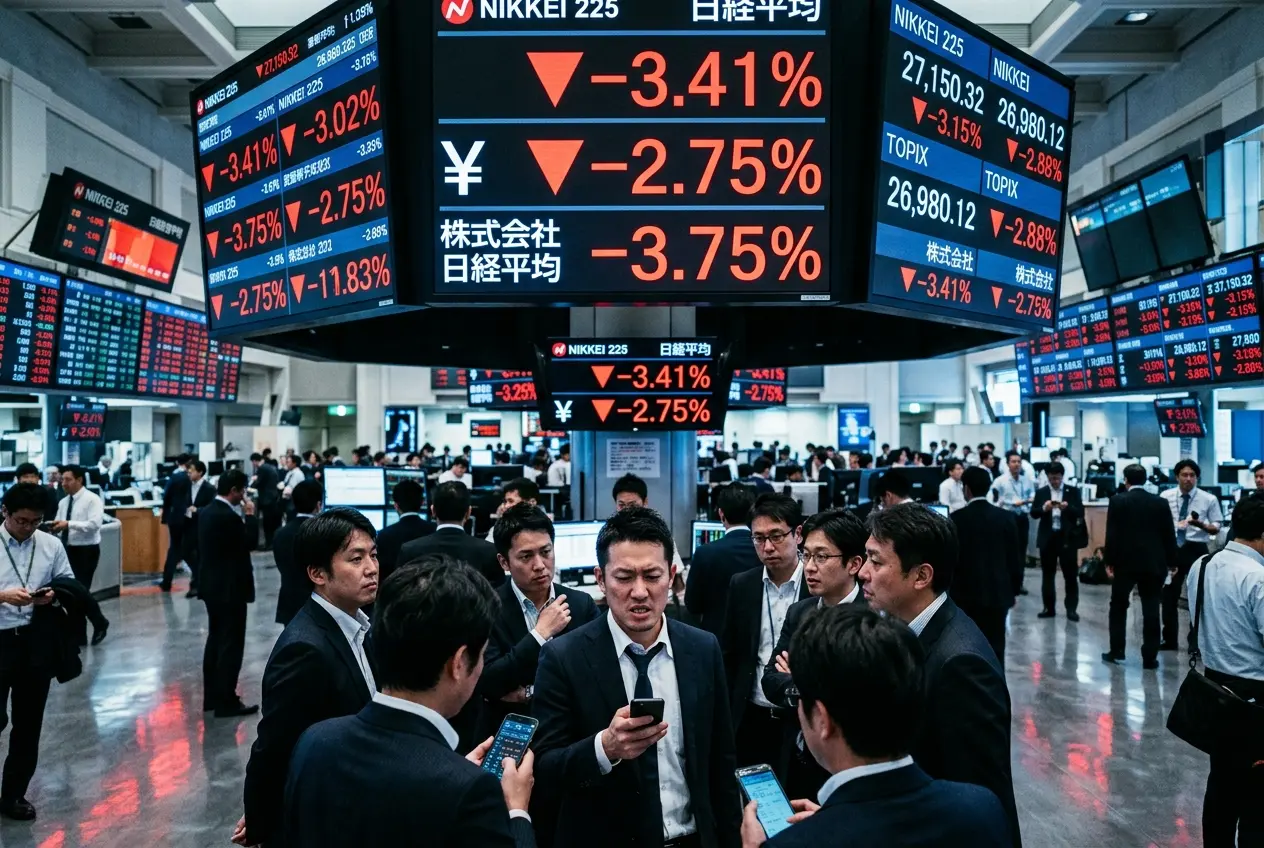
The Drag: Chip Equipment and AI Server Names Led the Selloff
The selling concentrated in stocks with the highest beta to the AI build-out. Shares of chip-making equipment maker Tokyo Electron fell 2.4 per cent, per the Reuters wire, and chip-testing equipment maker Advantest edged 0.38 per cent lower. The sharper move was in Taiyo Yuden, a manufacturer of multi-layer ceramic capacitors that regulate power in AI servers: its stock fell 6 per cent.
That trio carries an outsized weight on the Nikkei and has driven a meaningful slice of the index’s gains since the AI trade accelerated. With each pulling back, the index’s drag compounded. Tokyo Electron and SoftBank Group alone dragged the Nikkei down by approximately 464 points as of the morning close, according to a separate Biggo Finance write-up of the session’s contribution analysis.
Advantest’s relative resilience was a function of its smaller weight on the day, not of any company-specific reprieve. Tokyo Electron’s drop, in turn, was the cleanest read on global semiconductor sentiment, since its customer base sits across every major foundry in Asia and the US.
Taiyo Yuden’s 6 per cent slide illustrated the chain reaction. Multi-layer ceramic capacitors sit one or two steps back from the GPU itself, but they are sold into the same AI server programs. When Nvidia’s order book wobbles, the capacitor names wobble first.
The names that fell hardest
- Taiyo Yuden, -6 per cent
- Tokyo Electron, -2.4 per cent
- Advantest, -0.38 per cent
The Rotation: Where the Money Went Instead
Tokyo’s tape was not a uniform sell-off. While chip equipment names bled, other pockets rallied on a clear rotation theme.
Memory maker Kioxia recouped early losses to trade 2 per cent higher. The move looks counter-intuitive against a memory-led Asian selloff, but it tracks a pattern that has held for much of the cycle: when AI-linked chip equipment sells off on order-book worries, HBM and DRAM players attract flow as the AI demand beneficiaries whose pricing power is intact.
Phone company KDDI rose 1.69 per cent as investors rotated their target to shares sensitive to domestic demand. Game maker Konami Group, which had been beaten down on rising memory prices, rose nearly 1 per cent. Technology investor SoftBank Group, often the highest-beta AI proxy on the index, edged up 0.28 per cent. The Tokyo tape, in other words, was sorting names by their distance from the chip cycle, not treating them as a single block.
The Overnight Trigger: Nasdaq’s Chip Rout
The Wednesday Tokyo drop started on Tuesday in New York. The three major US averages closed lower on Tuesday, with the Nasdaq Composite dropping 1.16 per cent to close at 25,818.69, the S&P 500 settling down 0.45 per cent at 7,503.85, and the Dow Jones Industrial Average declining 130.76 points or 0.25 per cent to end at 52,925.15, per CNBC’s live updates page.
The selling was concentrated. Micron dropped 4.7 per cent and Sandisk lost 7.3 per cent, helping send the PHLX chip index down 4.65 per cent and trimming its 2026 gain to roughly 74 per cent, per a Reuters wire carried by U.S. News on July 7. Adding to the pressure was memory chip giant Samsung Electronics, whose earnings on Tuesday failed to meet investors’ elevated expectations and prompted profit-taking across the sector.
Nvidia, by contrast, traded around 1 per cent higher in afternoon trade, reversing earlier losses, as fellow chipmakers came under pressure, per CNBC. That split inside the chip complex is part of what gave the Tokyo tape its shape: when Samsung disappoints on memory pricing, the equipment and component names sold off, but the leading-edge AI beneficiary held its bid.
The trigger was a confidence reset, not a demand reset. The Reuters wire cited “heightened concerns about the durability of Wall Street’s AI-driven rally,” a phrase that does the work of explaining why chip equipment sold off harder than chip users.
Tuesday’s close, side by side
| Index | Close | Change |
|---|---|---|
| Nasdaq Composite | 25,818.69 | -1.16% |
| S&P 500 | 7,503.85 | -0.45% |
| Dow Jones Industrial Average | 52,925.15 | -0.25% |
| Nikkei 225 (Wed) | 67,146.21 | -1.63% |
| Topix (Wed) | 4,037.16 | -0.62% |
The Strategist View: AI Confidence Is Cracking
The market’s read on the selloff ran through one analyst note.
Investors can not fully regain their confidence in AI shares. Samsung Electronics flagged a strong outlook but the market was not convinced that prices will keep rising.
Those lines came from Daisuke Hashizume, senior strategist at Daiwa Securities, in remarks carried by the Reuters wire on July 8. The two-sentence diagnosis captures the tension under the surface: AI earnings are still strong, but a strong outlook no longer translates into a higher share price.
Asia’s Chip Complex Catches the Rout
Japan did not take the AI-confidence hit alone. South Korea’s Kospi, the most direct read on global memory pricing, fell 5.35 per cent to 7,246.79 on Wednesday, per Yahoo Finance’s KOSPI page. The move tracks the pattern set on Wall Street: Samsung Electronics, the anchor of the Kospi, missed expectations on Tuesday, and the index followed.
That link between Samsung’s print and Seoul’s index is now a direct one. When the memory leader reports and the market wants more, every other Korean memory name gets repriced; when Samsung delivers an in-line quarter, the same names get repriced lower. The Kospi’s decline on Wednesday is the second half of that arithmetic.
The Nikkei’s drop is the parallel half in Tokyo. With Tokyo Electron, Taiyo Yuden and the rest of Japan’s AI-equipment complex exposed to the same end-market, the spread between memory and equipment now defines a session like Wednesday as much as the broader index level does.
By the numbers
- Nikkei 225 close: 67,146.21, down 1.63%
- Topix close: 4,037.16, down 0.62%
- Kospi close: 7,246.79, down 5.35%
- Nasdaq Tuesday close: 25,818.69, down 1.16%
- PHLX chip index Tuesday: -4.65%
Frequently Asked Questions
Why did Japan’s Nikkei fall on July 8, 2026?
The Nikkei dropped because Japanese technology stocks, especially chip equipment and AI server component makers, tracked an overnight sell-off on Wall Street’s Nasdaq. The trigger was chip giant Samsung Electronics’ earnings on Tuesday, which Reuters reported failed to meet investors’ elevated expectations, prompting profit-taking across the global semiconductor complex.
Which Japanese tech stocks led the decline?
Multi-layer ceramic capacitor maker Taiyo Yuden fell 6 per cent, chip equipment maker Tokyo Electron dropped 2.4 per cent, and chip-testing equipment maker Advantest edged 0.38 per cent lower, per the Reuters wire carried on July 8. Tokyo Electron and SoftBank Group alone accounted for roughly 464 points of the Nikkei’s drag as of the morning close.
What was behind Tuesday’s chip sell-off on Wall Street?
The Nasdaq Composite dropped 1.16 per cent on Tuesday, dragged down by losses in Micron Technology and other chipmakers, per CNBC’s live updates page. Micron dropped 4.7 per cent and Sandisk lost 7.3 per cent, helping send the PHLX chip index down 4.65 per cent, per a Reuters wire carried by U.S. News.
Did anything on the Tokyo exchange actually rise?
Yes. Memory maker Kioxia traded 2 per cent higher after recouping early losses, phone company KDDI rose 1.69 per cent on a rotation into domestic-demand names, and game maker Konami Group rose nearly 1 per cent, per the Reuters wire. SoftBank Group edged up 0.28 per cent.
How does a Nasdaq drop hit Japanese markets?
Japanese chip equipment and AI server component makers sell into the same global semiconductor supply chain that drives Nasdaq-listed chip designers and memory makers. A confidence reset on Wall Street over the durability of the AI rally reaches Tokyo through share-price contagion, then compounds when local investors also reposition by AI exposure.