Kevin Michaluk’s keyboard company has reported more than 50,000 preorders for its Power Keyboard accessory since the device opened for reservations on January 2, a figure large enough that a niche product is starting to behave like a category. Chinese hardware maker Unihertz pulled in more than $4.8 million from over 8,200 Kickstarter backers for its Titan 2 Elite by early May, more than double what its previous campaign raised in the summer of 2025.
Six physical-keyboard handsets now ship or take preorders, and the consensus framing across launch coverage calls the surge a BlackBerry nostalgia revival. The buyer mix at Clicks Technology tells a different version: co-founder Kevin Michaluk has said roughly 45% of Clicks customers have never owned a phone with a tactile keyboard.
Consensus Says Nostalgia, Kickstarter Receipts Say Something Else
The nostalgia frame is intuitive. RIM’s last consumer handset shipped in 2016, the brand sold its smartphone hardware rights to TCL the following year, and a generation of former BlackBerry owners has spent a decade complaining that no touchscreen approximates the thumb-typing speed of an 8520 or a Bold. A wave of new tactile devices in 2026 reads, on the surface, like a market finally rewarding that complaint.
The funding data complicates the read. Unihertz’s Titan 2 Elite Kickstarter campaign has now outpaced the company’s 2025 effort by both backer count and dollars raised, and the bulk of pledges sits in the entry-level $389 tier, not at the Pro Edition’s $479 mark. Clicks’ Communicator preorder book skews toward buyers who list email triage, text-heavy work, and a desire to look away from a screen as their reasons for buying, according to the firm’s CES briefings.
Three numbers worth keeping together:
- $4.8 million pledged to the Titan 2 Elite Kickstarter by early May, compared with $2 million for the original Titan 2 in summer 2025.
- 50,000 Power Keyboard preorders taken since January, per Clicks, distributed across iPhone and Android device targets.
- 45% first-time tactile-phone buyers among Clicks customers, per the company’s own segmentation data shared with reporters at CES.
If the category were a returning-customer phenomenon, the customer mix would skew older and brand-loyal. It skews younger and curious instead, which is closer to the dumbphone and intentional-tech audience than to the corporate BlackBerry cohort of the early 2010s.
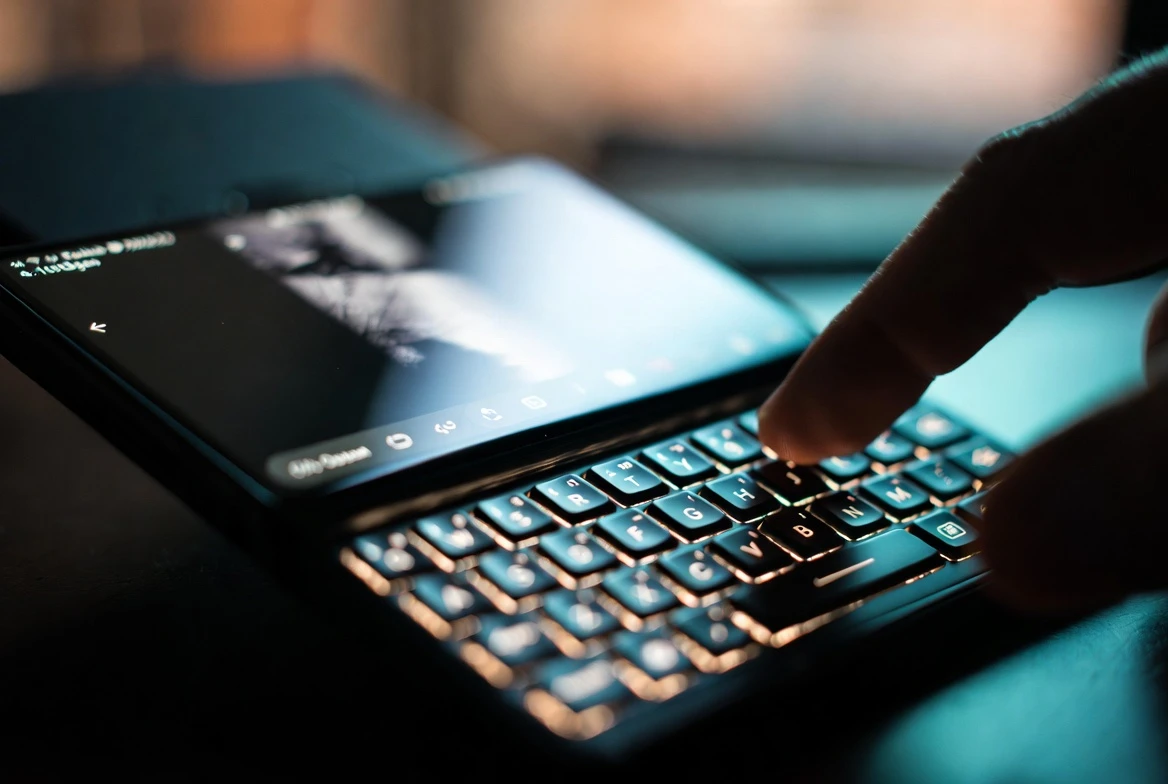
Six Pocket Devices Now Compete For The Same Tactile Niche
The 2026 roster of physical-keyboard phones is small but unusually distinct. Three vendors carry most of the volume, and each one sells to a slightly different buyer.
Clicks Technology, the UK-based startup co-founded by Michaluk and tech reviewer Michael Fisher, unveiled the Communicator at CES in January. The device pairs a 4.03-inch OLED display with a MediaTek Dimensity 8300 chip, runs Android 16 at launch, and promises five years of software updates. Reservations opened at $399 and the retail price climbs to $499 from February 27, with shipments scheduled for the fourth quarter.
Unihertz, the Shenzhen veteran of niche Android handsets, brought two successors to its 2025 Titan 2 to Mobile World Congress in Barcelona. The Titan 2 Elite uses a Dimensity 7400 chip and 256GB of storage; the Titan 2 Elite Pro upgrades to a Dimensity 8400 and 512GB. Both ship with Android 16, the company commits to security patches through 2031, and Kickstarter deliveries are scheduled for June.
The third lane is the Minimal Phone from Toronto’s Minimal Company, which prioritises low-stimulation over performance with a 4.3-inch grayscale E Ink panel and a four-day battery claim. The Minimal Company’s official product page lists Android 14 with full Google Play support and a $499 starting price.
| Device | Display | Chip | OS at Launch | Price (USD) |
|---|---|---|---|---|
| Clicks Communicator | 4.03-inch OLED, 120Hz | MediaTek Dimensity 8300 | Android 16 | $499 |
| Unihertz Titan 2 Elite | 4.03-inch AMOLED, 120Hz | MediaTek Dimensity 7400 | Android 16 | $489 retail / $389 KS |
| Unihertz Titan 2 Elite Pro | 4.03-inch AMOLED, 120Hz | MediaTek Dimensity 8400 | Android 16 | $579 retail / $479 KS |
| Minimal Phone | 4.3-inch E Ink, 800×600 | MediaTek Helio G99 | Android 14 | $499 |
| Zinwa Q25 | BlackBerry Classic conversion | Not disclosed | Android 13 | $400 (approx.) |
What none of these vendors compete on is screen size or camera bragging rights. The pitch is interface, not specs.
Why Almost Half The Buyers Have Never Touched A BlackBerry
Average global daily smartphone use peaked at 4 hours and 37 minutes in early 2026, according to multiple screen-time tracking firms; in the United States, total screen exposure across work and leisure runs past seven hours. The reaction inside that data is what shows up in the QWERTY preorder books.
Gen Z buyers are leading a documented shift toward intentional-tech hardware, and the cohort that buys minimalist devices like the Light Phone or installs a dumbphone-mode launcher is the same cohort showing up at Clicks and Unihertz’s checkout pages. The pitch resonates because a physical keyboard imposes a different relationship with a device. You stop scrolling because the keyboard occupies the half of the phone where the feed used to be.
A physical keyboard changes what the device is for. It favours writing, responding, and getting things done over endless scrolling and passive content consumption.
That framing comes from Clicks’ co-founder Kevin Michaluk, speaking to CNBC for a story published May 9 on the so-called keyboard-phone revival. It matters less as a quote about typing and more as a thesis about what the category is selling: not faster input, but constrained attention.
The category does not need a returning BlackBerry owner to pick up a Communicator for the math to work. It needs a 27-year-old buying a secondary device specifically because it isn’t designed to keep her watching short-form video. That buyer is the 45% the press releases keep mentioning, and she does not look like the corporate executive of the 2010s reaching for nostalgia.
The Accessories Lane Where The Volume Lives
The cheapest entry into the tactile category is not buying a new phone at all. Three accessories now bracket the price ladder, and they are doing the heavier sales lifting.
Clicks launched its first iPhone keyboard case in 2024 at $139 and extended the lineup to Google Pixel and Samsung Galaxy models in 2025; the company says cumulative shipments have crossed 100,000 units across 100-plus countries. At the Clicks Power Keyboard product page, the newer wireless accessory carries a 2,150 mAh battery, attaches via MagSafe or Qi2, and supports iPhone, Pixel, Galaxy Fold, smart TVs, and Apple Vision Pro headsets simultaneously through Bluetooth Low Energy. Early-bird preorder pricing started at $79 in January with an MSRP of $109.
Akko, the mechanical-keyboard maker, undercut Clicks with the MetaKey keyboard case for iPhone, launched in October 2025 at $59.99. The case fits the iPhone 16 Pro Max and iPhone 17 Pro Max, connects via USB-C with passthrough, and includes a nine-gram counterweight to balance the longer footprint. A scroll-mode toggle converts the top two key rows into navigation buttons, which is the feature reviewers most often single out.
The three accessories add up to a usable comparison:
- Akko MetaKey at $59.99: iPhone-only, USB-C tethered, no battery, narrow device support.
- Clicks Keyboard Case from $139: iPhone, Pixel, Galaxy support, lightning or USB-C, no battery.
- Clicks Power Keyboard from $79 early bird: wireless via MagSafe or Qi2, 2,150 mAh power bank built in, multi-device pairing.
An accessory does not commit a buyer to leaving the iPhone or Galaxy ecosystem, which is why the accessory tier outsells the standalone phones by an order of magnitude and is likely to keep doing so.
Where The Comeback Hits A Hard Ceiling
The optimistic read on the category has a ceiling that is easy to find. Three vendors selling Kickstarter handsets and one keyboard-case startup are not a threat to the touchscreen smartphone, and the major OEMs know it. Apple, Samsung, and Google have no public roadmap that includes a tactile-keyboard phone, and the engineering trade-offs of a sub-five-inch display attached to a fixed keyboard would surrender camera array space, battery density, and the foldable-screen real estate the flagship roadmap depends on.
The Communicator and the Titan 2 Elite Pro both weigh in around 200 grams in a footprint smaller than a standard slab phone, but their screens are roughly a third of the area buyers have grown used to. Watching a Netflix episode on a 4.03-inch panel is not the same product as watching it on a Galaxy S26 Ultra, and the secondary-phone framing all three vendors lean on quietly admits the device replaces only part of the primary phone’s job.
Niche economics also constrain software. None of the three vendors will get bespoke optimisation from Google, none will get day-one app updates from third-party developers, and the Android-on-niche-hardware track record (see Unihertz’s earlier Titan and Astroslide devices) is one of delayed security patches and middling camera tuning relative to specs on paper. Five years of updates is a generous promise on a Kickstarter-funded handset, and it has not been tested.
The ceiling is real, and so is the category sitting underneath it; the data behind the preorder pages says it does not vanish because a Kickstarter ran hot.
Frequently Asked Questions
Which Physical Keyboard Phones Can I Actually Buy in 2026?
Five distinct devices are shipping or taking preorders: the Clicks Communicator ($499, fourth-quarter delivery), the Unihertz Titan 2 Elite and Titan 2 Elite Pro (June delivery to Kickstarter backers, $489 and $579 retail), the Minimal Phone ($499 with an E Ink display), and the Zinwa Q25 (a Chinese conversion of an original BlackBerry Classic chassis, around $400).
How Much Does the Clicks Communicator Cost and When Does It Ship?
The Communicator reserves at $399 and retails at $499 from February 27, 2026. Production starts in the fourth quarter, with first deliveries scheduled to begin toward the end of the year, according to the company’s CES announcement.
Is BlackBerry Making Smartphones Again?
No. BlackBerry exited consumer smartphone hardware around 2016 and now focuses on automotive software through its QNX division. Every physical-keyboard phone on sale in 2026 comes from a separate company, including Clicks Technology, Unihertz, Minimal Company, and Zinwa Technologies. The form factor is being revived; the brand is not.
Why Are Physical Keyboard Phones Gaining Popularity Now?
The driving cohort is intentional-tech and digital-wellbeing buyers, not returning BlackBerry users. Clicks reports roughly 45% of its customers have never owned a tactile-keyboard phone. Daily global smartphone use averaged 4 hours and 37 minutes in early 2026, and a subset of buyers wants a device whose design discourages content scrolling.
What Is the Difference Between a Keyboard Accessory and a Keyboard Phone?
An accessory like the Akko MetaKey ($59.99) or the Clicks Power Keyboard (from $79 early bird) attaches to an existing iPhone or Android device. A keyboard phone like the Communicator or the Titan 2 Elite is a standalone handset with the keyboard built in. Accessories preserve your current phone and ecosystem; standalone devices commit you to a secondary device that runs separate software and a separate SIM.