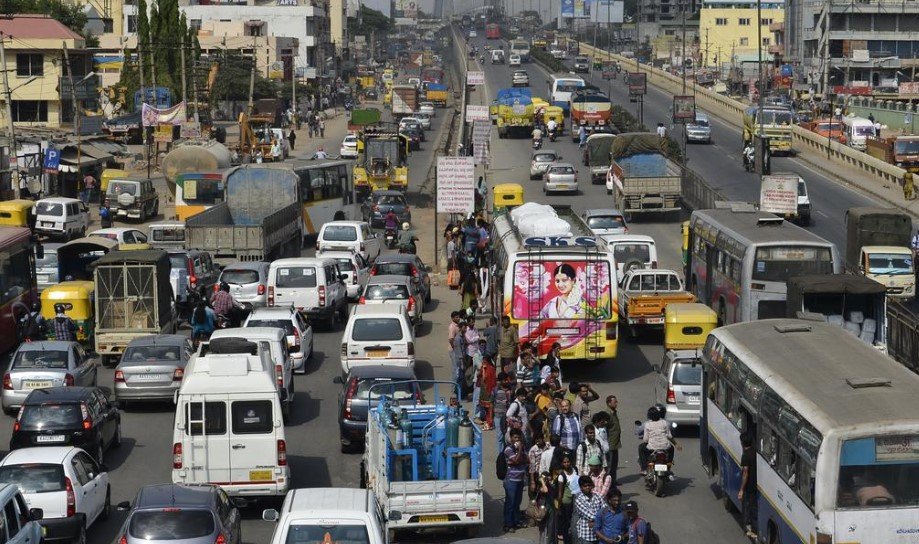
For all its digital ambitions, India’s Silicon Valley still moves at a snail’s pace. Bengaluru’s traffic, often mocked by its own residents, is fast becoming more than a local headache—it’s an economic problem worth billions.
The Tech Capital That Can’t Keep Moving
Every morning, the same scene unfolds. Cars honk in frustration. Bikes weave between stalled lanes. Bus drivers sigh into the distance.
Software engineer Shikher Chhawchharia is one of them. His 15-kilometer ride to work can stretch past an hour. “It’s maddening sometimes,” he said. “You try to make the best of it—I work on emails from the cab—but that’s still an hour of my life gone each day.”
For Bengaluru’s one million tech workers, this story repeats endlessly. A 2023 study pegged the economic loss from congestion at around US$2 billion annually, roughly equal to the cost of building two metro lines. That’s time, money, and productivity—stuck in traffic.
Some call the city India’s “traffic capital.” Others joke that it’s where innovation slows down to first gear.
From Startup Boom to Traffic Doom
Bengaluru’s rise was dazzling. What began as a modest IT outpost in the 1980s became a global tech magnet, drawing firms like Google, Visa, Amazon, and Infosys. The city’s mild weather, English-speaking talent, and academic network made it irresistible.
But with that success came chaos. Over the past two decades, the city’s population ballooned from 5 million to more than 13 million, spilling across farmlands and satellite towns. Roads didn’t keep up. Metro lines came late. And city planning—well, that got stuck in the same jam.
Today, a typical weekday looks like this:
-
Traffic peaks at 9:30 a.m., stretching commutes up to three times longer than off-peak hours.
-
Ride-hailing fares surge by over 40% during those windows.
-
Delivery trucks crawl at less than 10 km/h in central zones.
Basically, the city’s digital dream runs on analog roads.
The Metro Can’t Save Everyone
The Namma Metro, Bengaluru’s pride project, has helped a bit—but not nearly enough. Its limited coverage means many tech corridors like Outer Ring Road and Whitefield remain clogged.
Officials say new lines will connect those zones by 2026. Commuters are skeptical. “We’ve heard that promise for years,” said Rupa Menon, who works at a fintech firm in Marathahalli. “By the time they finish, traffic will be even worse.”
The irony? Workers in these tech parks build AI traffic systems for cities abroad while being late to their own offices.
One city transport expert, Prof. Ashish Verma of the Indian Institute of Science, argues the issue isn’t just infrastructure—it’s planning inertia. “We build roads for cars instead of people. We expand highways but not sidewalks or public transit integration,” he said in a recent interview.
Startups Find New Routes
The mess, though, has sparked innovation—ironically born out of frustration. Several Bengaluru startups are now targeting the very problem that slows them down.
Apps like Bounce, Rapido, and Yulu promote two-wheeler sharing and micro-mobility. Even corporate shuttle services like Shuttl and QuickRide are filling gaps left by the state.
One transport survey from 2024 found that nearly 38% of daily tech workers now use some form of shared mobility at least twice a week. That’s a silent revolution happening under the gridlock.
Yet, tech can’t solve everything. Bengaluru’s weather, roads, and parking chaos often make these solutions temporary band-aids. “You can optimize traffic lights all you want,” said a civic volunteer. “But if half the roads are dug up, what’s the point?”
A City Divided by Commute
There’s also a human story behind every jammed junction. For cab drivers, longer drives mean lower earnings. For working parents, it’s missed dinners and fewer hours at home.
And for many tech firms, employee fatigue is real. A 2024 HR survey by TeamLease Services showed commute stress as the top cause of job dissatisfaction among Bengaluru’s IT employees. Some firms now offer hybrid work not as a perk—but as survival.
| Average Commute (2024) | Distance | Time Taken | Mode |
|---|---|---|---|
| Tech employees (urban core) | 12 km | 68 minutes | Cab / Private Car |
| Suburban commuters | 20 km | 105 minutes | Bus / Bike |
| Metro users | 9 km | 42 minutes | Metro + Walk |
“People burn out faster here,” said a senior HR manager at a multinational. “By Friday, most are drained—not from work, but from the road.”
The government, for its part, says it’s working on solutions. New flyovers, metro extensions, and even “signal-free corridors” are in progress. But progress moves slower than the traffic they aim to fix.
Will the Tech Hub Choke on Its Own Growth?
Urban planners warn that Bengaluru could lose its competitive edge if congestion worsens. Big firms might start moving operations to other cities like Hyderabad or Pune, where commuting times are shorter.
“It’s ironic,” said one startup founder. “We talk about 5G, cloud, and AI, but can’t reach the office on time.”
Still, hope isn’t dead. The metro’s Phase 3 is underway, several road widening projects are in the pipeline, and citizens’ groups are pushing for carpool lanes and improved bus services.
The real challenge isn’t lack of money—it’s coordination. Agencies rarely talk to each other. Projects overlap, roads are dug up twice for different utilities, and planning is often reactive.
Yet amid the chaos, Bengaluru’s people remain oddly patient. Maybe it’s resilience, maybe it’s habit. Either way, as one weary commuter put it, “We don’t plan around traffic anymore. Traffic plans us.”
Tech City, Stuck City
The story of Bengaluru’s traffic isn’t just about cars—it’s about the cost of ambition. For every code written, a few hours are lost to the gridlock outside. The tech hub that powers India’s digital revolution now faces a very analog question: how long can innovation keep running on such slow roads?
Until something changes, the city that builds the future might stay stuck in the past—bumper to bumper.