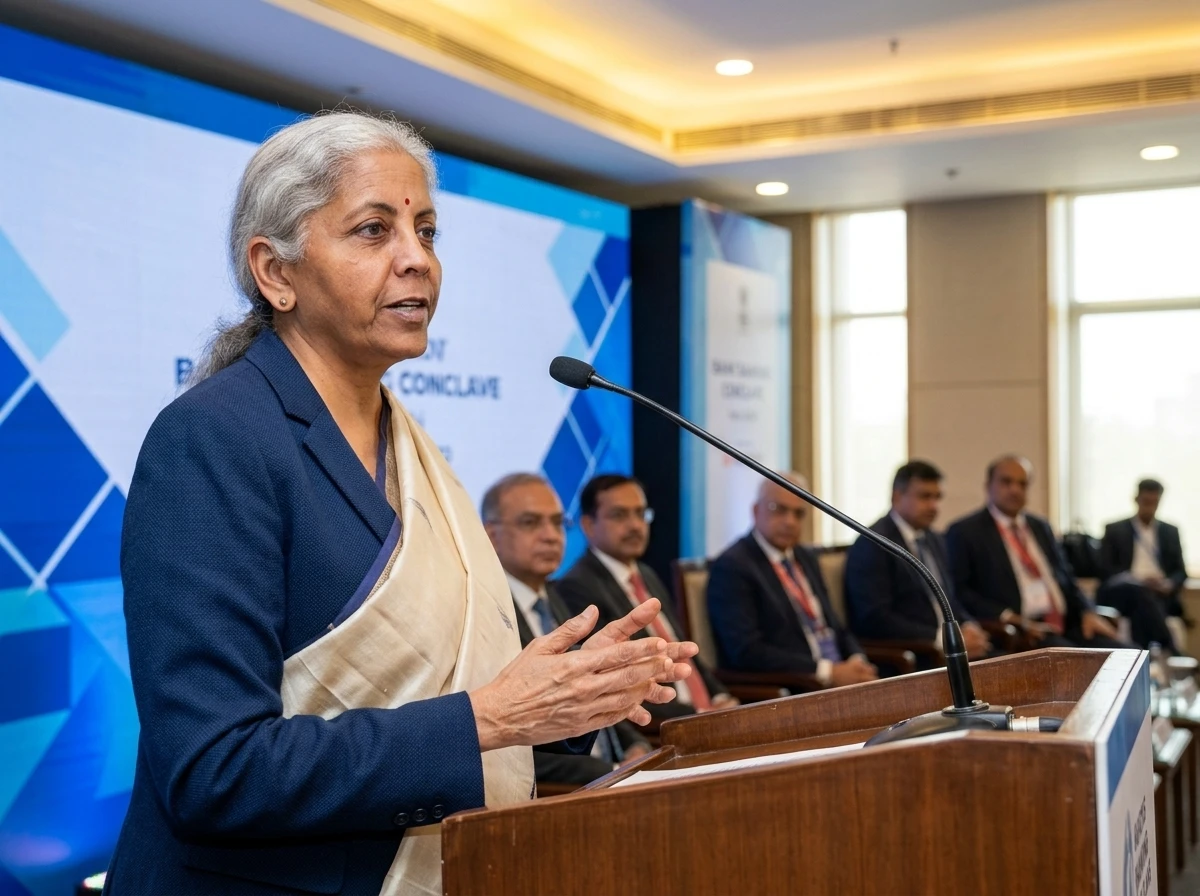
Finance Minister Nirmala Sitharaman told public sector bank chiefs on 17 August 2026 that a high-powered committee on banking for Viksit Bharat will be constituted later this month. The panel, first flagged in the Union Budget 2026-27, will draw on two days of PSB Confluence discussions and aim to ready the system for India’s 2047 development goals while protecting stability and inclusion.
The timing is no accident. Public sector banks just closed FY26 with their cleanest books in decades, giving the new panel a base earlier reform committees never enjoyed. Clean asset quality and thick capital buffers mean the next round of design work can focus on growth architecture rather than damage control.
Seven Themes From the PSB Confluence
The Department of Financial Services organised the two-day PSB Confluence 2026 in New Delhi to feed the coming panel. Sitharaman said the deliberations among PSBs and public financial institutions would supply key inputs, and that the government expects to announce the committee shortly.
DFS selected seven practical areas after research that included global practices:
- Mobilisation of deposits
- Banking services for young customers
- Financing the investment cycle
- Supporting global capability centres
- Strengthening agriculture and horticulture value-chain infrastructure
- Innovation in the credit card segment
- Priority sector lending
Sitharaman credited DFS for framing the themes and urged bankers to produce actionable ideas they themselves would own. Ownership matters because the same institutions that shape the recommendations will have to execute them under the panel’s eventual blueprint.
She also called for a focused “Banking for Youth” campaign starting 2 October 2026, aimed at those above 16 through colleges and skill institutions. The campaign sits inside the wider deposit and customer-franchise themes rather than as a stand-alone product push.
The NPAs are at the lowest ever Indian banking has seen, and therefore, there cannot be a better position of strength from which to drive reforms.
Nirmala Sitharaman, Finance Minister, PSB Confluence 2026
Financial Services Secretary Sanjay Lohiya noted that gross NPAs at PSBs had fallen from a peak of 14.6 percent in March 2018 to about 1.93 percent by March 2026.
PSB Numbers Show the Cleanup Worked
Official figures released by the Ministry of Finance confirm the turnaround. According to a PIB release based on RBI data, gross NPAs declining to 1.9 percent at end-March 2026 marked a multi-decadal low. Net profit hit a record ₹1.98 lakh crore. Capital adequacy (CRAR) stood at 16.6 percent.
| Parameter (₹ lakh crore except %) | 31.3.2022 | 31.3.2023 | 31.3.2024 | 31.3.2025 | 31.3.2026 |
|---|---|---|---|---|---|
| Total Business | 181.5 | 203.2 | 226.7 | 251.7 | 283.3 |
| Total Deposits | 107.2 | 117.1 | 129.0 | 142.0 | 156.3 |
| Loans & Advances | 74.3 | 86.1 | 97.7 | 109.8 | 127.0 |
| Net Profit | 0.67 | 1.05 | 1.41 | 1.78 | 1.98 |
| Gross NPAs (%) | 7.3 | 5.0 | 3.5 | 2.6 | 1.9 |
| CRAR (%) | 14.6 | 15.5 | 15.6 | 16.1 | 16.6 |
Credit growth was broad across segments:
- Retail loans rose 19.8 percent year-on-year
- MSME loans rose 19.6 percent
- Agriculture loans rose 16.2 percent
- Infrastructure loans rose 4.9 percent
Aggregate business crossed ₹283 lakh crore. System-wide scheduled commercial bank NPAs also sat near multi-decade lows around 1.7-1.8 percent.
These numbers matter because earlier high-level panels worked while banks were still digesting bad loans. The new committee starts after the heavy lifting on asset quality. Profit growth from ₹0.67 lakh crore in March 2022 to ₹1.98 lakh crore in March 2026 also gives boards more room to absorb the transitional costs of any fresh restructuring.
How Narasimham Changed the Rules Last Time
India’s modern banking architecture still rests on two committees chaired by former RBI Governor M. Narasimham. The first, set up in August 1991 amid the balance-of-payments crisis, produced a blueprint for liberalisation. The second, in 1998 after the Asian crisis, focused on strengthening and consolidation.
- 1991: Recommended cutting SLR from 38.5 percent toward 25 percent and CRR from around 15 percent, deregulating interest rates, introducing 8 percent capital adequacy, new private bank entry, and better NPA recognition.
- 1998: Pushed higher capital standards, bank mergers into fewer stronger entities, greater board autonomy, reduction of government stake toward 33 percent, and stronger recovery tools that later fed into SARFAESI.
Many recommendations were implemented over time. Reserve ratios fell, private banks such as HDFC and ICICI entered, prudential norms tightened, and the system proved more resilient in 2008. Some structural ideas, including full autonomy and deeper consolidation into three or four global-scale banks, moved more slowly. Later panels, including P.J. Nayak in 2014, returned to governance and board independence.
The parallel is explicit in current commentary. The new panel is cast in the same high-level mould, yet the starting point differs: Narasimham I faced a near-crisis system; today’s PSBs sit on record profits and capital buffers well above the 11.5 percent regulatory floor.
| Starting condition | Narasimham era | 2026 panel baseline |
|---|---|---|
| Asset quality pressure | Crisis and post-crisis cleanup | Gross NPAs near 1.9 percent |
| Capital position | Building toward new 8 percent norm | CRAR at 16.6 percent |
| Profit trajectory | Constrained by weak books | Record net profit of ₹1.98 lakh crore |
| Policy objective | Stabilise and liberalise | Scale for Viksit Bharat 2047 |
That contrast shapes what the new panel can responsibly attempt. Rules written in a crisis prioritise survival. Rules written from strength can prioritise long-horizon capacity without ignoring the stability lessons already learned.
What the Panel Is Likely to Weigh
Formal terms of reference have not been notified. Earlier reporting and parliamentary submissions give a clear sense of the menu.
Capital, Ownership and Scale
Sources told Mint in June 2026 that the committee could examine consolidating the remaining 12 PSBs further, possibly toward five larger entities, and raising the FDI cap in public sector banks from the current 20 percent toward 49 percent. A former DFS secretary, M. Nagaraju, was mentioned as a possible chair, with current secretary Sanjay Lohiya and other veterans as members. The government has previously reduced PSBs from 27 to 12 through the 2019-20 merger round.
A March 2026 Lok Sabha reply from the finance ministry stated there were no immediate merger proposals on the table and that focus remained on operational reforms under the EASE framework. The tension between scale ambitions and political caution on further consolidation will sit with the new panel.
Analysts note that even post-merger, Indian banks remain small by global standards. Creating institutions that can sit in the world’s top 20 would require both size and capital flexibility. Higher FDI could help, provided voting rights and government majority ownership rules are aligned.
Reserves, Licensing and Credit Capacity
DFS Secretary M. Nagaraju told a parliamentary panel earlier that the committee would look at whether CRR and SLR still need to lock up roughly 21 percent of bank resources, and at licensing norms and the transition path for small finance banks and NBFCs. The first Narasimham report had already driven a long phased reduction of SLR and CRR; a fresh look would ask whether further easing is safe given today’s stronger books.
Credit-to-GDP remains a structural constraint. Banks must finance infrastructure, manufacturing and the investment cycle without repeating the NPA cycle of the 2010s. Stronger credit assessment and monitoring systems sit high on every list.
Any easing of reserve ratios would free lendable resources only if underwriting quality keeps pace with volume. The 2010s cycle showed that capacity without discipline recreates the problem the cleanup just solved.
Scale Ambitions Meet Inclusion Risks
The seven Confluence themes show the government wants both bigger balance sheets and wider reach. Deposit mobilisation and youth banking address the funding side. Priority sector lending, agriculture value chains and GCCs address the deployment side. Credit cards and digital innovation sit in the middle.
Crowd reaction on X and among banking observers quickly surfaced the inclusion-scale trade-off. Some posts celebrated the NPA clean-up as the right platform for the next push. Others warned that talk of youth campaigns and Viksit Bharat can mask a quiet shift of ordinary borrowers toward higher-cost NBFCs and small finance banks while larger PSBs chase scale and corporate business. One thread argued that further mergers or capital market orientation could raise the cost of credit for rural and small borrowers even if headline inclusion numbers improve.
That tension is real. Past consolidations improved efficiency metrics, yet local branch presence and priority-sector discipline still depend on government ownership and regulatory mandates. The panel will have to show how larger, more competitive banks still deliver the last-mile credit that private lenders often price higher or avoid.
Elsewhere in the region, when private credit demand softens banks sometimes park surplus in government securities rather than push riskier loans; the private credit demand can stall pattern is a reminder that deposit strength alone does not guarantee productive lending.
Human resources form another quiet stake. PSBs still operate under older recruitment and pay structures. Autonomy on compensation and talent is repeatedly cited as unfinished business from earlier committees.
- Scale path: fewer, larger PSBs and possible FDI room up to 49 percent
- Inclusion path: priority sector rules, agriculture value chains, youth accounts
- Execution risk: credit priced out of reach for small borrowers if mandates weaken
- People risk: pay and hiring rules that still lag private peers
Clean Books Change What Reform Can Attempt
Earlier high-level panels spent much of their energy on recognition, recovery and basic prudential repair. The present balance-sheet snapshot removes that overhang. Gross NPAs near multi-decadal lows, CRAR at 16.6 percent, and record profits create space to debate structure, licensing and long-term capital markets access without first fighting a live bad-loan fire.
Mechanism matters here. When books are weak, every proposal is filtered through loss-absorption risk. When books are strong, the same proposal is filtered through growth capacity and competitive position. That is why the Confluence themes lean toward deposits, youth customers, investment-cycle finance and value-chain infrastructure rather than another emergency cleanup toolkit.
Strength is not a free pass. The same capital that funds ambition can also fund mistakes if credit assessment lags the push for volume. The panel’s practical test is whether it hard-wires monitoring and recovery discipline into any expansion of lendable resources, including any future look at the roughly 21 percent of resources still locked in CRR and SLR.
Deposit Growth Still Has to Become Credit
Total deposits at PSBs reached ₹156.3 lakh crore by end-March 2026 while loans and advances stood at ₹127.0 lakh crore. The gap underscores why mobilisation of deposits and financing the investment cycle appear together among the seven themes. Funding supply has improved; the open question is productive deployment.
Retail, MSME and agriculture credit already show double-digit growth, while infrastructure lags at 4.9 percent. That mix will shape how far the system can support manufacturing, logistics and long-gestation projects without recreating concentration risk. Global capability centres and horticulture value chains offer newer channels, but they still need underwriting tools that match their cash-flow patterns.
Deposit strength therefore sets up a lending test rather than completing it. If surplus funds drift into low-risk government securities whenever private demand softens, the 2047 capacity story slows even if headline deposit numbers keep rising. The panel’s recommendations on licensing, small finance bank transition paths and priority-sector design will influence whether the next decade converts franchise size into broad-based credit.
The Clock to 2047
Sitharaman repeatedly framed the exercise around Viksit Bharat 2047, noting that the target year is no longer distant. The committee is expected to work quickly; earlier government thinking suggested a three-to-four-month window for recommendations once constituted. Once the report lands, the government has said it will move to implement.
Technology, cyber resilience, climate risk and third-party dependencies will sit alongside the classic capital and governance questions. Digital banking and AI already reshape operations; the panel must translate those shifts into governance and operational resilience rules that do not freeze innovation.
The historical pattern is clear. High-level committees have twice reset the operating system of Indian banking, once in crisis and once in recovery. This third major exercise begins with clean books, strong capital and a political mandate to think in decades rather than quarters. Whether it produces another durable blueprint, or merely a list of operational tweaks, will decide if the current strength compounds into the scale India says it needs by 2047.
The first concrete test arrives when the government names the members and publishes the terms of reference later this month.