Sony put the Xperia 10 VIII on sale for £549 and €599, a jump of roughly £100 to €150 over the 10 VII’s launch price, while keeping the same Snapdragon 6 Gen 3 chip, 50 MP main camera, 13 MP ultrawide and 5,000 mAh battery. The company calls out a 50% brighter screen, 30% louder stereo speakers and hardware shortcuts as the main reasons to upgrade. Sales start mid-to-late September in Europe and the UK only.
The phone arrives in frozen white, frosted grey and misty lilac. It still measures 153 × 72 × 8.3 mm and weighs 168 g, with Gorilla Glass Victus 2 on the front, a plastic frame and back, and IP65/IP68 ratings. Those dimensions and that weight put it among the smallest OLED Android handsets still sold new, which is the frame Sony wants buyers to use when they see the higher sticker.
The formula is familiar: hold the chassis, ports and core silicon steady, polish a few everyday surfaces, then ask more money for the polish. Whether that trade works depends on how much a buyer still values the jack, the card slot and the compact body against the mid-range field around it.
The Spec Sheet That Barely Moved
GSMArena’s review team ran the numbers and found performance essentially identical to last year’s model. The Snapdragon 6 Gen 3 is the original 2024 SM6475-AB part, not a 2026 revision. It pairs with 8 GB of RAM (plus up to 6 GB virtual RAM) and 128 GB of UFS storage expandable by microSD.
| Feature | Xperia 10 VII | Xperia 10 VIII |
|---|---|---|
| Display | 6.1″ LTPS OLED, 120 Hz, FHD+ | Same panel, claimed 50% brighter |
| Chipset | Snapdragon 6 Gen 3 | Snapdragon 6 Gen 3 |
| RAM / Storage | 8 GB / 128 GB + microSD | 8 GB + virtual / 128 GB + microSD |
| Main camera | 50 MP, 1/1.56″, f/1.9, OIS | Identical |
| Ultrawide | 13 MP, 123° | Identical |
| Battery / Charge | 5,000 mAh / 30 W | Identical |
| Launch price (EU/UK) | ~€399-449 / £449 | €599 / £549 |
Body, ports and most cameras stay put. The front camera remains an 8 MP unit. Video tops out at 4K30 on the rear. Dual SIM (nano + eSIM), Wi-Fi 6E, Bluetooth 5.4, NFC and the side fingerprint sensor carry over unchanged.
The table makes the strategy plain. Almost every row that governs speed, capture quality or charge time is a copy of the prior model. The rows that move are brightness claim, software generation, virtual RAM and the launch price. That pattern is deliberate restraint priced as a new generation.
Brightness, Speakers and the Shutter Button
Sony’s own product page highlights a brighter display and new stereo speakers. Independent tests measured peak brightness around 1,509 nits in auto mode with a 75% window, a clear step up from the 10 VII and enough for outdoor maps or video.
- Display gain: 50% brighter claim, 120 Hz LTPS OLED, 422 ppi, DCI-P3, Triluminos tuning.
- Audio: Front-firing stereo speakers rated 30% louder with improved bass response; 3.5 mm jack and LDAC remain.
- Controls: Dedicated two-stage shutter button still launches the camera from sleep; double-press power now opens a customisable “Rewards and Pay” shortcut tray.
- Battery claim: Up to two days with Adaptive Charging and Battery Care software.
These are real, measurable improvements. They do not change the fact that the silicon, sensors and capacity are carry-overs.
The brighter panel and louder speakers are the upgrades a user notices on day one without opening a benchmark app. The shutter button and the new power double-press shortcut keep the hardware control language that Sony has defended for years. Together they form the tangible half of the refresh while the chip and cameras stay frozen.
Why the Price Climbed to €599
Last year’s Xperia 10 VII opened near €399 in parts of Europe and £449 in the UK. The new model asks €599 and £549 for the single 8 GB/128 GB configuration. On X, early reactions boiled down to the same observation: Sony kept the hardware and raised the sticker.
What buyers actually pay extra for looks like this:
- Brighter panel and louder speakers.
- Android 16 out of the box instead of 15.
- Virtual RAM toggle and minor camera processing tweaks.
- Same six-year security window now running to 2032.
- New frosted translucent colour finishes.
No higher storage tier, no telephoto, no wireless charging, no faster wired charge. The box still contains no charger or cable. The price lands the phone in territory occupied by stronger Dimensity and Snapdragon 7-series rivals that ship with more RAM or higher peak brightness for less money.
In short, the premium buys surface finish, launch software and longevity paper, not a faster SoC or a better lens stack. Shoppers comparing absolute speed per euro will find that math hard to defend. Shoppers comparing ports and size may still accept it.
Compact Body, Jack and Card Slot Still Rare
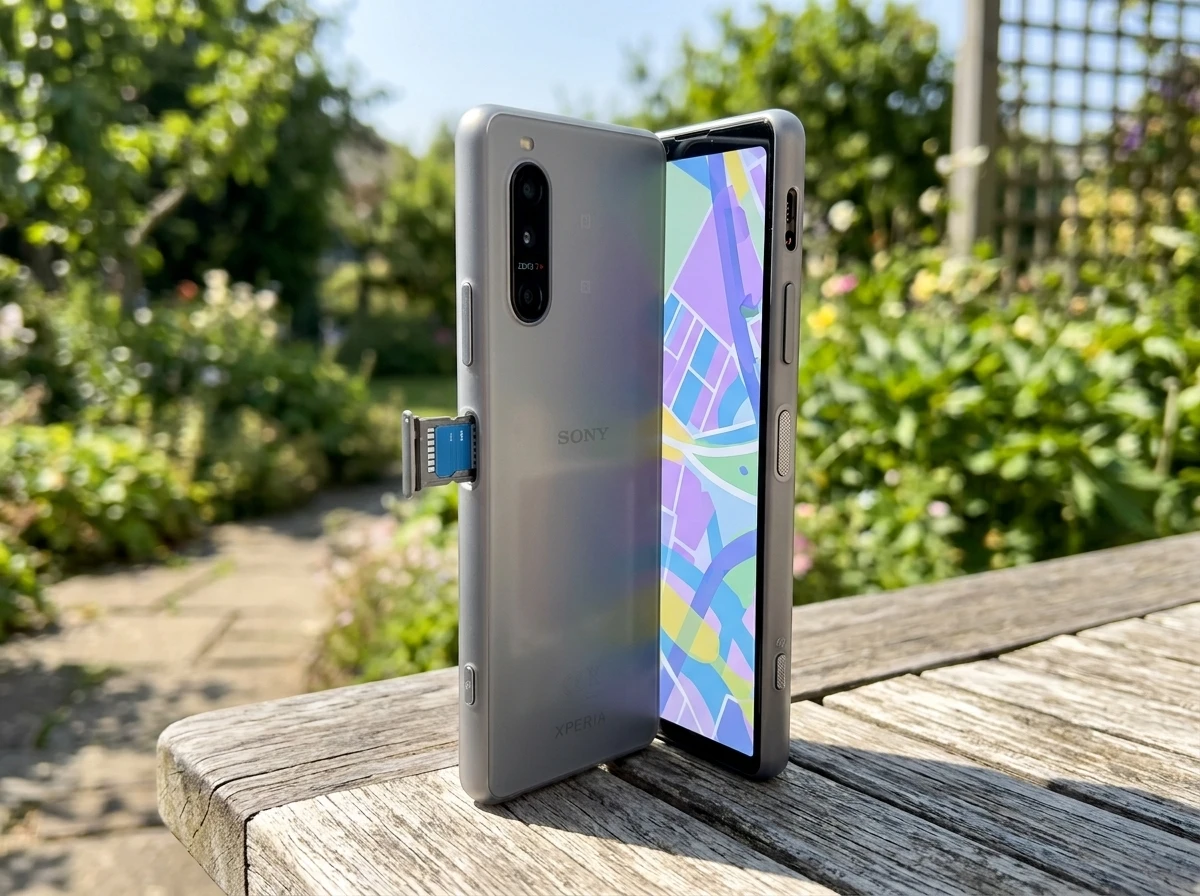
At 6.1 inches and 168 g the Xperia 10 VIII remains one of the smallest OLED Android phones you can buy new. It keeps three features that have vanished from almost every mid-range competitor:
- Physical 3.5 mm headphone jack with Hi-Res and 360 Reality Audio support.
- microSDXC expansion up to 2 TB (shared tray).
- Clean near-stock Android with minimal preloads and Side Sense edge gestures.
GSMArena noted the software still feels closer to AOSP than many Pixel builds in places. Google Gemini and Circle to Search are present, but Sony avoids heavy AI skin overlays. For users who want a compact phone that takes wired headphones and extra storage without a bulky case, the list of options has shrunk to a handful of Sony models and a few rugged outliers.
That uniqueness is the product’s entire sales pitch. The irony is that the same stubborn feature set now carries a price that pushes casual shoppers toward larger, more powerful Chinese phones that drop the jack and the card slot without apology.
The 153 × 72 × 8.3 mm shell is not a styling flourish. It is the constraint that forces the rest of the design: a 6.1-inch panel, a side fingerprint reader and a shared SIM-plus-card tray. Once a buyer accepts that constraint, the jack and microSD stop looking like leftovers and start looking like the point of the phone.
Four OS Upgrades Reach Android 20
Sony promises four major platform upgrades and six years of security patches. The phone ships with Android 16, so the path runs through Android 17, 18, 19 and 20, with security support listed until 2032. The full official specifications page confirms the timeline and the inclusion of Battery Care optimisations intended to keep the cell healthy for up to four years.
- 2026 launch: Android 16 out of the box.
- Next four platform steps: Android 17, 18, 19, then 20.
- Security window: patches listed through 2032.
- Cell health target: Battery Care software aimed at up to four years of healthier capacity.
In a mid-range segment where three years of OS updates is still common, the commitment is competitive. It turns the Xperia 10 VIII into a longer-lived device on paper than many faster chips that receive shorter support. Whether that longevity offsets the higher launch price depends on how long a buyer plans to keep the handset.
The support calendar is one of the few places where the VIII clearly outruns cheaper, faster rivals. A buyer who keeps a phone four or five years can amortise the €599 ask across more seasons than a three-year update promise allows. That is the only soft argument Sony has against the harder silicon gap.
How It Stacks Against 2026 Midrangers
Benchmark tables place the Snapdragon 6 Gen 3 well behind current Snapdragon 7 Gen 4, Dimensity 8400-class and even some Exynos mid chips. AnTuTu and Geekbench scores sit near the Xperia 10 VII and a few Redmi Note 15 models. Everyday scrolling and camera use remain smooth at 120 Hz; sustained gaming or heavy multitasking will show the age of the silicon.
Rivals in the €400-550 band routinely offer 12 GB RAM, brighter panels above 2,000 nits, faster 45-80 W charging and telephoto lenses. What they almost never offer is a true compact chassis, a headphone jack and official microSD. Sony is betting that enough people still want those three items to accept both the recycled hardware and the higher price.
| Priority | Xperia 10 VIII strength | Typical €400-550 rival strength |
|---|---|---|
| Size and weight | 6.1″ body, 168 g | Usually larger panels and heavier shells |
| Wired audio and storage | 3.5 mm jack, microSD to 2 TB | Almost never both |
| Peak brightness and charge speed | ~1,509 nits, 30 W | Often above 2,000 nits, 45-80 W |
| RAM and chip class | 8 GB + virtual, Snapdragon 6 Gen 3 | Often 12 GB, Snapdragon 7 or Dimensity 8400-class |
| Software term | Four OS upgrades, security to 2032 | Frequently shorter OS windows |
Early X chatter already frames the choice that way: keep the older 10 VII if you find one cheap, jump to a Pixel or Chinese alternative for raw speed, or pay the premium only if the jack, size and software purity matter more than the next chip generation.
Battery Care Aims for Four Healthy Years
The 5,000 mAh cell and 30 W wired charge rate are unchanged from the 10 VII. What Sony adds on top is software rather than silicon: Adaptive Charging paired with Battery Care, plus a claim of up to two days of mixed use when those tools are left on.
Battery Care is meant to limit long-term wear so the pack stays healthier for up to four years. That target lines up with the four major OS upgrades and sits inside the wider six-year security window that runs to 2032. The phone is therefore sold as a multi-year appliance, not a two-season chip chase.
There is still no wireless charging and no jump past 30 W. Buyers who want a full tank before leaving the house will keep looking at 45-80 W rivals in the same euro band. Buyers who dock overnight and keep a handset for several seasons get a clearer reason to stay with the Sony calendar.
- Capacity and peak wired rate match the 10 VII exactly.
- Adaptive Charging and Battery Care carry the longevity story.
- Two-day mixed-use claim depends on those software modes staying active.
- Four-year cell health goal matches the four OS upgrade promise.
The Premium Only Makes Sense for Some
Strip the marketing and the decision tree is short. The Xperia 10 VIII is the same compact jack-and-card machine as last year, with a brighter panel, louder speakers, Android 16 at launch and a support runway to 2032. Everything else that defines mid-range value in 2026 moved on without it.
That leaves three buyer types for whom the €599 and £549 ask can still clear:
- People who refuse to give up a 3.5 mm jack and microSD on a daily driver.
- People who want a true 6.1-inch, 168 g OLED body and will not accept a larger slab.
- People who plan to keep one phone through Android 20 and value the six-year security line more than peak AnTuTu.
Everyone outside those groups is being asked to fund a refresh that left the cameras, the chip and the charge rate alone. For them the older 10 VII at a discount, or a faster Dimensity or Snapdragon 7 rival under €550, remains the cleaner arithmetic.
Sony is not confused about this split. The product page leads with brightness, speakers and shortcuts precisely because those are the deltas it can prove. The rest of the pitch is continuity: same size, same ports, same software tone. Continuity now costs more than it did a year ago.
Available Mid to Late September in Europe
The Xperia 10 VIII goes on sale in the UK and selected European markets from mid-to-late September 2026. It is not coming to North America. Colours are limited to the three frosted translucent options. Only the 8 GB + 128 GB configuration exists at launch.
That single SKU choice keeps the line simple and also removes any escape hatch for buyers who wanted more storage without a microSD card. Frozen white, frosted grey and misty lilac are the only finishes. Regional availability stays narrow by design.
Sony’s mid-range formula has always been deliberate restraint. This year the restraint is priced like a stretch. Buyers who value the remaining unique ports and the six-year support window get a phone that still feels like a Sony. Everyone else will look at the unchanged cameras and chip and decide the €599 ask is simply too high for a refresh that could have stayed at last year’s money.
Frequently Asked Questions
What are the exact key specs of the Sony Xperia 10 VIII?
It uses a 6.1-inch 120 Hz FHD+ LTPS OLED, Snapdragon 6 Gen 3, 8 GB RAM plus virtual RAM, 128 GB storage with microSD, 50 MP main + 13 MP ultrawide cameras, 8 MP front, 5,000 mAh battery with 30 W PD charging, IP65/IP68, 3.5 mm jack, and Android 16. Full dimensions are 153 × 72 × 8.3 mm at 168 g.
How much more expensive is the Xperia 10 VIII than the 10 VII?
The 10 VII launched around €399-449 and £449. The 10 VIII starts at €599 and £549 for the same 8/128 configuration, a rise of roughly €150-200 depending on market.
Does the Xperia 10 VIII still have a headphone jack and microSD slot?
Yes. It retains the 3.5 mm jack with Hi-Res Audio and LDAC support plus a microSDXC slot rated to 2 TB, both of which are now rare in mainstream mid-range phones.
How long will Sony support the Xperia 10 VIII with updates?
Sony commits to four major Android OS upgrades (reaching Android 20) and up to six years of security patches, taking support into 2032 from the 2026 launch.
When and where can I buy the Xperia 10 VIII?
It goes on sale mid-to-late September 2026 in the UK and Europe in frozen white, frosted grey and misty lilac. There is no North American release planned.