Lauren Eckerle scored in the 13th minute and logged 47 minutes as South Dakota State opened its Summit League title defense with a 6-0 win over Manitoba last week. The defender had expected her college career to end after the 2025 season. A July federal court order changed that calculation for her and the entire high school Class of 2022.
She is the first Jackrabbit athlete cleared for the extra year under the ruling that extended the NCAA’s new age-based model. Her return arrived with one day to spare before the opener and already reshapes how SDSU soccer builds its next classes.
How the age-based model reached the Class of 2022
On June 23 the Division I Cabinet unanimously approved an age-based eligibility overhaul. Student-athletes who enroll no later than the academic year after their 19th birthday generally receive up to five years of eligibility. The change eliminates seasons-of-competition tracking, athletics redshirts and most hardship waivers.
NCAA president Charlie Baker said the model “eliminates aspects of the rules that have proven difficult to administer in the current litigious environment.” Illinois AD Josh Whitman, cabinet chair, called it simpler for roster decisions and better aligned with normal graduation timelines.
The NCAA initially excluded athletes who had just finished their fourth season in 2025-26. That left the high school Class of 2022 on the outside. Lawsuits followed. On July 9 an Ohio judge granted a preliminary injunction for a group of basketball players. On July 31 U.S. District Judge Charlotte Sweeney in Denver issued a class-wide injunction covering all Division I athletes from that class who had exhausted four seasons.
Sweeney found the players would suffer irreparable harm without the year. The NCAA signaled an appeal and warned of roster chaos. Baker tied the rulings to a pending congressional bill that would give the association antitrust protection on eligibility.
| Student-athlete group | Rules that apply |
|---|---|
| Used final season under old rules in 2025-26 | Originally no extra year; injunction restored fifth season for Class of 2022 |
| Still had eligibility remaining after 2025-26 | Whichever of old rules or age-based model is more favorable |
| First full-time enrollment in 2026-27 | Whichever model is more favorable |
| First full-time enrollment fall 2027 or later | Age-based model only |
The age-based eligibility rules establish a simpler continuous five-year clock that starts at initial full-time enrollment or the academic year after the 19th birthday. Limited exceptions remain for pregnancy, active-duty military service and official religious missions. Waivers for medical hardship and clock extensions largely disappear.
That design is what left Eckerle’s class stranded in the first place. The Cabinet framed the model as a clean break. The courts then reopened the door for athletes who had already burned their fourth season under the old system. The result is a temporary dual track rather than the single clock the NCAA preferred.
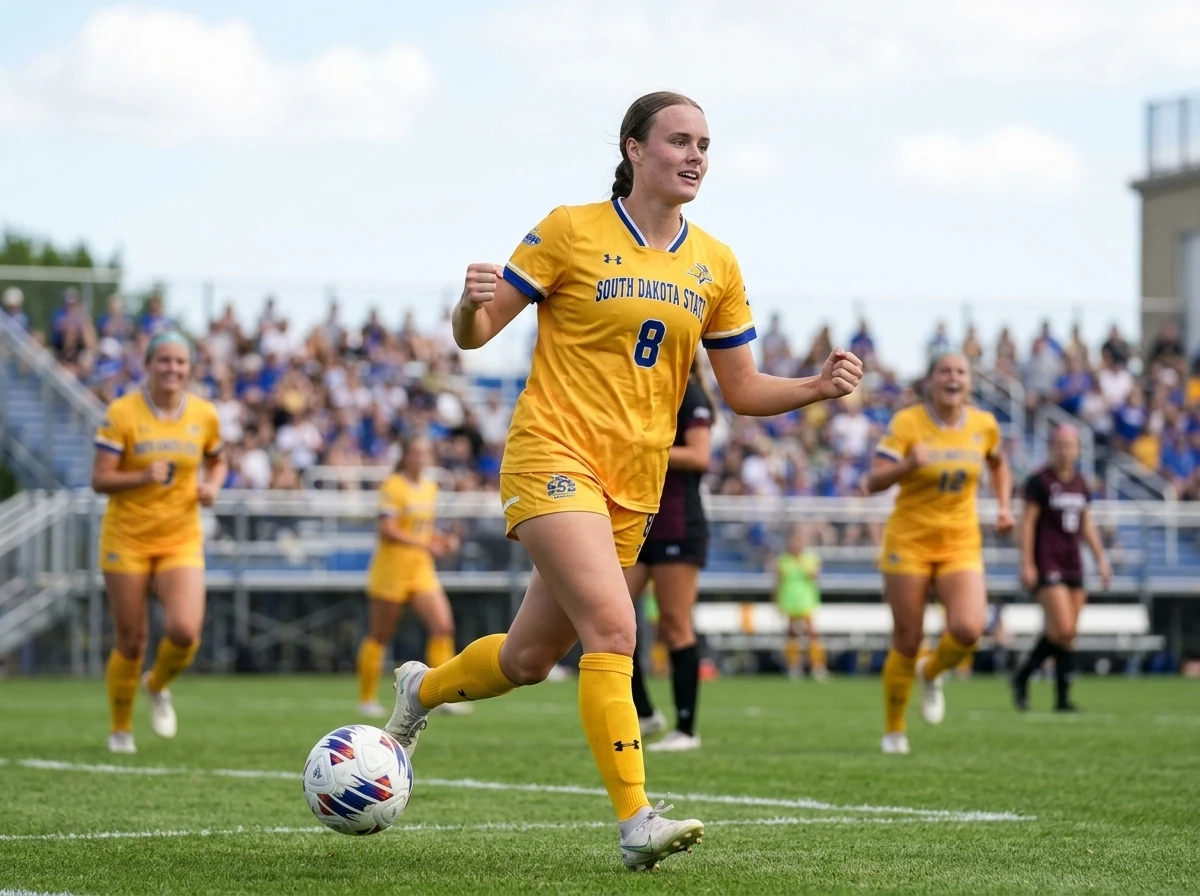
Eckerle’s path from ACL near-miss to season-opener goal
Eckerle, a 5-foot-6 defender from Hugo, Minnesota, arrived at SDSU in 2022. She earned All-Newcomer honors as a freshman. An ACL tear as a sophomore ended her 2023 season after 10 starts and left her three games short of a medical redshirt.
She returned as a captain in 2024 and 2025, starting nearly every match. Last season she played a team-high 1,770 minutes, recorded six assists and one goal, and earned first-team All-Summit League plus Summit League Tournament MVP and All-Tournament Team honors. The Jacks posted 11 shutouts and led the conference in goals-against average.
- Late June 2026: NCAA adopts age-based model; Eckerle begins asking about a possible return while staying in Brookings and training.
- July court orders: Injunctions open the fifth year for her class; compliance paperwork starts.
- August 1: Class officially cleared; she may practice but not play exhibitions.
- Day before opener: Final all-clear arrives; she starts against Manitoba and scores unassisted at 12:15.
“It was late June when the 5-for-5 got put into place and I was like, am I crazy if I try to see if I can come back?” Eckerle said. “Because I’ve been in Brookings and I kind of stayed consistent with my lifting and working out since the fall, so my body felt pretty ready for it.”
The ACL shortfall drove her decision as much as fitness. “That was a big reason I wanted to come back,” she said. “I was like, you’re going to give everyone five but I only got like three-and-a-half?”
She re-enrolled for a certificate in operations management, reapplied to graduate school and continues toward CPA plans as a business economics major. Soccer’s fall calendar means one extra semester of classes rather than a full year.
The near-miss on the medical redshirt is the hinge. Under the old hardship rules she fell three games short. Under the age-based model and the July injunction she receives the full fifth season the Cabinet said it wanted for athletes who lose time. Her 47 minutes and unassisted goal against Manitoba turned that legal recovery into an on-field one inside two weeks of final clearance.
SDSU soccer becomes an early test lab
Head coach Brock Thompson called the process an emotional rollercoaster. “It had been on my radar since January but you don’t want to get your hopes up,” he said. “But once everything went through it was like, well, what’s this going to look like? Our season started so early, like, we didn’t know.”
Eckerle could only train on the side at first. Full practice clearance came August 1. Suit-up clearance arrived the Monday before the Thursday opener. Thompson said the whole five-year model “was created for somebody like her, who missed half a season but not enough to get a year back.”
Not every eligible athlete is returning. Some have jobs, graduate programs or simply moved on. Eckerle stayed for the teammates. “They’re just so fun to be around, that was the reason,” she said. “There were definitely times over the last month where I was like, what am I doing with my life right now? Why am I doing this? But stick it out, because if you get another year with all your friends, it’s going to be worth it.”
Lauren’s a tremendous person and teammate. She represents Jackrabbit soccer so well.
Thompson said that after the clearance became real.
The compressed timeline left almost no margin. Practice rights on August 1, full clearance the Monday before a Thursday opener, and a start in the first match. SDSU treated her as a mid-preseason addition even though she already knew every system and every teammate. That is the practical shape of the injunction for fall sports that open in August.
Recruiting classes already getting smaller
Thompson has already adjusted. “As a fall sport we’ve started to recruit with the idea that you’re going to be on a four-and-a-half year graduate plan,” he said. “The recruiting classes get smaller. We go from recruiting eight kids a class to five or six, which has made the process more selective.”
Six current players could return next year; four have already committed. The other two are ready for the next stage. The program is shifting toward nine-semester plans. Thompson called the overall change “a huge positive for everybody” even while acknowledging the short-term uncertainty.
| Recruiting lever | Old approach | Adjusted approach |
|---|---|---|
| Incoming class size | About eight players | Five or six players |
| Degree planning | Four-year expectation | Four-and-a-half to nine-semester plans |
| Next-year returns on roster | Not built into the model | Six eligible; four already committed |
Fall sports feel the new reality first. Spring sports still have months to sort returns. Football faces extra friction: many Class of 2022 players already chased NFL camps or signed contracts that can bar a return under the injunction’s clarifications. SDSU cornerback Isaiah Johnson is the lone football player from last year’s roster who became eligible; indications are he will not return.
Smaller classes raise the floor on every offer. Thompson’s staff now picks five or six rather than eight, and every returner who stays compresses the next cycle again. The selectivity is intentional. It is also forced by House settlement roster caps once veterans reclaim spots that younger players already hold.
Other Jackrabbits and the wider roster ripple
Basketball presents larger open questions. Brooklyn Meyer announced in the spring she would play volleyball for SDSU this fall. The injunction now gives her another year of basketball eligibility, as it does guard Madison Mathiowetz. Basketball coach Aaron Johnston has not commented. Volleyball coach Dan Georgalas declined comment at Media Day.
Nationally the same pattern is appearing in scattered form. Former Auburn safety Caleb Wooden signed paperwork to rejoin Arkansas. Kansas announced Tre White’s return after he averaged 13.5 points and 6.7 rebounds last season. Individual injunctions continue for other athletes. Schools that add Class of 2022 returners remain bound by House settlement roster caps and revenue-sharing limits, so an extra veteran can force a hard choice elsewhere on the roster.
On X the conversation mixes excitement for veterans who missed time with practical skepticism about logistics, pay rules and late clearances. Mid-major programs like SDSU are quieter but more selective: one high-impact defender who already knows the system is easier to absorb than a wave of football returners.
Regional soccer pathways continue in parallel. Programs still send players to events such as the Midwest ODP ID Camp invites for soccer players while they recalibrate scholarship and roster math under the new clock.
Late Clearances Hit Fall Sports Hardest
Eckerle’s path shows how little buffer August sports receive. The class-wide injunction landed on July 31. Practice clearance followed on August 1. Suit-up rights arrived only days before the opener. Spring sports still have months to map the same paperwork. Football, already dealing with NFL camps and contracts, faces a different set of barriers even when a player such as Isaiah Johnson becomes eligible on paper.
Coaches must weigh a returning veteran against a younger player who already holds a roster spot and, in some cases, a revenue-share allocation. House settlement caps do not expand when a court restores a fifth year. Every yes to a Class of 2022 returner is a no, or a delayed yes, somewhere else on the same roster.
- Soccer and other fall sports absorb the scramble first because seasons open within days of final clearance.
- Basketball and volleyball at SDSU still carry open questions around Meyer and Mathiowetz while coaches stay quiet.
- National returns such as Wooden and White show the same pattern in higher-profile programs under the same caps.
Mid-majors can fold in one experienced defender more cleanly than a surge of football returners. That difference explains why SDSU’s response looks measured while larger roster sports remain louder and more unsettled.
Programs now live with nine-semester math
Eckerle’s clearance arrived so late that SDSU treated her as a mid-preseason addition rather than a planned fifth-year. That timing is the practical reality for many fall sports. Coaches must decide whether a returning veteran displaces a younger player who already has a roster spot and, in some cases, a revenue-share allocation.
The long-term trade-off is clearer roster predictability once the 2027 class arrives under the pure age-based model. The short-term cost is the very chaos the NCAA cited when it tried to wall off the Class of 2022. Thompson’s staff has already cut incoming classes by two or three players. Other Summit League and mid-major programs will face the same arithmetic this year and next.
Eckerle now has the chance to play four full seasons of college soccer. SDSU has its most experienced defender back for a title defense. Both sides are navigating a rule that was supposed to simplify everything and instead delivered an immediate, case-by-case scramble.